Rio police invade favelas ahead of FIFA World Cup and Olympics

As I, along with many others, predicted as soon as it was announced that Rio de Janeiro would host the two most globally important sports mega-events, the Rio authorities have launched a major drive to occupy and ‘pacify’ a growing number of the most significant favelas (informal settlements) in the city.

The rationale behind this is to drive out the gangs which control many of these communities. To this end a series of special police units has been created, the UPPs, which attempt to gain control of the settlements. Early experiments were in three favelas, one of which, Santa Marta, I visited in early 2009, when, along with Paola Barreto Leblanc, I conducted interviews with community association leaders and police.

Just last week the police moved into the largest favela, Rocinha. Unusually with police raids of this kind, there was little overt violence and ‘collateral damage’. This is certainly an improvement on some previous operations. However, not everyone was that impressed. This video from ITN News shows the stage-managed nature of the event, which seems to have been largely a demonstration of the ability of the Rio authorities to produce security on demand. As the reporter notes, only one person was arrested which means that hundreds of gang members (in this case of the Amigos dos Amigos, AdA, or ‘Friends of Friends’) will either have fled or remain in the favela.

The plan is apparently for the net to be widened still further, with Sergio Cabral, the Governor, claiming that 40 UPPs will be established, including very soon in the Mare Complex, 16 favelas with over 130,000 in all, which is vital to the preparation for the mega-events as it is close to the international aiport and other major transport links from Rio to the economic hub of Brazil, Sao Paulo. Many AdA members from Rocinha may have fled to the Mare Complex and at some point the pacification is bound to be become violent and less media-friendly. There are also, at least two other alliances of gangs who occupy other important favelas.

The current authorities have also started to emphasize the ‘community-building’ intention of these pacification measures, but it should not be forgotten that almost the first act that Cabral and his sidekick, the Mayor of Rio, Eduardo Paes, implemented on coming to office was to cancel the internationally-praised slum-upgrading program, favela bairro (see some thoughts I had on this after my interviews in 2009) of the former Mayor Cesar Maia, which was aimed at a much deeper and longer-term improvements not just at appeasing middle class voters and impressing the International Olympic Committee and FIFA. We will also see whether, like in Santa Marta, the initial community building efforts are undermined (or perhaps aided) by the installation of surveillance cameras

The Expansion of Video Surveillance in India

A recent market analysis (which contained many predictions, more of which tomorrow) identified India as one of the world’s fastest expanding video surveillance or Closed-Circuit Television (CCTV) markets, and the coverage of policing plans in the Indian media over the past couple of years would seem to confirm this. In particular, in the wake of the terrorist attack on Mumbai, authorities in all major cities have been pushing ahead with the intensification of security and surveillance measures. This is part of a more general expansion of surveillance in all areas of Indian governance, some of which, like the new biometric census and high-tech border surveillance and UAVs, I’ve mentioned here before.

Cities such as Chennai have announced plan for 10,000 cameras across a range of settings (interestingly in this case, ‘marriage halls’ were one of the first locations to get CCTV – perhaps someone can enlighten me as to why this would be – along with state banks and major malls) and the police chief is quoted as saying he wants “the whole city covered by CCTV.” Delhi is combining a massive expansion of CCTV with increasing numbers of police officers on the streets, so this is not a case of an inhuman technological gaze replacing the neighbourhood police officer. And here, as in the state of Gujarat, in cities like Ahmedabad, the road network is a particular priority with Automatic License (or Number) Plate Recognition (ALPR/ANPR) systems and cameras being installed on all major roads. This ‘Intelligent Traffic Management System’ (ITMS) is designed to be multipurpose and address security, traffic and emergency requirements.

The diffusion of CCTV to more remote and peripheral areas has also been remarkably quick. Just recently, the northern Haryana region has also announced a huge CCTV installation of around 5000 cameras in eight cities, which will be targeted at “shopping malls, main market, major traffic points and escape routes in these cities” – an interesting turn of phrase, which almost seems to portray the city as a prison. Just as in the major urban centres of the country, here too the new systems will employ analytics including movement recognition.

This expansion has not gone unchallenged – see this debate over some of the Chennai systems – but the debates seem rather lifeless and complaints seem to be limited to hoping that there will not be ‘abuse’ of the camera systems by police, and commenting on the lack of any regulatory body for video surveillance. Nor has it all been smooth in technological terms. The Delhi expansion of CCTV builds, as in many cases, from the security upgrades for a ‘mega-event’, in this case the Commonwealth Games in 2010. However, as with much of the infrastructure for these games, there were reports of systemic failure, if not a total lack of functionality from day one. The cameras for the event were apparently poorly calibrated and made watchers dizzy an in some cases, installed where no view could be obtained. It is also not the case that what many nation’s security authorities would consider to be priorities for video surveillance have actually already been covered, even where there has been a demonstrable threat: for example, it is only now that CCTV is being installed at Mumbai’s Chhatrapati Shivaji International Airport, which apparently had no CCTV at all prior to this.

Overall, there appears to be strong media backing for a combined state and private sector discourse that emphasises CCTV not so much as a protection against terrorism (though that is clearly present) but as an unquestionably ‘necessary’ or even simply ‘natural’ component of progress, economic development and modernisation. Consider, for example, this description of the new “shining steel” Metro system in the high-tech and global information economy service-centre region of Bangalore, where “automatic fare collecting gates, metal detectors, CCTV cameras and voice announcement systems” were all of a piece along with the announcement of the new ‘signature tune’ for the public transit network. And see also this rather peculiarly de-politicised description of the history (and future) of policing technology in India, written by a former senior officer from Kerala state, in which the British colonial imposition of fingerprinting in India is portrayed as a collaborative advance and in which, of course, CCTV is pictured as part of a similar and apparently totally necessary new series of technological advances designed to drag Indian policing out of a ‘medieval’ period.  At the same time, however the historic (and largely colonial) legacy of a slow-moving, fragmented and conflict-ridden bureaucracy is still resulting in a very uneven diffusion of video surveillance across this enormous country.

Fortress Toronto for G20 summit

There is an interesting article yesterday in the Toronto Star that does a good job of describing what will happen when the G20 arrives in town in June this year.

Of course, it will be accompanied by all the security and surveillance that these days comes as part and parcel of these ‘mega-events‘ (see also: here and here) whether they be sporting, economic or political – with the added hyper-security around world leaders. Rather like the peripatetic monarch’s court that used to be a feature of high mediaeval European societies, the travelling circus of global governance brings with it, its own security norms, creating locked-down ‘islands’ within cities, temporarily removing the rights and liberties of residents, and moving out and on those people seen to be ‘out-of place’ (the homeless, street vendors, protestors and so on). In many cases, ordinary people are suddenly potential troublemakers, and residents are harassed in advance by intelligence services who check profiles, backgrounds, political affiliations and so on. Business within the zone are usually negatively affected – even if the case is made, as it normally is, that there will be some nebulous ‘economic benefit’, which (oh, so conveniently) happens to cover the costs of security. The events are often also ‘test-beds’ for new technologies of surveillance and security – last year at the Pittsburgh G20 summit, we saw the use of sonic weapons on protestors for example.

Why do cities put up with this? Well, it’s all about inter-urban competition. For urban authorities these mega-events reinforce the global status of the city, or allow it to climb the ever-incrasing numbers of rankings of ‘world cities’ of ‘global cities’.  Toronto, like so many other cities in the second or third rank of global cities, is obsessed with appearing to be world class, and the local government will put up with almost any kind of inconvenience to its citizens that is seen to benefit the city’s global status.

I’ll be keeping an eye on developments, but if I was a Toronto resident, and if I could, I’d just leave town for a couple of weeks before and during the event…

Vancouver Olympic surveillance legacies

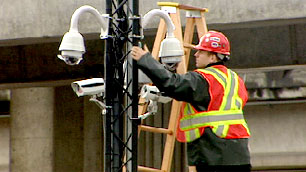
A city worker installs video surveillance cameras outside GM Place in downtown Vancouver. (CBC)

As the CCTV cameras are going up, Vancouverites are starting to become more concerned now about what the legacy of increased security and surveillance will be after the Olympics. Although the initial promises were that the cameras would be taken down afterwards, with the money that has been put into building a swish new control room, it seems unlikely that the authorities will want to ‘waste’ this investment. As we warned in our Vancouver Statement in November, it seems as if the Games have become a globe-trotting Trojan horse for the video surveillance industry.

Meet Rio’s new security advisor…

if this appointment is any sign of what is to come… this is going to be war on the favelas.

So, with Rio de Janeiro now hosting the FIFA World Cup in 2014 and the Olympics in 2016, and a huge set of social problems providing big obstacles to a PR success and the place climbing the world rankings of ‘global cities’, who have the right-wing administration of Governor Sergio Cabral and Mayor Eduardo Paes appointed to advise them on security?

Rudy Giuliani

Well, it’s none other than Mr Zero Tolerance himself, the ex-Mayor of New York and failed presidential candidate, Rudy Giuliani.

As I’ve argued before, Giuliani’s macho urban politics have inspired the new tough choque de ordem (shock of order) approach that has flourished under Paes undermining the previous progressive social measures of former Mayor Cesar Maia, in particular the Favela Bairro program that attempted to make the illegal settlements in which the excluded minority of Rio’s population live, into normal functioning neighbourhoods. Cabral and Paes have turned this back into an ongoing confrontation, which is costing lives and livelihoods, and if this appointment is any sign of what is to come, the World Cup and the Olympics are going to mean more than just the usual high security and surveillance exhibition that these mega-events have become – this is going to be war on the favelas and war on the poor.

(As ever, thanks to my eyes in Rio, Paola Baretto Leblanc, for the link).

The Vancouver Statement on the 2010 Winter Olympics

Following recent discussion, a number of leading surveillance researchers have signed and issued the following ‘Vancouver Statement’ of which I did the first draft (followed by multiple revisions from many hands!). If you are a researcher who has done any work on mega-event security and surveillance, and agree with the statement, you are encouraged to send your name and affiliation to Adam Molnar at UVic. It is being press-released and hopefully discussed in the BC Legislative Assembly.

The Vancouver Statement of Surveillance, Security and Privacy Researchers about the Vancouver 2010 Olympic Winter Games

As researchers from Canada and the wider world, who are conducting research on the global security dynamics of mega-events, we agree:

  • that the Olympic Games should be a celebration of human achievement, friendship and trust between people and nations.

However, having analysed past and planned Olympics and other mega events, from a variety of historical and international perspectives, we recognise:

  • that recent Games have increasingly taken place in and contributed to a climate of fear, heightened security and surveillance; and
  • that this has often been to the detriment of democracy, transparency and human rights, with serious implications for international, national and local norms and laws.

Therefore, we ask the City of Vancouver, the Province of British Columbia and the Government of Canada:

  • to moderate the escalation of security measures for Vancouver 2010 and to strive to respect the true spirit of the event;
  • to be as open as possible about the necessary security and surveillance practices and rationales;
  • to withdraw temporary bylaws that restrict Charter rights of freedom of speech and assembly;
  • to work constructively with the Provincial and Federal Privacy Commissioners;
  • to respect the rights of all individuals and groups, whether they be local people or visitors, and pay particular attention to the impacts on vulnerable people;
  • to conduct a full, independent public assessment of the security and surveillance measures, once the Games are over, addressing their costs (financial and otherwise), their effectiveness, and lessons to be learned for future mega-events;
  • not to assume a permanent legacy of increased video surveillance and hardened security measures in the Vancouver/Whistler area, and to have full and open public discussion on any such proposed legacy.

We hope that these recommendations will contribute to a unique and positive Olympic legacy by which Vancouver, British Columbia and Canada will be remembered for setting the highest ethical standards.

For further information, contact:

Richard Smith, tel: 778-782-5116; or Colin Bennett

And there’s now more on Richard’s blog!

Rio gets the Olympics – and now the poor will suffer

Most people will probably have heard the announcement that Rio de Janeiro has been awarded the 2016 Olympic Games. While I am pleased that Brazil has beaten the USA in particular in this race in the sense that it shows a slight shift in global power balances towards the global south, I am very concerned as to how the current right-wing administration of both the city and region of Rio will deal with the ‘security’ issues around this mega-event. The Pan-American Games, which Rio hosted in 2007 led to the violent occupation by military police of several particularly troubled favelas (informal settlements), and the new administration has already shown its authoritarian tendencies with the Giuliani- wannabe ‘choque de ordem’ (shock of order) policies that involve building demolition, crackdowns on illegal street vendors (i.e. the poor) and more recently, the building of walls around certain favelas, and most recently the unwelcome  imposition of CCTV cameras on favelas that were just starting to enjoy improvements in trust between police and community. The favelas that line the main highways into the city from the international airport were already slated for such ghettoization, and the Olympics will only make this more likely to happen and more quickly – just as has happened in South Africa, similarly afflicted by race and class-based social conflict, during the various international meetings and summits there in recent years. Foreign delegates and tourists don’t like to see all that nasty poverty, do they?

I will write more on this later (I am on the road right now…).

India plans ‘world class’ electronic surveillance for Commonwealth Games

The Times of India reports on the Indian government’s plans to implement comprehensive surveillance for the 2010 Commonwealth Games. One aim seems to be to create the kind of ‘island security’ with which we have become so familiar at these kinds of mega-events: vehicle check-points with automatic license-plate recording and recognition; x-ray machines and other scanners for vehicles (and perhaps people too). They will also massively expand CCTV systems and not just in the actual Games area, but throughout the city of Delhi.There are also, as usual plans to use more experimental surveillance and control techniques (as with the use of sub-lethal sonic weapons in Pittsburgh the other day), in this case a drone surveillance airship,” capable of taking and transmitting high-density visual images of the entire city.”

However, this is not just about the temporary security of the games. As with many other such mega-events, the Indian government appears to be planning to use the Delhi games as a kind of Trojan Horse for the rolling out of similar and more permanent measures in big cities across the country. The Times article claims that the Ministry of Home Affairs intends to expand the measures and “soon the same model is planned to be replicated across the country,” and in particular on use of airships, “similar airships would be launched in other big and vulnerable cities like Mumbai, Bangalore, Kolkata and Chennai.” And there will be an infrastructure too, apparently “the IB [Intelligence Bureau] is silently working to create a command center to monitor all-India intelligence and surveillance.”

Of course the threat of ‘terror groups’ is the justification, and there’s no doubt there is a threat to Indian cities from such groups, particularly those based in Pakistan. However, the Indian public shouldn’t assume that anything done in the name of ‘anti-terrorism’ will: 1. actually work (in the sense of preventing terrorism); or 2. be used for those purposes anyway. This same trend happened  in the UK during the early 1990s, when the threat of the Provisional IRA was the justification, and before most people in Britain had even noticed, a massive (and it seems ever-expanding) patchwork of CCTV camera systems had been created, which were joined by further repressive measures even before 9/11. And did this massive number of cameras stop London being attacked by terrorists? No, it didn’t.  7/7 still happened. But of course we had lots of good pictures after the event for the media… and they are very expensive and don’t even do much to stop regular crime, as a recent meta-study has shown. What would be more effective would be peace and co-operation with Pakistan, a move away from both chauvinistic Hindu and Muslim nationalisms and extremisms which only generate resentment and hatred, and old-fashioned targeted intelligence work on those very few people who are actually planning terrorism – not mass surveillance and the gradual erosion of civil liberties of the entire population based on state fears that some of them might be guilty.

Finally, this is about globalization. The whole way this is promoted by the Indian government is as if there is some international competition to install as much CCTV and security as possible. But the global spread of the surveillance standards and expectations of the rich western elite is a self-fulfilling logic that benefits only the massive global security-industrial complex.

Pittsburgh police use sub-lethal weapons against protestors

LRAD being used by the US Navy (ATC)

Mega-events are often the time for some surveillance / control / security innovation and experimentation by states. In what seems to be a rather unwelcome first, the Pittsburgh police have used a military sonic canon to clear protestors off the streets at the G20 summit. These devices are among many so-called ‘sub-lethal weapons’ (see the article by Steve Wright here) that have been gradually migrating from military to civilian use for a number of years – see for example the ongoing debate over the use in the UK of the ultrasonic ‘Mosquito’ device, which is supposed to target young people; its makers rather cynically advertise it as ‘so effective that they tried to ban it’.

The particular weapon used by the Pittsburgh police is the Long Range Accoustic Device (LRAD) made by the American Technology Corporation, which generates a piercing noise that is not only extremely unpleasant, it can damage eardrums and cause heart problems. It was rather eeriely appropriate to see them being used (as you can on The Guardian‘s website) on the same day that TNI / Statewatch released their report on the security-industrial complex and a reminder that this is a global phenomenon.

At the Tokyo Metropolitan Police HQ

The Tokyo Metropolitan Police HQ in Chiyoda-ku

We had an enlightening interview, which will give me much to analyse later, with three senior officers from the Seikatsu Anzen Bu (literally, ‘Everyday Life Safety Division’) of the Keisicho (Tokyo Metropolitan Police). Interestingly, this division that was created as a result of the Seikatsu Anzen Jourei (Governor Ishihara’s 2003 Tokyo Metropolitan Government ordinance) and which deals with all the community security and safety initiatives, including CCTV, is separate from the Chiki Bu (the community division) that is responsible for the koban neighbourhood police box system.

Like almost everyone in authority we have met here, the police were convinced that they were not doing surveillance in using the cameras. They also confirmed that almost all of the CCTV systems operated by shoutenkai (shopkeepers’ associations) are not monitored and are simply recorded. They also stressed their deep concern for privacy and the rights of citizens and said that data from the police-operated cameras – of which there are around 150 in Shinjuku (the largest system with 50 cameras in the Kabukicho entertainment district), Shibuya, Ikebukuro, Roppongi and Ueno – was only kept for 7 days unless there was a specific reason to retain it. This is a legal requirement not just a police guideline. The police cameras are monitored both in local stations and in a central control room, but we were told that it was strictly forbidden for us to visit (unlike every other city in which I have done research) as everyone who enters has to be pre-enrolled in the police iris-scan security database.

We talked a lot about the history of the development of CCTV and of community safety initiatives in Tokyo, and Governor Ishihara’s absolutely central role in backing video surveillance became very clear (it’s a shame he has so far refused an interview with us!). What was also particularly interesting was that the police themselves did not think that apparently obvious ‘trigger events’ were as important as it might seem. For example, they claim that the police only really began considering the use of CCTV cameras not after the Aum Shinrikyo sarin gas attacks on the Tokyo underground but because of the influence of G8 summit security. One officer specifically mentioned the Gleneagles summit (which was just starting when terrorists attacked the London transport system), but this was in 2005, well after the TMG had already introduced CCTV, and after which the Tokyo police have not introduced a lot more cameras. So I don’t quite understand their point. It may become clearer once I have the complete transcripts… They also claimed that it was the Tokyo police rather than Japan Railways themselves or the Tokyo Metro authority who insisted on installing CCTV in the Tokyo transport network after the Aum attacks.

The officers talked a lot about community involvement. They dismissed the objections to their public space CCTV systems for several reasons, not least as I have already mentioned that they were not doing ‘surveillance’, but more importantly because they claimed to have done extensive consultation with local community groups, businesses etc. The claimed that they could not do anything without this support. This may have been true for Kabukicho, which was undoubtedly afflicted by an influx of Chinese gangs in the 1990s, but we heard from the local government of another ward that is being lined up for one of the new volunteer-based child safety camera systems being introduced from 2010 that they were given no choice by the police, and that local people were not happy about it. The problem is that this local authority don’t want to be interviewed further about this as they are in a rather delicate position over this new system.

(Thank-you very much to the officers from the Seikatsu Anzen Bu for giving us their time)