The connection between what are often called ‘mega-events’ (international summits, major sporting competitions etc.), securitization, and he intensification of surveillance is becoming a very interesting area and one which we wrote about in our recent book on urban resilience. I am writing some further stuff on this with Kiyoshi Abe on how mega-events have been managed in Japan.
It seems that in general, such events are either used as ‘test-beds’ for new technologies and procedures which are then either continued afterwards (as with The Olympic Games and CCTV in Greece in 2004 and The FIFA World Cup and video surveillance in Japan/Korea in 2002), or become ‘islands’ of temporary exemption where normal legal human rights protections are reduced or removed and whole areas of public space are often literally, fenced off (as in Rio de Janeiro for the Pan-American Games of 2007, whose model will apparently be extended to include walling off the poor favelas in time for the 2014 FIFA World Cup). There’s going to be a very interesting conference on The Surveillance Games later this year to tie in with the Vancouver Winter Olympics.
Now The Guardian newspaper is reporting that the London Olympics 2012 may make use of a proposal originally designed to stop the proliferation of unofficial commercial advertising near games venues in order to prevent protest. The legislation even allows police to enter private houses to seize material.
Of course the government say that they have no plans to use it in this way, but it’s interesting to see the way in which the ‘standards’ being imposed by such travelling cicuses of globalization tend to end up looking more like the authoritarian regime in Beijing (host of the highly securitized 2008 Olympics) than the supposedly liberal west, whilst at the same time promoting a very controlled but highly commercialized environment. Even the original purposes of the 2006 law (necessary for London to host the Games) are an interesting reflection of the massive corporate interests involved in the Olympics, for which they apparently need a captive and docile audience.
…despite Britain’s reputation as a surveillance society… the USA is now eclipsing the UK. The post-9/11 surveillance surge has seen to that.
Back in the USA again. Chicago has been featuring a lot this week for its CCTV system. Newspapers generally offered glowing assessments of its capabilities based around homey anecdotes of pretty harmless incidents ‘solved’ by CCTV – in this case the stories, for example those in the Chicago Sun-Times and the New York Times, featured a theft from a Salvation Army kettle, which sounds like it is straight from a Mayoral press release. It is depressingly poor journalism and once again, all very reminiscent of the situation in the UK in the 1990s before academic and even government assessments dampened the enthusiasm for CCTV. There’s also a depressing naivety (and factual incorrectness) about the insistence from the authorities and from some ‘experts’ that these cameras have nothing to do with human rights like privacy as they are all in public spaces.
But there is one very important difference. Chicago, with massive investment from the Department for Homeland Security, has gone much further than most UK cities, not only in coverage but also in capabilities. First of all, Daley and police-chief Orozco have promised that “We’re going to grow the system until we eventually cover one end of the city to the other” in other words they do want, as the Chicago Sun-Times subheading claims, ” a camera on every street corner.”
The particular innovation that the city is pushing here is the linking up of the law-enforcement aspects with emergency services through something called Computer-Aided Dispatch (CAD). This is system that uses a live Geographic Information System to match camera location to reported incident location, so that when an incident is called in via 911, the nearest cameras can immediately turn to picture the scene. This is part of what Chicago calls ‘Operation Virtual Shield’, a fibre-optic cable system which links the cameras with other biological and chemical weapons-detection system in a “homeland security grid.’’
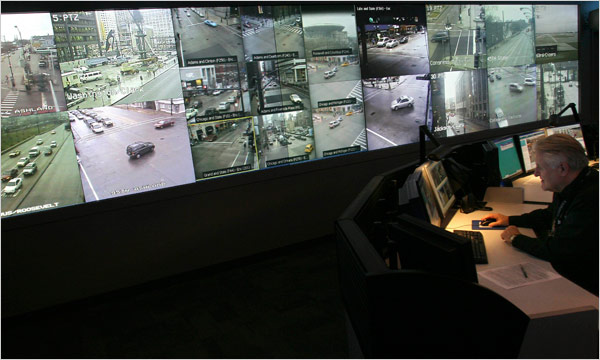
The Chicago control room (New York Times)
As part of the work we did for our latest book, Jon Coaffee Pete Rogers and I visited and analysed several different cities in the UK to assess their emergency-response and surveillance systems. While most had intentions to use the cameras for more active emergency-response purposes and particular local police were starting to try to install override systems for the multiple local camera systems that exist in the UK in the case of citywide emergencies (like a mass evacuation). And in particular, Manchester (whose high-tech control room looks like the Chicago one as seen in the NYT (picture above) and also often features in media PR for CCTV) has gone further down the Chicago route than most. But they still don’t come close. Britain’s systems are fragmented, ageing, generally not integrated with other functions and certainly don’t link to other kinds of sensors. Britain has introduced some stupid authoritarianism like the infamous ‘shouting cameras’ mostly as part of the Respect (sic) Zones initiative. But despite Britain’s reputation as a surveillance society I suspect that in terms of advanced integrated cameras systems, the USA is now eclipsing the UK. The post-9/11 surveillance surge has seen to that.
There’s two other points worth noting here. The first is that Chicago is bidding for the Olympics in 2016. I can almost hear multiple researchers in surveillance studies around the world, releasing a collective ‘of course!’. Mega-events like the Olympics, the World Cup – there will be a fantastic conference on this theme in November this year in Vancouver – or other non-sporting ones like world summits or the G-8 conference are often the trigger for the introduction of repressive measures and new surveillance systems. This was true in Japan (where state CCTV was first introduced because of the soccer World Cup in 2002), in South Africa (for various major world summits), and in Athens for the Olympics in 2004. Mayor Daley wants the city to be 100% free from the possibility of terrorist attack. Laving aside the actual impossibility of that desire, how far will he go to get there?
Well, the last Olympic venue, Beijing, might give some indication. For it is actually the plans in authoritarian, non-democratic China that seem most similar to what is going on in Chicago. Even the names have an eerie reminiscence: China’s Golden Shield, Chicago’s Virtual Shield. That is trivial, however the substance is not. The Chinese government, as Naomi Klein has written, is installing massive and comprehensive camera systems in every major city in China. It is also, of course, linking this system into its infamous Internet monitoring operation, with the ultimate aim of being able to track individuals in real and virtual space. Of course, the US, like most other nations is now trying to control Internet use too and the NSA already keeps massive data banks of communications traffic information as well as doing real-time monitoring as recent revelations have, once again, shown. But, it’s different in the USA isn’t it? The USA wouldn’t link up all these systems, would it? The Land of the Free? The home of democracy? I wouldn’t bet against it…
2-inch glass surrounds Obama at his victory celebrations (Associated Press)
One of the things, I an my co-authors wrote a lot about in our new book is the increasing prevalence of ‘island security’, the creation of temporary zones of exception around mega-events like the Olympics of the G-8 summits, or even smaller events like political party conferences. It looks like the inauguration of Barack Obama as President of the USA will be one of the biggest ever island security operations, which a 3.5km exlcusion area, no-fly zone and thousands of police and military personnel on duty.
When it comes to many of these kinds of events, the security is often symbolic, or what we called ‘stage-set security’, but, rather like the new official presidential limousine (AKA ‘The Beast’), the security involved here is hardly likely to be quite so superficial. Nor, I think, do many of the usual advance objections to heavy-handed policing apply: I don’t think there has been a US president in recent history who has either sparked so much hope by so many in the USA or been quite so likely to be targeted for assassination by a few.


 ubisurv