A few years ago I was talking around the place about surveillance, security and “ambient government” (or “ambient governance”), but it turned out that so were plenty of other people and no one person really has a claim on this phrase or others like it. It was, somewhat appropriate, in the academic air at the time… and it still should be!
Looking back on it, I don’t think I’ve bettered how I discussed this back then, and I never fully published what I was talking about. So here is the vastly underwatched talk I gave in Victoria back in 2014. If you have 45 minutes to spare, I think it’s worth a watch. Plus, I look so young!
But this is all way too little too late. I warned of the danger of the increased technological capabilities and decreasing costs of ‘surveillance-in-a-box’ systems as far back as 2008 (see my post here which refers to that). Instead of taking horizon-scanning and pre-emptive action to limit this, Britain, the USA and many other states have encouraged this trade with state aid – as they have with military and security industries more broadly – and, not least, encouraged the use of surveillance on a global scale themselves. Their own extensive breaches of human rights through programs like PRISM and TEMPEST give them no real moral high ground to talk about what authoritarian regimes might do, when they are already pursuing the same actions.
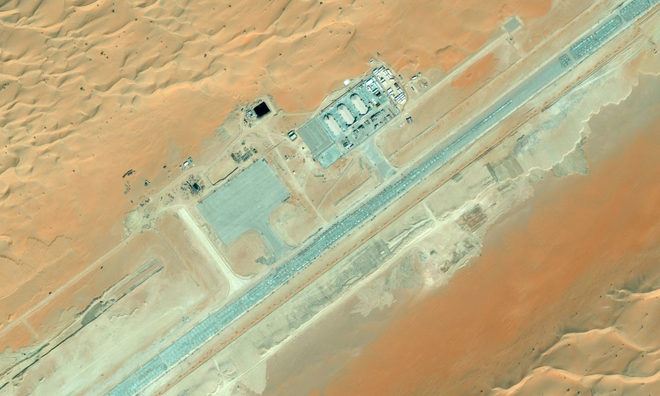
Wired’s Danger Room blog has published pictures of what may be the hitherto secret CIA drone base in Saudi Arabia, revealed as part the confirmation hearings for John Brenner as proposed Director of the CIA…
So much has been happening over the US drone warfare program over the last few weeks that it’s hard to keep up.
First, the United Nations Special Rapporteur for Human Rights and Counter-Terrorism, instigated an inquiry into the targeted killing programs operated by the USA, largely using drones, and focusing on the issue of civilian casualties. The rapporteur, Ben Emmerson, made it clear that the inquiry would pull no punches and might result in war crimes charges against the US, should evidence be discovered of such crimes.
Second, NBC television in the USA revealed a leaked Justice Department document laying out the legal justification for the targeted assassination of US citizens using drones. The full memo is also available from this link and assembles a tortuous argument about how US citizens can be killed by their own government from above if there an “informed, high-level” official decides that the person has “recently” been involved in undefined “activities” threatening a violent attack against the US and “there is no evidence suggesting that he has renounced or abandoned such activities.”
And now, the Washington Post is reporting that the nomination of President Obama’s counter-terrorism guru, John Brennan, to head the CIA, has led to all sorts of revelations and difficult questions for Brennan to answer about the CIA’s targeted assassination program, including the acknowledgement of a secret drone base, at a still undisclosed location, in Saudi Arabia.
A while ago it looked like Obama’s drone strategy was unassailable despite increasing public knowledge via the Bureau of Investigative Journalism and criticisms from groups like the International Committee for Robot Arms Control. Now, this is going mainstream and it’s not looking so good for what former CIA Director, Leon Panetta, called the ‘only game in town’.
I’ve been blogging for a while about miniaturization and the ‘vanishing’ of surveillance devices. This disappearance occurs in many ways, one of which is the incorporation of high-tech surveillance features into objects and devices that we are already used to or their reduction to a size and form factor that is relatively familiar. Two examples coincidentally arrived in my inbox over the last week.
The first was the news that the US Navy has awarded a development contract for binoculars that incorporate three-dimensional face-recognition technology from StereoVision Inc (who may well be the bunch of California-based face recog people I met at a biometrics industry show a few years back). This supposedly gets round the problems that standard two-dimensional face recognition has dealing with unpredictably mobile crowds of people in natural light (AKA ‘the real world’). The issue I’m highlighting here however is that we don’t expect binoculars to be equipped with face recognition. Binoculars may not be entirely socially acceptable items, and already convey implications of creepy voyeurism when used in urban or domestic situations, however this is something else entirely.
Small terahertz wave scanner being tested by NYPD in January (NYPD_
The second is the extraordinarily rapid ongoing progress towards working handheld terahertz wave technology (a far more effective form of scanning technology than either the backscatter x-ray or millimeter wave systems used in the bulky bodyscanners currently in use at airports). Just four years ago, I noted the theoretical proof that this was possible, and last month, it was revealed that police in New York were testing handheld terahertz wave scanners, (Thruvision from Digital Barriers) which of course people were likening to Star Trek’s tricorders. The idea that the police could perform a virtual strip search on the street without even having to ask is again, a pretty major change, but it’s also the case that the basic technology can be incorporated into standard video camera systems – potentially everyone with a mobile phone camera could be doing this in a few years.
I’m not a technological determinist, but in the context of societies in which suspicion, publicity and exposure are becoming increasingly socially normative, I have to ask what these technologies and many others like them imply for conventional responses based on ‘privacy’. Privacy by design is pretty much a joke when the sole purpose of such devices is to breach privacy. And control by privacy regulators is based on the ability to know that one is actually under surveillance – when everything can potentially be performing some kind of highly advanced surveillance, how is one able to tell, let alone select which of the constant breaches of privacy is worth challenging? So, do we simply ban the use of certain forms of surveillance technology in public places? How, would this be enforced given that any conventional form factor might or might not contain such technology? And would this simply result in an even more intense asymmetry of the gaze, when the military and the police have such devices, but people are prevented from using them? Do we rely of camouflage, spoofing and disabling techniques and technologies against those who might be seeking to expose us? You can bet the state will not be happy if these become widespread – just look at the police reaction to existing sousveillance and cop-watching initiatives…
I’m privileged to be supervising some great students at all levels, but Jeff Monaghan is something else*. Not surprisingly for someone who previously worked with the awesomely prolific and engaged, Kevin Walby (now over in Victoria – who may be the young researcher I most admire in surveillance studies), he mainly uses Access to Information and Privacy requests (ATIPs – under Canada’s freedom of information legislation) as a basic method, and as far as I can see he is constantly firing these things off and sorting through them for revealing nuggets. Right now, Jeff is working in the way in which Canadian development aid, like that of many wealthy nations, is becoming increasingly entwined with a security agenda, what he calls ‘security aid’. Anyway, he’s in the news today because one of his ATIPs has revealed that Canada was engaged in planning for military intervention in Mali, of some sort, over a year ago, belying their apparent public reluctance to get involved right now.
The US Defense Advanced Research Projects Agency (DARPA) has been consistently generating some of the most creepy projects for surveillance and security systems from biomimetic nano-humingbirds to cyborg super-soldiers.
One of the latest is entitled ‘Upward Falling Payloads’ (UFP) and is a call for proposals to develop distributed robotic systems that will ‘hibernate’ at the bottom of the sea potentially for periods of years, and then, when called for, ‘fall upwards’ to the surface to release whatever surveillance or weapons platform they contained. They are particularly interested in merging this kind of platform with UAVs or drones, as the press release says, “an example class of systems might be small unmanned aerial vehicles (UAVs) that launch to the surface in capsules, take off and provide aerial situational awareness, networking or decoy functions.” The language used in the press release is also particularly interesting for its use of post-Fordist supply chain management terms like ‘just-in-time’, a perfect example perhaps of the increasingly hybrid nature of security and neoliberalism in US military policy discourse.
It is increasingly seeming like UAVs will continue to form the core of Obama’s military strategy, and it seems no coincidence that he has nominated John Brennan, described as the ‘architect’ of his drone policy, to be the new head of the Central Intelligence Agency.
Meanwhile, Canada is more likely to have widespread use of drones by police and the private sector before it gets any military models. It was reported just at the end of last year that the Canadian military drone program is now not likely to be in operation until 2017 and the cost has gone up to over $1Bn (Can). This doesn’t seem to have attracted anything like the attention that has been given to the ingoing farago surrounding the Canadian government’s attempt to purchase US Lockheed F-35 fighter jets, although admittedly that is no estimated as being something in the region of 50 times as expensive…
(Thanks to Chris Prince for keeping me updated on this!)
On January 1st this year, US President Obama signed into law the National Defense Authorization Act (NDAA) that, amongst other many other provisions, allows for the US military to indefinitely detain without trial anyone suspected of terrorists acts inside the United States and, the same for anyone captured in battle wherever it is in the world. Even the UK’s provisions, which were widely criticised, were nothing like this, indeed the argument was not about indefinite detention at all, but simply over how many days someone suspected of terrorism should be allowed to be detained without trial: 14 or 28. That’s some way short of indefinite.
Of course, the infinitely compromising and slippery Obama is trying to have his cake and eat by promising that he will not actually allow this power to be used except in strict accordance with the constitution. That may provide some temporary relief for US citizens accused of terrorism, at least and until a more gung-ho President is elected or Obama gives in to demands that he must use it – something military sources are looking forward to, it seems. However the provisions on the treatment of foreign captives effectively provide a legal footing in domestic law for the extrajudicial actions of former President Bush’s establishment of Guantanemo Bay and the associated global network of extraordinary rendition and torture / interogation sites. They undoubtedly contravene the Geneva Conventions (see 75 UNTS 135, for example)and several other aspects of International Law, notably the International Covenant on Civil and Political Rights.
But, this is far from the only current assault on the rights of those who remain innocent in law of any criminal act in the USA. In New York, for example, the New York Police Department in conjunction with the CIA was last year revealed as operating a secret surveillance program against Muslims, titled ‘Ancestries of Interest’. It is unlikely to be the only such program. Like Obama’s indefinite detention provision, this is a perversion of the constitutional rights of US citizens. US police forces from the FBI downwards are not generally permitted to use undercover agents without there being some kind of specific allegation or exisiting evidence of crime. Essentially, this makes a whole community subject to categorical suspicion and permanent infiltration and investigation. It seems that every level of policing and justice in the USA from investigation to trial to sentencing has been indelibly stained by the War on Terror.
But this has all happened several times before of course, and happily not everyone has forgotten their history. Now black Christian pastors who remember the FBI/NSA COINTELPRO operations of the 1960s against black radical and civil rights groups, are reportedly joining with Islamic groups in opposing the NYPD’s racist and islamophobic surveillance program. Along with the challenges being mounted to Obama’s new law by ACLU and others, there are signs that Obama is no longer being given the benefit of the doubt by many of the groups who supported him first time around. How successful any of these moves will be is anyone’s guess but solidarity that moves beyond American Islamic groups having to defend themselves against the howling mob is something of a step forward.
Top Secret America is a really excellent project from The Washington Post with some excellent articles and classy and educative graphics. It traces the huge current US security-intelligence complex, and is partituclarly interesting for noting the massive private sector involvement. This isn’t actually entirely new – private technology companies have been intimately involved in both the manufacture and the servicing and operation of intelligence for a long time – look at the example of RCA and the early history of the National Security Association, for example. However, this blurring of the boundary between state and private sector now goes much further into the operations of intelligence. The Post alleges that “out of 854,000 people with top-secret clearances, 265,000 are contractors.” That’s almost a third. And the database of companies involved is enormous – nearly 2000. The searchable database is also going to be very helpful in our current work at the Surveillance Studies Centre on the involvment of private companies in Canadian border control!
PS: I should be back up and posting regularly now. I’ve had one of my occasional anti-blogging periods!



 ubisurv