More military robots…

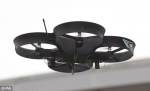
A story in the Daily Mail shows two new military robot surveillance devices developed for the UK Ministry of Defence’s Defence and Equipment Support (DES) group. The first is a throwable rolling robot equipped with multiple sensors, which can be chucked like a hand-grenade and then operated by remote-control. The second is another Micro-(Unmanned) Aerial Vehicle (Micro-UAV or MAV), a tiny helicopter which carries a surveillance camera. There have been rolling surveillance robots around for a while now (like the Rotundus GroundBot from Sweden), but this toughened version seems to be unique. The helicopter MAV doesn’t seem to be particularly new, indeed it looks at least from the pictures, pretty similar to the one controversially bought by Staffordshire police in Britain – which is made by MicroDrones of Germany.

The proliferation of such devices in both military and civil use is pretty much unchecked and unnoticed by legislators at present. Media coverage seems to be limited to ‘hey, cool!’ and yes, they are pretty cool as pieces of technology, but being used in useful humanitarian contexts (for example, rolling robots getting pictures of a partially-collapsed building or MAVs flying over a disaster zone) is a whole lot different from warfare, which is a whole lot different again from civilian law enforcement, commercial espionage or simple voyeuristic purposes. As surveillance gets increasingly small, mobile and independent, we have a whole new set of problems for privacy, and despite the fact that we warned regulators about these problems back in 2006 in our Report on the Surveillance Society, little government thought seems to have been devoted to these and other new technologies of surveillance.

The use of robots in war is of course something else I have become very interested in, especially as these flying and rolling sensor-platforms are increasingly independent in their operation and, like the US Predator drones employed in Afghanistan and Pakistan or the MAARS battlefield robot made by Qinetiq / Foster-Miller, become weapons platforms too. This is an urgent but still largely unnoticed international human rights and arms control issue, and one which the new International Committee for Robotic Arms Control (in which I am now getting involved), will hopefully play a leading role in addressing.

Pittsburgh police use sub-lethal weapons against protestors

LRAD being used by the US Navy (ATC)

Mega-events are often the time for some surveillance / control / security innovation and experimentation by states. In what seems to be a rather unwelcome first, the Pittsburgh police have used a military sonic canon to clear protestors off the streets at the G20 summit. These devices are among many so-called ‘sub-lethal weapons’ (see the article by Steve Wright here) that have been gradually migrating from military to civilian use for a number of years – see for example the ongoing debate over the use in the UK of the ultrasonic ‘Mosquito’ device, which is supposed to target young people; its makers rather cynically advertise it as ‘so effective that they tried to ban it’.

The particular weapon used by the Pittsburgh police is the Long Range Accoustic Device (LRAD) made by the American Technology Corporation, which generates a piercing noise that is not only extremely unpleasant, it can damage eardrums and cause heart problems. It was rather eeriely appropriate to see them being used (as you can on The Guardian‘s website) on the same day that TNI / Statewatch released their report on the security-industrial complex and a reminder that this is a global phenomenon.

Europe’s new security-industrial complex

neoconopticonThere is a superb and chilling new report out today that utterly demolishes the European Union’s claims to be in any way an  ethical or progressive leader on issues of security and surveillance. The report written by Ben Hayes for the Transantional Institute and Statewatch, documents in some detail the new vision for security in the EU, which the authors describe as a ‘neo-con-opticon.’ The report confirms a lot of things that have been concerning me about the direction and emphasis of EU security research and the increasingly unnacountable and behind closed-doors ways in which security policy is being developed. I asked back in January in an editorial in Surveillance & Society whether surveillance was becoming the new ‘baroque arsenal’, Mary Kaldor’s famous phrase to describe the huge, intricate and complex technocentric security structures of the second Cold War. This report answers that question with a resounding ‘yes’.

The press release quotes from the introduction:

“Despite the often benign intent behind collaborative European research into integrated land, air, maritime, space and cyber-surveillance systems, the EU’s security and R&D policy is coalescing around a high-tech blueprint for a new kind of security. It envisages a future world of red zones and green zones; external borders controlled by military force and internally by a sprawling network of physical and virtual security checkpoints; public spaces, micro-states and mega events policed by high-tech surveillance systems and rapid reaction forces; peacekeeping and crisis management missions that make no operational distinction between the suburbs of Basra or the Banlieue; and the increasing integration of defence and national security functions at home and abroad.

It is not just a case of sleepwalking into or waking up to a surveillance society, as the UK’s Information Commissioner famously warned, it feels more like turning a blind eye to the start of a new kind of arms race, one in which all the weapons are pointing inwards. Welcome to the NeoConOpticon.”

But don’t stop there. You can (well, you must) read the full report here: NeoConOpticon – The EU Security-Industrial Complex

And whilst you are at it, download Tony Bunyan’s equally superb report, The Shape of Things to Come – the EU Future Group, on the EU’s thoroughly undemocratic attempt to bypass public debate and hand internal security and surveillance policy over to the transnational security companies and the police and intelligence services.

(thanks to Rosamunde van Brakel for passing this on)

US cameras to see the whole of the moon…

There’s been a story developing for a while now on the US-Canadian border. This used to be one of the most casual and friendly of borders, indeed there are families stretched across both sides and in many places the border meant only slight differences in the price of some goods…

But no more. There might be a new president, but Obama seems to be allowing the Bush-era plans for strengthening the border with Canada to continue. There are now CCTV towers being erected, Unmanned Aerial Vehicles (UAVs) patrolling, and new much stricter passport regulations and customs and immigration checks. As usual this seems to be being done with a kind of macho indifference to the opinions of the Canadians that is making the US actions doubly unpopular.

If this seems like some kind of sci-fi nightmare then then most crazy, Philip K. Dick-style element is to be found on the Michigan-Ontario border at Port Huron, where the Sierra Nevada Corporation, a US military aerospace company, has launched a tethered balloon camera (the company calls it an MAA (medium altitude airship) pointed at the town of Sarnia across the border. This isn’t even an official scheme, it’s a private company trying to sell this insanity to the Department of Homeland Security, and naturally the Mayor and citizens of Sarnia are angry about this international violation of their privacy, and many of both sides of this border think that this intensified security as an attack on the trust that exists between Americans and Canadians.

So what are Sarnians doing? They are giving the cameras something to look at, that’s what. More specifically they are planning to drop their pants for a mass ‘moon the balloon’, which in these days of ever more insane surveillance schemes seems just about the only possible response.

SIVAM and Brazilian extremist nationalism

A Brazilian nationalist street stall in Rio

Whilst finishing up my work in Rio de Janeiro yesterday, I came across this interesting bunch of people, mv-brasil, who appear to be a Brazilian nationalist movement, with much in common with organisations like the British National Party or the various right-wing groups in the USA. Their website contains the usual odd mixture of anti-globalisation, evangelical Christian (they campaign against Halloween) and anti-United Nations / New World Order stuff with the added anti-Americanism. There of course is the usual rather uncomfortable fact of the ‘Brazilian Christian’ nationalist being a representative of a colonial power that invaded the country and took it from the indigenous people, but they roll over this one with some nods to Indian rights when it suits their cause, most notably when it comes to the Amazon.

A t-shirt with anti-internationalisation and privatisation of the Amazon slogan

One of the T-shirts for sale makes reference to this, being against ‘internationalisation and privatisation’ of the Amazon by the USA. It is a conspiracy theory I’ve come across before when I was doing some research on the SIVAM program – which provides some actual evidence for contentions that there is a secret American program to control the rainforest. I had someone tell me here in complete good faith that it was a ‘fact’ that several Amazonian tribes already thought that they were part of the USA and flew the US flag! This is combined with the fact the UN and international environmental organisations are very concerned about the destruction of the rainforest and the perceived lack of effort by successive Brazilian administrations to stop it. Put all this together and you have the ingredients for nationalist paranoia.

sivam_logoSo what is SIVAM? And why would I be interested in it anyway? The reason is that SIVAM is a surveillance system. Announced at the Earth Summit in 1992, and finally completed in 2002 and fully operationial from 2004, the Sistema de Vigilância da Amazônia (SIVAM) is a multipurpose, multi-agency network of satellite, aerial and ground surveillance and response that aims to monitor the illegal traffic of drugs and forest animals and plants, control national borders and those of indigenous peoples’ lands, and prevent the further destruction of protected areas of forest. A good technical account in English can be found in Aviation Today from 2002, and there is an interesting article on its construction here.

Donald Rumsefld visits the SIVAM control centre, 23 March 2005 (Wikimeda Commons)

The problem is that, although an initiative of various Brazilian government agencies including the environment and Indian affairs ministries, the federal police and the army, SIVAM is supported and funded by the USA – most of the initial $1.39Bn US cost came through a grant from the U.S. Export-Import Bank, and the consortium that supplies the equipment includes giant US military supplier, Raytheon – amongst many others from Brazil to Sweden. The visit of former President George W. Bush’s right-hand man and then Secretary of State for Defense, Donald Rumsfeld, to the SIVAM control centre in 2005, was widely reported in Bazil. It was of course interpreted by many as further evidence of Brazil’s ceding of control of the Amazon to the USA, or even presaging a US invasion of the Amazon, as Senator Norm Coleman discovered on a fact-finding mission later that year.

Latin American countries have every right to be suspicious of US motives: the Monroe Doctrine; George Kennan’s Cold War ‘grand area’ vision; the support for dictators like Augosto Pinochet; the invasions of Panama and Grenada; Plan Columbia and the widespread use of military ‘advisors’… the list goes on. And it is certainly the case that US strategic surveillance plans for ‘Full Spectrum Dominance’ and the like, have have long included ‘leveraging’ any system in which they are involved from the International Space Station to things like SIVAM. So of course they will have a strategic interest, and no doubt SIVAM data will find its way to US military C4ISR centres, but this does not amount to a plan to invade Brazil or take control of the Amazon.

Research as Espionage

There’s no doubt that academic research and military intelligence have a more tangled history than some would imagine, although in many countries in recent years ‘imperial disciplines’ like geography and anthropology have been through a long process of reevaluation and rejection the values that gave them birth. In the USA, however, geography remains intimately connected to the state and more particularly to current US military projects, indeed since 9/11 such ‘patriotic’ research has become more rather than less common.

z magazine has a very interesting article on a growing furore around first of a new US government cartography / geography program called the Bowman Expeditions. This half a million dollar project, México Indígena, has been mapping indigenous lands in Oaxaca, Mexico, where a popular insurgency has been growing in recent years. Local organisations under the umbrella of the Union of Organizations of the Sierra Juárez of Oaxaca (UNOSJO) have rejected the activities of the expedition and claim they were duped by researchers.

A slide from a Powerpoint from the project reveals ideological connections to US military goals, but the links are material too.

And it seems they were right to do so: the grant scheme is associated with the U.S. Army’s Foreign Military Studies Office (FMSO), which seems to be largely associated with so-called ‘open source intelligence’, in other words ‘leveraging’ academic mapping projects for military purposes, in particular the ‘cultural terrain’ for potential future counter-insurgency purposes, learning the lessons of failures in Afghanistan and Iraq. The academics involved, Jerome Dobson and Peter Herlihy from the University of Kansas, just down the road from FMSO, are now furiously backpedaling as previous denials are shown to be evasive and disingenuous…

US plans surveillance drone airship

I am sure there will be arguments about the violation of airspace, which will not be trivial as the ongoing diplomatic and increasingly military row over US surveillance vessels off China is showing…

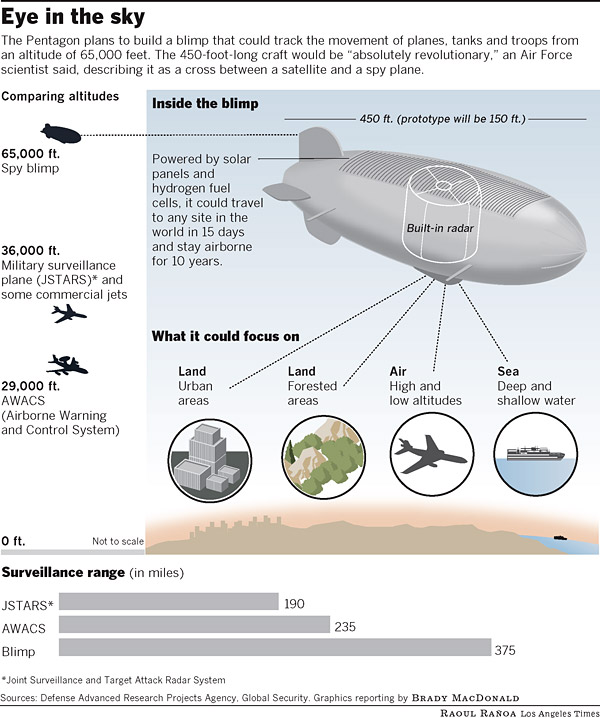
Unmanned aerial vehicles (UAVs) are one of the fastest-developing areas of surveillance technology. A new plan revealed by the US Department of Defense combines old and new tech with a plan, first revealed by the Los Angeles Times, for an pilotless surveillance airship called ISIS (Integrated Sensor Is the Structure) that will fly right at 65,000 feet (about 20km) high, right at the edge of ‘airspace’. The point of the airship is to provide the kind of constant watch that a geostationary satellite provides, but at a much lower level so that for more detailed pictures of the precise movements of vehicles, objects and people could be observed.

airship

Well, as usual, the reports only seem to to be concerned about how great this would be for US military tactics, and are not interested in the law, politics and ethics of such devices. For example, I am sure there will be arguments about the violation of airspace, which will not be trivial as the ongoing diplomatic and increasingly military row over US surveillance vessels off China is showing. And of course there are issues around the violation of human rights by such intrusive technology: international violations are very hard to deal with, however. And this will only be the beginning. The new Obama administration has promised more investment in intelligence and surveillance and less in warfighting. That sounds good in some ways, but of course just poses new problems and new issues for those of us concerned with ongoing US attempts to cover the whole world with surveillance for the benefit of its strategic aims.

Surveillance and the ‘Open-source Insurgency’

Hierarchical, national and corporate bodies are profoundly afraid of the openness, apparent lack of interest in conventional goals and absence of obvious leadership or deference that is represented by the new collaborative networks like Open-source. They are not ‘under control’. The answer for the military-industrial complex is a consistent one, and as usual it combines strategic military and economic goals. This answer is surveillance.

The US military-industrial complex is always trying to identify new threats to bolster its budgets. There was a minor outcry a few years ago when US military powerpoint slides on strategy seemed to indicate that it regarded international civil society organisations, including the Red Cross, as a potential source of such threat. Then came 9/11 and the war on terror and for a while it didn’t need these phantom menaces as there were real global enemies, and fortunately for the military-industrial complex, it seemed that those enemies might be infinitely expandable and malleable into what was briefly termed the ‘long war’.

But the war on terror isn’t what it was. So there seems to be some effort to resurrect previous threats. One of these is ‘the war on drugs’ now rebranded as ‘narco-terrorism’ or ‘narco-insurgency’. And the particular focus of the concern is closer to the United States: Mexico. Writing in the self-proclaimed ‘capitalist tool’, Forbes magazine, Reihan Salaam argued that Mexico’s ongoing struggle with drug-related violence was a major threat which could ‘blind-side’ the USA. Now, Republicans like Salaam are struggling to find anything important to say when its obvious what the major global problems are, and the US electorate has decided that the Republicans aren’t the people to solve them. He is of course correct that there is a serious situation in Mexico – and indeed elsewhere in Latin-America: the drug-trafficking gangs are also the major problem for the Brazilian government in any attempt to include their excluded favela communities. However, he makes no mention of the other underlying cause of destabilization in the USA’s southern neighbour – the way in which NAFTA has transformed Mexico into a subordinate economic role to the USA as source of cheap production facilities and cheap labour, all the while being told that its people are not wanted in the USA. The EU has its critics, but at least its building of free-trade has been accompanied by a far greater degree of free movement of people and reciprocal political rights. Nor is there any reference to the consumption of cocaine and crack in the USA that is driving the trade (as the first comment on the article notes).

Instead Salaam tries to analyze the Mexican situation using a recent strategic theory, and one which is profoundly worrying in its implications. In an essay in the New York Times in October 2005, John Robb argued that the Iraq war had turned into what he termed an ‘open-source’ insurgency, “a resilient network made up of small, autonomous groups”. He argued that those resisting the US occupation and other armed groups were like open-source software developers in that “the insurgents have subordinated their individual goals to the common goal of the movement”. (Never mind once again, that there is an obvious underlying common goal – that of getting rid of an occupying foreign power!).

Now of course, in many ways this was just a restatement of the whole post-Cold War, network-centric warfare hypothesis. There are also echoes back to the kind of language which has been used to describe ‘eastern’ or ‘foreign’ peoples for centuries – the British in India being unable to tell ‘them’ apart, the faceless and numberless ‘yellow peril’, the ‘godless communists’ who subordinated their individual will to the collective, and the ‘clash of civilizations’. It’s the hive-mind, the fear of humans who don’t appear to act ‘like us’. Without the overt racism of course: this is Orientalism 2.0, the politically-correct version!

However the addition of the label ‘open-source’ is no accident. Hierarchical, national and corporate bodies are profoundly afraid of the openness, apparent lack of interest in conventional goals (profit, advancement, etc.), and absence of obvious leadership or deference that is represented by the new collaborative networks like Open-source. They are not ‘under control’.

So how to bring them ‘under control’? John Robb’s first (and rather refreshing) answer was that in many ways you probably can’t and that in Iraq, the US should have probably ‘let them win’. But this is an unpopular response for the uneconstructed military-industrial complex. For them the first answer is a consistent one, and as usual it combines strategic military and economic goals. This answer is surveillance. For the Internet, we have seen, and continue to see, attempts in multiple countries to attack the basis of what makes the Internet creative and free, in the name of all kinds of ‘risks’ (mainly terrorism, identity crime, pirating and paedophilia). Of course these risks are no greater on the Internet than in the material world, but the Internet is still for many people, and many politicians in particular, a vast, unknown terrain which they do not understand: ‘here be dragons’ as the old maps used to have it of any such ‘terra incognita’.

For countries afflicted by the new ‘open-source insurgency’, the answer is the same. The Defense Industry Daily today starts off its story on Mexico with the apparently uncontentious statement that “Mexico needs surveillance.” It then lists with the usual kind of techno-pornographic relish of these publications, all the mainly Israeli UAVs and surveillance craft that the Mexican state is buying. We are supposed to cheer. We are supposed to think that this is evidence of Mexico’s growing maturity. Soon Mexico will be monitored and ‘under control’. No evidence of whether surveillance ‘works’ (even in military terms) troubles these kinds of stories. That is taken as self-evident. And certainly there is no question of whether this could in any way be the wrong approach, or even a counterproductive strategy. As the Brazilian parliamentarian to whom I was talking yesterday said, about the favelas, the only answer to both crime (because, let’s not forget that’s what ‘narco-terrorism’ really is) and the poverty on which it feeds, is in the long-term (and that means starting now not later): sanitation, schools, hospitals, transport, jobs – in other words providing the poor with access to the same society that the wealthier enjoy. Extending intensive high-tech military surveillance across the global south is not only a complete failure to address these underlying issues, it also diverts much-needed money away from social priorities. It is the wrong answer to the wrong question… except for the defense industry.

The robots are coming and now they’re angry…

A mindless drone robot is one thing but an independent robot with a tiny mind capable only of death and destruction – that is something else entirely.

Whilst I was doing my PhD in the late 90s, I met a guy called Steve Wright who used to run the Omega Foundation (who were like the ‘Lone Gunman’ organisation from the X-Files, but for real), and who is now at the Praxis Centre at Manchester Metropolitan University, UK. He was investigating the development of new forms of automated killing and control systems and ever since then, I’ve been keeping an eye on the development of remote-controlled and increasingly automated surveillance technologies, and in particular the development of robotic devices that are able not only to collect or transfer data, but to respond physically.

Two stories this week reflect the variety of developments in all kinds of different arenas, and raise all sorts of issues around the distancing of human responsibility from material, in many cases, punitive or lethal action.

'Intruder' captured by web-slinging robot
Japanese security robot (AP)

The first was the news that Japanese technologists have produced a mobile remote-controlled robot that can fire a net over ‘intruders’. Until recent years such developments had been carried out largely in the area of military research by organisations like the RAND corporation in the USA. However, particularly since the end of the Cold War when military supply companies started to look to diversify and find new markets in a more uncertain time when the ‘military-industrial complex’ might no longer ensure their profits, there has been a gradual ‘securitization’ of civil life. One consequence of this has been that so-called ‘less-lethal’ weapons are increasing regarded as normal for use in law enforcement, private security organisations and even by individuals.

However a further change has been in the when these operations can be automated when an intermediary technology using sensors of some kind is placed between the person operating them and the person(s) or thing(s) being monitored. This removes the person from the consequences of their action and allows them to place the moral burden of action onto the machine. The operation is aided still more if the machine itself can be ‘humanized’, in the way that Japanese robots so often are. But a kawaii(cute) weaponized robot is still a weaponized robot.

A 'Predator' Drone (USAF)

In the skies above Afghanistan, Iraq and Gaza however, ‘cuteness’ doesn’t matter. Remote-control military machines have been stealthily entering the front lines, colonising the vertical battlespace, with lethal consequences that have not yet been considered enough. This week we saw US unmanned aircraft operated by the CIA kill a total of 21 people in Pakistan, one of the few aspects of Bush-era policy that new President Obama has not (yet) promised to change.

All of these machines are still under some kind of control from human operators, but several profoundly misguided scientists are trying to create systems that are more independent, even ‘intelligent’. This week, I read about Professor Mandyam Srinivasan of Queensland University in Australia who, at least according to a report in The Australian, thinks it is a great idea to give missiles brains like angry bees. A mindless drone robot is one thing but an independent robot with a tiny mind capable only of death and destruction – that is something else entirely. I can think of few things that are less in the spirit of social progress than this, but he’s hardly the only one thinking this way: there are billions of dollars being pumped into this kind of research around the world…