
I am just on my way back from Brasilia to Curitiba, so there won’t be anything from me this Sunday. The next few days are also ‘Carnaval’ here in Brazil 🙂 so not much work will be happening, and certainly I won’t be in the university (as it is closed!) and I may take a trip or two out of town. I might also try to catch up on a few things which I will post here – but probably there won’t be more than a post a day over the coming week…
Category: travel
Leaving Sao Paulo
It’s my last morning here in Sao Paulo. I have to say that, with the greatest respect to my friend and Sao Paulo native, Rodrigo, I am not going to be sorry to leave. A lot of what I thought when I arrived here hasn’t changed. This is big, dirty, noisy, exhilarating city with an unapologetic commercial drive, and all the divisions and human debris that this creates. In many ways, it reminds me of Osaka in Japan, but the extremes are greater. The problem is that the huge divisions can’t be ignored if you are in any way sensitive to human suffering, and the suffering here cries out from every raw-smelling homeless man sleeping on the street, from the ragged kids sorting through rubbish at night, from the women selling themselves in the parks, stations – well, everywhere. Certainly, these things are part of city life in many places in the world, and there are many far, far poorer places, but there is something profoundly saddening, depressing, about the gulf between the helicopter-chauffeured elite and the people on the street in O Centro, and especially in the ignorance and indifference – which I have not only been told about but have seen. By the end of just one week, during which I have tried to be as much a part of the place as I could, when I have spent time talking to everyone from human rights groups to people in ordinary bars, I feel like retreating, curling into a ball in the corner of my room.
So thank-you, Sampa, but I am not sorry to be leaving. Here are some pictures of the hundreds I took, of aspects booth good and bad…
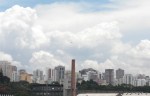









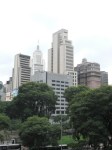
In the old centre of Sao Paulo
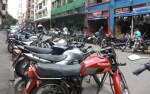
These are just some pictures of the neighbourhood. Off the main streets, it’s generally a decaying but still lively place, full of tiny shops, with a few hotels and a major specialism in motorbikes…






UK travel database
Lots of media outlets today and yesterday reporting on the UK government’s e-Borders initiative. I’m not quite sure why particularly now: we’ve known about the e-Borders program – which is based around the new RFID-chipped passports – for some time. Of course the system involves collecting vast amounts of data, including rather more personal information than seems in any way necessary, like for example, travel companions – as if terrorists and criminals will obediently identify themselves by booking and traveling together!
For that is the justification for all this. On the Politics.co.uk website, Phil Woolas, the Minister of State for Borders and Immigration – another barrel-scraping appointment by a government that doesn’t really have many options for ministers now – said that this is is just about allowing ‘us to count all passengers in and out of the UK.’ But this isn’t just counting. What was a system derived in a combination of bowing to US demands after 9/11 and embarrassment over the government’s total inability to counter opposition criticism over immigration with any real facts has expanded its functionality (as with all of these systems) into something rather more comprehensive.
Woolas goes on to say that it ‘targets those who aren’t willing to play by our rules’ – tough talk, but it with the ever increasing numbers of trivial, silly and sometimes plain bad rules introduced by the current government, it’s hard to know what playing by the rules means anymore. This is a major problem for those who just accept all of this with a shrug and argue ‘nothing to hide nothing to fear’. I also wonder how long it will be before this database is hacked or details get left on a train or the whole thing is ‘lost’. Maybe I will start paying attention to Phil Woolas’s idea of the rules when his government starts paying attention to the European Convention on Human Rights, introduces some proper accountability and oversight for all these new surveillance initiatives as the House or Lords recommended, and stops losing our data and pandering to fear. Accountability, competence, ethics and rationality: it’s not much to ask from a government is it?
Touchdown in Sao Paulo
The centre of Sao Paulo not a place for those who don’t like the scent of human beings together or being touched and jostled. The streets smell of piss and sweat and there are boys begging and running and men lying in boarded-up doorways or just on the sidewalks, with their dogs or without…
It’s hot and wet and I’m lying on a bed in a hotel which is a good 2 stars short of the 4 that it claims to have, in a neighbourhood in which the only stars you’ll see are if you’re lying in the gutter. And many are.
I’m sorry to go gonzo on y’all but on first impressions that is the way I will have to write it. Sao Paulo is the kind of city that seems to have that effect. I’ve only really come here to talk to a few social organisations and to see Rio’s great rival, but it’s hard to know what to make of it. Flying into Congohas, we cut through the low clouds to the spectacle of this endless sprawl of towers and factories and suburbs and favelas and highways thrown together with as little sense or plan as any place I’ve been in Asia. Like Tokyo or Mumbai it’s just too big to take in or apprehend even from the air, although you can’t avoid the scalar indicators of class divisions – both vertical and horizontal. The airport is one of those which has been drowned in this rising sea of humanity which makes the final descent pass with a feeling of rooftop-skimming alarm, which a slight sideways jolt on the infamously greasy runway surface – a plane skidded out of control here in July 2007, killing 187 people – does little to allay.
We make it safely down. As we are heading to the terminal I see my first helicopter, another reminder of the social extremes of this place where the super-rich just don’t let their feet be soiled by the streets any more and which has the largest private helicopter use outside of New York.A taxi to the centre – they tell me there aren’t any buses though I am sure there are, and I won’t be making that mistake again!. The highway that snakes deeper into the city is hemmed in with rotting stone and concrete and every space that hasn’t been walled off has been reclaimed and is packed tight with self-constructed dwellings in various stages from shack to house. Occasionally huge voids are opened up – precursors to a further gentrification, some new fortified tower condominium – and the archaeology of the city is laid bare: a splash of colonial colour, deco curves and the confident lines of Brazilian modernism, all cut neatly and disrespectfully for some tower block with a European name and not a hint of Indio or African heritage. Brazil might not be an overtly racist culture in many ways, but ‘whiteness’ remains the shade of aspiration…
Then a sharp left off the highway and we are in the old centre. The taxi driver knows the map but he doesn’t know the area, and out path is blocked by a Sunday market. I take a mental note – I’ll be back later. We get to the hotel, which pleasingly is not anything like the priggish image on the website and if it is ‘perfect for business’, it certainly doesn’t look like the kind of business you do with a briefcase… This turns out to be exactly what O Centro is all about. I get out and head back towards the market for a pastel com queijo and a cool caldo de cana com limao, and just to wander amongst the fruit and veg sellers. This place is much more obviously mixed than Curitiba. The faces of the vendors are a whole range of darker shades, the accents more varied, tougher and more incomprehensible!
The toughness isn’t just in the voices of the stallholders though. The is a brash, hard city. The centre of Sao Paulo not a place for those who don’t like the scent of human beings together or being touched and jostled. The streets smell of piss and sweat and there are boys begging and running and men lying in boarded-up doorways or just on the sidewalks, with their dogs or without. Sleeping, drunk, dead – who knows? The market is winding down, an at the ends of the street, amidst the sickly sweet decaying piles of vegetable leaves and squeezed sugarcane pulp, several middle-aged whores work the last few departing customers. They half-heartedly ask me if I want something. I just smile and politely say no thank-you very much, which seems to amuse them. I don’t suppose they get or expect much of that sort of interaction. This sets a theme. There are women working the car parks, women on the street, women trying to entice any likely-looking customers into a seedy-looking film theatre for ‘fantasia’. Turning a corner suddenly the street is full of younger men standing around with largely older guys passing by. It’s only after the second transvestite offers me something else that I realise I’ve entered another kind of business district, which happily filters into a much more ordinary a relaxed set of gay bars and pastelarias. There seems to be some kind of club open, with another very tall transvestite on the door, but the queue outside seems to be mostly teenagers. I’ve only been a few blocks and this isn’t even (apparently) the really lively part of SP…
Cutting back to the Praca da Republica, there’s another much bigger market winding down, this one more of a craft-type affair with lots of wiry men and women selling hats and carvings and a whole avenue of dealers in stones and minerals and, outside the entrance to the Metro, food stalls selling either Japanese yakisoba or cream cakes. Neither appeals, and as it looks like rain, I head into a bar. Sao Paulo against Botafogo is on the TV but not too loudly and no-one seems interested, the beer is cheap and the woman behind the bar is singing to herself so I stay and sip the cold lager and watch the rain come down and the passing beggars and freaks and drunks and I am thinking that I am just a few hundred yards from Parque da Luz where the city has installed public-space CCTV, and it might be the beer but just makes me want to laugh. It just seems so tiny, so pathetic a gesture, how can it possibly do anything to this roiling mass of humanity with its desires and suffering and joy and desperation.
I’ve touched down in Sao Paulo.
My plans
Today there probably won´t be that much new here as I am concentrating on preparing for interviews for the next two weeks in Saõ Paulo and Brasília. I will be talking to various NGOs (mainly concerned with urban violence and security), academics, parliamentarians and representatives for the federal police and government ministers. I am also meeting Danilo Doneda later today, who is the leading Brazilian legal expert on privacy and data protection, and a member of the Habeus Data network, which campaigns for information rights in Latin American.
(My netbook has also decided not to work today, so if I can´t get that fixed there might not be much here at all for the next two weeks! Why do these things always happen just when it is least convenient?)
In Brazil
Just a quick post to say that I’ve arrived in Curitiba safely – the Brazilians seem to have the nice kind of border controls that now seem long gone in the UK. It is raining incredibly hard now, and we already had a massive electrical storm that knocked out power in our neighborhood for a couple of hours.
Note: this post was interrupted by another power cut last night!
Off to Brazil…
Welcome to the new ‘Notes from the Ubiquitous Surveillance Society’, now on WordPress…old posts are still archived at Newcastle University for those who are interested.
I’m just about to leave for Brazil, were I will be a Visiting Scholar in the Postgraduate School of Urban Development at the Pontifical Catholic University of Curitiba, Brazil for three months.
In the meantime, there’s more to sort out than I have time for, but I will certainly get the relaunch of Surveillance & Society done…
 ubisurv