Chicago: the future of US CCTV?

…despite Britain’s reputation as a surveillance society… the USA is now eclipsing the UK. The post-9/11 surveillance surge has seen to that.

Back in the USA again. Chicago has been featuring a lot this week for its CCTV system. Newspapers generally offered glowing assessments of its capabilities based around homey anecdotes of pretty harmless incidents ‘solved’ by CCTV – in this case the stories, for example those in the Chicago Sun-Times and the New York Times, featured a theft from a Salvation Army kettle, which sounds like it is straight from a Mayoral press release. It is depressingly poor journalism and once again, all very reminiscent of the situation in the UK in the 1990s before academic and even government assessments dampened the enthusiasm for CCTV. There’s also a depressing naivety (and factual incorrectness) about the insistence from the authorities and from some ‘experts’ that these cameras have nothing to do with human rights like privacy as they are all in public spaces.

But there is one very important difference. Chicago, with massive investment from the Department for Homeland Security, has gone much further than most UK cities, not only in coverage but also in capabilities. First of all, Daley and police-chief Orozco have promised that “We’re going to grow the system until we eventually cover one end of the city to the other” in other words they do want, as the Chicago Sun-Times subheading claims, ” a camera on every street corner.”

The particular innovation that the city is pushing here is the linking up of the law-enforcement aspects with emergency services through something called Computer-Aided Dispatch (CAD). This is system that uses a live Geographic Information System to match camera location to reported incident location, so that when an incident is called in via 911, the nearest cameras can immediately turn to picture the scene. This is part of what Chicago calls ‘Operation Virtual Shield’, a fibre-optic cable system which links the cameras with other biological and chemical weapons-detection system in a “homeland security grid.’’
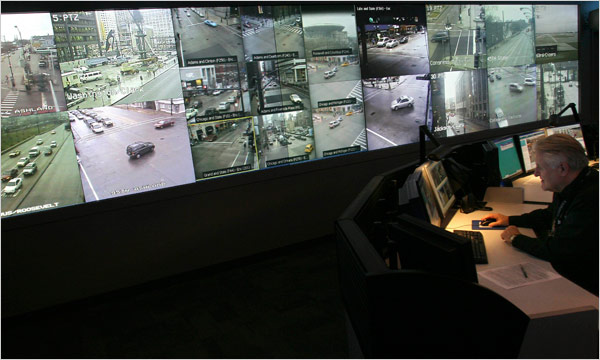
The Chicago control room (New York Times)

As part of the work we did for our latest book, Jon Coaffee Pete Rogers and I visited and analysed several different cities in the UK to assess their emergency-response and surveillance systems. While most had intentions to use the cameras for more active emergency-response purposes and particular local police were starting to try to install override systems for the multiple local camera systems that exist in the UK in the case of citywide emergencies (like a mass evacuation). And in particular, Manchester (whose high-tech control room looks like the Chicago one as seen in the NYT (picture above) and also often features in media PR for CCTV) has gone further down the Chicago route than most. But they still don’t come close. Britain’s systems are fragmented, ageing, generally not integrated with other functions and certainly don’t link to other kinds of sensors. Britain has introduced some stupid authoritarianism like the infamous ‘shouting cameras’ mostly as part of the Respect (sic) Zones initiative. But despite Britain’s reputation as a surveillance society I suspect that in terms of advanced integrated cameras systems, the USA is now eclipsing the UK. The post-9/11 surveillance surge has seen to that.

There’s two other points worth noting here. The first is that Chicago is bidding for the Olympics in 2016. I can almost hear multiple researchers in surveillance studies around the world, releasing a collective ‘of course!’. Mega-events like the Olympics, the World Cup – there will be a fantastic conference on this theme in November this year in Vancouver – or other non-sporting ones like world summits or the G-8 conference are often the trigger for the introduction of repressive measures and new surveillance systems. This was true in Japan (where state CCTV was first introduced because of the soccer World Cup in 2002), in South Africa (for various major world summits), and in Athens for the Olympics in 2004. Mayor Daley wants the city to be 100% free from the possibility of terrorist attack. Laving aside the actual impossibility of that desire, how far will he go to get there?

Well, the last Olympic venue, Beijing, might give some indication. For it is actually the plans in authoritarian, non-democratic China that seem most similar to what is going on in Chicago. Even the names have an eerie reminiscence: China’s Golden Shield, Chicago’s Virtual Shield. That is trivial, however the substance is not. The Chinese government, as Naomi Klein has written, is installing massive and comprehensive camera systems in every major city in China. It is also, of course, linking this system into its infamous Internet monitoring operation, with the ultimate aim of being able to track individuals in real and virtual space. Of course, the US, like most other nations is now trying to control Internet use too and the NSA already keeps massive data banks of communications traffic information as well as doing real-time monitoring as recent revelations have, once again, shown. But, it’s different in the USA isn’t it? The USA wouldn’t link up all these systems, would it? The Land of the Free? The home of democracy? I wouldn’t bet against it…
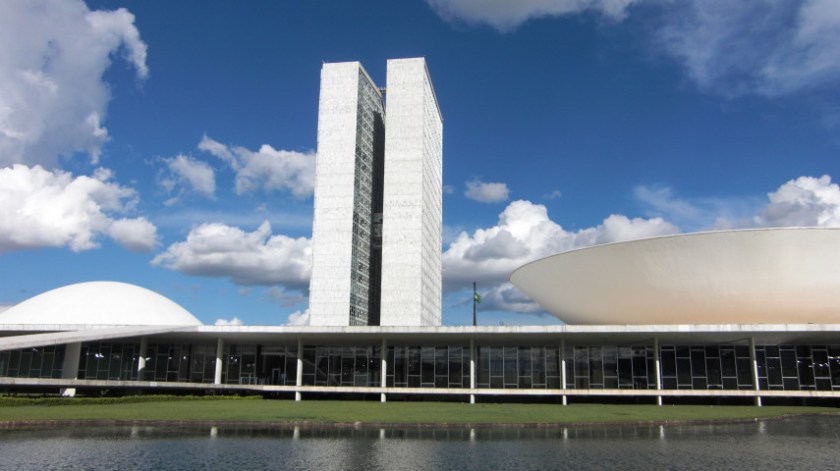
At the Camara dos Deputados

I had a great meeting at the architecturally stunning Camara dos Deputados (the Brazilian equivalent of the British House of Commons or the House of Representatives in the USA), which almost made up for the fact that it was the only one of the three scheduled interviews that I had arranged that actually went ahead… it really does look like I will have to come back.

The parliamentary buildings in Brasilia, originally laid out by Lucio Costa. The Camara dos Depuados, by Oscar Niemeyer, is to the left.
The parliamentary buildings in Brasilia, originally laid out by Lucio Costa. The Camara dos Deputados, by Oscar Niemeyer, is to the right.

This meeting took place in the Comissao de Direitos Humanos e Minorias (the Commission for Human Rights and Minorities) and was with Federal Deputy and committee member, Pompeo de Mattos, the secretary of the Commission, Marcio Marques de Araujo, and Hebe Guimareas-Dalgaard, who works in the International Relations office and who served as translator.

The meeting covered all sorts of background issues around security in Brazil, and concentrated on Deputado de Mattos’s specialities in this area, which are in justice and drug-trafficking issues. Again, I won’t do more than summarize a few immediately important things here. There was a lot of talk of police corruption and some hair-raising stories of the ways in which military police officers in particular has become involved in selling equipment and ammunition, and of course the autodefesas communitarias that I have mentioned before. Interestingly though, it was the deputy’s opinion that the military police, despite having a ‘culture of violence’ inherited from their role as enforcers of the military dictatorship, were less corrupt (in an everyday way) than the civil police. The latter are even lower down the police food-chain and correspondingly more poorly paid and equipped.

The inadequacies of the civil police has led many Mayors of larger towns and cities to introduce so-called ‘Municipal Guards’ – basically private security given some official status. They have few powers but are basically there to increase the visibility of security, a kind of prophylactic community policing. The problem is however that the official police and the massive private security sector are thoroughly intermixed already. Many officers moonlight as private security guards, which leads to all kinds of conflicts of interest.

Deputado de Mattos was certainly not obsessed with the inadequacies of the police however. Serious and organized crime associated with drug-trafficking paralyzes the everyday life of poorer areas of large cities in Brazil. Despite the fears of the rich over crime, it is the poorest that suffer most. He described the drug gangs as being the major obstacle to any positive change in Brazilian cities. However he didn’t see any militaristic solution – fighting a war against the drug gangs would only lead to more violence. The only solution to the problems of both crime and the poverty from which it emerges is social inclusion. The favelados must be provided with the same opportunities and infrastructure as everyone else. The need schools, hospitals, transport, and so on. Programs like Bolsa Familia, however well-intentioned, make no fundamental difference, he argued – contradicting, as most people with whom I have talked have done, the assessment of external organisations like the World Bank.

However providing such opportunities is not easy, and not just because of the costs. The drug-gangs actively resist any attempt by the state to introduce services, to the extent of intimidating or even killing construction workers. And this shouldn’t be in any way romanticized as some kind of popular resistance of the poor to the imposition of unwanted state interference – this is an attempt to maintain the rule of fear and violence. Somehow, one can never get away from the security issue in Brazil.

Leaving the Camara dos Deputados, looking past the parliamentary buildings up towards the Esplanada dos Ministerios, with all the government Ministries lined up in identical blocks.

(Thanks to Deputado Pompeo de Mattos, who as you will see if you check out his website is quite a character. He is fiercely proud of his southern ‘gaucho’ roots, and writes poetry to that effect. He is also – and I don’t say this very often of politicians – a genuinely nice guy. Thanks also to Marcio Marques de Araujo and to Hebe Guimares-Dalgaard without whom the meeting would have been impossible).

At the Departamento de Policia Federal

Both human rights advocates and the police seem to be strongly in favour of the new RIC system as a means of social inclusion and to replace the chaotic and corrupt identification system based in individual Brazilian states at present, which allows anyone with any other form of ID to get a state Registro Geral card in each different state.

Departemento de Policia Federal, Brasilia
Departamento de Policia Federal, Brasilia

I have just come back from a very productive interview with Romulo Berredo, from the Director-General’s office at the Departamento de Policia Federal (DPF), who are the Brazilian equivalent of the FBI. There was a lot covered and I couldn’t hope to reproduce it all here. There were however a number of immediately interesting aspects.

The first was more evidence that the whole basis on which identity cards and database issues are being considered here is entirely different from the UK. Now I know this represents a police, and a state, view, but so far, both Brazilian human rights advocates and the police seem to be strongly in favour of the new Registro de Identidade Civil (RIC) system. This is both as a means of social inclusion and to replace the chaotic and corrupt identification system based in individual Brazilian states at present, which allows anyone with any other form of ID to get a state Registro Geral card in each different state. It is fairly easy to acquire 27 different identities in Brazil at present. And identification is important here. The great fear that many people seem to have – indeed it was called a ‘cultural’ characteristic by Berredo – is not the use of identification by the state as a form of control or intrusion but as a guarantee against the anonymity that would allow abuses by the state or indeed by other malicious persons. It provides a metaphysical and material kind of certainty and stability. The legacy of the last dictatorship was not so much an East German-style nightmare of knowledge and order but of corrupt and arbitrary rule.

It is this latter legacy which also drives the divisions between the different police forces in Brazil. The states-based Policia Militar (Military Police) and Policia Civil are both tainted in different ways by associations with authoritarian rule, and the former particularly with extra-legal execution and torture, and they continue to be regarded with caution, suspicion or even hatred by many Brazilians. The other police forces are also suspicious of the growing role of the DPF, which is often seen in terms of a power struggle not rational subsidiarity. Ironically then it is the states-based police forces that are dragging their heels over plans to create the kinds of national databases of criminal information that the UK has, and not for any libertarian reasons. In fact the DPF seem far more concerned with protecting human rights and defending the idea of citizenship, and because they are tasked with anti-corruption investigations have even arrested Senators and Judges, something unheard of even ten years ago. Of course those very same Senators and Judges are now fighting back, in a manner rather similar to Berlusconi in Italy, trying to alter the law to give immunities and protections. For example, handcuffing of arrested suspects was always normal until it happened to a Senator arrested for corruption. The Senate suddenly became interested in the ‘human rights’ of arrested suspects and passed a law limiting the use of handcuffs! Corruption at every level is still an enormous problem here, though Berredo argued that it was largely associated with those who had retained power from the years of the dictatorship.

The concentration on inclusion and joining-up government where it is clearly much needed does however lead to some gaps in thinking. The creation of new databases brings with it new duties and new potential problems of data-handling. As the privacy and data-protection law expert, Danilo Doneda, pointed out to me the other day, Brazil is in an almost unique position in not having any kind of regulator for privacy and information / data rights. He argued it was because the authorities just don’t see the need. Berredo confirmed this. He claimed that the DPF were trusted by the public – and relative to other police forces, that is certainly true! – and that they had to carry out their duties appropriately or they would lose that trust. It sounds nice, but it isn’t a good-enough (or legally-sound) basis for the protection of data-rights.

It all confirmed once again that Brazil is not yet a surveillance society – the state does not yet have the capabilities. There is no national database of fingerprints (even for convicted criminals) for example. But as Berredo said, it is moving in that direction. He was keen that there should be be limits. I liked the fact that he used this word. ‘Limits’ is a word that I found that the neither the UK government nor the European Commission seem to like, and they seem very unwilling to say what limits might be. However Berredo was quite clear that a technologically-driven surveillance future in which individuals could be tracked – he used the example of Google Latitude – was not one which he wanted to see. He recognised that he was both a policemen (at work) and a private citizen (at home) and that he, as much as anyone else, valued his privacy.

(Thank-you very much to Delegado Romulo Barredo of the DPF, for his openness, time and patience, and also to Agent Alessandre Reis, for his help)

Leaving Sao Paulo

It’s my last morning here in Sao Paulo. I have to say that, with the greatest respect to my friend and Sao Paulo native, Rodrigo, I am not going to be sorry to leave. A lot of what I thought when I arrived here hasn’t changed. This is big, dirty, noisy, exhilarating city with an unapologetic commercial drive, and all the divisions and human debris that this creates. In many ways, it reminds me of Osaka in Japan, but the extremes are greater. The problem is that the huge divisions can’t be ignored if you are in any way sensitive to human suffering, and the suffering here cries out from every raw-smelling homeless man sleeping on the street, from the ragged kids sorting through rubbish at night, from the women selling themselves in the parks, stations – well, everywhere. Certainly, these things are part of city life in many places in the world, and there are many far, far poorer places, but there is something profoundly saddening, depressing, about the gulf between the helicopter-chauffeured elite and the people on the street in O Centro, and especially in the ignorance and indifference – which I have not only been told about but have seen. By the end of just one week, during which I have tried to be as much a part of the place as I could, when I have spent time talking to everyone from human rights groups to people in ordinary bars, I feel like retreating, curling into a ball in the corner of my room.

So thank-you, Sampa, but I am not sorry to be leaving. Here are some pictures of the hundreds I took, of aspects booth good and bad…

Gentrification and Control in the Old Centre of Sao Paulo

Yesterday, I met up with Brazilian surveillance researcher, Marta Kanashiro, and she showed me around the Luz area of the old centre of Sao Paulo, where she has been working. Luz was once a grand colonial district around the railway station designed by British architect, Charles Driver, in brick and iron, but it lost its importance in the mid-Twentieth Century as the station ceased to be the terminal for the coffee trade. The area acquired notoriety as home to a police headquarters where opponents of the dictatorship where tortured, and as a centre for prostitution, violence and drugs.

In more recent years there has been a real effort by the city authorities to reclaim the area which, despite being in many ways a laudable project, has been controversial both for its effects on the poor, and for its treatment of memory and the particular history of the place. On one side of Parque da Luz, the formal gardens in front of the station, is the Museum of Portuguese language, yet on other side of the station, all memory of the victims of police oppression and torture has been erased with the restoration of the police building.

In the park itself, the park authorities installed CCTV (the story of which can be read in Marta’s article in Surveillance & Society), but they haven’t tried to drive out the prostitutes, many of whom were still standing forlornly under the tall trees in the driving rain as we visited. However, according to Marta, they have tried to persuade the women to dress more respectably in keeping with the desired new image of the the neighbourhood! At one point the prostitute’s union was more involved in the management of the park, as were other community organisations, however the building in the centre of the park where these groups used to meet is now closed for refurbishment and it is unclear whether it will still be available in the same way afterwards. Another building in the corner of the part, next to the rather ramshackle security rooms, has already been restored, and where once the plans and documents about the park were on public display, now the place is prettier but empty.

The Luz regeneration has plenty in common with revanchist redevelopment in many other big cities around the world, and there are big questions about what happens to the already excluded population of the area as the regeneration spreads. There are two contrasting visions for the centre from two different but very similar-sounding organisations: Viva O Centro and Forum Centro Vivo. Both want regeneration – everyone does – but they have entirely different approaches to how it should be done. The former is an association of mainly businesses and police, similar to the Business Improvement Districts (BIDs) which are common in US and British city centres. It is behind a lot of the current redevelopment and has the ear of the city authorities. The latter is a group of academics and community activists who want a more democratic and participatory process, and who hold a lot of local events, cultural and political. They also accuse Viva O Centro of either actively or tacitly encouraging intimidation and violence (which has certainly taken place) against the poor population of the area. It is another reason why the attempt to erase of the memory of the brutality of the dictatorship is so important: it is a memory that needs to be constantly refreshed as the actions are echoed and repeated.

(A very big ‘thank-you’ to Marta Kanashiro for her time and patience! All mistakes in this account, as usual, are my own…)

Some things are just wrong

It is disturbing that… the default position for state officials seems to be that surveillance is a normal, even required part of everyday life.

Ok, there are some things about surveillance that are arguable, some things that are good, but some things are just wrong.

The Guardian today is reporting the story of Nick Gibson who is taking over the tenancy of a pub in Islington in north London. The police have insisted that he will not receive the licence he needs to run the pub unless he installs CCTV and is prepared to hand over footage to them whenever they want. Mr Gibson complained to his Member of Parliament, Emily Thornberry (not Thornhill as The Guardian claims), but she is apparently a spineless New Labour loyalist who has no time for niceties like civil liberties. She refused to represent him on the grounds that other local residents ‘want more CCTV’.

It is one thing to want to install CCTV if you run a business. Your customers can chose whether to patronise your establishment or not. It is however, entirely another matter to be quasi-legally blackmailed into installing it by police. There is no law that mandate the installation of surveillance cameras an in fact there is no statutory basis for CCTV at all in the UK – it is something that the Lords committee report on surveillance recommended as a matter of urgency. The police are simply abusing their right to impose licensing conditions to make local policy. The installation of CCTV is not a matter of ‘common-sense’, it is an ethical judgement, and police should not be be able to override the ethical judgement of individuals by edict in this way.

This is a very worrying case, because it shows that there is a kind of cozy ‘common-sense’ authoritarianism developing in the UK. It is disturbing that despite all the research, including that of the Home Office and the Association of Chief Police Officers, showing that CCTV has very limited utility, the default position for state officials seems to be that surveillance is a normal, even required part of everyday life.

Australian targeted surveillance convictions ‘appallingly low’

If mass surveillance (through CCTV and huge databases) is often ineffective, then surely targeted surveillance, through judicially-approved orders warranting the use of high-tech secret cameras, listening devices and tracking, must at least ‘work’. However, The Canberra Times reports that in Australia at least, this does not appear to be the case.

In fact out of 311 such warrants issued in 2007-8, just 86 individuals were prosecuted and only 10 criminal convictions resulted. Now we don’t know exactly why this was in each case, however it does suggest that Bill Rowlings, the Civil Liberties Australia chief executive is right to describe the conviction rates as “appallingly low” indicting that the many if the warrants for targeted surveillance are “fishing expeditions” by the police, rather than backed by serious evidence.

It would be interesting to see how the Australian figures compare to those available for similar countries, particularly the UK (if indeed the figures are available and comparable).

Sao Paulo Metro Surveillance and Security

I spent some time on the Sao Paulo metro system yesterday so I tried to get some pictures of security and surveillance underground… Some things I would have loved to have got pictures of: the military policemen stalking a groups of favela kids through the crowds; the very tired and twitchy officer who looked to be absolutely itching for a fight, who got on the Metro after me; the perfect shot of two policemen standing under a camera. But I didn’t get those ones, so my words will have to do. The main reason is that I have a healthy instinct for self-preservation and taking pictures of men with guns – particularly when they are caressing the handgrip and trigger like it was an intimate part of their anatomy as the twitchy officer was – is a sure way to end up attracting unwelcome and possibly fatal attention. The officers in the stations did notice me taking pictures pretty quickly too – which perhaps suggests both the pervasiveness and the effectiveness of trained human surveillance. Anyway, I only have two shots, one of which was an experiment in a longer take, which didn’t quite come off so I might have to try this again…

I am sure I will have more to say today tomorrow on this after I have met up with Marta Kanashiro, the scholar of surveillance studies from the State University of Campinas.

CCTV watches (and catches) the watchman

surveillance can be a weapon of the weak and perhaps right wrongs committed by representatives of the state…

Sometimes surveillance ends up rebounding on those who are usually on the other side of the camera. Videos from citizens can hold violent officers to account, as in the Rodney King incident. But occasionally, CCTV cameras themselves will catch a violent cop out, as is alleged to have happened in New York in the case of Officer David London’s arrest of Robert Morgenthau, a Iraq-war veteran suffering from PTSD. According to the New York Times, video footage from a CCTV system in the building where the arrest occurred shows Officer London repeatedly beating and kicking Mr Morgenthau.

Ironically, London’s lawyer claims that “oftentimes the videotape is the beginning of the story, not the end.” This isn’t usually the attitude that the police have to CCTV footage of a crime!

Now of course, this kind of thing is also sightly uncomfortable for anti-CCTV activists too. In some ways, it shows CCTV failing of course (it didn’t deter Officer London from assaulting Mr Morgenthau), but it also shows that surveillance, and not particularly countersurveillance or sousveillance just surveillance, can be a weapon of the weak and perhaps right wrongs committed by representatives of the state. We shouldn’t forget that surveillance, whether we object to it generally or in particular cases, is not always about repression; it often has caring intent and can result in the right thing being done.

Sao Paulo Surveillance and Security

Nor surprisingly there is very little surveillance in the area around the hotel, except the old fashioned kind and you better be sure that people are watching you from the little shops and street corners. However when you head down the Av. Sao Joao into the financial district, it’s a different story. I was cautious about taking obvious pictures of police and security guards, let alone the serious security inside the bank entrances (metal detectors, scanners, guards etc.) because I just don’t know what kind of trouble that would bring, but here’s a flavour.