The latest city to fall for the current wave of government enthusiasm for surveillance that is sweeping the USA is, unfortunately, the city of Austin… Sorry Austin – unless you people do something about this, you are off my list of cool cities…
Austin, Texas… lone island of sanity and liberalism in a less-than-liberal state. With its laid-back attitude, massive urban bat population, superb music scene and reputation for weirdness, it must for some time have been a candidate for coolest city in the States.
Austin... no longer cool
Well no longer. The latest city to fall for the current wave of government enthusiasm for surveillance that is sweeping the USA is, unfortunately, the city of Austin, whose authorities have voted to install a CCTV system. The local newspaper, The Daily Texan, jauntily informs us that the city has voted to sacrifice privacy for security: that does not sound like the attitude of a confident, hip place. Sorry Austin – unless you people do something about this, you are off my list of cool cities!
Seriously, though: Austin is not a city with an especially high crime rate, nor has it seen any massive recent increase in crime – even if CCTV was any good at reducing crime, which we know from the multiple assessments done in the UK and elsewhere that it isn’t. Yet Police Chief Art Acevedo is quoted as praising CCTV in the UK, specifically in London. Perhaps he has been reading too much of the hype and hasn’t read the British government’s own assessments of CCTV (conducted under the auspices of the Home Office)?
So why the sudden urge to install cameras? Could it be because of the lure of federal funding from the Department of Homeland Security? It could be. Austin has acquired $350,000 to install cameras, and what set of city fathers turns down cash (whatever it is for)? That was one of the main lessons of the expansion of CCTV in Britain in the 1990s and of course cities are now paying the long-term price of their enthusiasm as they struggle to find the money to monitor and maintain their camera systems. Chief Acevedo seems to have no worries about this though – this techno-evangelist is already talking about automation and computer recognition systems. He really sounds like a guy who has started to believe the sales pitches at all those law enforcement technology trade fairs…
there appears to be a gathering of forces and a drawing of battle lines amongst the ‘big beasts’ of security policy in the UK…
The UK’s Institute for Public Policy Research (IPPR), the influential think-tank that was behind the New Labour project, has released a report on intelligence and national security that argues that privacy and human rights will have to take second place in the War on Terror. The report, National Security Strategy, Implications for the UK Intelligence Community, is written by former civil service security and intelligence coordinator, David Omand, is part of the IPPR’s Commission on National Security in the 21st Century, whose rather unimpressive launch event I attended last year.
The Guardian newspaper’s story on this is trying to build this up into an ‘end of privacy’ / ‘end of civilisation as we know it’ story and Omand certainly comes down firmly on the side of security over liberty. He recognises that his arguments are contrary to ours and go “against current calls to curb the so-called surveillance society.” But he is not actually making a total ‘by any means necessary’ argument. Even the Guardian’s own report quotes his rather qualified statement that “in some respects [new intelligence methods] may have to be at the expense of some aspects of privacy rights.”
The report is simply not as strong or even as interesting as The Guardian‘s story suggests. Most of it is simply a description of how intelligence works (and not even a very comprehensive or insightful one at that). Much, as we predicted in our recent book (see My Publications), it tries to set the creation of ‘resilience’ as a key rationale for reducing civil liberties, as if resilience in itself was a good thing that needed no justification when in fact it is being used as a bland container for all sorts of questionable policies – from the use of torture and imprisonment without trial to the everyday use of intrusive high-tech surveillance. The references to the political controversies over surveillance are rather cursory and don’t really say much other than that people are worried and really they shouldn’t be. These are just the usual ‘trust us, we know what we are doing’ and ‘these are exceptional circumstances’ arguments that we have heard many times before, and they are as weak and old-fashioned coming from Omand as from anyone else.
It is worth noting that there appears to be a gathering of forces and a drawing of battle lines amongst the ‘big beasts’ of security policy in the UK. I reported yesterday on David Blunkett’s conversion to the cause of limiting surveillance society, and a few days ago, Stella Rimington, the former Head of the Security Service, MI5, condemned the current government’s approach to liberty and security in even stronger terms, arguing that the approach that Omand typifies would lead to ‘a police state’.
Surveillance has finally become an issue on which it is becoming less possible to be unengaged, apathetic or even neutral. That in itself is a good thing, however it does not guarantee a good outcome even if more major public figures suddenly discover their enthusiasm for liberty once they leave office. However, I hope this reflects a split which is growing within the current government too – normally when retired politicians and civil servants speak out, they are conscious of the way in which they speak on behalf of friends and colleagues who feel they cannot be so candid.
You read it right. The former UK Home Secretary, with a reputation as one of the most authoritarian of recent years (though it is hard to chose in that regard), will condemn the growth of surveillance in a speech at the University of Essex today. He will also, according to Tom Young at VUnet, call for the ID card scheme (which he introduced!) to be scrapped, and for the information-sharing powers that were hidden in the new Coroners and Justice Bill, to be reduced. He also argues that the latter will happen as he knows the Justice Minister, Jack Straw, recognises the problem.
I don’t know whether to laugh or cry. Certainly it is fantastic when a prominent figure like this changes their mind and is prepared to admit that they were wrong, I just wish that sometimes they listened to the arguments against what they were doing when they were in office. In addition, of course Blunkett spent several years after leaving office writing very strong pro-surveillance, pro-ID card pieces for the populist, right-wing tabloid newspaper, The Sun, and is (or was) according to the Register of House of Commons Members Interests, paid £25-30,000 ($35-40,000 US) as the Chair of the International Advisory Committee of Entrust Inc., a company that works on digital certification and Internet surveillance, and which was involved in consortia for the ID card contract. Perhaps they have had enough of him.
But let’s hope he really has had a genuine change of heart.
t seems that there is a mood in Germany for much stronger action, and a growing awareness that the country cannot, unlike in the UK at present, or indeed Germany in its own recent past, be allowed to slip into a situation in which surveillance becomes normal…
There is a major ongoing storm in Germany over the behaviour of its major corporations in spying on workers. There is a nice summary news report from the BBC which you can watch here.
The newest scandal emerged in January when it was revealed that the railway company, Deutsche Bahn, had conducted surveillance operations against thousands of its staff, both workers and management, possibly over years. The operations, with names like ‘Squirrel’, involved all kinds of intrusive internal espionage including tracking family members. The company’s aim was apparently to do with corruption and links to other rival corporations but the management have now admitted they went too far.
Internal security was also the reason behind the massive surveillance operations at Deutsche Telekom, the communications giant, possibly dating back to 2000. Here journalists and managers were targeted by a private detective agency. And of course then there was last year’s scandal over the way that the Lidl supermarket chain created a kind of Stasi-style operation at many of its stores and warehouses in Germany and the Czech Republic with secret cameras and operatives making detailed notes on the movements (especially toilet breaks) of its employees. According to The Guardian, the level of personal detail recorded by the store was incredible, one entry read: “Frau M wanted to make a call with her mobile phone at 14.05 … She received the recorded message that she only had 85 cents left on her prepaid mobile. She managed to reach a friend with whom she would like to cook this evening, but on condition that her wage had been paid into her bank, because she would otherwise not have enough money to go shopping.”
In the BBC report, the conclusion seems to be that better data protections laws are needed. Certainly this is true. But the cases involving corporations are important because they provide clear and comprehensible examples of how people ‘with nothing to hide’ can be targeted anyway and do have to be worried. There are enough of them too to show that this is not a series of isolated cases, but a part of a ‘culture of surveillance’. However it seems that there is a mood in Germany for much stronger action, and a growing awareness that the country cannot, unlike in the UK at present, or indeed Germany in its own recent past, be allowed to slip into a situation in which surveillance becomes normal. This means more than stronger DP, it means not allowing corporations and government to reduce fundamental liberties with arguments about ‘exceptions’. There seems to be growing awareness from the strong German Trades Unions in particular about this, we will see if this translates into wider social, and state, action.
Maybe what Jacqui Smith needs is a dose of ‘Chinese democracy’ to go with her Chinese-style attitude to security and surveillance…
In the last fortnight there have been interesting developments that have reminded us, as if we needed reminding, that those who want to infringe on the liberty of others need to be absolutely squeaky-clean themselves or risk severe censure, and that those who introduce systems which encourage suspicion and spying should not be surprised if people no longer trust them and start to investigate their activities.
The first of course was the saga of Jacqui Smith’s apartment. The basic facts are that the UK Home Secretary has been claiming £24,000 (around $35,000 US) per year in allowances for an apartment that she does not actually live in. The particular irony (and we love a bit of irony in Britain!) was that she has been reported by a neighbour – in other words she was a victim of the kind of suspicious, back-stabbing, trust-no-one society that she has been encouraging. Of course she should resign if she had any intelligence or integrity, but we already know to the cost of our civil liberties that she does not.
Funnily enough, it is to China we go to another example and one with, it seems, a rather more accountable outcome. This is almost the second time in a row that I have unfavourably compared a western country to China – this is getting rather disturbing particularly as I am no friend of the Chinese state, being a long-term Free Tibet supporter. However, Variety (of all places) is reporting that Yu Bing, who is director of the internet monitoring department of Beijing’s Public Security Bureau, and therefore a major figure in the infamous Golden Shield, and surveillance of journalists, bloggers and net democracy activists (as well as those just trying to access unapproved content), has been arrested for taking bribes from a contractor.
Admittedly it is a lot more than the sums in the Jacqui Smith case (40M Yuan, or about $5.8M US), and corruption is endemic within the Chinese state at all levels, but it does show a rather different attitude to the establishment towards top officials who fail to live up to the standards we expect of them. Maybe what Jacqui Smith needs is a dose of ‘Chinese democracy’ to go with her Chinese-style attitude to security and surveillance?
…despite Britain’s reputation as a surveillance society… the USA is now eclipsing the UK. The post-9/11 surveillance surge has seen to that.
Back in the USA again. Chicago has been featuring a lot this week for its CCTV system. Newspapers generally offered glowing assessments of its capabilities based around homey anecdotes of pretty harmless incidents ‘solved’ by CCTV – in this case the stories, for example those in the Chicago Sun-Times and the New York Times, featured a theft from a Salvation Army kettle, which sounds like it is straight from a Mayoral press release. It is depressingly poor journalism and once again, all very reminiscent of the situation in the UK in the 1990s before academic and even government assessments dampened the enthusiasm for CCTV. There’s also a depressing naivety (and factual incorrectness) about the insistence from the authorities and from some ‘experts’ that these cameras have nothing to do with human rights like privacy as they are all in public spaces.
But there is one very important difference. Chicago, with massive investment from the Department for Homeland Security, has gone much further than most UK cities, not only in coverage but also in capabilities. First of all, Daley and police-chief Orozco have promised that “We’re going to grow the system until we eventually cover one end of the city to the other” in other words they do want, as the Chicago Sun-Times subheading claims, ” a camera on every street corner.”
The particular innovation that the city is pushing here is the linking up of the law-enforcement aspects with emergency services through something called Computer-Aided Dispatch (CAD). This is system that uses a live Geographic Information System to match camera location to reported incident location, so that when an incident is called in via 911, the nearest cameras can immediately turn to picture the scene. This is part of what Chicago calls ‘Operation Virtual Shield’, a fibre-optic cable system which links the cameras with other biological and chemical weapons-detection system in a “homeland security grid.’’
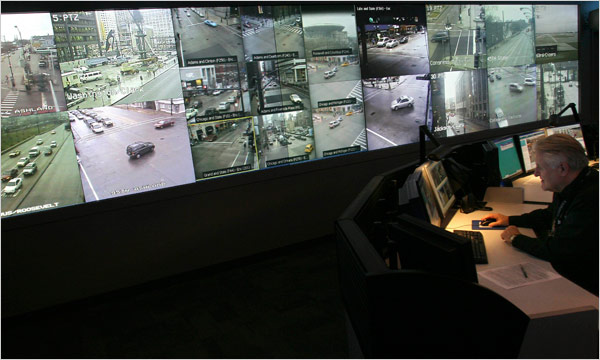
The Chicago control room (New York Times)
As part of the work we did for our latest book, Jon Coaffee Pete Rogers and I visited and analysed several different cities in the UK to assess their emergency-response and surveillance systems. While most had intentions to use the cameras for more active emergency-response purposes and particular local police were starting to try to install override systems for the multiple local camera systems that exist in the UK in the case of citywide emergencies (like a mass evacuation). And in particular, Manchester (whose high-tech control room looks like the Chicago one as seen in the NYT (picture above) and also often features in media PR for CCTV) has gone further down the Chicago route than most. But they still don’t come close. Britain’s systems are fragmented, ageing, generally not integrated with other functions and certainly don’t link to other kinds of sensors. Britain has introduced some stupid authoritarianism like the infamous ‘shouting cameras’ mostly as part of the Respect (sic) Zones initiative. But despite Britain’s reputation as a surveillance society I suspect that in terms of advanced integrated cameras systems, the USA is now eclipsing the UK. The post-9/11 surveillance surge has seen to that.
There’s two other points worth noting here. The first is that Chicago is bidding for the Olympics in 2016. I can almost hear multiple researchers in surveillance studies around the world, releasing a collective ‘of course!’. Mega-events like the Olympics, the World Cup – there will be a fantastic conference on this theme in November this year in Vancouver – or other non-sporting ones like world summits or the G-8 conference are often the trigger for the introduction of repressive measures and new surveillance systems. This was true in Japan (where state CCTV was first introduced because of the soccer World Cup in 2002), in South Africa (for various major world summits), and in Athens for the Olympics in 2004. Mayor Daley wants the city to be 100% free from the possibility of terrorist attack. Laving aside the actual impossibility of that desire, how far will he go to get there?
Well, the last Olympic venue, Beijing, might give some indication. For it is actually the plans in authoritarian, non-democratic China that seem most similar to what is going on in Chicago. Even the names have an eerie reminiscence: China’s Golden Shield, Chicago’s Virtual Shield. That is trivial, however the substance is not. The Chinese government, as Naomi Klein has written, is installing massive and comprehensive camera systems in every major city in China. It is also, of course, linking this system into its infamous Internet monitoring operation, with the ultimate aim of being able to track individuals in real and virtual space. Of course, the US, like most other nations is now trying to control Internet use too and the NSA already keeps massive data banks of communications traffic information as well as doing real-time monitoring as recent revelations have, once again, shown. But, it’s different in the USA isn’t it? The USA wouldn’t link up all these systems, would it? The Land of the Free? The home of democracy? I wouldn’t bet against it…
Largely unnoticed in commentary on US President Obama’s fiscal stimulus plan has been the $4Bn for the Justice Department. Now there are various very worthy programs nominated for funding including quite a large chunk to combat violence against women, but also a lot of cash washing around for rather more vague aims, in particular the $2Bn (i.e.: half the cash injection) for the Edward Byrne Justice Assistance Grant (JAG) program “to fund grants for state and local programs that combat crime”.
The JAG program has already providing funding for many cities to install cameras as part of ‘demonstration programs’, as well as covert surveillance capabilities. However $2Bn is a massive increase in funding and will allow some rather more ambitious schemes to be funded. With the current popularity of CCTV cameras as a catch-all solution in the USA (regardless of negative assessments of their effectiveness elsewhere – see ACLU’s recent convenient US-focused summary), could one side-effect of the stimulus package be a massive ‘surveillance surge’ in the USA? After all, this is exactly what happened in the UK in the 1990s when central state funding through the ‘City Challenge’ program sparked a mania for installing city-centre CCTV systems – see the editorial and the articles by Will Webster, Pete Fussey and Roy Coleman in the special issue of Surveillance & Society on CCTV.
Those concerned with civil liberties and the intensifying push for videosurveillance in the USA should keep a careful eye on applications to the JAG program.
Both human rights advocates and the police seem to be strongly in favour of the new RIC system as a means of social inclusion and to replace the chaotic and corrupt identification system based in individual Brazilian states at present, which allows anyone with any other form of ID to get a state Registro Geral card in each different state.
Departamento de Policia Federal, Brasilia
I have just come back from a very productive interview with Romulo Berredo, from the Director-General’s office at the Departamento de Policia Federal (DPF), who are the Brazilian equivalent of the FBI. There was a lot covered and I couldn’t hope to reproduce it all here. There were however a number of immediately interesting aspects.
The first was more evidence that the whole basis on which identity cards and database issues are being considered here is entirely different from the UK. Now I know this represents a police, and a state, view, but so far, both Brazilian human rights advocatesand the police seem to be strongly in favour of the new Registro de Identidade Civil (RIC) system. This is both as a means of social inclusion and to replace the chaotic and corrupt identification system based in individual Brazilian states at present, which allows anyone with any other form of ID to get a state Registro Geral card in each different state. It is fairly easy to acquire 27 different identities in Brazil at present. And identification is important here. The great fear that many people seem to have – indeed it was called a ‘cultural’ characteristic by Berredo – is not the use of identification by the state as a form of control or intrusion but as a guarantee against the anonymity that would allow abuses by the state or indeed by other malicious persons. It provides a metaphysical and material kind of certainty and stability. The legacy of the last dictatorship was not so much an East German-style nightmare of knowledge and order but of corrupt and arbitrary rule.
It is this latter legacy which also drives the divisions between the different police forces in Brazil. The states-based Policia Militar (Military Police) and Policia Civil are both tainted in different ways by associations with authoritarian rule, and the former particularly with extra-legal execution and torture, and they continue to be regarded with caution, suspicion or even hatred by many Brazilians. The other police forces are also suspicious of the growing role of the DPF, which is often seen in terms of a power struggle not rational subsidiarity. Ironically then it is the states-based police forces that are dragging their heels over plans to create the kinds of national databases of criminal information that the UK has, and not for any libertarian reasons. In fact the DPF seem far more concerned with protecting human rights and defending the idea of citizenship, and because they are tasked with anti-corruption investigations have even arrested Senators and Judges, something unheard of even ten years ago. Of course those very same Senators and Judges are now fighting back, in a manner rather similar to Berlusconi in Italy, trying to alter the law to give immunities and protections. For example, handcuffing of arrested suspects was always normal until it happened to a Senator arrested for corruption. The Senate suddenly became interested in the ‘human rights’ of arrested suspects and passed a law limiting the use of handcuffs! Corruption at every level is still an enormous problem here, though Berredo argued that it was largely associated with those who had retained power from the years of the dictatorship.
The concentration on inclusion and joining-up government where it is clearly much needed does however lead to some gaps in thinking. The creation of new databases brings with it new duties and new potential problems of data-handling. As the privacy and data-protection law expert, Danilo Doneda, pointed out to me the other day, Brazil is in an almost unique position in not having any kind of regulator for privacy and information / data rights. He argued it was because the authorities just don’t see the need. Berredo confirmed this. He claimed that the DPF were trusted by the public – and relative to other police forces, that is certainly true! – and that they had to carry out their duties appropriately or they would lose that trust. It sounds nice, but it isn’t a good-enough (or legally-sound) basis for the protection of data-rights.
It all confirmed once again that Brazil is not yet a surveillance society – the state does not yet have the capabilities. There is no national database of fingerprints (even for convicted criminals) for example. But as Berredo said, it is moving in that direction. He was keen that there should be be limits. I liked the fact that he used this word. ‘Limits’ is a word that I found that the neither the UK government nor the European Commission seem to like, and they seem very unwilling to say what limits might be. However Berredo was quite clear that a technologically-driven surveillance future in which individuals could be tracked – he used the example of Google Latitude – was not one which he wanted to see. He recognised that he was both a policemen (at work) and a private citizen (at home) and that he, as much as anyone else, valued his privacy.
(Thank-you very much to Delegado Romulo Barredo of the DPF, for his openness, time and patience, and also to Agent Alessandre Reis, for his help)
£34Bn is probably a small proportion of this wider surveillance economy, and may not even be anywhere near the total ‘cost’ to citizens of the obsession with surveillance.
How much does surveillance cost? It is a key question which is very difficult to answer with any precision. The groups associated with the Convention on Modern Liberty (mainly Liberty, No2ID and Privacy International) have come up an estimate of £34 Billion (about $50Bn US) for the UK. This seems to be mainly costs related to central government databases, and includes £10Bn for the setting up and running of the proposed new communications database. Is it correct? Or even close? Well, it’s a good start as a guess. It doesn’t of course differentiate between costs for aspects of the systems that might be desirable or even necessary (like parts of the NHS Spine system). But then I’ve had this argument with No2ID before – the don’t get the idea that ‘surveillance’ includes things that without which there would be no welfare, education or health services at all. It is worth thinking about it from the other way, from the supply side too – the question of what is the overall size of the surveillance industry. Because of course, it isn’t just government that is spying on us. The biggest databases are run by private corporations (especially retailers, insurance companies and loyalty-card operators)… there are all sorts of private security and surveillance operations. £34Bn is probably a small proportion of this wider surveillance economy, and may not even be anywhere near the total ‘cost’ to citizens of the obsession with surveillance.
Following the damning reports of the House of Lords Constitution Committee and yesterday, the International Commission of Jurists, now Stella Rimington, ex-Head of the security service, MI5, has warned that Britain risks becoming a police state. In an internview with the Spanish newspaper La Vanguardia reported by the Daily Telegraph, Ms Rimington attacked government plans for the National Identity Register and the soon-expected plans for a database of all communications (delayed from last year). If even ex-heads of the security service are now asking the government to change direction, in addition to civil liberties experts, independent judges, and just about everyone else, their stock of excuses must be rapidly diminishing. The current cabinet must know that their actions smack of the desperation of a failing government desperately searching for votes in being ‘tough on crime and terrorism’… but they seem to be locked into a trajectory of ever-increasing surveillance and security that they cannot justify but cannot escape. You do wonder who is actually advising them that this is all a good idea…




 ubisurv