How many cameras are there in Britain? (2)

Well, Aaronovitch’s piece came out. It’s not even as interesting as I had thought it would be, and my account yesterday says all that needs to be said in response, except to note that he even managed to get my surname wrong and that of the character in Clive’s book, which is more than ironic for an attack on inaccuracy! Journalists, eh? Gotta love ’em…

To be fair to The Times, it has been getting better recently on this issue, and they carried a very good interview with the Information Commissioner, Richard Thomas, last week, which was in marked contrast to their sniping at him a few years ago. It also shows a depth of understanding and the political maturity needed to recognise what is important in the debate on surveillance.

How many cameras are there in Britain?

The truth is that no-one knows exactly how many cameras there are in Britain or indeed in any country in the world

I’ve been having an interesting little private exchange with a David Aaronovitch of The Times newspaper, who seems to think he has uncovered a terrible conspiracy… and I think I am about to be accused (tomorrow) of being ‘cavalier’ with the truth and of misleading the public. Interestingly enough this is going to be in the same newspaper that was the only one that tried to rubbish the Information Commissioner back in 2006 when we published our Report on the Surveillance Society and indeed were actively lobbying against his reappointment. I suppose someone has to argue the establishment case…

What David has been e-mailing me about is the validity of figures concerning the number of CCTV cameras in Britain that journalists have been happily spreading about for the last ten years. These figures are the ‘4.2million CCTV cameras in Britain’, and the ‘person can be captured on 300 different cameras in a day.’ He seems to think that it is an urgent matter of national importance if these old figures aren’t ‘accurate’ or apply to the average person. Well, they were and are purely indicative – they aren’t ‘accurate’ and never were, and the latter one doesn’t apply to a typical Briton and neither Clive Norris, whose figures they are, nor myself, nor any other credible surveillance studies academic that I know, has ever claimed that they are and do.

The first figure derives from what Professor Norris openly described as a ‘guesstimate’ in his working paper with Mike McCahill on CCTV in London that was done for the EU’s UrbanEye project. Based on a casual count of cameras in one small neighbourhood in London in around 2000 (not the City of London where cameras were much more concentrated even then) it aimed to get a very loose handle on the scale of the spread of CCTV in Britain. The police at the time claimed that the real figure was in hundreds of thousands, but they were only talking about public cameras, and they had just as little idea of the extent of CCTV.

The other figure that of 300 cameras a day came from a little fictional vignette that Professor Norris and Dr Gary Armstrong wrote for their book, The Maximum Surveillance Society, which came out back in 1999. It was simply designed to illustrate how many cameras a person could possibly be caught be in any one day. I was thinking it would actually be very hard for this to be that likely even now, except perhaps in the very core of global cities like London, but then there are over 300 cameras on the university campus where I am currently, and I haven’t even started on all the private cameras, the public cameras in the city, the traffic cameras, the cameras in the buses, banks, shops, cafes, restaurants, bars, in the hotel etc. etc. I would estimate that I am caught by around 100 cameras when I am out and about here and this isn’t even a city that considers itself to be particularly ‘under surveillance.’

The truth is that no-one knows exactly how many cameras there are in Britain or indeed in any country in the world. We deliberately used words like ‘may’ or ‘can be’ in reference to these figures in our Report on the Surveillance Society because they are so rough, so inaccurate – and we were quite clear that this was not in any case a report about CCTV; if anything we tried to downplay CCTV and get to other technologies and techniques, such as dataveillance and RFID, and more importantly the way connections and links are being made, and boundaries blurred. ‘Millions’ may be about as accurate as we can guess for the UK. But does it matter if there are 1 million, 4.2 million or 10 million? Not hugely. It matters as one crude indicator of a surveillance society, but even then, the number of cameras is a very crude measure and more cameras does not necessarily mean more comprehensive coverage or better pictures, or more ‘control’. For example, would it be worse or better if I was only seen by one camera in a day, but that camera was there all the time and I was constantly being assessed on my performance (as for example is the case with many workers in call centres)? The Guardian today seems to understand this – in its report on the high-tech control room in Westminster, it clearly states that ‘no-one knows’ how many cameras there are (before quoting some even more made-up figure than ours!).

I know the media likes its easy numbers, but an old saying about not being able to see the wood for the trees comes to mind… As a researcher, I am more interested in characteristics of the wood than the specific number of trees. Now if there were no trees at all or very few, that would matter. And in my current comparative project it has some importance as one of the many indicators of what constitutes a surveillance society that I am looking into. So in a couple of year’s time I may have more of an idea of from any cameras there really are in Britain. One of the things I am trying to do during my current project is develop better ways of assessing ‘how much surveillance’ there is, and what it means. Because that is the important issue – meaning. Does it matter if there were 1/6 or 1/7 or 1/8 of the population of the former East Germany who were recruited as informers? You’ll find all those as educated guesses in the literature. What matters was that there was a culture of informing that pervaded every action. It was a society that became increasingly based on deception and distrust.

The key questions with CCTV are:

  1. first of all, why are there any cameras, and particular any cameras in public space, at all? Surely there was a line crossed when the first use of CCTV occurred. What was the reasoning?
  2. why did CCTV spread so quickly to so many places, and was so little contested?
  3. why is CCTV now considered so ‘normal’ in Britain?
  4. connected to this, why do the myths of CCTV’s effectiveness continue to be spread when all of the evidence shows a small and very limited impact on crime?
  5. what kind of a society does pervasive CCTV create? what are the social effects? what kind of social and cultural responses are there?

etc.

Unfortunately the media doesn’t seem to like depth or uncertainty. Maybe that was our real mistake – to overestimate the intelligence of the media. I have asked them for a right of reply – I am more than happy to debate the issue in public. Let’s see if that happens…

Convention on Modern Liberty

The largest ever British meeting of people against the surveillance society took place in London yesterday. The Convention on Modern Liberty site has (unedited) transcripts of some of the speeches an debates including author, Phillip Pullman’s excellent keynote. The Guardian/Observer website also has a strongly supportive report and there is an editorial in the The Observer, which argues that “whether by complacency, arrogance or cynical design, the government has erected an edifice of legal constraint to liberty that would suit the methods and aims of a despot.”

It was a shame that I couldn’t be there but I like to think I played some small part in the process that has led here, and will hopefully this campaign will continue to go on to forcing a retreat by the state from its illiberal course. This meeting is merely the beginning of the convention…

Brazilian church sends mixed signals on security

CNBB 2009 Campaign on 'Fraternity and Public Security'

One organisation I haven’t mentioned much since I have been in Brazil is one of the most important, influential and yet always controversial: the Catholic Church. Brazil was one of the centres of the Liberation Theology movement and these activist priests, unlike the church hierarchy in many Catholic countries, never sided with the dictatorships. Liberation Theology remains a major influence and movement within the Brazilian church and it is no surprise to see the fraternal organisation of the Conferência Nacional dos Bispos do Brasil (National Conference of Bishops of Brazil or CNBB) taking their campaign theme for this year as Public Security.

However, at the same time, the Church in Brazil seems to be clamping down on dissent and on those priests who are too outspoken on behalf of the poor and the victims of violence and insecurity. Today, the BBC is reporting that Father Luiz Couto, who is from the north-east and a colleague of President Lula (he’s a Workers’ Party federal deputy), has been suspended by the Church for advocating the use of condoms for public health and having a liberal attitude to gay rights.

Couto has however also been for many years a serious campaigner against unofficial ‘death squads’ and Autodefesas Communitárias. It seems to be at the very least bad timing by the church to suspend him just after announcing their year of campaigning on public security. He has my support and my sympathy. The Church needs to live up to what the CNBB are proposing this year and focus more on the realities of the big social questions that bedevil Brazil and not shoot themselves in the foot by suspending their best members over what should be matters of opinion on personal morality.

Austin no longer the coolest city in the USA

The latest city to fall for the current wave of government enthusiasm for surveillance that is sweeping the USA is, unfortunately, the city of Austin… Sorry Austin – unless you people do something about this, you are off my list of cool cities…

Austin, Texas… lone island of sanity and liberalism in a less-than-liberal state. With its laid-back attitude, massive urban bat population, superb music scene and reputation for weirdness, it must for some time have been a candidate for coolest city in the States.

Austin... no longer cool

Well no longer. The latest city to fall for the current wave of government enthusiasm for surveillance that is sweeping the USA is, unfortunately, the city of Austin, whose authorities have voted to install a CCTV system. The local newspaper, The Daily Texan, jauntily informs us that the city has voted to sacrifice privacy for security: that does not sound like the attitude of a confident, hip place. Sorry Austin – unless you people do something about this, you are off my list of cool cities!

Seriously, though: Austin is not a city with an especially high crime rate, nor has it seen any massive recent increase in crime – even if CCTV was any good at reducing crime, which we know from the multiple assessments done in the UK and elsewhere that it isn’t. Yet Police Chief Art Acevedo is quoted as praising CCTV in the UK, specifically in London. Perhaps he has been reading too much of the hype and hasn’t read the British government’s own assessments of CCTV (conducted under the auspices of the Home Office)?

So why the sudden urge to install cameras? Could it be because of the lure of federal funding from the Department of Homeland Security? It could be. Austin has acquired $350,000 to install cameras, and what set of city fathers turns down cash (whatever it is for)? That was one of the main lessons of the expansion of CCTV in Britain in the 1990s and of course cities are now paying the long-term price of their enthusiasm as they struggle to find the money to monitor and maintain their camera systems. Chief Acevedo seems to have no worries about this though – this techno-evangelist is already talking about automation and computer recognition systems. He really sounds like a guy who has started to believe the sales pitches at all those law enforcement technology trade fairs…

Battle lines being drawn in UK surveillance debate

there appears to be a gathering of forces and a drawing of battle lines amongst the ‘big beasts’ of security policy in the UK…

securitystrategybannerThe UK’s Institute for Public Policy Research (IPPR), the influential think-tank that was behind the New Labour project, has released a report on intelligence and national security that argues that privacy and human rights will have to take second place in the War on Terror. The report, National Security Strategy, Implications for the UK Intelligence Community, is written by former civil service security and intelligence coordinator, David Omand, is part of the IPPR’s Commission on National Security in the 21st Century, whose rather unimpressive launch event I attended last year.

The Guardian newspaper’s story on this is trying to build this up into an ‘end of privacy’ / ‘end of civilisation as we know it’ story and Omand certainly comes down firmly on the side of security over liberty. He recognises that his arguments are contrary to ours and go “against current calls to curb the so-called surveillance society.” But he is not actually making a total ‘by any means necessary’ argument. Even the Guardian’s own report quotes his rather qualified statement that “in some respects [new intelligence methods] may have to be at the expense of some aspects of privacy rights.”

The report is simply not as strong or even as interesting as The Guardian‘s story suggests. Most of it is simply a description of how intelligence works (and not even a very comprehensive or insightful one at that). Much, as we predicted in our recent book (see My Publications), it tries to set the creation of ‘resilience’ as a key rationale for reducing civil liberties, as if resilience in itself was a good thing that needed no justification when in fact it is being used as a bland container for all sorts of questionable policies – from the use of torture and imprisonment without trial to the everyday use of intrusive high-tech surveillance. The references to the political controversies over surveillance are rather cursory and don’t really say much other than that people are worried and really they shouldn’t be. These are just the usual ‘trust us, we know what we are doing’ and ‘these are exceptional circumstances’ arguments that we have heard many times before, and they are as weak and old-fashioned coming from Omand as from anyone else.

It is worth noting that there appears to be a gathering of forces and a drawing of battle lines amongst the ‘big beasts’ of security policy in the UK. I reported yesterday on David Blunkett’s conversion to the cause of limiting surveillance society, and a few days ago, Stella Rimington, the former Head of the Security Service, MI5, condemned the current government’s approach to liberty and security in even stronger terms, arguing that the approach that Omand typifies would lead to ‘a police state’.

Surveillance has finally become an issue on which it is becoming less possible to be unengaged, apathetic or even neutral. That in itself is a good thing, however it does not guarantee a good outcome even if more major public figures suddenly discover their enthusiasm for liberty once they leave office. However, I hope this reflects a split which is growing within the current government too – normally when retired politicians and civil servants speak out, they are conscious of the way in which they speak on behalf of friends and colleagues who feel they cannot be so candid.

David Blunkett Attacks Surveillance!

I know. Pause. Take a deep breath…

You read it right. The former UK Home Secretary, with a reputation as one of the most authoritarian of recent years (though it is hard to chose in that regard), will condemn the growth of surveillance in a speech at the University of Essex today. He will also, according to Tom Young at VUnet, call for the ID card scheme (which he introduced!) to be scrapped, and for the information-sharing powers that were hidden in the new Coroners and Justice Bill, to be reduced. He also argues that the latter will happen as he knows the Justice Minister, Jack Straw, recognises the problem.

I don’t know whether to laugh or cry. Certainly it is fantastic when a prominent figure like this changes their mind and is prepared to admit that they were wrong, I just wish that sometimes they listened to the arguments against what they were doing when they were in office. In addition, of course Blunkett spent several years after leaving office writing very strong pro-surveillance, pro-ID card pieces for the populist, right-wing tabloid newspaper, The Sun, and is (or was) according to the Register of House of Commons Members Interests, paid £25-30,000 ($35-40,000 US) as the Chair of the International Advisory Committee of Entrust Inc., a company that works on digital certification and Internet surveillance, and which was involved in consortia for the ID card contract. Perhaps they have had enough of him.

But let’s hope he really has had a genuine change of heart.

They want us to trust them…

Maybe what Jacqui Smith needs is a dose of ‘Chinese democracy’ to go with her Chinese-style attitude to security and surveillance…

In the last fortnight there have been interesting developments that have reminded us, as if we needed reminding, that those who want to infringe on the liberty of others need to be absolutely squeaky-clean themselves or risk severe censure, and that those who introduce systems which encourage suspicion and spying should not be surprised if people no longer trust them and start to investigate their activities.

The first of course was the saga of Jacqui Smith’s apartment. The basic facts are that the UK Home Secretary has been claiming £24,000 (around $35,000 US) per year in allowances for an apartment that she does not actually live in. The particular irony (and we love a bit of irony in Britain!) was that she has been reported by a neighbour – in other words she was a victim of the kind of suspicious, back-stabbing, trust-no-one society that she has been encouraging. Of course she should resign if she had any intelligence or integrity, but we already know to the cost of our civil liberties that she does not.

Funnily enough, it is to China we go to another example and one with, it seems, a rather more accountable outcome. This is almost the second time in a row that I have unfavourably compared a western country to China – this is getting rather disturbing particularly as I am no friend of the Chinese state, being a long-term Free Tibet supporter. However, Variety (of all places) is reporting that Yu Bing, who is director of the internet monitoring department of Beijing’s Public Security Bureau, and therefore a major figure in the infamous Golden Shield, and surveillance of journalists, bloggers and net democracy activists (as well as those just trying to access unapproved content), has been arrested for taking bribes from a contractor.

Admittedly it is a lot more than the sums in the Jacqui Smith case (40M Yuan, or about $5.8M US), and corruption is endemic within the Chinese state at all levels, but it does show a rather different attitude to the establishment towards top officials who fail to live up to the standards we expect of them. Maybe what Jacqui Smith needs is a dose of ‘Chinese democracy’ to go with her Chinese-style attitude to security and surveillance?

Chicago: the future of US CCTV?

…despite Britain’s reputation as a surveillance society… the USA is now eclipsing the UK. The post-9/11 surveillance surge has seen to that.

Back in the USA again. Chicago has been featuring a lot this week for its CCTV system. Newspapers generally offered glowing assessments of its capabilities based around homey anecdotes of pretty harmless incidents ‘solved’ by CCTV – in this case the stories, for example those in the Chicago Sun-Times and the New York Times, featured a theft from a Salvation Army kettle, which sounds like it is straight from a Mayoral press release. It is depressingly poor journalism and once again, all very reminiscent of the situation in the UK in the 1990s before academic and even government assessments dampened the enthusiasm for CCTV. There’s also a depressing naivety (and factual incorrectness) about the insistence from the authorities and from some ‘experts’ that these cameras have nothing to do with human rights like privacy as they are all in public spaces.

But there is one very important difference. Chicago, with massive investment from the Department for Homeland Security, has gone much further than most UK cities, not only in coverage but also in capabilities. First of all, Daley and police-chief Orozco have promised that “We’re going to grow the system until we eventually cover one end of the city to the other” in other words they do want, as the Chicago Sun-Times subheading claims, ” a camera on every street corner.”

The particular innovation that the city is pushing here is the linking up of the law-enforcement aspects with emergency services through something called Computer-Aided Dispatch (CAD). This is system that uses a live Geographic Information System to match camera location to reported incident location, so that when an incident is called in via 911, the nearest cameras can immediately turn to picture the scene. This is part of what Chicago calls ‘Operation Virtual Shield’, a fibre-optic cable system which links the cameras with other biological and chemical weapons-detection system in a “homeland security grid.’’

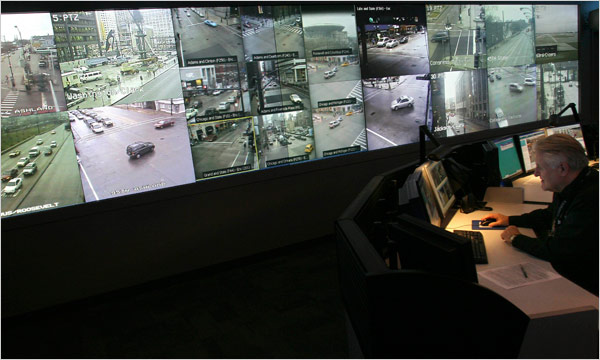
The Chicago control room (New York Times)

As part of the work we did for our latest book, Jon Coaffee Pete Rogers and I visited and analysed several different cities in the UK to assess their emergency-response and surveillance systems. While most had intentions to use the cameras for more active emergency-response purposes and particular local police were starting to try to install override systems for the multiple local camera systems that exist in the UK in the case of citywide emergencies (like a mass evacuation). And in particular, Manchester (whose high-tech control room looks like the Chicago one as seen in the NYT (picture above) and also often features in media PR for CCTV) has gone further down the Chicago route than most. But they still don’t come close. Britain’s systems are fragmented, ageing, generally not integrated with other functions and certainly don’t link to other kinds of sensors. Britain has introduced some stupid authoritarianism like the infamous ‘shouting cameras’ mostly as part of the Respect (sic) Zones initiative. But despite Britain’s reputation as a surveillance society I suspect that in terms of advanced integrated cameras systems, the USA is now eclipsing the UK. The post-9/11 surveillance surge has seen to that.

There’s two other points worth noting here. The first is that Chicago is bidding for the Olympics in 2016. I can almost hear multiple researchers in surveillance studies around the world, releasing a collective ‘of course!’. Mega-events like the Olympics, the World Cup – there will be a fantastic conference on this theme in November this year in Vancouver – or other non-sporting ones like world summits or the G-8 conference are often the trigger for the introduction of repressive measures and new surveillance systems. This was true in Japan (where state CCTV was first introduced because of the soccer World Cup in 2002), in South Africa (for various major world summits), and in Athens for the Olympics in 2004. Mayor Daley wants the city to be 100% free from the possibility of terrorist attack. Laving aside the actual impossibility of that desire, how far will he go to get there?

Well, the last Olympic venue, Beijing, might give some indication. For it is actually the plans in authoritarian, non-democratic China that seem most similar to what is going on in Chicago. Even the names have an eerie reminiscence: China’s Golden Shield, Chicago’s Virtual Shield. That is trivial, however the substance is not. The Chinese government, as Naomi Klein has written, is installing massive and comprehensive camera systems in every major city in China. It is also, of course, linking this system into its infamous Internet monitoring operation, with the ultimate aim of being able to track individuals in real and virtual space. Of course, the US, like most other nations is now trying to control Internet use too and the NSA already keeps massive data banks of communications traffic information as well as doing real-time monitoring as recent revelations have, once again, shown. But, it’s different in the USA isn’t it? The USA wouldn’t link up all these systems, would it? The Land of the Free? The home of democracy? I wouldn’t bet against it…

At the Camara dos Deputados

I had a great meeting at the architecturally stunning Camara dos Deputados (the Brazilian equivalent of the British House of Commons or the House of Representatives in the USA), which almost made up for the fact that it was the only one of the three scheduled interviews that I had arranged that actually went ahead… it really does look like I will have to come back.

The parliamentary buildings in Brasilia, originally laid out by Lucio Costa. The Camara dos Depuados, by Oscar Niemeyer, is to the left.
The parliamentary buildings in Brasilia, originally laid out by Lucio Costa. The Camara dos Deputados, by Oscar Niemeyer, is to the right.

This meeting took place in the Comissao de Direitos Humanos e Minorias (the Commission for Human Rights and Minorities) and was with Federal Deputy and committee member, Pompeo de Mattos, the secretary of the Commission, Marcio Marques de Araujo, and Hebe Guimareas-Dalgaard, who works in the International Relations office and who served as translator.

The meeting covered all sorts of background issues around security in Brazil, and concentrated on Deputado de Mattos’s specialities in this area, which are in justice and drug-trafficking issues. Again, I won’t do more than summarize a few immediately important things here. There was a lot of talk of police corruption and some hair-raising stories of the ways in which military police officers in particular has become involved in selling equipment and ammunition, and of course the autodefesas communitarias that I have mentioned before. Interestingly though, it was the deputy’s opinion that the military police, despite having a ‘culture of violence’ inherited from their role as enforcers of the military dictatorship, were less corrupt (in an everyday way) than the civil police. The latter are even lower down the police food-chain and correspondingly more poorly paid and equipped.

The inadequacies of the civil police has led many Mayors of larger towns and cities to introduce so-called ‘Municipal Guards’ – basically private security given some official status. They have few powers but are basically there to increase the visibility of security, a kind of prophylactic community policing. The problem is however that the official police and the massive private security sector are thoroughly intermixed already. Many officers moonlight as private security guards, which leads to all kinds of conflicts of interest.

Deputado de Mattos was certainly not obsessed with the inadequacies of the police however. Serious and organized crime associated with drug-trafficking paralyzes the everyday life of poorer areas of large cities in Brazil. Despite the fears of the rich over crime, it is the poorest that suffer most. He described the drug gangs as being the major obstacle to any positive change in Brazilian cities. However he didn’t see any militaristic solution – fighting a war against the drug gangs would only lead to more violence. The only solution to the problems of both crime and the poverty from which it emerges is social inclusion. The favelados must be provided with the same opportunities and infrastructure as everyone else. The need schools, hospitals, transport, and so on. Programs like Bolsa Familia, however well-intentioned, make no fundamental difference, he argued – contradicting, as most people with whom I have talked have done, the assessment of external organisations like the World Bank.

However providing such opportunities is not easy, and not just because of the costs. The drug-gangs actively resist any attempt by the state to introduce services, to the extent of intimidating or even killing construction workers. And this shouldn’t be in any way romanticized as some kind of popular resistance of the poor to the imposition of unwanted state interference – this is an attempt to maintain the rule of fear and violence. Somehow, one can never get away from the security issue in Brazil.

Leaving the Camara dos Deputados, looking past the parliamentary buildings up towards the Esplanada dos Ministerios, with all the government Ministries lined up in identical blocks.

(Thanks to Deputado Pompeo de Mattos, who as you will see if you check out his website is quite a character. He is fiercely proud of his southern ‘gaucho’ roots, and writes poetry to that effect. He is also – and I don’t say this very often of politicians – a genuinely nice guy. Thanks also to Marcio Marques de Araujo and to Hebe Guimares-Dalgaard without whom the meeting would have been impossible).