At the Departamento de Policia Federal

Both human rights advocates and the police seem to be strongly in favour of the new RIC system as a means of social inclusion and to replace the chaotic and corrupt identification system based in individual Brazilian states at present, which allows anyone with any other form of ID to get a state Registro Geral card in each different state.

Departemento de Policia Federal, Brasilia
Departamento de Policia Federal, Brasilia

I have just come back from a very productive interview with Romulo Berredo, from the Director-General’s office at the Departamento de Policia Federal (DPF), who are the Brazilian equivalent of the FBI. There was a lot covered and I couldn’t hope to reproduce it all here. There were however a number of immediately interesting aspects.

The first was more evidence that the whole basis on which identity cards and database issues are being considered here is entirely different from the UK. Now I know this represents a police, and a state, view, but so far, both Brazilian human rights advocates and the police seem to be strongly in favour of the new Registro de Identidade Civil (RIC) system. This is both as a means of social inclusion and to replace the chaotic and corrupt identification system based in individual Brazilian states at present, which allows anyone with any other form of ID to get a state Registro Geral card in each different state. It is fairly easy to acquire 27 different identities in Brazil at present. And identification is important here. The great fear that many people seem to have – indeed it was called a ‘cultural’ characteristic by Berredo – is not the use of identification by the state as a form of control or intrusion but as a guarantee against the anonymity that would allow abuses by the state or indeed by other malicious persons. It provides a metaphysical and material kind of certainty and stability. The legacy of the last dictatorship was not so much an East German-style nightmare of knowledge and order but of corrupt and arbitrary rule.

It is this latter legacy which also drives the divisions between the different police forces in Brazil. The states-based Policia Militar (Military Police) and Policia Civil are both tainted in different ways by associations with authoritarian rule, and the former particularly with extra-legal execution and torture, and they continue to be regarded with caution, suspicion or even hatred by many Brazilians. The other police forces are also suspicious of the growing role of the DPF, which is often seen in terms of a power struggle not rational subsidiarity. Ironically then it is the states-based police forces that are dragging their heels over plans to create the kinds of national databases of criminal information that the UK has, and not for any libertarian reasons. In fact the DPF seem far more concerned with protecting human rights and defending the idea of citizenship, and because they are tasked with anti-corruption investigations have even arrested Senators and Judges, something unheard of even ten years ago. Of course those very same Senators and Judges are now fighting back, in a manner rather similar to Berlusconi in Italy, trying to alter the law to give immunities and protections. For example, handcuffing of arrested suspects was always normal until it happened to a Senator arrested for corruption. The Senate suddenly became interested in the ‘human rights’ of arrested suspects and passed a law limiting the use of handcuffs! Corruption at every level is still an enormous problem here, though Berredo argued that it was largely associated with those who had retained power from the years of the dictatorship.

The concentration on inclusion and joining-up government where it is clearly much needed does however lead to some gaps in thinking. The creation of new databases brings with it new duties and new potential problems of data-handling. As the privacy and data-protection law expert, Danilo Doneda, pointed out to me the other day, Brazil is in an almost unique position in not having any kind of regulator for privacy and information / data rights. He argued it was because the authorities just don’t see the need. Berredo confirmed this. He claimed that the DPF were trusted by the public – and relative to other police forces, that is certainly true! – and that they had to carry out their duties appropriately or they would lose that trust. It sounds nice, but it isn’t a good-enough (or legally-sound) basis for the protection of data-rights.

It all confirmed once again that Brazil is not yet a surveillance society – the state does not yet have the capabilities. There is no national database of fingerprints (even for convicted criminals) for example. But as Berredo said, it is moving in that direction. He was keen that there should be be limits. I liked the fact that he used this word. ‘Limits’ is a word that I found that the neither the UK government nor the European Commission seem to like, and they seem very unwilling to say what limits might be. However Berredo was quite clear that a technologically-driven surveillance future in which individuals could be tracked – he used the example of Google Latitude – was not one which he wanted to see. He recognised that he was both a policemen (at work) and a private citizen (at home) and that he, as much as anyone else, valued his privacy.

(Thank-you very much to Delegado Romulo Barredo of the DPF, for his openness, time and patience, and also to Agent Alessandre Reis, for his help)

UK and USA have actively undermined international law

A major new report by the independent International Commission of Jurists has concluded that the actions taken by the many countries, but in particular the USA and the UK, since 9/11 in the name of fighting terrorism add up to “a serious threat to the integrity of the international human rights legal framework.” Acording to the BBC, the eminent jurists have been ‘shocked’ by the “excessive or abusive counter-terrorism measures in a wide range of countries around the world,” including detention without trial, torture (and of course the massive extension of surveillance powers). The report, entitled Assessing Damage, Urging Action is available for download here.

The loneliness of personal data

Surveillance like this harms us all: it makes our lives banal and reveals only the sadness and the pain.

Still from I Love Alaska

There is something at once banal and heartbreaking about what is revealed through the examination of personal data. The episodic film, I Love Alaska, captures this beautifully. The film by Lernert Engelberts and Sander Plug is based on AOL’s accidental exposure of the search data of hundreds of thousands of its users, and focuses on just one, 711391. The film consists of an actress reading out the (unusually discursive and plain language) search terms of User 711391 like an incantation, with background sound from Alaskan locations and static camera shots that serve to emphasize her boredom, isolation and loneliness.

I was watching episode 5 of the film when two stories popped into my inbox that just happened to be related. The first was from the New York Times business section and dealt with the other side of the recent US sporting scandal over revelations that baseball player Alex Rodriguez has taken steroids. Like User 711391, Rodriguez had given up his data (in this case, a sample) in the belief that the data would be anonymous and aggregated. But it wasn’t.

So, then we come to how the state deals with this. The Toronto Globe and Mail comments on the way the Canadian federal government is, like so many others, proposing to introduce new legislation to monitor and control Internet use. The comment argues that there is no general need to store personal Internet use data (or Canada will end up like the UK…), and that Internet surveillance should be governed by judicial oversight. Quite so. But, as the NYT article points out, it isn’t just the expanding appetite of the state for data (frequently coupled in the UK with incompetence in data handling) that we should fear but the growth in numbers of, and lack of any oversight or control over, private-sector dataveillance operations.

Some people will argue that any talk of privacy here is irrelevant: User 711391 was cheating on her husband; Rodrguez was taking steroids; there are paedophiles and terrorists conspiring on the Internet. With surveillance the guilty are revealed. Surely, as Damon Knight’s classic short story, ‘I See You’, claimed, with everything exposed we are truly free from ‘sin’? But no. In its revelations, surveillance like this harms us all: it makes our lives banal and reveals only the sadness and the pain. For User 711391, her access to the Internet served at different times as her main source of entertainment, desire, friendship, and even conscience. The AOL debacle revealed all of this and demeaned her and many others in the process. Most of us deserve the comfort of our very ordinary secrets and the ability for things to be forgotten. This is the true value of privacy.

(Thanks to Chiara Fonio for letting me know about I Love Alaska)

Leaving Sao Paulo

It’s my last morning here in Sao Paulo. I have to say that, with the greatest respect to my friend and Sao Paulo native, Rodrigo, I am not going to be sorry to leave. A lot of what I thought when I arrived here hasn’t changed. This is big, dirty, noisy, exhilarating city with an unapologetic commercial drive, and all the divisions and human debris that this creates. In many ways, it reminds me of Osaka in Japan, but the extremes are greater. The problem is that the huge divisions can’t be ignored if you are in any way sensitive to human suffering, and the suffering here cries out from every raw-smelling homeless man sleeping on the street, from the ragged kids sorting through rubbish at night, from the women selling themselves in the parks, stations – well, everywhere. Certainly, these things are part of city life in many places in the world, and there are many far, far poorer places, but there is something profoundly saddening, depressing, about the gulf between the helicopter-chauffeured elite and the people on the street in O Centro, and especially in the ignorance and indifference – which I have not only been told about but have seen. By the end of just one week, during which I have tried to be as much a part of the place as I could, when I have spent time talking to everyone from human rights groups to people in ordinary bars, I feel like retreating, curling into a ball in the corner of my room.

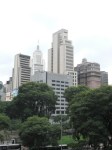
So thank-you, Sampa, but I am not sorry to be leaving. Here are some pictures of the hundreds I took, of aspects booth good and bad…

Talk to Parliamentary Committee

I’ve been invited back to the British Parliament (yes, I know – I’m surprised they keep asking me back too!). This time it is to address a meeting of the Parliamentary & Scientific Committee on the subject of “Security Technology and Individual Freedom” in April, just after I get back from Brazil.

Is there anything anyone wants me to tell them? 😉

Gentrification and Control in the Old Centre of Sao Paulo

Yesterday, I met up with Brazilian surveillance researcher, Marta Kanashiro, and she showed me around the Luz area of the old centre of Sao Paulo, where she has been working. Luz was once a grand colonial district around the railway station designed by British architect, Charles Driver, in brick and iron, but it lost its importance in the mid-Twentieth Century as the station ceased to be the terminal for the coffee trade. The area acquired notoriety as home to a police headquarters where opponents of the dictatorship where tortured, and as a centre for prostitution, violence and drugs.

In more recent years there has been a real effort by the city authorities to reclaim the area which, despite being in many ways a laudable project, has been controversial both for its effects on the poor, and for its treatment of memory and the particular history of the place. On one side of Parque da Luz, the formal gardens in front of the station, is the Museum of Portuguese language, yet on other side of the station, all memory of the victims of police oppression and torture has been erased with the restoration of the police building.

In the park itself, the park authorities installed CCTV (the story of which can be read in Marta’s article in Surveillance & Society), but they haven’t tried to drive out the prostitutes, many of whom were still standing forlornly under the tall trees in the driving rain as we visited. However, according to Marta, they have tried to persuade the women to dress more respectably in keeping with the desired new image of the the neighbourhood! At one point the prostitute’s union was more involved in the management of the park, as were other community organisations, however the building in the centre of the park where these groups used to meet is now closed for refurbishment and it is unclear whether it will still be available in the same way afterwards. Another building in the corner of the part, next to the rather ramshackle security rooms, has already been restored, and where once the plans and documents about the park were on public display, now the place is prettier but empty.

The Luz regeneration has plenty in common with revanchist redevelopment in many other big cities around the world, and there are big questions about what happens to the already excluded population of the area as the regeneration spreads. There are two contrasting visions for the centre from two different but very similar-sounding organisations: Viva O Centro and Forum Centro Vivo. Both want regeneration – everyone does – but they have entirely different approaches to how it should be done. The former is an association of mainly businesses and police, similar to the Business Improvement Districts (BIDs) which are common in US and British city centres. It is behind a lot of the current redevelopment and has the ear of the city authorities. The latter is a group of academics and community activists who want a more democratic and participatory process, and who hold a lot of local events, cultural and political. They also accuse Viva O Centro of either actively or tacitly encouraging intimidation and violence (which has certainly taken place) against the poor population of the area. It is another reason why the attempt to erase of the memory of the brutality of the dictatorship is so important: it is a memory that needs to be constantly refreshed as the actions are echoed and repeated.

(A very big ‘thank-you’ to Marta Kanashiro for her time and patience! All mistakes in this account, as usual, are my own…)

CCTV watches (and catches) the watchman

surveillance can be a weapon of the weak and perhaps right wrongs committed by representatives of the state…

Sometimes surveillance ends up rebounding on those who are usually on the other side of the camera. Videos from citizens can hold violent officers to account, as in the Rodney King incident. But occasionally, CCTV cameras themselves will catch a violent cop out, as is alleged to have happened in New York in the case of Officer David London’s arrest of Robert Morgenthau, a Iraq-war veteran suffering from PTSD. According to the New York Times, video footage from a CCTV system in the building where the arrest occurred shows Officer London repeatedly beating and kicking Mr Morgenthau.

Ironically, London’s lawyer claims that “oftentimes the videotape is the beginning of the story, not the end.” This isn’t usually the attitude that the police have to CCTV footage of a crime!

Now of course, this kind of thing is also sightly uncomfortable for anti-CCTV activists too. In some ways, it shows CCTV failing of course (it didn’t deter Officer London from assaulting Mr Morgenthau), but it also shows that surveillance, and not particularly countersurveillance or sousveillance just surveillance, can be a weapon of the weak and perhaps right wrongs committed by representatives of the state. We shouldn’t forget that surveillance, whether we object to it generally or in particular cases, is not always about repression; it often has caring intent and can result in the right thing being done.

Human Rights in Brazil

In Brazil, the almost universal perception amongst the middle and upper classes is that human rights defenders are simply defending criminals…

I spent some time yesterday talking to people from the justice program at Conectas, a collection of organisations that works on the unpopular issue of human rights in Brazil. Conectas also has a global south program that works more broadly in the developing world, and publishes the excellent journal, Sur.

ipbI say that human rights is unpopular, which may sound surprising, but talking to the valiant lawyers and organisers at the Instituto Pro Bono, which provides lawyers to those who can’t afford them, mainly prisoners, and Artigo 1o, which brings civil actions against the state on behalf of prisoners killed or injured by police and prison staff, I was immediately reminded of the depth of the social divisions, and the sheer mutual ignorance of people in different social classes here in Brazil.

In part, I was told, the gap has to do with the experience of the dictatorship that came to and end from 1985. Human rights had grown in opposition to the dictatorship, and once the end came, many wealthier people started to wonder why people still needed these apparently strange and special rights in a ‘free society’. The almost universal perception amongst the middle and upper classes is that human rights defenders are simply defending criminals, end of story. The Artigo 1o staff told me that they regularly receive hate-mail and threatening or angry telephone calls. The Instituto Pro Bono is still battling to have its lawyers even accepted in courts in many states in Brazil. Bar associations are opposing them on the grounds that they take business away from defence lawyers! Neither organisation gets any more than a tiny proportion of its income from Brazil; most comes from the European Union and the USA.

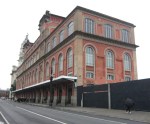
Everything you need to know about what drives Sao Paulo (Nineteenth Century Building in the heart of the city)
Almost everything you need to know about what drives Sao Paulo (Nineteenth Century business federation building in the heart of the city - the other side of the entrance says INDUSTRIA)

Partly too there is a partially Catholic Christian legacy of accepting one’s ‘natural’ social place and waiting for what one deserves after death. However there are also questions of geography. And sociospatial variety leads to different relationships and different attitudes by the ruling classes in different parts of the country. In Sao Paulo, the poorer areas, and the favelas – I was reminded of course that there are both and many, many very poor people are not living in illegal settlements – are largely peripheral. This means that they can be ignored by the rich. Sao Paulo is also a mercantile city absolutely dedicated to making money and many of the rich seem to regard the masses of poor as simply ‘failed entrepreneurs’ whose fate is their own fault. This contrasts with Rio, where rich and poor are thrust right up against each other, with favelas running right into the heart of the city. The poverty cannot be ignored, but instead it is crushed, repressed by the actions of groups like the Autodefesas Comunitárias, (illegal ‘community self-defence’ groups).

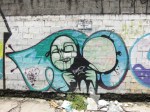
Welcome to Sao Paulo! ("REVENGE - Intruders will die" says the graffiti)
Welcome to the other Sao Paulo! ("REVENGE - Intruders will die" says the graffiti)

Of course such mass violence does occur in Sao Paulo too – Artigo 1o is currently looking for funding (not a lot in relative terms BTW – please contact me if you have about $6000 US to spare!) to publish their report into the mass battles between police and organisations of ex-prisoners and criminals, which resulted in the extra-legal execution of hundreds of people by the police. However, in general, the staff of Artigo 1o argued, the relationships are different.

(there was a lot more, but I will write about issues around security and surveillance later)