RIPA to be limited

The UK Home Office is finally publishing plans to reform the Regulation of Investigatory Powers Act (RIPA) which defined in law the surveillance powers open to hundreds of government bodies. You can see what I have previously said about the consultation here. The consultation on RIPA actually had 7 major questions. The Home Office has now responded to all the opinions offered during the consultation. In more detail, this is what was said:

1.    Taking into account the reasons for requiring the use of covert investigatory techniques under RIPA set out for each public authority, should any of them nevertheless be removed from the RIPA framework?

Response: basically, none should be removed. Although the Home Office noted that many respondents had objections, they didn’t feel they added up. Indeed this section also seems to include extensions of the powers (or clarifications that act effectively as extensions) for example the ability of the Child Maintenance and Enforcement Commission (the replacement for the Child Support Agency), to have access to telecommunications data to investigate fathers required to pay child support. These extensions may be warranted or not, but they show the tendency for what Gary Marx long ago called ‘surveillance creep’ to occur – the saving of telecommunications data has increased since RIPA was proposed and now RIPA will be used to allow new agencies access to this data.

They also note that they will not be returning any of these investigatory functions to the police. This is interesting because later they use the reason of non-interference in law-enforcement for denying elected councillors detailed oversight. So this confirms a trend to less and less accountable law enforcement.

2. If any public authorities should be removed from the RIPA framework, what, if any, alternative tools should they be given to enable them to do their jobs?

Response: given the previous response, it is not surprising that no real change is proposed here. The Home Office in fact insists that more emphasis should be placed on overt surveillance by local authorities (like CCTV) in order to reduce the need to resort to RIPA’s covert surveillance!

3.    What more should we do to reduce bureaucracy for the police so they can use RIPA more easily to protect the public against criminals?

This wasn’t a question that I ever noticed critics of RIPA asking. Some agencies seem to have objected to the amount of paperwork around RIPA and The Home Office “agrees that it is in no-one’s interests for documentation to be unnecessarily time-consuming” and they, for once, insist on a proper auditable trail that can help protect privacy. They say in any case, applications are already down massively.

There is an interesting note that suggests the increasing use of RIPA for counter-terrorism activities which is left rather open – “the Government is facilitating the work of police collaborative units, such as the regional counter-terrorist units… This means officers seeking to use techniques under RIPA will be able to apply to authorising officers in different forces, where the Chief Officers have made a collaboration agreement that permits this”, in other words that RIPA might be used for massive, blanket undercover surveillance operations. Now that certain wasn’t what the government has recently claimed it was intended for – although of course, as anyone with any kind of memory will recall, it was exactly the justification used for passing it.

4.    Should the rank at which local authorities authorise the use of covert investigatory techniques be raised to senior executive?

Response: The media reports thus far have focused on the plan to limit the authorisation of such practices to council chief executives and directors – a recommendation made by the House of Lords Constitution Committee – what the Home Office actually recommends is to restrict the decision to a rather wider set: ‘Director, Head of Service, Service Manager or equivalent’. So, no junior officers any more, which is good, but not necessarily senior managers only. They also recommend having a compliance officer designated, which is good if they genuinely work on active and ethical compliance rather than thinking of excuses in retrospect.

5. Should elected councillors be given a role in overseeing the way local authorities use covert investigatory techniques?

Response: yes they should, but it should be ‘strategic’ and limited to once a year setting of policy and strategy with quarterly oversight meetings. They argue, as I mentioned earlier, that non-interference in law-enforcement is a good reason for keeping elected officials away from the details… Councillors in the UK have been increasingly hamstrung in the way that they can oversee their supposed bureaucracy, even to the point where they have been fined and suspended for criticising their own officers. Some real control would be welcome (after all, that is what the purpose of local democracy should be).

6. Are the Government’s other proposed changes in the Consolidating Orders appropriate?

Response: the Home Office basically rejected all the respondents’ comments on the proposals.

7.    Do the revised Codes of Practice provide sufficient clarity on when it is necessary and proportionate to use techniques regulated in RIPA?

Response: the codes of practice will be made clearer. No more guidance will be given. The Guardian says that the proposals will ‘ban’ the use of RIPA for ‘minor matters’ but I can’t really see that they do this, and the points of such codes is usually to avoid recourse to the law by encouraging a voluntary self-regulation; it is how CCTV is largely – and incredibly ineffectively – regulated in the UK too.

UK police still adding innocent people’s DNA to database


Research in the UK has shown that police forces in Britain are continuing to add the DNA – and incidentally the fingerprints, although this is never mentioned – of innocent people to the DNA database despite the European Court of Human Rights ruling that it was illegal (and the government’s promise to accept the ruling). According to The Guardian newspaper today, 90,000 innocent people have been added to the National DNA database (NDNAD) since a the court ruling and the Association of Chief Police Officers (ACPO) – incidentally, a private organisation – is still telling chief constables to continue with this collection. On the other hand the process of removing individual profiles has been painfully slow: only 611 DNA profiles of innocent people have been removed, and all as a result of individual challenges in court. It seems that the police are determined to drag their feet as long as possible and, in fact, break the law quite openly. Hardly a good example…

Lies, Damned Lies and CCTV Statistics…

Earlier today, I reported on reports that claimed that 96% of US citizens support video surveillance. Now, thanks to Vicki Contavespi, and the people at BRS Labs who commissioned the survey from Harris Interactive, I have the raw figures. And, unsurprisingly enough, whilst they aren’t ‘lies’, they don’t quite show what the headlines suggested – just as my headline, a quote often attributed of course to Disraeli, is also an overstatement of the case at hand. This is a very interesting survey. There were quite a few questions asked, and I don’t have time to go through all of them here now, but I will just deal with the question of ‘support’ for video surveillance and break it down just a little more.

First of all, the main questions on the acceptability of video surveillance (and other surveillance techniques) are couched in an particular way that is common in market research. The lead question is “How strongly do you agree or disagree with each of the following statements?” There is then a list of statements, which each have four options: strongly agree, somewhat agree, somewhat disagree, and strongly disagree. There is no ‘neutral / don’t care / no opinion’ option, which might have taken out many of those in the ‘somewhat’ categories on either side. The headline figures used then, of course, elide the ‘strongly’ and ‘somewhat’ figures.

For video surveillance, there are two main statements, firstly, “The federal government should be able to utilize video surveillance as long as my personal privacy is not invaded”, and secondly, “Local law enforcement should be able to use surveillance cameras to monitor public places.” The first question already contains a bias, in that is specifies a situation of no privacy invasion. This effectively nullifies the most common objection to video surveillance, and especially for those for whom the Federal Government is a intrinsically suspicious entity. The second, interestingly, doesn’t have this proviso, but then ‘local law enforcement’ isn’t ‘the Feds’ and generally does not attract the same antipathy. But the lack of a qualifying statement might provide a better clue to US public attitudes on video surveillance overall. For the first statement, the ‘headline’ figure of agreement is 82% and the second is 78%. However this disguises the fact that ‘strong agreement’ is much more limited, 36 and 35% respectively. And if you add up the ‘somewhat agree’ and ‘somehat disagree’ figures, you get 57% and 58%, which indicates to me that the majority of US people don’t have strong opinions for or against CCTV. See – statistics are all about what you are looking for in them!

What is even more interesting is that the question was then asked: “Which of the following aspects of video surveillance cameras, if any, concern you?” You would think that, given the headline and press release, that the survey showed no real concerns about CCTV. But that really isn’t the case at all. In fact, 88% of respondents said they were concerned by at least one of the listed aspects of video surveillance. Now remember, you’ve only got 18% or 22% who said that they disagreed with CCTV in terms of the question posed above, so this means that even most of the people who supported CCTV to whatever degree of strength, had concerns and most had more than one concern. This is quite striking. The main concerns were “not knowing what will be done with the information that is gathered ” (66%), “The fact that recorded footage can be used to mistakenly incriminate me” (61%), “Not knowing the background of whoever may be watching” (60%), “Not knowing how often and where I might be watched” (50%) and “The fact that photographs can be taken of me without permission” (48%). The only one on which there was significant difference between men and women seems (and I haven’t done any statistical analysis of the difference) to be over the concern about how often and where people might be watched, about which women were more likely to be concerned than men. In fact, in the whole survey, there appear to be no real overt differences in response based on gender.

So where, you might well be asking, does this 96% support figure come from? I searched through the tables some distance for the 96% figure before I found it. It certainly doesn’t refer to generalised support, but comes in response to the following question: “Which of the following areas, if any, do you think should be monitored by video surveillance in an effort to help protect U.S. citizens?” A-ha! So we have a question that implies the use of video surveillance somewhere, and that it will be used specifically to help protect US citizens (none of those foreigners!). The question is clearly pushing the respondents towards a positive answer. But here too things are not quite what the headlines claimed. Certainly, 96% of respondents said that video surveillance should be used in some areas. However, it is only in “Airports” (92%), “Public transportation” (85%) and “Seaports” (82%) that there is an overwhelming vote of confidence (though quite why seaports are considered to be less at risk or would benefit less from video surveillance than airports, I am not quite sure – the ghosts of 9/11 hover, I suppose).

“Public schools/Universities” barely scrape a majority (53%), and one wonders what the figures would be if they split universities and schools (and indeed different levels of school). “Playgrounds” only hit 39% – not so much of the common British ‘think of the kiddies’ paranoia here perhaps – “Businesses” – where of course surveillance is actually more likely to be found than anywhere else! – doesn’t manage a third (32%) and “Local neighborhoods”, which is the only unequivocal ‘public space’ category is only on 22%. Why not parks? Why not city centre streets? It is of course these places where the real controversy and the real fire and debate over CCTV lies. And the indications from this survey are that the more personal, the more intimate, the more there is a sense of ‘community’, the less likely US citizens are to accept video surveillance, even if it is couched in the overly positive way it is here.

And there is a question whose answers demonstrate further the complexity here. And, ironically, the percentage of respondents who replied to the question “Which of the following, if any, do you think are currently the biggest threats to your personal privacy?” with one of more concerns was – you guessed it – 96%! The major concerns were actually mostly from private or criminal surveillance: “identity theft” (74%), “Internet security threats” (70%) and “Unknown individuals who handle my personal information” (60%). Only 33% were concerned about federal or local government, but this isn’t surprising when this category is headed, as it is in the survey, “Big Brother”! Who is going to admit to being scared of ‘Big Brother’? And if you are going to give a silly popular stereotype as a potential answer, then the other categories should be similarly labelled… And why wasn’t this 96% the lead-in for the media?

As I said, there is a lot more in here too, and despite its flaws, this is an interesting survey which has much to it than meets the eye if you just read the media reports.

UK state spy program targets innocent

The headline may not come as any surprise but a damning report has been released on a key strand of the British government’s counterterrrorism strategy, Preventing Violent Extremism (or just ‘Prevent’). £140m (around $200m US) has been allocated to this program but much of it seems to have been devoted not to combatting nascent Islamic extremism (which is the stated aim) but MI5 simply collecting masses of information on entirely innocent British Muslims – information that will be kept until they are 100 years old! Part of this is because of the tenuous nature of the strategy in the first place: how would one define or identify those who are not terrorists but might become so? Will it be, as in cases reported by The Guardian, the student who attends a lecture on the conditions in Gaza or Muslim men with mental health problems? And much of this depends on teachers and lecturers reporting students. Therefore the program would seem inevitably to encourage suspicion and distrust, as Arun Kundnani writes and as the general tone of left and civil liberties critique has reinforced. But opposition has come from all sides: Pauline Neville-Jones, the Conservative shadow security minister, but also former chair of the Joint Intelligence Committee and political director of the Foreign Office, has also condemned the whole approach of New Labour, which she argues is rooted in the identification of discrete ‘communities’ who share similar characteristics. This can of course be the basis of a form of multiculturalism, but at times of increased security and suspicion it seems all to easy for it to morph into what is effectively racial profiling…

Surveillance cameras in the favelas (2)

A couple of weeks ago, I found out that the military police had installed surveillance cameras in the favela of Santa Marta, in Rio de Janeiro, Brazil, which I visited back in April. This is the first time such police cameras have been put into such informal settlements in Rio. My friend and colleague, Paola Barreto Leblanc, sent me this link to these youtube broadcasts from a local favela TV company, in which residents discuss their (largely negative) views of the cameras.

There is also a poster that has been put up around the area produced by the Community Association and other local activist and civil society groups – see here – which reads as follows in English:

SANTA MARTA , THE MOST WATCHED PLACE IN RIO

At the end of August, the inhabitants of Santa Marta were surprised to learn from newspapers and TV that nine surveillance cameras would be installed in different areas of the favela. A fear of being misinterpreted paralysed the community.

Many of the people of the city, and some in the Moro itself support this initiative.  However, we are a pacified favela, so why do they keep treating us as dangerous?

Walls, three kinds of police, 120 soldiers, cameras – this is no exaggeration.  When will we be treated as ordinary citizens instead of being seen as suspects?

Wall: 2 million Reais, Cameras, half a million Reais. How many houses could this amount of money build? How many repairs to the water and sewage system?

The last apartments built in Santa Marta are 32 square metres. The Popular Movement for Housing [an NGO] says that the minimum size should be 42 square metres. Other initiatives have gone with 37 square metres. So why don’t we stand up and demand this minimum standard? This should be our priority!

When will the voice of the inhabitants of this community be heard?

We need collective discussion and debate.

Fear is paralysing this community and preventing criticism. But the exercise of our rights is the only guarantee of freedom.

“Peace without a voice is fear”

We want to discuss our priorities. We want to know about and be involved in the urban development project in Santa Marta.

We will only be heard and respected if we unite.

Think, talk, reflect, debate, get involved…

More military robots…

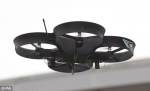
A story in the Daily Mail shows two new military robot surveillance devices developed for the UK Ministry of Defence’s Defence and Equipment Support (DES) group. The first is a throwable rolling robot equipped with multiple sensors, which can be chucked like a hand-grenade and then operated by remote-control. The second is another Micro-(Unmanned) Aerial Vehicle (Micro-UAV or MAV), a tiny helicopter which carries a surveillance camera. There have been rolling surveillance robots around for a while now (like the Rotundus GroundBot from Sweden), but this toughened version seems to be unique. The helicopter MAV doesn’t seem to be particularly new, indeed it looks at least from the pictures, pretty similar to the one controversially bought by Staffordshire police in Britain – which is made by MicroDrones of Germany.

The proliferation of such devices in both military and civil use is pretty much unchecked and unnoticed by legislators at present. Media coverage seems to be limited to ‘hey, cool!’ and yes, they are pretty cool as pieces of technology, but being used in useful humanitarian contexts (for example, rolling robots getting pictures of a partially-collapsed building or MAVs flying over a disaster zone) is a whole lot different from warfare, which is a whole lot different again from civilian law enforcement, commercial espionage or simple voyeuristic purposes. As surveillance gets increasingly small, mobile and independent, we have a whole new set of problems for privacy, and despite the fact that we warned regulators about these problems back in 2006 in our Report on the Surveillance Society, little government thought seems to have been devoted to these and other new technologies of surveillance.

The use of robots in war is of course something else I have become very interested in, especially as these flying and rolling sensor-platforms are increasingly independent in their operation and, like the US Predator drones employed in Afghanistan and Pakistan or the MAARS battlefield robot made by Qinetiq / Foster-Miller, become weapons platforms too. This is an urgent but still largely unnoticed international human rights and arms control issue, and one which the new International Committee for Robotic Arms Control (in which I am now getting involved), will hopefully play a leading role in addressing.

Big Brother Watch

I’ve just been contacted by a UK organisation calling itself ‘Big Brother Watch’, which claims to be a ‘think-tank’ asking for my help and support. Now the UK already has Liberty, Privacy International, No2ID, No-CCTV, not to mentioned the Surveillance Studies Network, and various other campaigns and organisations, so why this new one? Of course anyone and their dog can call themselves a ‘think-tank’ but Big Brother Watch is being more than a little disingenuous. It is basically a creation of the Taxpayers’ Alliance, which in turn is a fake ‘popular’ pressure group, and a front for neoliberal economic think-tanks like the Adam Smith Institute, various large industrial interests and the most free-market wing of the Conservative Party – you can find out more about what they are really about here. Now, if those are your politics, and you are happy with who backs them, then you are most welcome to support this new creation, but they aren’t my politics and I won’t be offering any support for such front organisations.

Manchester Airport trials virtual strip-search system

Rapiscan image (BBC)

You would think after 4 years of trials at Heathrow, that British airports would now be able to work out whether or not they could and more importantly, should, use the various varieties of body scanners that are now available. However Manchester Airport is holding another trial starting from now at its Terminal 2. At least it will give a chance for the public to say what they think. The scans are remote – i.e.: the officer observing the images is not on the airport floor, which prevents the kind of scenario we mentioned in our Report on the Surveillance Society of lewd remarks directed at passengers. Personally, I am rather less concerned about this rather abstract view of my body being seen briefly as I pass through an airport than I am about my financial details and personal life being traded between private companies, or about being under constant video surveillance in ordinary public space in the city. However, the images, although ghostly, are detailed enough that genitals, deformities, medical implants and so on can be seen, and if this story is to be believed it would seem that there is no provision for women’s images to be seen by a women alone and men’s only by a man. This will make it entirely unacceptable to some people, in particular members of certain religious groups. But the scans are – at least, for now – voluntary, in that passengers can refuse and have a traditional pat-down search instead.

However, this technology won’t be staying in the airports for long. I reported back in July on stories that terahertz wave scanning could soon be made to fit into portable cameras. That raises a whole different set of social, political and ethical questions…

(Thanks to Simon Reilly for sending me the link)

Automation and Imagination

Peter Tu writes over on Collective Imagination, that greater automation might prevent racism and provide for greater privacy in visual surveillance, providing what he calls ‘race-blind glasses’. The argument is not a new one at all, indeed the argument about racism is almost the same proposition advanced by Professor Gary Marx in the mid-90s about the prospects for face-recognition. Unfortunately, Dr Tu does several of the usual things: he argues that ‘the genie is out of the bottle’ on visual surveillance, as if technological development of any kind is an unstoppable linear force that cannot be controlled by human politics; and secondly, seemingly thinking that technologies are somehow separate from the social context in which they are created and used – when of course technologies are profoundly social. Although he is more cautious than some, this still leads to the rather over optimistic conclusion, the same one that has been advanced for over a century now, that technology will solve – or at least make up for – social problems. I’d like to think so. Unfortunately, empirical evidence suggests that the reality will not be so simple. The example Dr Tu gives on the site is one of a simple binary system – a monitor shows humans as white pixels on a black background. There is a line representing the edge of a station platform. It doesn’t matter who the people are or their race or intent – if they transgress the line, the alarm sounds, the situation can be dealt with. This is what Michalis Lianos refers to as an Automated Socio-Technical Environment (ASTE). Of course these simple systems are profoundly stupid in a way that the term ‘artificial intelligence’ disguises and the binary can hinder as much as it can help in many situations. More complex recognition systems are needed if one wants to tell one person from another or identify ‘intent’, and it is here that all those human social problems return with a vengeance. Research on face-recognition systems, for example, has shown that prejudices can get embedded within programs as much as priorities, in other words the politics of identification and recognition (and all the messiness that this entails) shifts into the code, where it is almost impossible for non-programmers (and often even programmers themselves) to see. And what better justification for the expression of racism can there be that a suspect has been unarguably ‘recognised’ by a machine? ‘Nothing to do with me, son, the computer says you’re guilty…’ And the idea that ‘intent’ can be in any way determined by superficial visualisation is supported by very little evidence which is far from convincing, and yet techno-optimist (and apparently socio-pessimist) researchers push ahead with the promotion of the idea that computer-aided analysis of ‘microexpressions’ will help tell a terrorist from a tourist. And don’t get me started on MRI…

I hope our genuine human ‘collective imagination’ can do rather better than this.

US Congress debates online data protection

The US House of Representatives will finally get to debate whether online advertising which tracks the browsing habits of users is a violation of privacy and needs to be controlled. A bill introduced by Rep. Rick Boucher of Virginia will be propsing an opt-out regime that gives users information about the uses to which their data will be put, and allows them to refuse to be enroled. At present many such services work entirely unannounced, placing cookies on users’ hard drives and using other tracking and datamining techniques, and without any way in which a user can say ‘no’. Of course, we have yet to see the results of the inveitable industry scare-stories and hard-lobbying on the what will be proposed, let alone pased. But the proposal itself is particularly significant because so far the US has so far always bowed to business interests on online privacy and data protection, and if this bill is pased, it is a sign that what EFF-founder, Howard Rhiengold, long ago called the ‘electronic frontier’ might start to acquire a little more law and order in favour of ordinary people.