Disguised man allowed to board flight to Canada

An effective disguise (CNN)

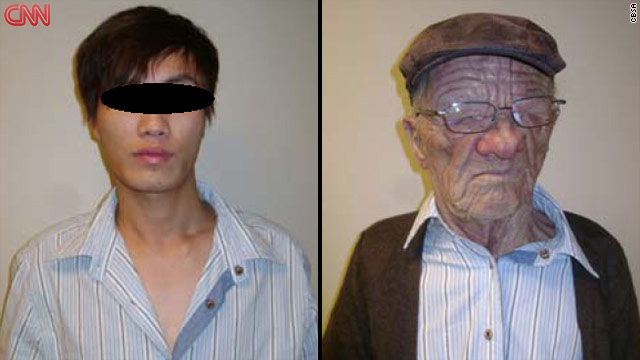
CNN has an exclusive today on a young Chinese man who boarded an Air Canada flight from Hong Kong disguised as an old white man. During the flight he removed the mask and then claimed asylum on landing in Canada.

No-one outside of the man concerned and the Canadian Border Security Agency knows much more about this right now. The disguise looks pretty impressive. And he had a boarding pass for a man of the correct age and origins. Of course some people will try to spin this as a ‘security threat’ story, or make it about terrorism. But really this says far more about the desperation of those trying to claim asylum faced with the rather kafkaesque logic of such systems, which tend to assume that claimants can use legal means to escape from situations where their life might be in danger…

Not everything is about the (still relatively small) risk of terrorism and nor should we overreact or organise or always try to reorganise our societies on the basis of that risk. Canada has a historically-deserved reputation as a humane refuge for those in need. This should be defended.

Support Peter Watts

I’ve been snowed under teaching recently and haven’t been posting much. One thing has really got my goat though and I think it needs wider attention. Those of you who read boingboing will already know, but the SF author, Peter Watts (who wrote the excellent novel of really alien contact, Blindsight) has been convicted of obstructing US border guards and could spend up to two years in prison. This is despite the fact that the border guards lied about the whole incident (they claimed he had tried to choke an officer, when in fact they were assaulting him, a fact admitted in court). He basically got convicted for challenged the guards and getting out of his car to ask what was going on. As Cory Doctorow comments on BoingBoing, this is not about security, this is not about safety, and it is not even about crime as we would recognise it, it is about authority and the massive increase in humourless abuse that has increased so much in recent years, particularly on the US border*. Peter Watts was convicted essentially of not responding fast enough and questioning commands. He’s now posted more on his own blog, including some comments from some of the jury, who couldn’t quite believe the outcome…

Anyone who thinks ‘nothing to hide, nothing to fear’ or truly believes that it couldn’t happen to you, read this a be concerned. Show your support for Peter too. Write to your congressmen if you are in the USA, or Members of Parliament in Canada, write to Ministers and Secretaries of State. Make a fuss. Write to Peter too and tell him you support him.

*And sure, there’s a context, but it seems to me that the post-9/11 situation is used as an excuse by rather too many guards to exercise a petty brutality on anyone who does not conform to their perception of normality. That critical point where liberty comes up against security is just as much about interpersonal encounters like this as it is about grand policy.

After the Thighbomber: Virtual Strip Searches at every airport?

The botched attempt to bomb a flight into the US by a the son of a wealthy Nigerian family, using explosive components strapped to his thigh, has led to an immediate techno-economic consequence, which is to speed up the process of installing terahertz wave or other body scanners in major airports, which if nothing else will provide a guaranteed income stream to Rapiscan and Qinetiq, who make these kinds of machines. Schipol in Amsterdam, where  announced they would be extending their body scanning operation and the British government almost immediately followed by saying that major British airports would be rolling out body scanning within weeks. Now, Canada is to do the same.

But, will this make a real difference or is it just more symbolic security? The scanners certainly ‘work’ in the sense that they do provide pretty good images of what is under the clothes of passengers (see below). However, interpreting what is seen is still no easy task and will the scanners will certainly not replace physical searches, but will add yet another extra layer of surveillant sorting and therefore delay. And there are questions over the effectiveness of the scanners in particular areas of the body. The Toronto Sun reports that trials at Kelowna Airport in British Columbia “left blind spots over the head and feet”, so these machines are certainly not the ‘silver bullet’.

Then of course, there are the privacy issues. I don’t have any particular problem with the technology, provided it is restricted to airports and doesn’t start to get used in other, more everyday, social settings (which given the rapid development of this technology is by no means certain). However, as I noted the last time I wrote about this, there will be many religious, gender-based and personal reasons for objecting to their use. The other question of course is whether, every time some lone lunatic tries something like this – that was, let us not forget, poorly planned and ineffective, and which should have been prevented by other conventional intelligence operations working properly – it makes sense to jump and harden security (or at least be seen to harden security) for everyone travelling internationally. Doing this just plays into the hands of terrorists as it disrupts the ordinary workings of an open society.

Body Scan Image (US TSA)

Manchester Airport trials virtual strip-search system

Rapiscan image (BBC)

You would think after 4 years of trials at Heathrow, that British airports would now be able to work out whether or not they could and more importantly, should, use the various varieties of body scanners that are now available. However Manchester Airport is holding another trial starting from now at its Terminal 2. At least it will give a chance for the public to say what they think. The scans are remote – i.e.: the officer observing the images is not on the airport floor, which prevents the kind of scenario we mentioned in our Report on the Surveillance Society of lewd remarks directed at passengers. Personally, I am rather less concerned about this rather abstract view of my body being seen briefly as I pass through an airport than I am about my financial details and personal life being traded between private companies, or about being under constant video surveillance in ordinary public space in the city. However, the images, although ghostly, are detailed enough that genitals, deformities, medical implants and so on can be seen, and if this story is to be believed it would seem that there is no provision for women’s images to be seen by a women alone and men’s only by a man. This will make it entirely unacceptable to some people, in particular members of certain religious groups. But the scans are – at least, for now – voluntary, in that passengers can refuse and have a traditional pat-down search instead.

However, this technology won’t be staying in the airports for long. I reported back in July on stories that terahertz wave scanning could soon be made to fit into portable cameras. That raises a whole different set of social, political and ethical questions…

(Thanks to Simon Reilly for sending me the link)

Racial profiling hits a new low

Just when you think that state surveillance in supposedly free countries could not sink any lower, it has been revealed that UK Border Agency is finding a pilot project into using DNA and isotope analysis to determine the origin of asylum-seekers. This is not a joke or a scare-story. It is a real project. Science Insider has the details here. The Agency is refusing to say who is doing this research for them, nor has it provided any references to studies that show that what they are proposing will work. It appears that most scientists working in the area think it is based on entirely faulty premises and there is no reason to believe it will work. That’s only a minor objection compared to the political and ethical ones of course. As the story in Science Insider points out the Border Agency seem to be making a fundamental (and totally racist) error in assuming that ethnicity and nationality are synonymous. And this research would probably not got past any university ethics committee, which makes one wonder what kind of screening or ethical procedures the Border Agency used, and indeed who would carry out such an obviously unsound piece of research. It’s another example of increasingly unaccountable arms-length agencies (which have proliferated in recent years) using the ‘technical’ as an excuse to bypass what should be a matter of high-level policy, and indeed something that so obviously harks back to the bad days of Europe’s racist and genocidal past that it beggars belief that any sane official would have let this get further than a suggestion in a meeting.

(thanks to Andy Gates for pointing me to the story)

US border surveillance pours billions into Boeing… and still doesn’t work

Federal Computer Week reports that the Secure Border Initiative (SBI) designed to provide secure and highly surveilled border systems between the USA and Mexico, is in trouble again. There have been major technological failures, cost overruns, and more with the result that the system is way behind schedule. Half the reason seems to be a political economic one. In many ways this system is a giant pork barrel for the Boeing Corporation, which has been sucking up US state subsidies for years and is taking literally billions of US dollars for this project and in unrelated federal recession subsidies. No-one seems to have really checked whether Boeing could really do the job, and like so many large state security and surveillance projects, and most things that have been tried on the Mexico border, it just doesn’t really work.

The article reports the new Director of the SBI, Mark Borkowski as admitting that “the program was first conceived as a quick implementation of existing off-the-shelf technologies […] In retrospect, it would have functioned better if a customized technology solution was developed to meet the requirements […] Some of the things we put into place, in hindsight, were not effective […] What we bet on, which was probably not a good bet, was that this was like buying a new printer for your computer. …We started the wrong way, in my opinion.”

The cost breakdown for the Department of Homeland Security is reported by FCW as:

$1.1Bn to Boeing ($620M  for SBInet technology and $440M for border-vehicle barriers and fencing).

$2.4Bn on construction of fencing and vehicle barriers along the southwestern border

$6.5 Bn longer-term to maintain, monitor and repair the fences and structures.

Of course the ridiculous costs are bad enough, but the wider issues here are with the obsession with controlling migration in an economic climate in which the North America Free Trade Agreement (NAFTA) has progressively stripped Mexico of any economic autonomy and made its (and by extension the whole of Central America’s) working class a reserve of cheap labour for US corporations and its relatively increasingly wealthy, a market for US consumer goods. It’s not surprising that the Mexicans regard it as more than a little unfair that they have been forced into a subservient position, yet are not welcome to come into the USA, and are subject to such harsh security and surveillance to prevent them from doing so. Added to this, as the Mexican President made clear last year, relaxed US laws on gun ownership have resulted in a massively increased flow of weapons into Mexico from the USA, which has exacerbated gang conflicts which thrive in the atmosphere of inequality and exploitation. And of course, the violence just adds to the reasons why people want to leave and find opportunities in the richer, safer USA…

In many ways, what richer nations are doing is not only prioritising their own security, but also simultaneously exporting their insecurity.

Controlling the outsiders

One of the most interesting meetings we had in our last week here in Japan was with two representatives from the Japan Civil Liberties Union (JCLU) and the association to defend the rights of foreign migrant workers. One thing that has always been clear to me from being a gaikokujin (or more casually, just gaijin – foreigner) in Japan is how distinct is this status. I’m a white, western European and therefore at the top of the list of acceptability in foreigners in Japan, but even so I’ve had some interesting experiences, including having two police squad cars and 5 officers deal with the matter of my ‘suspicious’ bicycle (an experience that practically all resident foreigners have had at one time or another), and just the other day I was stopped at the train station by two plain-clothes police officers, who started off quite strong, but then backed down and started mumbling apologies about ‘looking for someone’ when they realised my (Japanese) wife was just behind me. It was pretty obvious that they were conducting an immigration sweep – i.e. just stopping anyone who ‘looked foreign’ to check their immigration status.

This gave me just a tiny taste of what life can be like here for those whose immigration status is problematic. And, as the campaigners told us, this is an increasing number of people who have come to Japan because of the wealth and opportunities and because, whisper it, Japan needs immigrants. Like so many advanced industrial nations, Japan is a hyper-ageing society, with an increasingly unbalanced population pyramid. There are not enough working age Japanese people to support the increasing number of retirees, and government schemes to encourage people to have more children simply haven’t worked. The problem is that successive Japanese governments have refused to recognise the implications. The rules now make provision for ‘skilled’ immigrants, but not for those who are ‘unskilled’ and it is actually those in this latter category that Japan needs. In practice this is demonstrated by the increasing numbers of foreign delivery and construction workers in Tokyo as well as those working in the shadier areas of the ‘night economy’ – doormen, bar staff, masseurs, prostitutes etc.. The same politicians who deny the need for immigrants are probably having their personal ‘needs’ serviced by Filipino or Vietnamese women and this hypocrisy colours all the mainstream political debate about the place of foreigners in Japan, especially in Tokyo where Mayor Ishihara has never disguised his nationalist views in this area.

So, whilst the politicians refuse to deal with reality, the police are enforcing the law as it is. We have spent some time, whilst we are here (and I have gathered data on previous visits) in the night city of Kabukicho in Shinjuku. This time I was taken out to bars in the old post-war neighbourhood of Golden Gai by Professor Tonoma, who formerly led both Shinjuku-ku and Tokyo city planning bodies, and we also talked to Shinjuku community safety officers, and to the Kabukicho Town Manager, who runs the day-to-day operations of the body trying to improve Kabukicho’s image, Kabukicho Renaissance.

Kabukicho of course is famous as the first place that the Tokyo police installed CCTV, ostensibly to deal with Chinese gangs, but according to what we learned from these visits and from talking to the campaigners, as crime has declined (as it has nationally – it’s probably nothing to do with the cameras), the cameras and intensive policing (raids etc.) have been used largely to curb illegal migrant workers. And the authorities seem to make no distinction between the gangsters and the mainly South-east Asian women who work in the bars and massage parlours. They are all visa-overstayers. There is no attempt to treat the women as people in need of help and support at all. Of course this all inflates the crime figures and makes it easy to paint what the police always term ‘foreign crime’ (whatever the exact nature or seriousness of the crime) as a growing threat, as it becomes proportionally a larger part of shrinking crime rates (which were already low by global standards to begin with).

Now there is a new threat to this already massively targeted population. The inclusion of foreigners on the jyuminhyo (residents’ registry), combined with the digitisation and networking of this registry through juki-net, means that the authorities will be able to correlate residency and immigration status much more easily – the residency information for foreigners will be linked to the Houmusho (Ministry of Justice), which has entry records, and now fingerprints and facial photos too, following post-9/11 reforms. Of course, resident skilled foreigners wanted to be in the residents’ registry. They argued that not being on it was itself a form of discrimination and meant further difficulties in terms of things like buying property. However the inclusion of foreigners now opens up new forms of discriminatory practice against those who are already the most disadvantaged in Japanese society, the kinds of foreigners who more high-status ‘official’ foreigners do not generally recognise as kin to them at all.

Japan’s surveillance society, like most, is therefore a profoundly uneven one. Every society has its Others, and surveillance is deployed both to distinguish those Others and to control them. In each of the cities I have been studying the Others are different populations. In London, the Others are (at the moment) the resident Muslim community (or more particularly, ‘radicalised’ young Muslims). Here the surveillance combines repression and ‘caring’ programs to bring the disaffected back into the mainstream. In Rio de Janeiro, the Others are the urban poor, the favelados. They are largely simply excluded – walls protect the rich in their homes, and now walls are being built around the poor communities. In Tokyo, the Others are foreigners, but there are gradations of Otherness, and effectively still aping the western ‘scientific racism’ that it acquired during the Meiji period modernisation at the end of the nineteenth century, Japan’s Others are poor Blacks and Asians (for many on the right here, the Japanese are not ‘Asian’ at all, but something unique). Just as the British state is struggling with the legacy of its particular colonial and post-colonial approach to immigration, and the Brazilian state with a history of years of differentiated citizenship, the Japanese state has still not yet really come to terms with the prospect of the mixing of people at all.
More border madness

I could probably blog all the time just about border surveillance and security issues… Aaron Martin has pointed out the reported latest new development on the Israel-Palestine border, which is an apparently arbitrarily used stamp which allows visitors to visit only the Palestinian territories in the West Bank and not Israel itself. Gaza remain closed to foreign visitors, and effectively an open-air prison camp.

It seems hard to define this as a ‘policy’ since the Israeli government officially deny that any order was given for the new stamp, despite the fact there is witness and photographic evidence of its use. Its purpose seems to be clearly to define for future reference, ‘enemies of Israel’ and to make it as hard as possible for those interested in the welfare of Palestinians to enter Israel.

Moon protest highlights wider border surveillance issues

The mass mooning of the US balloon camera owned by Sierra Nevada Corporation went ahead, but the irony was that the system had already been disabled by the weather. Apparently a large thunderstorm cause a gash in the fabric of the balloon last week which, if nothing else, should prove rather more effective than the protest in making sure that the US government does not invest in it.

However the wider issue of the US surveillance of the border with Canada remains (not mention that of the Mexican border, already a major concern) and whilst this particular technology and the appropriately ridiculous protest, has attracted most attention in the media, let’s not forget that camera towers have been erected and the USA is flying UAVs along the border. Surely President Obama should realise that the paranoid policies of his predecessor do nothing apart from damage relationships (and trade) with a close neighbour?

US cameras to see the whole of the moon…

There’s been a story developing for a while now on the US-Canadian border. This used to be one of the most casual and friendly of borders, indeed there are families stretched across both sides and in many places the border meant only slight differences in the price of some goods…

But no more. There might be a new president, but Obama seems to be allowing the Bush-era plans for strengthening the border with Canada to continue. There are now CCTV towers being erected, Unmanned Aerial Vehicles (UAVs) patrolling, and new much stricter passport regulations and customs and immigration checks. As usual this seems to be being done with a kind of macho indifference to the opinions of the Canadians that is making the US actions doubly unpopular.

If this seems like some kind of sci-fi nightmare then then most crazy, Philip K. Dick-style element is to be found on the Michigan-Ontario border at Port Huron, where the Sierra Nevada Corporation, a US military aerospace company, has launched a tethered balloon camera (the company calls it an MAA (medium altitude airship) pointed at the town of Sarnia across the border. This isn’t even an official scheme, it’s a private company trying to sell this insanity to the Department of Homeland Security, and naturally the Mayor and citizens of Sarnia are angry about this international violation of their privacy, and many of both sides of this border think that this intensified security as an attack on the trust that exists between Americans and Canadians.

So what are Sarnians doing? They are giving the cameras something to look at, that’s what. More specifically they are planning to drop their pants for a mass ‘moon the balloon’, which in these days of ever more insane surveillance schemes seems just about the only possible response.