Satellite collision opens up the world of space surveillance

Top story on many news channels today is the collision of a US Iridium telecommunications satellite with an obsolete Russian military satellite. Iridium is an interesting company that is almost permanently bankrupt (due to the rise of GPS-enabled mobile telephones) yet whose largest single customer is the US Department of Defense, which uses a Hawaii-based gateway for a secure network using NSA-approved handsets.

The Phased Array Radar pyramid at RAF Fylingdales (Yorkshire CND)

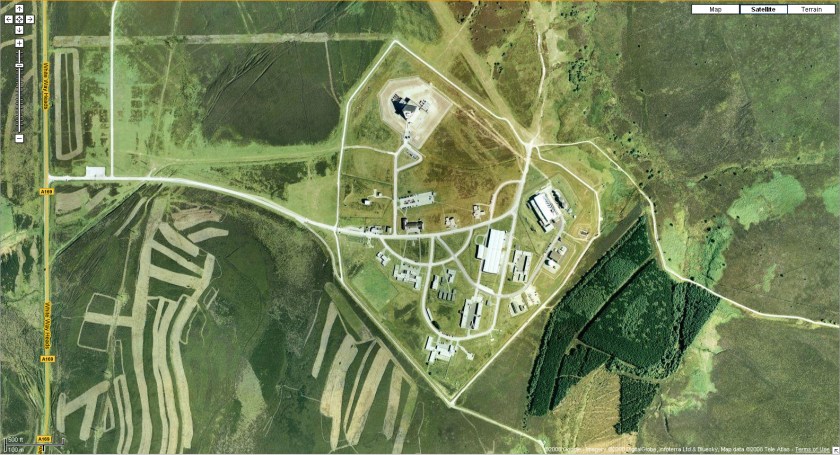
Even more interesting however is that the story mentions the obscure work of the Space Surveillance Network or SPACETRACK, formerly operated by US Space Command (USSPACECOM), now along with all of that influential body’s operations, part of US Strategic Command (USSTRATCOM). This global network of 25 bases using Phased-Array Radar and other tracking systems includes the RAF station at Fylingdales in North Yorkshire.

Satellite view of RAF Fylingdales (Cryptome)
Debris in Low Earth Orbit (NSA Orbital Debris Program Office)

SPACETRACK continually watches earth orbit for new objects, which are then added to the US space catalogue. It also tracks debris fields, which are increasing in number and becoming more of a hazard for new space craft, and therefore problems for both military and civilian communications, weather, mapping and surveillance systems. This collision would seem to have been in relatively low orbit which causes the most problems. Cleaning up earth orbit would be a very good idea, but few people seem to have any serious ideas as to how it might be done. Some even argue that such a clean-up could destroy a valuable source of historical information!

Bar talk

Brazil can’t really be called a surveillance society… talk of surveillance is just science fiction. It doesn’t mean anything to the people at the bar.

Back at the bar last night I got talking with the regulars – in the limited way I can manage to in Portuguese – about all sorts of things particularly the upcoming carnival – I’m invited – and the football: Brazil beat Italy yesterday in a friendly match. But it was how these ordinary guys – one is a factory worker, one works in an office, and another runs his own one-man business that seems to do anything and everything to do with IT – talked about fear and danger, security and safety, in the city that really interested me. We got talking about where they lived, and the centre of Sao Paulo and how they felt in each place. I told them what I had been advised about not going out at night here, and despite the fact that we were all out at night, Milton, the IT guy, a chunky black man in his 40s, agreed that this wasn’t bad advice for the centre. The area, he said, was full of thieves and drug-addicts, and whilst anyone would be safe amongst friends (and here he gestured expansively to include me and practically everyone else at the bar), even he wouldn’t want to spend much time alone. Milton is from out east – he’s a Corinthians fan; the centre-west is Palmeiras territory, and the red Metro line goes from one to the other – and in his own neighbourhood he says he doesn’t have much to worry about, although of course he has security. Everyone has security. You have to. Joao, the fat, slightly lugubrious office worker, nods in silent agreement.

I tell them I’d quite like to talk to some women. This prompts laughter and a lot of nudging and punching of arms: of course you do, don’t we all? No, no, I mean I’m interested in what women think about all this – what about her? I ask, gesturing to a handsome black women probably about the same age as Milton. Carla? No, you don’t want to talk to her. Not without paying. Open your eyes! (he makes an eye-opening signal with his right hand). Of course I could see that Carla wasn’t just here for fun. And that’s exactly why I wanted to talk to her. She agreed with the guys about the danger, but added that it was much worse for her, not because she was working nights, but because she was black. Being a black woman in Brazil is not good. Everyone, she said, pinching the skin of her forearm, just sees the colour of your skin. especially if you are on your own. With her white friend, people don’t care. I told her that some people think that Brazil isn’t racist or dangerous for black people. She laughed and not in a happy way. Those people didn’t know her life. I asked her if Lula had changed things – it is something I try to ask everyone at some point – in particular with the Programa Bolsa Familia since Carla had told me she has three kids, one grown up and two still at home. She shook her head. No. Nothing. Nothing has changed. It may be pessimistic or cynical but it’s what everyone seems to be thinking apart from the government and the World Bank.

All this bar talk might be casual and fueled by beer (and it is often difficult to understand exactly what people are saying) but it is a useful corrective to the formal interviews and other research I am doing here. It also tends to add to my growing certainty that Brazil can’t really be called a surveillance society at all in terms of how people experience their lives and relationships with the state. Talk of surveillance is just science fiction. It doesn’t mean anything to the people at the bar. The reality is all about danger (not risk in the bland sociological terminology, but actual danger) and security.

(All the names in this piece have been changed…)

CCTV watches (and catches) the watchman

surveillance can be a weapon of the weak and perhaps right wrongs committed by representatives of the state…

Sometimes surveillance ends up rebounding on those who are usually on the other side of the camera. Videos from citizens can hold violent officers to account, as in the Rodney King incident. But occasionally, CCTV cameras themselves will catch a violent cop out, as is alleged to have happened in New York in the case of Officer David London’s arrest of Robert Morgenthau, a Iraq-war veteran suffering from PTSD. According to the New York Times, video footage from a CCTV system in the building where the arrest occurred shows Officer London repeatedly beating and kicking Mr Morgenthau.

Ironically, London’s lawyer claims that “oftentimes the videotape is the beginning of the story, not the end.” This isn’t usually the attitude that the police have to CCTV footage of a crime!

Now of course, this kind of thing is also sightly uncomfortable for anti-CCTV activists too. In some ways, it shows CCTV failing of course (it didn’t deter Officer London from assaulting Mr Morgenthau), but it also shows that surveillance, and not particularly countersurveillance or sousveillance just surveillance, can be a weapon of the weak and perhaps right wrongs committed by representatives of the state. We shouldn’t forget that surveillance, whether we object to it generally or in particular cases, is not always about repression; it often has caring intent and can result in the right thing being done.

Privatising political policing in the UK?

Another good piece by Henry Porter on the Guardian’s Comment is Free website, against the influence of the Association of Chief Police Officers (ACPO), which despite being a private organisation with no public accountability, has a very large influence on policy. The particular concern is with reports that ACPO has set up a new Confidential Intelligence Unit (CIU), to monitor so-called ‘domestic extremists’ which will apparently be based at Scotland Yard. They are currently advertising for a Chief Executive.

According the Emergency Services News, the CIU will target environmental groups and those behind anti-Israel demonstrations and ” infiltrate neo-Nazi groups, animal liberation groups and organisations behind unlawful industrial action such as secondary picketing.” In other words we are back to the bad old days of defining everyone who doesn’t agree with the state as ‘subversives’ and putting them under surveillance. This is hardly new. I was one of a quite a large number of environmental protestors targeted by a private detective agency employed by the government back in the early 1990s, and in fact this kind of activity, far from being incidental to ordinary policing was at the heart of the ‘new police’ in Britain from their foundation in the Nineteenth Century. Statewatch founder, Tony Bunyan’s excellent history of The Political Police in Britain (Quartet, 1977) shows how the experience of colonial rule of India and Ireland was imported back to Britain. Targeting organised labour is hardly new either: immediately after the first world war, the British government introduced the Emergency Powers Act (1920) which was specifically targeted at strikes, and was used many times against striking workers. This was also always one of the major functions of MI5.

This isn’t the only recent story of this nature either. Last year The Guardian drew attention to the practice of ‘blacklisting’ workers, mainly those who are known as union activists or radicals. It was in reference to the new National Dismissal Register (NDR), which keeps a record of all workers who are dismissed from their jobs, supposedly for wrongdoing. The initiative was originally set up a joint venture between the Home Office and the British Retail Consortium through an organisation called Action Against Business Crime (AABC), although after revelations about its activities, the government rapidly withdrew leading to the announcement of its closure to new business on December 19th, 2008. However the website now seems to indicate its resurrection…

We have been here before too. Another product of the post-WW1 paranoia about organised labour was The Economic League, a right-wing anti-communist, anti-union organisation, that had attempted to prevent those it saw as dangerous subversives from gaining employment. (see: Arthur McIvor. 1988. ‘A Crusade for Capitalism’: The Economic League, 1919-39. Journal of Contemporary History 23(4): 631-655). The League was finally wound up in 1993, following the end of the Cold War, and more importantly the massive negative publicity it had endured. However, some of those involved went on to form CAPRiM, which continues to do much the same job of selling blacklists of workers to subscribing companies, and which may or may not be connected to the NDR.

The very significant point here though is that ACPO is an undemocratic, unaccountable, private organisation. Yet it is being allowed to operate a new private intelligence service from within New Scotland Yard, the headquarters of the Metropolitan Police, a publicly-funded and accountable body. This is effectively a kind of privatisation of MI5 functions. There are several questions here.

Firstly, what is the CIU’s relationship to the Metropolitan Police’s National Extremism Tactical Co-ordination Unit (NETCU), which sprung to prominence last year with much the same agenda and a disgraceful planted scare story in The Observer implying that environmental activists were terrorists? (the story has since been removed, but see my old blog for some details).

Secondly and more importantly, how can the Home Secretary possibly justify this outsourcing of anti-democratic internal security activities? It was unable to do so with the NDR, and it seems the only reasons for this new public-private initiative is to keep the CIU free from examination (and Freedom of Information requests) from the public and ‘off balance-sheet’ so not subject to National Audit Office or Parliamentary budgetary scrutiny. Yet in that case, how can its position within police headquarters be justified? If it is public, it should be subject to parliamentary and judicial oversight – as the Lords Constitution Committee on Surveillance recently demanded for all surveillance activities – and if it is private, it should not be allowed to benefit from public funds.

They can’t have it both ways.

Sao Paulo Surveillance and Security

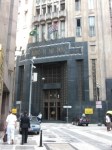
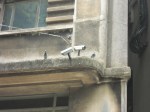
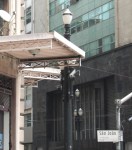
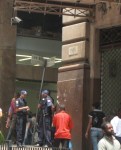
Nor surprisingly there is very little surveillance in the area around the hotel, except the old fashioned kind and you better be sure that people are watching you from the little shops and street corners. However when you head down the Av. Sao Joao into the financial district, it’s a different story. I was cautious about taking obvious pictures of police and security guards, let alone the serious security inside the bank entrances (metal detectors, scanners, guards etc.) because I just don’t know what kind of trouble that would bring, but here’s a flavour.

UK travel database

Lots of media outlets today and yesterday reporting on the UK government’s e-Borders initiative. I’m not quite sure why particularly now: we’ve known about the e-Borders program – which is based around the new RFID-chipped passports – for some time. Of course the system involves collecting vast amounts of data, including rather more personal information than seems in any way necessary, like for example, travel companions – as if terrorists and criminals will obediently identify themselves by booking and traveling together!

For that is the justification for all this. On the Politics.co.uk website, Phil Woolas, the Minister of State for Borders and Immigration – another barrel-scraping appointment by a government that doesn’t really have many options for ministers now – said that this is is just about allowing ‘us to count all passengers in and out of the UK.’  But this isn’t just counting. What was a system derived in a combination of bowing to US demands after 9/11 and embarrassment over the government’s total inability to counter opposition criticism over immigration with any real facts has expanded its functionality (as with all of these systems) into something rather more comprehensive.

Woolas goes on to say that it ‘targets those who aren’t willing to play by our rules’ – tough talk, but it with the ever increasing numbers of trivial, silly and sometimes plain bad rules introduced by the current government, it’s hard to know what playing by the rules means anymore. This is a major problem for those who just accept all of this with a shrug and argue ‘nothing to hide nothing to fear’. I also wonder how long it will be before this database is hacked or details get left on a train or the whole thing is ‘lost’. Maybe I will start paying attention to Phil Woolas’s idea of the rules when his government starts paying attention to the European Convention on Human Rights, introduces some proper accountability and oversight for all these new surveillance initiatives as the House or Lords recommended, and stops losing our data and pandering to fear. Accountability, competence, ethics and rationality: it’s not much to ask from a government is it?

Surveillance and the Recession

In the editorial of the latest issue of Surveillance & Society, I speculated that that the global recession would lead to surveillance and security coming up against the demands of capital to flow (i.e. as margins get squeezed, things like complex border controls and expensive monitoring equipment become more obvious costs). This was prompted by news that in the UK, some Local Authorities were laying off staff employed to monitor cameras and leaving their control rooms empty.

However an article in the Boston Globe today says different. The piece in the business section claims that – at least in its area of coverage – the recession is proving to be good business for surveillance firms, especially high tech ones. The reasons are basically that both crime and the costs of dealing with it become comparatively larger in lean periods. The article doesn’t entirely contradict my reasoning: organisations in the USA are also starting to wonder about the costs of human monitoring within the organisation, but instead they are installing automated software monitoring or are outsourcing the monitoring to more sophisticated control rooms provided by security companies elsewhere.

Shouting cameras in the UK (The Register)

They also note that human patrols are in some case being replaced (or at least they can be replaced – it’s unclear exactly how much of the article is PR for the companies involved and how much is factual reporting) by ‘video patrols’, i.e.: remote monitoring combined with reassuring (or instructive) disembodied voices from speakers attached to cameras. Now, we’ve seen this before in the UK as part of New Labour’s rather ridiculous ‘Respect Zones’ plan, but the calming voice of authority from a camera, now what famous novel does that sound like? Actually if it’s not Nineteen Eighty-Four, it is also rather reminiscent of the ubiquitous voice of Edgar Friendly in that odd (but actually rather effective) combination of action movie and Philip K. Dickian future, Demolition Man. The point is that this is what Bruce Schneier has called the ‘security show’. It doesn’t provide any real security, merely the impression that there might be.

How long will it be before people – not least criminals – start to get cynical about the disembodied voice of authority? This then has the potential to undermine more general confidence in CCTV and technological solutions to crime and fear of crime, and could end by increasing both.

Quiet in the Library! Controlling the Internet

For many supposedly liberal politicians and bureaucrats the Internet is just a library of information, and we all know that libraries must be quiet and orderly, used responsibly and under the supervision of trained librarians…

Just a quick one: Boing Boing covered the story of an Australian EFF information rights campaigner, Geordie Guy, who has received a death threat from supporters of the government´s plan to control the Internet – just like so many other states around the world.

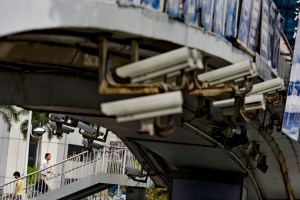
Surveillance cameras in Dajuyuan, Shenzhen (Rolling Stone)

It is no accident that the EFF campaign in Australia makes reference to their government´s plan as a ‘great wall’.  The first government to do this was, of course, China with its jīndùn gōngchéng (‘Golden Shield’) system which was exposed by Greg Walton.

As Naomi Klein´s more recent investigations have shown, it seems that western governments and companies are not only deeply involved with supplying equipment and expertise to China´s new surveillance state, but also see the development of the combined physical and virtual surveillance infrastructure being built by the authoritarian Chinese government as some kind of model for their own supposedly more liberal nations.

The Internet seems to worry all sorts of otherwise level-headed and well-meaning people. I was invited to speak at a recent conference in Finland on security in the Baltic states, and I got into a small argument with the rapporteur of one of the working groups, who said that one of their conclusions was that ‘we’ must stamp out hate-speech on the Internet. I asked the rapporteur how they would intend to do this without destroying the structures which enabled the creativity and freedom of the Net, and the response was that stamping out hate-speech was too important and just must be done. I suspect this is how a lot of supposedly liberal politicians and bureaucrats are thinking. For them the Internet is just a library of information, and we all know that libraries must be quiet and orderly, used responsibly and under the supervision of trained librarians. If enforcing order destroys everything that makes the Internet so revolutionary and so important, so what? Order must be maintained. There must be quiet in the library!

RFID chips readable ´from more than a mile away´

The important thing about RFID chips is not that they are the ´Mark of the Beast´ or any other such nonsense but that they are an appalling security risk

A story that has been circulating around the place over the last 48 hours, but which was originally in The Register on February 2nd, was the latest from Chris Paget´s valiant attempts to show that using RFID chips is just about the worst way to safeguard confidential information. This time he drove around San Francisco with a simple antenna and managed to read the unique number (which can be used to gain access to information on the US Department of Homeland Security database) from passports up to 30 feet (around 13m away), but he claims that with more powerful equipment, chips could be read from more than a mile (1.6km) away. There is also a very informative video on the site.

The important thing about RFID chips is not that they are the ´Mark of the Beast´ or any other such nonsense but that they are an appalling security risk…

The case of the serial killer and a South Korean surveillance surge

the case of the serial killer, Kang Ho-Soon, looks like it will be the signal for a surveillance surge in South Korea

Martin Innes described how certain ´signal crimes´ can trigger major cultural shifts, changes in policy or in many cases what, a few years ago, I called a ´surveillance surge´. In the UK, the case of James Bulger was one such incident that continues to resonate in all sorts of ways, but in particular has been held to be a major factor in the nationwide expansion of CCTV. 9/11 can be seen as another for the expansion of surveillance in the USA. Now the case of the serial killer, Kang Ho-Soon, looks like it will be the signal for a surveillance surge in South Korea.

Kang, described as a classic psychopath, killed seven women in Gyeonggi province between late 2006 and 2008. He met the women through personal ads and by offering them lifts home as they were waiting at bus stops at night, and then raped and killed them before disposing of the bodies in remote locations. His capture was at least partly down to CCTV images of his car near the sites of the murders.

According to Kim Rahn´s story in the Korean Times, South Korea seems to in the grip of frenzy of fear of strangers, with massive increases in applications to companies offering mobile phone location and tracking services, all schools in Seoul installing CCTV apparently to prevent violence and kidnappings, and in Gyeonggi province, 1,724 surveillance cameras, many with high resolution night vision will be installed. The murders have also sparked new debates about the use of the death penalty in the country.

But, and there is always a ´but´, one interesting fact in the story is that the bus stops where Kang met his victims were unlit. Street lighting is now apparently also to be added. Now it is one of the truisms of studies of CCTV that improved street lighting is a far better deterrent of opportunist crime than cameras – not that you are ever going to deter a true psychopath. Neither street lighting nor all the CCTV cameras in the world will do that.

More broadly however, I wonder whether South Korea is going through a similar breakdown of the feeling of social assurance that Japan is experiencing. At the risk of sounding like George W. Bush, I know Japan is not South Korea and South Korea is not Japan, but both societies traditionally had highly structured, ordered cultures which have been rapidly transformed in the face of industrialisation and globalisation. From my own research in Japan, it seems that the move towards increasing surveillance is strongly connected to this transformation. However at the same time, increasing surveillance is also encouraging the further decline of trust and a move toward a society of strangers. This can be seen as part of what David Lyon is starting to call the ´surveillance spiral´, a self-reinforcing movement in which more surveillance is always the answer to the problems that can at least partly be traced to living in a surveillance society.