
Private Security in Brazil: the global versus the specific

One of the purposes of my project here is to differentiate what is the product of globalising forces (or indeed generator of such forces), and what is more specific and particular to each of the countries and cities that I am examining. If you skim Mike Davis and Daniel Bertrand Monk´s 2007 collection, Evil Paradises, you can certainly come away with the overall impression that everything bad in the world is down to neoliberal capitalism. But actually, many of the contributors to that book, particularly Tim Mitchell on the reasons why the state and private capital are so entangled in Egypt and Mike Davis himself on Dubai, are quite careful about describing the particular historical roots and contemporary developments that have led to the situations they observe. I am trying to do the same.

insurgentAs I wrote last week, the private security industry here in Brazil is obvious and ubiquitous. It is easy to see this simply as part of a trend towards privatisation, and the growth of personal, community and class-based responses to risk and fear that is pretty much the same, or is at least in evidence, all over the world. However, there are several factors here that point internally and backwards in time. The first was made clear to me reading James Holston´s superb 2008 book Insurgent Citizenship, which is both an excellent ethnographic study of contemporary conflicts over housing and land in Saõ Paulo and an illuminating historical account of the roots of such conflicts in the development of citizenship, property rights and order in Brazil from its foundation.

Brazilian National Guard troops in the C19th

Holston makes a comparison between the foundation of Brazil and the other, and in many ways superficially similar, federal state in the Americas, the USA. He argues that whilst the USA consolidated itself within a smaller territory before expanding west, Brazil arrived as a massive fully-formed state. In consequence,  the USA developed a form of governance that expanded with the territory, and this included centrally-determined land surveying and an emphasis on small townships to control territory and organise development. Brazil on the other hand, being basically divided between highly administered colonial towns and practically no administration at all elsewhere, had ´an incapacity to consolidate itself´ (65). The state therefore depended on large landowners, and in particular after the creation of the National Guard (1831), which was delegated to these property owners, these landowners also acquired a military-police power. Effectively, this conflation of private interest and the law, or coronelismo, was built into the governing structure and culture of Brazil.

One of the thousands of private security firms...

It is a masterly analysis but Holston´s one slight error, I think, is to call this ´a nationwide privatisation of the public´ (66). It is hard to argue this when the public had never really yet existed in anything like the idealised sense in which it is used by political scientists – in other words the nature of the ´public´ in Brazil was always pre-defined by the private, and by the power of the private, rather than the other way around. In other words, what has happened since, off and on, has been a struggle by the more democratic and progressive interests in Brazil to bring the private into the public. You can see this right up to the present day with the struggles by the state to prohibit and eradicate the so-called Autodefesas Comunitárias, the authoritarian paramilitary groups that have emerged in Rio and other cities in recent years. The struggle is essentially one of creating the ´public´.
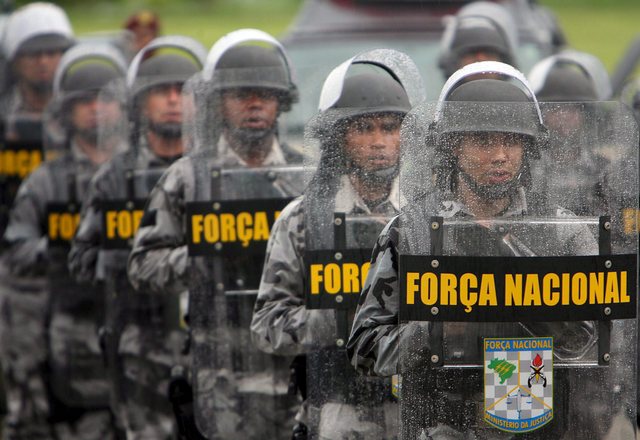
Member of the elite Brazilian National Public Security Force in training, 2007 (EPA/Antônio Lacerda)
Members of the elite Brazilian National Public Security Force in training, 2007 (EPA/Antônio Lacerda)

The ADC issue highlights another historical reason for the dependence on and trust in, private security in Brazil. The reason is simply that the law is not trusted. Judges and courts have long been perceived as essentially tools of privilege and the official police in their various forms are not trusted by many people of all social classes. The former, as with coronelismo, goes way back into the post-colonial period, but the latter is also a particular legacy of the dictatorships (which can also be seen as the ultimate private control of the public), the last of which only ended in 1985. This leaves Lula´s government, the first that can really claim to be at all progressive, with several major problems: making an untrusted police more trustworthy whilst at the same time increasing their effectiveness and equipment; regulating the thousands of private security firms and, if possible, reducing the dependence of property-owning Brazilians upon them; and finally, and most importantly, dealing with the massive underlying inequalities, that are also a product of what Holston calls the the inclusive but inegalitarian nature of Brazil´s constitution and subsequent socio-economic development. The latter subject is outside the scope of my project, but I will be continuing to delve into the differentiations and intersections between segurança pública and segurança privada whilst I am here.

US No-Fly List is a big fat waste of money

I can’t say I am remotely surprised, but in the journal, Homeland Security Affairs, Marcus Holmes has written a comprehensive demolition of the claim that the US federal government’s No-Fly List is an efficient security policy. He isn’t concerned with civil liberties – ACLU has done that elsewhere – nor with effectiveness – Bruce Schneier nailed that one a while back. He simply demonstrates, using elementary Cost-Benefit Analysis that the policy is a big fat waste of money. The article isn’t complicated to understand, so the best thing I can suggest is that you just go read it… (and thanks to Bruce Schneier and Boingboing.net for posting on this one).

More CCTV stories: from Jerusalem to Cambridge

CCTV cameras are seen as the answer to anything and everything. It’s not much more than a form of magical thinking.

Two contrasting CCTV stories today.

On the one hand, we have a seemingly typical story of civic authorities wanting to install cameras, right down to the lazy, cliched, headline: ‘Smile, you’re on surveillance camera’ – how many times have we seen variations on that one? The cameras are proposed to arrest a decline in custom at a busy city market except… that the city is Jerusalem, and the market is the Mahane Yehuda market, a favoured target for suicide bombers. Now, I am not entirely sure how cameras will stop a determined suicide bomber, who by definition isn’t really that bothered about being seen committing a crime, but this is just an extreme case of underlying causes being missed. There are the usual civil rights concerns raised, and the effectiveness of cameras questioned. But suicide bombing isn’t just some unavoidable fact of life, it’s directly related to the ongoing repression by Israel of the Palestinian territories… a clear case of sticking plaster for a mortal wound if ever I saw one.

Here as in many cases, CCTV cameras are seen as the answer to anything and everything. It’s not much more than a form of magical thinking.

On the other hand, we see the town of Cambridge, Massachusetts, voting against allowing Homeland Security cameras to be used. It’s another extreme case of course. You could hardy find a more comfortable and safe middle-class town with a higher concentration of liberal intellectuals – they even had a former head of ACLU speaking at the meeting. It must be positively terrifying to be a city councilor in the face of informed opposition like that. Of course the story is replete with all kinds of ironies, not least the city representative who argues that the city voted against it only because there hasn’t been enough public participation!

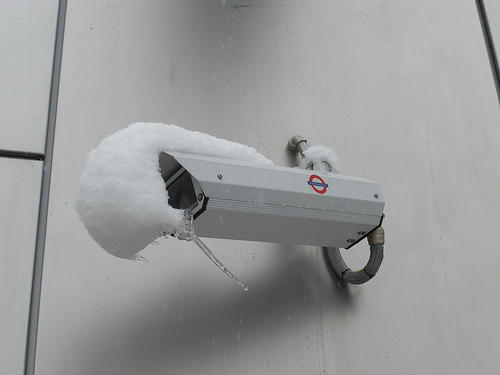
However, as the article also notes, the cameras are already installed, they just aren’t switched on. Perhaps, like this snowbound camera photographed yesterday in London, their ‘magic’ will work anyway and everyone will be happy…

They can see through snow, you know. London CCTV camera (by Almost Wiity on boingboing)
They can see through snow, you know. London CCTV camera (by Almost Witty on boingboing.net)

CCTV in Canada

News from Queen’s University’s Surveillance Project that the Surveillance Camera Awareness Network (SCAN), a stellar group of Canadian Surveillance Studies scholars, has released the first phase of its report on Camera Surveillance in Canada.

The report shows that public space CCTV is still relatively rare in Canada, with only 14 cities having implemented it. It argues that despite the lack of evidence for any effectiveness, and the absence of proper informed consent to schemes, the vast majority of the public support cameras largely on the basis of an ill-defined hope that they ‘work’.

My view is that the conditions for a British-style expansion would seem to be in place, were it not for the very different and much more activist role of Privacy Commissioners, informed by research like this, in questioning the need for CCTV. Let’s hope Britain’s role as an experimental surveillance guinea pig for the world will at least teach people elsewhere something…

The authors also mentioned that there is a surveillance series in the Ottawa Citizen that began Wednesday January 29. It features many surveillance studies academics from SCAN and more, and the first piece is really very good.

As another part of the series, the Citizen has adapted the 2016 scenarios that Kirstie Ball and I wrote for the Report on the Surveillance Society for the ICO back in 2006. They have pushed a load of things together so that it doesn’t quite makes sense, but never mind…

Come to Britain and we will fingerprint your kids…

fingerprintLast week I mentioned the approval of the biometric passports scheme by the European Parliament, and that there were several countries that planned to fingerprint children under the age of 12 despite the legal, ethical and technical problems with this.

However, what I didn´t mention is that – surprise, surprise – Britain is one of the countries that does fingerprint kids, and indeed it has already been fingerprinting foreign children resident in Britain as young as 6. As Privacy International´s Gus Hossein argues on The Guardian´s Comment is Free website, the UK government claims that this is only bcause the EU has forced this upon them when in fact it was the UK government that forced the EU into adopting that position in the first place!

Now, as I mentioned, the European Parliament has pushed the age limit upwards, but will this make any difference to the UK Home Office? Given that the Home Office is still ´carefully considering´ its responce to the kicking it received from the European Court of Human Rights over the taking and retention of the DNA of 857,000 children, I wouldn´t bank on it.

Learning Surveillance Systems

Several years ago, during my postdoctoral work on algorithmic surveillance, I was warning of the problems associated with the development of heuristic (learning) software applied to surveillance systems. I argued that their popularity would grow as the amount of data acquired through growing numbers of cameras that could not possibly be watched by human operators. Today in CSO Security and Risk, a magazine for ´security executives´, there is a piece by Eric Eaton which summarises the current state of the art, and which makes exactly that argument as a reason why operators of surveillance systems should consider using such learning software. As Eaton says,

¨Various tools have emerged that not only “see video better,” but also analyze the digitized output of video cameras in real time to learn and recognize normal behavior, and detect and alert on all abnormal patterns of activity without any human input.¨

Judge, jury... and executioner
Judge, jury... and executioner (IPC magazines)

The key issue here, and one which I mentioned in my post about angry robots the other day, is the automated determination of normality. As French theorist, Michalis Lianos, argued in Le Nouveau Contrôle Social back in 2001, the implementation of these kinds of systems threatens to replace social negotiation with a process of judgement and sometimes even the consequences (which in some border control systems can be fatal – Judge Dredd as computer).

Eaton identifies the first part of this conundrum when he says that ¨the key to successful surveillance is learning normal behaviors¨and he believes that this will enable systems to filter out such activity and ¨help predict, and prevent, future threats.¨ He does admit that in many cases the numbers of actual instances of systems detecting suspicious behaviour is very small and therefore the cost of systems may not be economically justified, but there is as usual amongst his ´5 musts´ for security operators, no place to be found for ethics, human rights (or indeed humanity outside of systems operators) or consideration of the wider social impacts of the growth in use of learning security machines.

No doubt he would say, as most developers and operators do, that this is simply a matter of how systems are used in compliance with best practice and the law, which in itself ignores the possibility of already consciously or unconsciously programmed-in biases, but the more that systems become intelligent and are able to make decisions independently of human operators, the thinner this legalistic response becomes. I´m not saying that we are about to have automatic car park CCTV cameras with guns any time soon, but it´s about time we had some forward-looking policy on the use of heuristic systems before they become as normal as Eaton suggests…

Brazil as Surveillance Society? (1) Bolsa Família

The claim that Brazil is a surveillance society, or at least uses surveillance in the same fundamental organising way as the UK or Japan does, is based on the bureaucracy of identification around entitlement and taxation, rather than policing and security.

My previous post on the subject of whether Brazil was a surveillance society put one side of an argument I am having with myself and colleagues here: that the use surveillance in Brazil is fundamentally based on individual (and indeed commodified and largely class-based) security, rather than surveillance as fundamental social organising principle (as one might legitimately claim is the case in Britain). Now, I deliberately overstated my case and, even as I was posting, my argument was being contradicted by colleagues in the same room!

So here´s the counter-argument – or at least a significant adjustment to the argument. In most nation-states, entering into a relationship with the state involves forms of surveillance by the state of the person. This relationship is more or less voluntary depending on the state and on the subject of the relationship. In most advanced liberal democracies, the nature of surveillance is based on the nature of citizenship, particularly:

  1. the ability of citizens to establish claims to entitlement, the most fundamental to most being a recourse to the law (to protect person and property), secondly the ability to case a vote, and more something that is generally more recent in most states, the right to some kind of support from the state (educational, medical, or financial);
  2. the ability of the state to acquire funds from citizens through direct or indirect taxation, to support the entitlements of citizens, and to maintain order.

I am not going to consider law and order, or indeed electoral systems, here but rather I will concentrate on the way that surveillance operates in an area I had previously begun to consider: the bureaucracy of identification around state-citizen relations particularly in the areas of entitlement and taxation. The claim that Brazil is a surveillance society, or at least uses surveillance in the same fundamental organising way as the UK or Japan does, is based on this rather than policing and security.

There are two broad aspects: on the one side, taxation, and on the other, entitlement. I´ll deal first with the latter (which I know less about at the moment), in particular in the form of Lula´s Programa Bolsa Família (PBF, or Family Grant Program), one of the cornerstones of the socially progressive politics of the current Brazilian government. The PBF provides a very simple, small but direct payment to families with children, for each child, provided that the children go to school and have medical check-ups.

Of course these requirements in themselves involve forms of surveillance, through the monitoring of school attendance by children – for which there is a particular sub-program of the PBF called Projeto Presença (Project Presence) with its own reporting systems – and epidemiology and surveillance of nutrition through the Ministério de Saúde (Ministry of Health). However underlying the entitlement is massive compulsory collection of personal information through the Cadastro Único para Programas Sociais (CadÚnico, or Single Register for Social Programs), set up by Lula´s first administration to unify the previous multiple, often contradictory and difficult to administer number of social programs. This is, of course a database system, which as the CadÚnico website states, ¨funciona como um instrumento de identificação e caracterização socioeconômica das famílias brasileiras¨ (¨functions as an means of identification and socioeconomic caracterization of Brazilian families¨). Like most Brazilian state financial systems, CadÚnico is operated through the federal bank, the Caixa Econômica Federal (CAIXA). The CadÚnico database is founded on ¨um número de identificação social (NIS) de caráter único, pessoal e intransferível¨ (¨a unique, personal and non-transferable Social Identification Number or NIS¨). I am unclear yet how this NIS will relate to the new unique identification system for all citizens.

The PBF Card
The PBF Card

Entitlement is demonstrated with (yet another!) card, the patriotic yellow and green Cartão PBF. Like the CPF card, this is a magnetic strip card rather than a smart card, and is required for all transactions involving the PBF. Also like the CPF, but unlike many other forms of Brazilian ID, it has nothing more than the name of the recipient and the CadÚnico number printed on it. In this case the recipient is generally the mother of the children being claimed for, a progressive and practical measure shared with other family entitlement programs in Brazil.

Happy smiling PBF cardholders!

The PBF card in itself may not be enough to claim as you would still need at least the Registro Geral (national ID) card to prove that you are the named holder of the PBF card. The card itself may be simply designed to generate a sense of inclusion, as the pictures of happy smiling PBF cardholders on the government websites show consistently emphasise, although of course, like so many other markers of entitlement to state support, it could also become a stigma.

The information collection to prove entitlement is quite extensive, and here I have translated roughly from the website:

  • house characteristics (number of rooms; construction type; water, sewerage and garbage systems);
  • family composition (number of members, dependents like children, the elderly, those with physical handicaps);
  • identification and civil documents of each family member;
  • educational qualification of each family member;
  • professional qualifications and employment situation;
  • income; and
  • family outgoing (rent, transport, food and others).

Although PBF is a Federal program, the information is collected at the level of individual municipalities, and there is thus the potential for errors, differences in collection methods, delays and so on to hamper the correct distribution of the money. So each municipality is required to have a committee called the Instância de Controle Social (Social Control Authority) which, whilst it may sound sinister to anglophone ears, actually refers to the control of civil society over the way that the government carries out its social programs. This is also quite a lot of information of the most personal kind and whilst, unlike in many countries there is no central authority of Commissioner for Data Protection in Brazil, there is particularly for PDF, an Observatório de Boas Práticas na Gestão do Programa Bolsa Família (Observatory for Best Practice in the Management of the PBF), which has a whole raft of measures to safeguard and protect the data, correct errors etc (what has been called habeus data principles). Effectively, this is a case of knowing exactly quis custodis ipsos custodes!

Now of course, such a large database of information about the most vulnerable people in society has the potential to be misused by a less progressive or even fascist government. Marxist analysis of early welfare systems has tended to colour our views of such programs as being solely about the management of labour on behalf of capital and the control of the working classes by the state to prevent them from more revolutionary action. For more recent times in Surveillance Studies, John Gilliom´s book, Overseers of the Poor, showed how much Federal assistance programs in the USA could impact negatively upon the lives of claimants, particularly women, in the Appalachian region, and revealed the everyday forms of resistance and adaptation that such women used to make the programs function better for them. I will have to examine more detailed anthropological studies of the PBF to see whether similar things are true of the Brazilian program. I don´t want to get too much into the effectiveness of this program now, although I am trying to examine the correlation of the PBF with apparently declining crime rates in Brazilian cities, but it is worth noting that the World Bank rates it as one of the most successful ways of dealing with extreme poverty in the world. As a general observation, it does seem that only those who object to redistributive policies full stop (or just dislike Lula himself) or those who think it does not go far enough, have any serious complaint about the PBF. But there is far more to consider here…

Keep quiet or get labelled a terrorist…

BoingBoing brings this piece from the Daily Kos to my attention. It’s a disturbing story of what has happened on a number of occasions to people who annoy flight attendants and end up being labeled as terrorists. These ridiculous rulings have been severely debilitating – in the most extreme case, one woman lost access to her children, and in a Kafkaesque twist was unable to argue the case because she could not reach the custody hearing (in Hawai’i) because she was banned from flying!

These rulings have all occurred through extreme interpretations of the provisions of the US PATRIOT Act. However both this tendency for laws to extend their reach is not unique to the USA, indeed Britain may be far more culpable in this regard but in its mundane, bureaucratic way. Examples include the way that the Harassment Act, designed to protect people from stalkers, has become a tool of corporations against protestors, and the Regulation of Investigatory Powers Act (RIPA), which has enabled local authorities to employ intensive surveillance of individuals for such heinous acts as recycling wrongly.

The other issue here is once again, one of responsibilization, the enabling of ordinary people in minor positions of responsibility, or none, to use powers that would previously have been reserved to law enforcement officials or the court system. In the USA, it is flight attendants, whose role has increased markedly as post-9/11 provisions have ratcheted up expectations of passenger behaviour, but in Britain, the New Labour administration has enabled hundreds of bureaucrats to issue fines without any court process through the Regulatory Enforcement and Sanction Act, passed last year.

Basically, there are more and more people who, on a whim and with little or no evidence, can make life extremely difficult if you don’t conform to increasingly tight behavioural norms based on pre-established categories – ‘acting like a terrorist‘ being just one. Some of these norms we may even agree with – no-one likes rudeness – but what is happening is a process of desocialization and the replacement of what used to be matters of civility by narrow protocols.

Brazil: Surveillance Society or Security Society?

although there are many forms of surveillance in evidence, Brazil is not fundamentally a ´surveillance society´

What I am doing here is a broad survey of issues around surveillance. I am trying to get to grips with as wide a range of indicators as possible. One impression I have already – which as an impression may be partly or entirely wrong – is that although there are many forms of surveillance in evidence, Brazil is not fundamentally a ´surveillance society´ in the way that the UK is, or in the rather different way that Japan is: Brazil is much more a ´security society´. This is not to say, for example, that there are not many CCTV cameras in the country: Marta Kanashiro´s article in Surveillance & Society last year indicated that there are well over a million cameras (the total is hard to estimate because of the number of illegal installations).

However, surveillance here is very much tied into security. It´s not a ´security state´ – although it still retains reminders of its more authoritarian past – the concentration on security is largely private. Industry reports I have found, for example, this one from the Massachussets South America Office, indicate that the security industry is growing at rates of betwen 10 and 15% regardless of wider economic trends. Foreign companies are poised like vultures over the thousands of SME security companies that make up the huge private security sector, and positively salivate over the high crime figures.

If one talks in abstracts and absolutes, investment in security at a national level seems to make a difference to these figures. The Fórum Brasileiro de Segurança Pública (or Fórum Segurança, the Brazilian Forum on Public Safety), an independent network of local groups, experts and members of state and private secuirty organisations, has started to publish an annual report. The second report, available late last year, indicates a strong correlation between increased spending ($35 Billion US in 2007) and the decline in homicides. For example, in Rio there was an increase in spending of 4.4% and a decline in homicides of 4.7%. A summary in English is available here.

The big thing is not so much public space surveillance (although the industry report mentioned above estimates a $1Bn US market for electronic surveillance technology mainly for the private sector), but both fortification (especially the upsurge in the building of secure condominiums) and the increasing numbers of human security operatives. These may be private security, the new Municipal Guards – basically private security now employed by more than 750 local mayors – or even more worryingly, the urban militias, particularly in Rio. Despite the massive investment in public safety highlighted by Fórum Segurança, official police and other state agents of security and safety are still poorly paid, demotivated and not trusted. To remedy their perceived weakness, in particular in dealing with drug trafficking gangs, so-called Autodefesas Comunitárias (ADC, or Community Self-Defence) groups have emerged. These are paramilitaries made up of current and former police, soldiers, firemen and private security, who basically invade favelas to drive out traffickers in the name of safety, but which soon come to dominate the area and create a new kind of violent order. Now a report by the Parliamentary Hearing Commission into the Militias of Rio de Janeiro, has named names (including several local representatives), and various measures are promised.