
Virtual surveillance fail

this Open-Circuit TV (OCTV) is also about ´responsibilizing´citizens, trying to turn ordinary people into civic spies. Luckily, whilst people love to watch, they generally refuse to behave as agents of surveillance

The US-Mexican border has been a pretty good barometer of the levels of paranoia, waste and stupidity around immigration and surveillance for quite some time now. Now the El Paso Times of Texas reports on the stupendous failure of one massive initiative that was supposed to spread the burden of watching the border by installing webcams (and associated infrastructure) for US citizens to watch online and report anything suspicious.

Around $2 Million US was sunk into the program, yet it had few tangible outcomes. The figures, released under the Texas Public Information Act show that despite 1,894,288 hits on the website, there have been just 3 arrests out of a projected 1200, and only 8 incidents reported in total out of a projected 50,000.

What made me laugh was the comment from the office of Governor Rick Perry, who initiated the scheme, that the only problem was the way in which the scheme´s success had been assessed – there is a quote from a spokesperson that is a classic of government evasion: apparently, ¨the progress reports need to be adjusted to come in line with the strategy¨!

The only sensible comment on the whole debacle comes from Scott Stewart, a surveillance and security expert from Stratfor, who notes as all surveillance experts already know, that cameras are not that effective at deterring or stopping crime, and blames our naive faith in technological solutions that ¨can provide us with a false sense of security¨.

This isn´t just about whether cameras work though.

Of course there are wider issues about the fairness of US relations with Mexico which, under NAFTA, effectively mean that the US uses Mexico as a source of cheap labour and land for manufacturing and the free flow of goods, but does not permit the free flow of people. However for studies of surveillance, it is also about whether encouraging virtual voyeurism is either socially desirable or effective in reducing crime. In terms of effectiveness, of course Bruce Schneier has been arguing for quite a while that most security schemes are inefficient and counterproductive and there was an excellent paper by John Mueller of Ohio State University exploding the statistical myths around security measures in the War on Terror.

But this Open-Circuit Television (OCTV) – not the the usual Closed-Circuit Television (CCTV) we are used to in malls and big cities – is also about ´responsibilizing´citizens, trying to turn ordinary people into civic spies. Luckily, whilst people love to watch, they generally refuse to behave as states would want and do not willingly become agents of surveillance – as this scheme and the experiment in the London borough of Shoreditch with such participatory surveillance schemes, which was similarly successful amongst viewers but achieved no measurable result and was shelved, show.

Note: Hille Koskela of the University of Helsinki, who works mainly on webcams, has been following the Texas border watch scheme and will be presenting a paper on it at our Surveillance, Security and Social Control in Latin America sumposium here in Curitiba in March… I look forward to hearing her analysis.

Civil liberties in Britain

In February, the Convention on Modern Liberty will be taking place in cities across the UK and online. Unfortunately I will still be in Brazil and there are no listed events in Newcastle, which is a great shame – I would certainly have been organising some. This is an issue that tends to cross party lines and unite people of all political persuasions, so I hope as many people as possible in the UK get involved…

The Guardian newspaper´s Comment is Free site also has a special section set up for the event called Liberty Central. Surveillance Studies Network and Surveillance & Society were supposed to be listed there (they contacted us), but they aren´t yet…

Internet Surveillance in Brazil (2)

I’ve been catching up with what has been going on in Brazil in terms of Internet surveillance over the past few months. The good news is that the opposition has had some success in persuading several members of Brazil’s lower house, the Chamber of Deputies, to take their criticisms seriously.

Sérgio Amadeu, who is an Professor at the Faculade Cásper Líbero in São Paulo, a self-described ‘militant for free software’, and one of the originators of the ‘NÃO’ campaign against the proposed bill of Senator Azeredo, reported in December on the outcome of a public consultation on the bill and a flashmob protest against it in São Paulo in November. The outcome has been that a new counter-proposal is being developed by various activist organisations and individuals together with Deputy Julio Semeghini favouring Internet freedom. In fact, the proposal would recast Azeredo’s proposed law on the basis of net citizenship rather than cybercrime.

Professor Amadeu claims that now the Ministry of Justice is in contact with the campaign and that the Secretary for Legislative Affairs at the Ministry, Pedro Abramovay, has apparently shown that he is rather more interested in an appropriate balance between Internet freedom and security. I am always rather suspicious about talk of ‘balance’ in these contexts, and we still don’t know who these impressions will be transformed into action or how many lower house legislators share Deputy Semeghini’s view, but it sounds like there is some reason to be positive – that and the fact that as of today, 134494 people have signed the petition against Azeredo’s bill.

Obama’s new NSA-approved PDA

One story I didn’t mention last week, but which still seems to be doing the rounds, is the saga of new US President Obama´s PDA. Obama is well-known as a Blackberry-addict, using it constantly during the campaign, but as CNET pointed out such wireless devices are known to be highly insecure and vulnerable to all kinds of illicit monitoring and capture. There is, however, one device approved by the US National Security Agency (NSA), which its own employees use, the Sectera Edge Secure Mobile Environment Portable Electronic Device (SME PED), made by defence contractor, General Dynamics C4 Systems of Scottsdale, Arizona. It looks pretty similar to athe Palm Treo series, apart from the strengthned chasis, ‘secure’ ports and special ‘trusted’ display… all this for just $3500! (I hope he´s better at not losing his phones than me…)

Obama´s new PDA
Obama's new PDA

The rest of us, I guess will just have to put up with our insecure communications. The CNET article gives plenty of scary examples of just how insecure they are to simple hacking, even without the NSA’s rather more sophisticated programs. Of course even such NSA-approved ‘secure’ systems will undoubtedly have built-in backdoors that are accessible to the NSA, which is one of the main reasons they are even involved in the development of such technologies. And it is not just these unusual products of course – remember the Windows backdoor revelations from a few years back? Or further back, the Swedish government’s discovery that the NSA could access all their encrypted Lotus Notes documents – this later reverse engineering of the backdoor by Adam Back shows that the spooks are not without a (very bleak) sense of humour. Obama might now have secure communications, but there is always one agency whose evesdropping even he will not be able to avoid…

Violent Crime in Brazil

Murder rates in Brazil and Sao Paulo (The Economist)
Murder rates in Brazil and São Paulo (The Economist, 2008)

Most people tend to think of Brazilian cities as divided and violent, with especially high rates of gang-related gun deaths in and around the favelas. Certainly that was the impression I was starting to get. However, there was an excellent piece last year in The Economist on falling murder rates in Brazilian cities. Yes, that´s right, I said falling murder rates. And not just falling, plummeting.

However, as the article points out, the decline is largely due to a halving of the murder rate in Brazil´s second city, São Paulo. The Economist put this down to a combination of: tighter gun control; better policing (including community policing initiatives and a large new Murder Squad, which ¨uses computer profiling to spot patterns and to act preventively¨); and, a relative decline in the youth demographic as the baby-boom cohort of children born after the mass immigration from the 1970s ages – the gangsters are getting older and getting out of crime, and there are slightly fewer young recruits to replace them. But one note of caution is that this may all be the temporary result of one particular gang gaining a dominant and unchallengable position. My view (not The Economist´s) is that if this latter development is a genuinely long-term trend, it could either result in a move to more legal community development activities by the gang (as has happened in some US cities) or a more stable but persistant pattern of criminality such as that in exhibited by the endemic gang-cultures of Southern Italy or in Japan…

Of course, I should also note that these figures are official ones from the Ministry of Health and I have no idea yet how reliable are the collection or categorisation methods for crime statistics used by the Brazilian authorities.

(thanks to Rodrigo Firmino for this one)

First impressions of Brazil

“whilst Curitiba may not be as divided as its bigger northern neighbour, the pervasiveness of defensive urban architecture is clear”

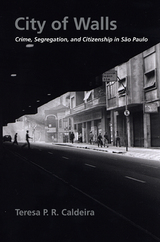
City of Walls by Teresa Caldeira

I have only been here a few days, but some things are already pretty clear. Brazil does not (yet) seem to be as obsessed by surveillance as the UK, but there is a noticeable concern with physical security. The Brazilian urbanist, Teresa Caldeira, called Sao Paulo the ¨City of Walls¨ in her excellent book of the same name, and whilst Curitiba may not be as divided as its bigger northern neighbour, the pervasiveness of defensive urban architecture is clear. Even fairly ordinary suburban houses have high walls, fences and gates,  and some boast razor wire or even electric fences on top. Shopping malls and banks have large numbers of private security guards who are not just hanging around doing nothing as they do in the UK, but seem alert and active. When I went to change some traveller´s cheques, the agency could only be accessed one person at a time, via two locked doors with intercoms and an intervening antechamber with a metal detector.

What is the source of the fear? Of course it is the poor, and in particular the favelados (the people who live in the favelas, the informal settlements that line the riverbanks). Even though in Curitiba, there are not so many favelas and they are not so extensive as in the larger cities of Brazil, the favelas are still no-go areas for non-favelados and I have been warned not even to think about entering. Of course I will be later in Rio, but I will have local help (I hope). Whether one thinks that these are people driven to desperation and crime, or as one contact here said, it is because the drug-runners chose to live amongst the favelados because the police will not follow them there, the division between the favelados and the rest of society is obvious. It is also blatantly racial. The favelados are generally darker, although in Curitiba, which is generally a more European and less African part of Brazil, there are also a significant number of favelados of eastern European descent, the families of immigrants who came to work in construction and were later left without work.

The engineering faculty of the Pontifical Catholic University of Parana, home to the Postgraduate School of Urban Management, where I am based for now, is right up against one of the favelas of Curitiba. The large windows at the back have had to have concrete shields fixed across them as some young guys from the favela had started to enjoy testing their guns out on the panes. There are still a few bullet holes visible in the walls! But don’t let me give you the impression that this is a war zone, or that everyone is paranoid and afraid of each other. It doesn’t seem that way either, and I don’t feel any less safe than I did in Washington DC in the early 90s…

Obama inauguration security

2-inch glass surrounds Obama at his victory celebrations
2-inch glass surrounds Obama at his victory celebrations (Associated Press)

One of the things, I an my co-authors wrote a lot about in our new book is the increasing prevalence of  ‘island security’, the creation of temporary zones of exception around mega-events like the Olympics of the G-8 summits, or even smaller events like political party conferences. It looks like the inauguration of Barack Obama as President of the USA will be one of the biggest ever  island security operations, which a 3.5km exlcusion area, no-fly zone and thousands of police and military personnel on duty.

When it comes to many of these kinds of events, the security is often symbolic, or what we called ‘stage-set security’, but, rather like the new official presidential limousine (AKA ‘The Beast’), the security involved here is hardly likely to be quite so superficial. Nor, I think, do many of the usual advance objections to heavy-handed policing apply: I don’t think there has been a US president in recent history who has either sparked so much hope by so many in the USA or been quite so likely to be targeted for assassination by a few.

Surveillance, Security and Social Control in Latin America Symposium

Some people are probably wondering what I am actually doing here. I sometimes feel like am not quite sure myself, but I will write more on my research over the next few days. One thing my hosts and I are doing is organising the first gathering of surveillance studies scholars in Brazil, the symposium on Surveillance, Security and Social Control in Latin America here at the Pontifical Catholic University of Parana, Curitiba. Hopefully this will form the nucleus of the Surveillance Studies Network in Latin America. We’ve selected 46 papers for presentation, although actually we could do with some more Spanish language contributions… we may issue another extended call soon.