
Border Security Market estimated at $16Bn

A marketing consultancy has estimated that the global border security market, including Unmanned Aerial Vehicles (UAVS), Unmanned Ground Vehicles (UGVs) and perimeter surveillance is due to hit $15.8bn in 2010. Without any sense of irony whatsoever, the company calls the border security market “one of the most exciting emerging markets within the global defence and security marketplace.”

They ask questions like:

“Which regional border security marketplaces offer the most significant growth opportunities? What are the prospects for European and North American defence and security companies seeking business opportunities in the Middle East? How is spending on different types of border security technology likely to be affected as government budgets come under intense pressure? What is the status of the Secure Border Initiative Network (SBInet) or ‘virtual fence’ along the US-Mexico border? To what extent is public opinion driving government policy on border security? What effect is the economic downturn having on illegal immigration?”

To know their answers to these questions though, you’ll have to pay £1499.00 (or $2,418.00 US)! Clearly they believe that the market for reports on border security is also pretty ‘exciting’…
Growing Movement Against Body Scanners in the USA

Two of the major pilots’ unions in the USA are advising their members not to submit to body scans. There have also been a number of cases of people refusing to cooperate with the new (and so far unofficial) more intense TSA ‘pat-downs’ (including ‘testicular cupping’ for men…) for those who decide not to be scanned. Geek website, Boing Boing, has been documenting the growing movement against body scanning, including T-shirts, no-fly days and the like, however it seems rather optimistic to suggest, as they do, that the action of the unions will hasten the inevitable end of the scanners following some talk that they do not detect internal objects in the body and earlier demonstrations that they may not even be that good at finding some external objects. In fact, it seems more likely that not only will they eventually become mandatory sooner rather than later, but that the technical limitations of the current scanners will prompt their replacement by more advanced models that are now already being tested, which do detect internal foreign objects.

Well, I will soon have up close and personal experience of just what is going on when I fly to San Francisco tomorrow… wish me luck!

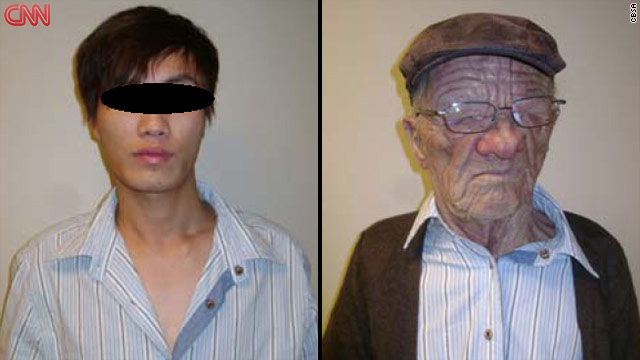
Disguised man allowed to board flight to Canada

An effective disguise (CNN)

CNN has an exclusive today on a young Chinese man who boarded an Air Canada flight from Hong Kong disguised as an old white man. During the flight he removed the mask and then claimed asylum on landing in Canada.

No-one outside of the man concerned and the Canadian Border Security Agency knows much more about this right now. The disguise looks pretty impressive. And he had a boarding pass for a man of the correct age and origins. Of course some people will try to spin this as a ‘security threat’ story, or make it about terrorism. But really this says far more about the desperation of those trying to claim asylum faced with the rather kafkaesque logic of such systems, which tend to assume that claimants can use legal means to escape from situations where their life might be in danger…

Not everything is about the (still relatively small) risk of terrorism and nor should we overreact or organise or always try to reorganise our societies on the basis of that risk. Canada has a historically-deserved reputation as a humane refuge for those in need. This should be defended.

Rio de Janeiro to continue in hardline direction

The Brazilian presidential elections may be only at the half-way stage – with Lula’s hand-picked successor, Dilma Rousseff, not quite securing the 50% she needed to avoid a run-off, largely due to a late surge by the radical Green Party candidate, Maria Silva – but the results of the elections for Rio de Janeiro’s Governor were much clearer. The incumbent, Sergio Cabral, was easily re-elected with just over 66% of the vote. Second was, once again, a Green Party candidate, Fernando Gabeira, with almost 21%, followed by a slew of minor candidates.

Cabral was expected to win as he is supported by the growing middle classes who have done well due to the economic bouyancy of Rio in the last few years. However, it is by no means clear that this result will do much good for the poorest in society. Cabral, along with the Mayor Eduardo Paes, favours a hardline approach to the favelas and their inhabitants, favouring a law-enforcement and crime-control approach to a social one – what Paes calls the choque de ordem. In this sense he is out of step with the national government, however for the middle class of Rio reading their copies of O Globo behind the doors of their secured apartments, the favelas represent not an unfair city which is still unable to close the massive gap between the rich, growing ever richer, and the poor, but a spectre of criminal disorder and a source of fear

The upcoming mega-events, particularly the FIFA World Cup, 2014, and the Olympics in 2016, have only strengthened the feeling amongst the privileged that Rio must simply crack down on violence rather than dealing with the underlying problems (poverty and the international drugs and small arms trades) that fuel the violence. What this means in practice is ‘out of sight, out of mind’: walling off favelas, installing surveillance cameras, stopping the illegal street vending that gives many in the favelas some small hope of a livelihood, and demolishing high-profile new construction.

*For more on my work in Brazil and in Rio de Janeiro, see the entries from January to April last year…

Dawn of the Surveillance Dead

My second zombie story today may be (at least for anti-surveillance advocates) a more positive one. Every since the global credit crunch hit, I have been wondering about its effects on the expansion of the surveillance industry (see here, here, here and here). On the one hand, it could be hit as hard as any other sector, but on the other, security tends to be the one sector that thrives in recessions as crime, or at least fear of crime, rises in these periods. I saw on the UK industry site, Surveillance Park, a story about a report by Plimsoll Analysis, conducted over the summer this year, saying that of 960 companies surveyed in the surveillance field in the UK, 143 have been left in a ‘zombie’ state by the recession. Essentially these companies are the living dead: they look like active companies, they have an offficial existence, but in reality there is nothing alive inside – they stumble on merely to pay off existing debts.

However, whilst this may seem like a significant blow to the ongoing expansion of the surveillance industry – that’s 21% of the companies in the sector in trouble – the industry analysts argue that in fact this provides a further opportunity for market consolidation. They say that 79 of these companies are in fact ripe for take-over.

This is part of a trend we have also been witnessing in the research we are doing currently for the Canadian Federal Privacy Commissioner on the involvement of private companies in border control – see e.g. this story. In my view, what is emerging from the recession is a global surveillance and security industry that will be composed of bigger, more diversified companies – a ‘rationalization’ of the proliferation of small start-ups and spin-offs that started in the 1990s but really took off after the US (and international) response to the 9/11 attacks, which made it clear that there would be long-term state investment in and purchasing of high-tech surveillance and security ‘solutions’. The thing is that for those interested in challenging the onward march of surveillance, this may not be such good news after all – bigger companies with their own institutional structures and cultures, and lucrative guaranteed state contracts, are likely to be far less amenable to influence from the outside.

Top Secret America

Top Secret America is a really excellent project from The Washington Post with some excellent articles and classy and educative graphics. It traces the huge current US security-intelligence complex, and is partituclarly interesting for noting the massive private sector involvement. This isn’t actually entirely new – private technology companies have been intimately involved in both the manufacture and the servicing and operation of intelligence for a long time – look at the example of RCA and the early history of the National Security Association, for example. However, this blurring of the boundary between state and private sector now goes much further into the operations of intelligence. The Post alleges that “out of 854,000 people with top-secret clearances, 265,000 are contractors.” That’s almost a third. And the database of companies involved is enormous – nearly 2000. The searchable database is also going to be very helpful in our current work at the Surveillance Studies Centre on the involvment of private companies in Canadian border control!

PS: I should be back up and posting regularly now. I’ve had one of my occasional anti-blogging periods!

Surveillance and Ethical Investment

An interesting case today. Associated Press is reporting that Sweden’s major pension fund has decided to drop the company, Elbit Systems, from its investment portfolio on the grounds that it provides surveillance equipment to the separation barrier that cuts through the Occupied Territories of the West Bank. The find has an ethical policy and as the European Union considers the barrier to be in violation of international law, it seems they had little moral choice but to drop it. Interestingly the Israeli government has complained on behalf of this private company, which of course just serves to highlight still further the close links between the state and security firms and arms manufacturers in Israel. I am not sure that it’s particularly ethical for any national pension fund to be propping up another nation’s security policies, let alone a policy that is so controversial not to say overtly illegal. But beyond this Elbit is a major arms company that would, I thought, in any case have been off-limits for a fund with ‘ethics’ – see: Neve Gordon’s report on The Political Economy of Israel’s Homeland Security produced for The New Transparency collaborative research initiative here at the Surveillance Studies Centre at Queen’s.

Google does the right thing, but…

Google is, as I type this, closing down its Chinese site as the first stage of its withdrawal of service from mainland China, in response to numerous attacks on the company’s computers from hackers allegedly connected to the Chinese state and ongoing demands to provide a censored service with which they felt they could not comply. The company claims that Chinese users will still be able to use Google, only through the special Hong Kong website, http://www.google.com.hk, which for historical reasons falls outside the Chinese state’s Internet control regime. Whether this will mean that the site will actually be accessible to Chinese Net users is debateable. Some say they cannot access it already. There are also numerous ‘fake Google’ sites that have sprung up to try to make some fast cash out of the situation.

But there’s more to this of course. Google has been widely reported to have opened its doors to the US National Security Agency (NSA) in order, they say, to solve the hacking issue, but the NSA only get involved in matters of US national security – if Google is essentially saying it is effectively beholden to US intelligence policy and interests, I am not sure that this is a whole lot better than bowing to China. You can be sure as well, that once invited in, the NSA will insinuate themselves into the company. Having a proper official backdoor into Google would make things a lot easier for the NSA, especially in populating its shiny new data warehouse in Utah

Support Peter Watts

I’ve been snowed under teaching recently and haven’t been posting much. One thing has really got my goat though and I think it needs wider attention. Those of you who read boingboing will already know, but the SF author, Peter Watts (who wrote the excellent novel of really alien contact, Blindsight) has been convicted of obstructing US border guards and could spend up to two years in prison. This is despite the fact that the border guards lied about the whole incident (they claimed he had tried to choke an officer, when in fact they were assaulting him, a fact admitted in court). He basically got convicted for challenged the guards and getting out of his car to ask what was going on. As Cory Doctorow comments on BoingBoing, this is not about security, this is not about safety, and it is not even about crime as we would recognise it, it is about authority and the massive increase in humourless abuse that has increased so much in recent years, particularly on the US border*. Peter Watts was convicted essentially of not responding fast enough and questioning commands. He’s now posted more on his own blog, including some comments from some of the jury, who couldn’t quite believe the outcome…

Anyone who thinks ‘nothing to hide, nothing to fear’ or truly believes that it couldn’t happen to you, read this a be concerned. Show your support for Peter too. Write to your congressmen if you are in the USA, or Members of Parliament in Canada, write to Ministers and Secretaries of State. Make a fuss. Write to Peter too and tell him you support him.

*And sure, there’s a context, but it seems to me that the post-9/11 situation is used as an excuse by rather too many guards to exercise a petty brutality on anyone who does not conform to their perception of normality. That critical point where liberty comes up against security is just as much about interpersonal encounters like this as it is about grand policy.

German Constitutional Court shoots down new ‘Lawful Access’ Provisions

Germany’s Constitutional Court is one of the few such national institutions that has been brave enough to interpret the right to privacy as actually meaning something that might outweight the state’s desire to know. According to the BBC, in a really strong decision, it has just ruled that a 2008 law, requiring all telecommunications traffic data to be stored for 6 months, violated privacy rights of citizens and should be struck out. Germany had already threatened to veto the European Union’s Telecommunications Directive 2006/24/EC (which came into force last year), a move which prompted the Council of Minister to take the unethical and devious step of redefining the Directive as belonging to the ‘commercial’ field (which requires only majority vote) as opposed to being a matter of ‘security’ (in which there has to be unanimity). We will now see what is the reaction of the German government to their own law being declared unconstitutional, and indeed, what international reverberations this have – the USA will certainly not like this.

(Thanks to ‘Unkraut’ for the pointer)