
The Unbearable Shallowness of Technology Articles… or, what Facebook Graph Search really means.

Wired has a feature article about Facebook’s new search tool. The big problem with it is that its vomit-inducing fawning over Facebook’s tech staff. In trying to make this some kind of human interest story – well, actually the piece starts off with Mark Zuckerberg’s dog, you see, he is human after all – of heroic tech folk battling with indomitable odds to create something amazing – what in science fiction criticism would be called an Edisonade – it almost completely muffles the impact of what a piece like this should be foregrounding, which is about what this system is, what is has been programmed to do and where it’s going.

And this is what Graph Search does, very simply: it is a search engine that will enable complex, natural language interrogation of data primarily but not limited to Facebook. So instead of trying to second-guess what Google might understand when you want to search for something, you would simply be able tell you what you ask. And because this is primarily ‘social’ – or about connection, and you should have already given up enough information to Facebook to enable it to ‘graph’ you so that it knows you, the results should supposedly be the kind if things you really wanted from your query. Supposedly. An FB developer in the article describes this as “a happiness-inducing experience” and further says, “We’re trying to facilitate good things.” However what this ‘happiness’ means, just like what ‘friendship’ means in the FB context, and what “good” means, just like the use of ‘evil’ in Google’s motto, is rather different than how we might understand such a term outside these contexts.

In the article, one example demonstrated by the developer is as follows:

[He] then tried a dating query — “single women who live near me.” A group of young women appeared onscreen, with snippets of personal information and a way to friend or message them. “You can then add whatever you want, let’s say those who like a certain type of music,” [he] said. The set of results were even age-appropriate for the person posing the query.

So when Mark Zuckerberg is quoted in the article saying that Graph Search is “taking Facebook back to its roots”, he seems to mean creeping on girls, as was, let us not forget, the main intention of the early Harvard version. Doesn’t this generate exactly the concern that the notorious ‘Girls Around Me’ app encountered? As the title of my favourite tumblr site has it, this isn’t happiness. Or it’s the happiness of the predator, the pervert and the psychopath.

But more fundamentally, this isn’t about privacy, or even online stalking. In fact, in many ways, both are side-issues here. This is about control and access: control over my information and how I access other information, not just on Facebook but in general. To me, the plans outlined for Graph Search look worrying, even outside of my idea of what would constitute happiness, because they have nothing to do with how I use Facebook or how I would want to use it. I don’t use Facebook as my gateway to the Web and I am never going to. As Eli Pariser pointed out in The Filter Bubble a couple of years back, that would both be limiting of my experience of the Web (and increasingly therefore of my communications more broadly) and give one organisation way too much power over both that experience and the future of the Web. But this does seem to be how Facebook wants it to be, and further, I suspect that, just like Bill Gates before him with his .NET initiative and other schemes, and just like the walled garden locked-in hardware that Apple produces, Zuckerberg is more interested in Facebook colonizing the entire online experience, or layering itself so entirely, tightly and intimately over the online world that the difference between that world and Facebook would seem all but invisible to the casual user.

These developments are dramatic enough in themselves. Never mind fluffy stories of heroic techies and their canine sidekicks.
Lives at stake for social media users

Al-Jazeera is carrying an excellent piece from the Electronic Frontier Foundation reminding social media network owners and regulators in their home countries that lives could be at stake because of the choices they make about security, privacy and anonymity.

Countries like Syria and Iran are purusing a plethora of surveillance and disruption tactics to identity and frustrate activists using social media to organise against their oppressive regimes, and the responses of the networks could be vital. This is something that Google in particular does not appear to have appreciated at all in its current insistance on ‘real indentities’ being the basis for all networking on Google+. Its attitude makes a very naive and dangerous assumption about the nature of states both present and future.

Guess who likes the UK’s proposals to control the Internet?

In the wake of the riots, several British Conservative MPs, and indeed PM David Cameron himself, have suggested a harsher regime of state control of both messenger services and social networks. Their suggestions have attracted widespread derision from almost everybody who either knows something about the Internet and communications more broadly, or who places any value on freedom of speech, assembly and communication and regards these things as foundational to any democratic society.

However, the a yet vague proposals have gained support from one quarter: China. The Chinese state-controlled media have suggested that the Conservative Party’s undemocratic suggestions prove that the Chinese state was right all along about controlling the Internet and that now these events are causing liberal democracies to support the Chinese model of highly regulated provision (via Boing Boing).

This is pretty much what I have been suggesting is happening for the last 2 or 3 years – see here, here, here and here. It is just that now, the pretense of democratic communication is being dropped by western governments. And just in case David Cameron doesn’t get it – and he really does not appear to right now, no, it is not a good thing that the Chinese government likes your ideas: it makes you look undemocratic and authoritarian.

Facebook learns nothing

Having been strongly criticised over its ‘Places’ feature for its lack of understanding of the concept of ‘consent’ in data protection, and why ‘opt-in’ is better for users than ‘opt-out’ when it comes to new ‘services’ (i.e: ways they can share your data with other organisations), Facebook is doing it again.

Between today and tomorrow, the new Facebook feature called “Instant Personalization” goes into effect. The new setting shares your data with non-Facebook sites and it is automatically set to “Enabled”.

To turn it off: Go to Account>Privacy Settings>Apps & Websites>Instant Personalization>edit settings & uncheck “Enable”.

(Or of course, you can just ‘Turn Off All Platform Apps” too!)

The really important thing is that if your Facebook Friends don’t do this, they will be sharing info about you as well. So, copy this and repost to yours…

(Thanks to Lorna Muir for this alert)

Facebook face-recognition

Reports are that US users can now use an automated face-recognition function to tag people in photos posted to the site. To make it clear, this is not the already dubious practice of someone else tagging you in a photo, but an automated service – enter a picture and the system will search around identifying and tagging.

As a Facebook engineer is quoted as saying:

“Now if you upload pictures from your cousin’s wedding, we’ll group together pictures of the bride and suggest her name… Instead of typing her name 64 times, all you’ll need to do is click ‘Save’ to tag all of your cousin’s pictures at once.”

Once again, just as with Facebook Places, the privacy implications of this do not appear to have been thought through (or more likely just disregarded) and it’s notable that this has not yet been extended to Canada, where the federal Privacy Commissioner has made it very clear that Facebook cannot unilaterally override privacy laws.

Let’s see how this one plays out, and how much, once again, Facebook has to retrofit privacy settings…

A map of the Facebook world

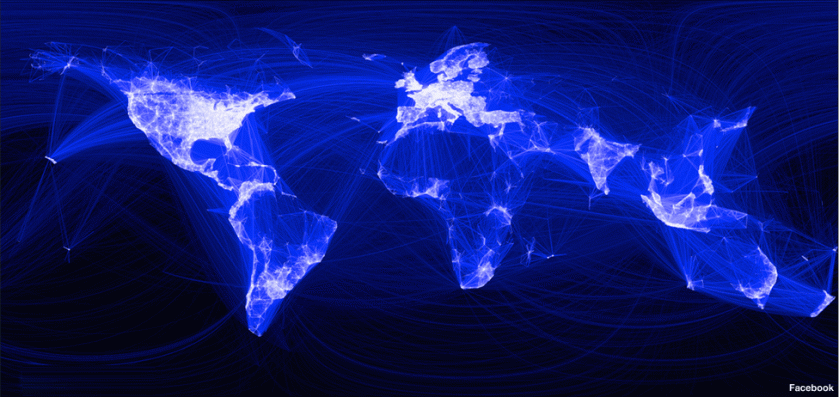
This is a map of Facebook’s world. It was created by Paul Butler, an intern working for the company. It seems quite clearly influenced by those NASA Earth at night images, or those cybergeography maps of Internet connection, and it’s not surprising that the distribution of points is similar.

Butler’s view of this is that:

“It’s not just a pretty picture, it’s a reaffirmation of the impact we have in connecting people, even across oceans and borders.”

Well, yes and no. If you are a flag-waving Facebook utopian or an uncritical naif, then yes, that’s what it could be. But all maps are political and express political economies. For a Facebook executive, this is a map of markets, both current and unexploited. For anyone interested in the ‘digital divide’ and global social justice, this is yet another map of global inequalities, of power, and of uneven access to resources: Africa is still ‘the dark continent’ in the way this data is visualized. Politically, it is also a map of a particular kind of American-centred global power. Whilst it reflects the rise of India and Brazil to some extent (South Americans tend to use other social networking tools like Orcut) or , it also shows how disengaged from this nexus are Russia and China, which have their own networks (and in the latter case, signifcant control over social networking). But essentially, you can see this as a map of contemporary US influence as much as anything.

And, of course, finally, it is also Facebook saying to all of us: “We know where you live!” 😉

Facebook owns patent on location-based social networking

Via Boingboing: Facebook has been awarded a ‘broad’ US patent on location-based social networking services. This seems curious when Foursquare, Gowalla, Google Latitude and many others were doing this long before Facebook, but it seems that Facebook applied for this patent back in 2007, so even though they weren’t doing it before others, in the way the patent system works, they can claim they were thinking about doing it before others.

Facebook seems to be moving strongly to consolidate its hold on social networking and it clearly sees its location-based service, Places, and such like as being the guarantee of its future success. In short, it seems intent on creating a ‘brandscape’ which recombines the virtual and the material producing a seamless data-stream on the lives of its users for it to exploit.

The Tools of Personal Surveillance

There’s always something interesting on BoingBoing, and it was via that site that I came across this story in Salon magazine about one woman’s decision to track down the man who had robbed her. Now, most of the commentary about this has focussed on her commitment and determination and the usual stuff about how the police let criminals prospers etc. However, what interested me was the techniques and technologies that she was able to employ to find this guy: basically not only did she use a whole lot of techniques and technologies that not so long ago would have been the preserve of the intelligence services, police or private investigators, but also the thief in question was also an inveterate social networker and was about as careless with his online personae as most of us are. Of course, what it also shows is that it takes an awful lot of effort to do this, and this kind of obsessive hunt takes over lives, so it would not be a practical option: individual surveillance is not a substitute for the power of the state. It’s a fascinating read…

Facebook Places: opt-out now or everyone knows where you are?

Facebook Places… what to say? Most of the criticism writes itself because we have been here before with just about every new ‘feature’ that Facebook introduces, and they seem to have learned absolutely nothing from any of the previous criticisms of the way in which they introduce their new apps and the control users have over them. Basically, Facebook Places is just like Google Latitude, but:

1. instead of having to opt-in to it, you are automatically included unless you opt out; and (here’s the really creepy part),
2. instead of just you being able to tell your ‘friends’ where you are, unless you do turn it off, anyone who is your friend can tell anyone else (regardless of their relationship to you) where you are, automatically.

Luckily we know how to turn it off, thanks to Bill Cammack (via Boingboing).

When, if ever, will Facebook realise than ‘opt-out’ is an entirely unethical way of dealing with users? It lacks the key element of active consent. You cannot be assumed to want to give up your privacy because you fail to turn off whatever new app that Facebook has suddenly decided to introduce without your prior knowledge. Facebook is basically a giant scam for collecting as much networked personal data as it can, which eventually it will, whatever it says now, work out how to ‘add value’ to (i.e.: exploit or sell), whether its users like it or not. And surely this is now the ideal time for an open source, genuinely consensual social networking system that isn’t beholden to some group of immature, ethically-challenged rich kids like Zuckerberg et al.?

Voluntary Self-Surveillance

In a nice bit of synchronicity with the ‘Surveillance and Empowerment’ call just issued by Surveillance & Society, there’s a really interesting little piece on the rise of ‘self-tracking’ by Curetogether founder, Alexandra Carmichael, in the latest issue of h+ magazine, an open-access publication from ‘transhumanist’ pioneer, R.U. Sirius.

The piece concentrates on those who have health problems who want to track and share symptoms and other biometric data, but argues that this is a wider interest: “we do it because we love data, or we do it because we have specific things we want to optimize about ourselves.”

There are also some useful links to life-logging and patient data-sharing sites.

(thanks to BoingBoing for the link to h+)