The Right to Watch?

I’ve always defended the right to photograph in public places. However, a number of cases in the last few weeks are highlighting an important new development in this area, a new front in the increasingly confusing information wars. Gary Marx always like to say that surveillance is neither good nor bad but that intent, circumstances, and effects make it so, but a growing number of people and organizations seem to be treating surveillance – or at least watching, and certainly not all watching is surveillance – as a right which supersedes rights to privacy. We’ve seen this in the case of Google Glass – even before it was launched commercially – and more recently with the arguments over the ‘right to be forgotten’ in Europe, with personal privacy being counterposed to freedom of information and actions to protect privacy being compared to censorship. It’s all somewhat reminiscent of Dave Eggers’ novel, The Circle, in which a Facebook-Google-Apple-a-like company completely turns around social values until, as one of the corporate slogans has it, “PRIVACY IS THEFT!”

The latest case is that of the use of drones / micro-UAVs / MAVs in the USA. The Federal Aviation Authority (FAA), the government body that controls US airspace, is trying to regulate the use of drones and has attempted to fine commercial drone operators who fly surveillance drones without their permission. The case revolves around one Robert Pirker, who used an unlicensed drone to film a promotional video back in 2011. At the moment the FAA is appealing against the National Transportation Safety Board (NTSB), who rule that it could not fine Pirker as it did have jurisdiction over small drones. Now the media has weighted in on Pirker’s side, arguing that the FAA’s stance infringes the first amendment and creates a ‘chilling effect’ on journalism.

I’m really not sure about either argument. On the FAA side, this is partly about a bureaucracy trying to keep control of its regulatory territory as much it is about the object of the regulation – the FAA does not want to be seen to be losing control just as the number of small drones is increasing massively.

On the other side, is this really about the rights of journalists? Pirker was making a commercial film not covering a story, and the effect of the FAA’s ruling being overturned is more likely to open the door to a corporate free-for-all, an absurd PKDickian world of drones as far as the eye can see, with all the attendant crashes and legal battles, could result. Think not? Well, back in the 1900s, people thought there would never be that many cars on the roads either… so it is certainly it is partly about their mandate, i.e. air safety.

The big question here, as with Google Glass and with Search, is whether technological change makes a difference. Is a flying camera just the same as a hand-held camera? Does the greater potential for intrusion, or on the other hand the inability to know that one is being filmed, matter? Does that possibility that ‘the truth’ will be revealed justify any technological method used to obtain it? If not, which ones are acceptable, whereis the line drawn, and who decides and how? In the UK, the ‘public interest’ would be a good basis for deciding, as has been frequently alluded to in the Leveson Inquiry into telephone tapping conducted by Murdoch-owned newspapers, however ‘public interest’ is a much vaguer term in the USA… what is certain is that conflicts around the ‘right to watch’ versus the ‘right to privacy’ and other human rights and social priorities are only going to intensify.
Rio police invade favelas ahead of FIFA World Cup and Olympics

As I, along with many others, predicted as soon as it was announced that Rio de Janeiro would host the two most globally important sports mega-events, the Rio authorities have launched a major drive to occupy and ‘pacify’ a growing number of the most significant favelas (informal settlements) in the city.

The rationale behind this is to drive out the gangs which control many of these communities. To this end a series of special police units has been created, the UPPs, which attempt to gain control of the settlements. Early experiments were in three favelas, one of which, Santa Marta, I visited in early 2009, when, along with Paola Barreto Leblanc, I conducted interviews with community association leaders and police.

Just last week the police moved into the largest favela, Rocinha. Unusually with police raids of this kind, there was little overt violence and ‘collateral damage’. This is certainly an improvement on some previous operations. However, not everyone was that impressed. This video from ITN News shows the stage-managed nature of the event, which seems to have been largely a demonstration of the ability of the Rio authorities to produce security on demand. As the reporter notes, only one person was arrested which means that hundreds of gang members (in this case of the Amigos dos Amigos, AdA, or ‘Friends of Friends’) will either have fled or remain in the favela.

The plan is apparently for the net to be widened still further, with Sergio Cabral, the Governor, claiming that 40 UPPs will be established, including very soon in the Mare Complex, 16 favelas with over 130,000 in all, which is vital to the preparation for the mega-events as it is close to the international aiport and other major transport links from Rio to the economic hub of Brazil, Sao Paulo. Many AdA members from Rocinha may have fled to the Mare Complex and at some point the pacification is bound to be become violent and less media-friendly. There are also, at least two other alliances of gangs who occupy other important favelas.

The current authorities have also started to emphasize the ‘community-building’ intention of these pacification measures, but it should not be forgotten that almost the first act that Cabral and his sidekick, the Mayor of Rio, Eduardo Paes, implemented on coming to office was to cancel the internationally-praised slum-upgrading program, favela bairro (see some thoughts I had on this after my interviews in 2009) of the former Mayor Cesar Maia, which was aimed at a much deeper and longer-term improvements not just at appeasing middle class voters and impressing the International Olympic Committee and FIFA. We will also see whether, like in Santa Marta, the initial community building efforts are undermined (or perhaps aided) by the installation of surveillance cameras

London Riots and Video Surveillance, Pt.2

My last post was about the lack of any apparent deterrence of rioting from CCTV. However that’s not to say that video surveillance is proving of no use to the authorities. However the way it is being used says a lot about both the limits of CCTV and the general problem of analysis of video images.

As part of ‘Operation Withern’, the investigation into the rioting, the Metropolitan Police have set up a special section of their website, London Disorder Images, as well as on Flickr, which is essentially crowdsourcing the identification of suspects. Despite being the most well-resourced police force in the UK, the Met lacks the resources, time and expertise to analyse and identify everyone it wishes to identify itself, and with widespread popular anger about the riots, they are banking on opening up the process of surveillance and identification as being more efficient and effective – and they may well be right.

Of course, with the problems of lighting, angle, distances, and image quality, the images vary in identifiability – and bear in mind that the few posted so far are probably amongst the best ones – and no doubt there will be many misidentifications. And, in addition, hundreds of people are already being processed through magistrates courts without much need to video evidence. But it is a tactic we are seeing more and more in many places (e.g. Toronto, following the G20 disturbances).

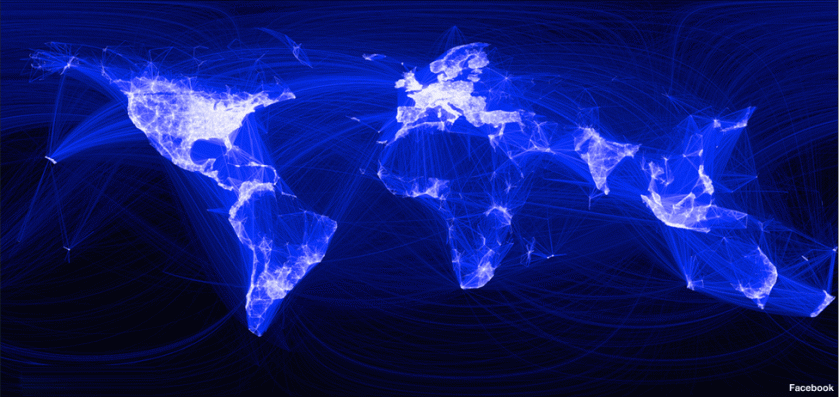
A map of the Facebook world

This is a map of Facebook’s world. It was created by Paul Butler, an intern working for the company. It seems quite clearly influenced by those NASA Earth at night images, or those cybergeography maps of Internet connection, and it’s not surprising that the distribution of points is similar.

Butler’s view of this is that:

“It’s not just a pretty picture, it’s a reaffirmation of the impact we have in connecting people, even across oceans and borders.”

Well, yes and no. If you are a flag-waving Facebook utopian or an uncritical naif, then yes, that’s what it could be. But all maps are political and express political economies. For a Facebook executive, this is a map of markets, both current and unexploited. For anyone interested in the ‘digital divide’ and global social justice, this is yet another map of global inequalities, of power, and of uneven access to resources: Africa is still ‘the dark continent’ in the way this data is visualized. Politically, it is also a map of a particular kind of American-centred global power. Whilst it reflects the rise of India and Brazil to some extent (South Americans tend to use other social networking tools like Orcut) or , it also shows how disengaged from this nexus are Russia and China, which have their own networks (and in the latter case, signifcant control over social networking). But essentially, you can see this as a map of contemporary US influence as much as anything.

And, of course, finally, it is also Facebook saying to all of us: “We know where you live!” 😉

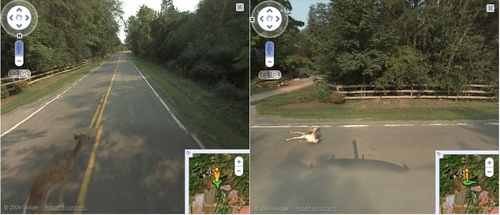
Who killed Bambi?

Google Street View seems to be the surveillance system we currently love to hate, and now those horrible, nasty people only gone and have killed a baby deer. How can Google possibly top this? Perhaps only if Larry Page was captured on camera punching some cute fluffy kittens…

googlebambi
The Daily What preserves the evidence - they have now been removed from Street View

The ironic thing is that the incident was uncovered by viewing Google Street View. Don’t people have better things to do? The more you discover about participatory surveillance or synopticism, the more you realise that the answer is probably not… which is exactly the urge (or lack of it) that Google Street View taps into: the terminal ennui of spectacular consumer capitalism. Sometimes, it’s not Foucault or Kafka or Orwell we should be reading but J.G. Ballard

Virtual surveillance fail

this Open-Circuit TV (OCTV) is also about ´responsibilizing´citizens, trying to turn ordinary people into civic spies. Luckily, whilst people love to watch, they generally refuse to behave as agents of surveillance

The US-Mexican border has been a pretty good barometer of the levels of paranoia, waste and stupidity around immigration and surveillance for quite some time now. Now the El Paso Times of Texas reports on the stupendous failure of one massive initiative that was supposed to spread the burden of watching the border by installing webcams (and associated infrastructure) for US citizens to watch online and report anything suspicious.

Around $2 Million US was sunk into the program, yet it had few tangible outcomes. The figures, released under the Texas Public Information Act show that despite 1,894,288 hits on the website, there have been just 3 arrests out of a projected 1200, and only 8 incidents reported in total out of a projected 50,000.

What made me laugh was the comment from the office of Governor Rick Perry, who initiated the scheme, that the only problem was the way in which the scheme´s success had been assessed – there is a quote from a spokesperson that is a classic of government evasion: apparently, ¨the progress reports need to be adjusted to come in line with the strategy¨!

The only sensible comment on the whole debacle comes from Scott Stewart, a surveillance and security expert from Stratfor, who notes as all surveillance experts already know, that cameras are not that effective at deterring or stopping crime, and blames our naive faith in technological solutions that ¨can provide us with a false sense of security¨.

This isn´t just about whether cameras work though.

Of course there are wider issues about the fairness of US relations with Mexico which, under NAFTA, effectively mean that the US uses Mexico as a source of cheap labour and land for manufacturing and the free flow of goods, but does not permit the free flow of people. However for studies of surveillance, it is also about whether encouraging virtual voyeurism is either socially desirable or effective in reducing crime. In terms of effectiveness, of course Bruce Schneier has been arguing for quite a while that most security schemes are inefficient and counterproductive and there was an excellent paper by John Mueller of Ohio State University exploding the statistical myths around security measures in the War on Terror.

But this Open-Circuit Television (OCTV) – not the the usual Closed-Circuit Television (CCTV) we are used to in malls and big cities – is also about ´responsibilizing´citizens, trying to turn ordinary people into civic spies. Luckily, whilst people love to watch, they generally refuse to behave as states would want and do not willingly become agents of surveillance – as this scheme and the experiment in the London borough of Shoreditch with such participatory surveillance schemes, which was similarly successful amongst viewers but achieved no measurable result and was shelved, show.

Note: Hille Koskela of the University of Helsinki, who works mainly on webcams, has been following the Texas border watch scheme and will be presenting a paper on it at our Surveillance, Security and Social Control in Latin America sumposium here in Curitiba in March… I look forward to hearing her analysis.

CCTV is good for something… or is it?

MSNBC has some great footage of US Airways 1549 that crash-landed in the Hudson yesterday, taken from CCTV cameras on a nearby wharf.

However well this footage shows the undoubted skill of the pilot, I can’t help thinking every time I see this kind of use of CCTV footage that it must play a really important part in the process of normalisation. The fact that people can see footage from CCTV on the news adds to a largely mistaken impression that video surveillance ‘works’. It doesn’t matter whether the footage is of an amazing tale of heroism and survival, a crash or a crime prevented or committed, the images have a pre-rational power. They create a ‘demand’ for more cameras or the idea that they are necessary even though we may be watching something that nothing to do with the purpose of the cameras, and may even, as in the case of images of crime occurring, be witnessing the overt failure of the preventative purpose of CCTV.

Still, great video, isn’t it?