
On the ‘Right to Be Forgotten’

While Viktor Mayer-Schönberger is arguing today both that there’s really not a lot new to the European Court of Justice decision to order Google to adjust its search results to accommodate the right to privacy for one individual and that it really won’t be a problem because Google already handles loads of copyright removal requests very quickly, the decision has also sparked some really rather silly comments all over the media, usually from the neoliberal and libertarian right, that this is a kind of censorship or that it will open the door to states being able to control search results.

I think it’s vital to remember that there’s really an obvious difference between personal privacy, corporate copyright and state secrecy. I really don’t think it’s helpful in discussion to conflate all these as somehow all giving potential precedent to the other (and I should be clear that Mayer-Schönberger is not doing this, he’s merely pointing out the ease with which Google already accommodates copyright takedown notices to show that it’s not hard or expensive for them to comply with this ruling). State attempts to remove things that it finds inconvenient are not the same as the protection of personal privacy, and neither are the same as copyright. This decision is not a precedent for censorship by governments or control by corporations and we should very strongly guard against any attempts to use it in this way.

Google algorithms already do a whole range of work that we don’t see and to suggest that they are (or were) open, free and neutral and will now be ‘biased’ or ‘censored’ after this decision is only testament to how much we rely on Google to a large extent, unthinkingly. This is where I start to part company with Mayer-Schönberger is in his dismissal of the importance of this case as just being the same as a records deletion request in any other media. It isn’t; it’s much more significant.

You are sill perfectly free to make the effort to consult public records about the successful complainant in the case (or anyone else) in the ways you always have. The case was not brought against those holding or even making the information public. What the case sought to argue, and what the court’s verdict does, is to imply that there are good social reasons to limit the kind of comprehensive and effortless search that Google and other search engines provide, when it comes to the personal history of private individuals – not to allow that one thing that is over and one to continue to define the public perception of a person anywhere in the world and potentially for the rest of their life (and beyond). Something being public is not the same as something being easily and instantaneously available to everyone forever. In essence it provides for a kind of analog of the right of privacy in public places for personal data. And it also recognizes that the existence and potentials of any information technology should not be what defines society, rather social priorities should set limits on how information technologies are used.

Personally, I believe that this is a good thing. However, as the politics of information play out over the next few years, I also have no doubt that it’s something that will be come up again and again in courts across the world…

PS: I first wrote about this back in 2011 here – I think I can still stand behind what I though then!

Mozilla stops ad-network cookies

Mozilla, the developer of the Firefox web-browser, has decided that voluntary compliance by advertisers with its ‘Do Not Track’ settings is not working. Advertisers have basically been ignoring what is essentially a request by users, so instead of giving up, Mozilla has taken the right step and will simply not allow ad networks to install cookies on user’s computers or phones. This will of course cut ad revenue to some sites that rely on it, but it will also be a major step to slowing the proliferation of online tracking.

Of course, it can also be seen as a new negotiating position in a long conflict, as the Centre for Democracy and Technology points out, it could be a negotiating position that is all about trying to force companies to implement Do Not Track requests as a compromise from wholesale cookie-blocking. But I’m fully on board with Mozilla here either way. I very much doubt that Microsoft will take a similarly ethical stance on user control – because that’s what this is really about, not privacy as such but who has the right to control information about themselves.

How online companies can protect privacy and free speech

QR_logoThere have been a lot of stories about online services breaching privacy, losing user’s data, being hacked, being to willing to give into state requests for information and much more. But not so much on how companies might provide a positive service that works, whilst respecting privacy, free speech and other fundamental rights. But now ACLU has issued a helpful guide. Clearly, it’s designed for business rather than being a critique of businesses and their practices, and as such is hardly a manual for revolution, but it will be interesting to see who takes notice… and who doesn’t.

Is Google taking a stand?

According to Wired’s Threat Level blog, Google is taking a rather tougher stance towards the US federal government when it comes to requests for cloud-stored data for investigations. The company is now, it says, asking for judicial warrants from state organisations. As Wired points out, even though this might seem ethically sound, it is dubious legal ground as the US Electronic Privacy Communications Act allows the federal government access to such documents without a warrant. And yet, no court challenge has yet been made by the government to Google’s stance.

So what is going on here? Is Google serious about taking on ‘the feds’ in favour of users? Is this new pro-user line by Google merely contingent and once something ‘really important’ is demanded, the company would cave in? Is there some other kind of backroom deal? Is Google actually being rather cynical because the company knows that the NSA can access everything they have anyway (and probably by arrangement – after all, the NSA helped Google out a lot in its battle with China’s authorities)? I suspect there is much more to this apparently casual revelation…

The Unbearable Shallowness of Technology Articles… or, what Facebook Graph Search really means.

Wired has a feature article about Facebook’s new search tool. The big problem with it is that its vomit-inducing fawning over Facebook’s tech staff. In trying to make this some kind of human interest story – well, actually the piece starts off with Mark Zuckerberg’s dog, you see, he is human after all – of heroic tech folk battling with indomitable odds to create something amazing – what in science fiction criticism would be called an Edisonade – it almost completely muffles the impact of what a piece like this should be foregrounding, which is about what this system is, what is has been programmed to do and where it’s going.

And this is what Graph Search does, very simply: it is a search engine that will enable complex, natural language interrogation of data primarily but not limited to Facebook. So instead of trying to second-guess what Google might understand when you want to search for something, you would simply be able tell you what you ask. And because this is primarily ‘social’ – or about connection, and you should have already given up enough information to Facebook to enable it to ‘graph’ you so that it knows you, the results should supposedly be the kind if things you really wanted from your query. Supposedly. An FB developer in the article describes this as “a happiness-inducing experience” and further says, “We’re trying to facilitate good things.” However what this ‘happiness’ means, just like what ‘friendship’ means in the FB context, and what “good” means, just like the use of ‘evil’ in Google’s motto, is rather different than how we might understand such a term outside these contexts.

In the article, one example demonstrated by the developer is as follows:

[He] then tried a dating query — “single women who live near me.” A group of young women appeared onscreen, with snippets of personal information and a way to friend or message them. “You can then add whatever you want, let’s say those who like a certain type of music,” [he] said. The set of results were even age-appropriate for the person posing the query.

So when Mark Zuckerberg is quoted in the article saying that Graph Search is “taking Facebook back to its roots”, he seems to mean creeping on girls, as was, let us not forget, the main intention of the early Harvard version. Doesn’t this generate exactly the concern that the notorious ‘Girls Around Me’ app encountered? As the title of my favourite tumblr site has it, this isn’t happiness. Or it’s the happiness of the predator, the pervert and the psychopath.

But more fundamentally, this isn’t about privacy, or even online stalking. In fact, in many ways, both are side-issues here. This is about control and access: control over my information and how I access other information, not just on Facebook but in general. To me, the plans outlined for Graph Search look worrying, even outside of my idea of what would constitute happiness, because they have nothing to do with how I use Facebook or how I would want to use it. I don’t use Facebook as my gateway to the Web and I am never going to. As Eli Pariser pointed out in The Filter Bubble a couple of years back, that would both be limiting of my experience of the Web (and increasingly therefore of my communications more broadly) and give one organisation way too much power over both that experience and the future of the Web. But this does seem to be how Facebook wants it to be, and further, I suspect that, just like Bill Gates before him with his .NET initiative and other schemes, and just like the walled garden locked-in hardware that Apple produces, Zuckerberg is more interested in Facebook colonizing the entire online experience, or layering itself so entirely, tightly and intimately over the online world that the difference between that world and Facebook would seem all but invisible to the casual user.

These developments are dramatic enough in themselves. Never mind fluffy stories of heroic techies and their canine sidekicks.

Unlawful Access

The campaign video a lot of us were involved in, to raise awareness of the dangers to Canadian communication rights posed by potential new ‘lawful access’ legislation, is now out. Lawful Access legislation was proposed last year but came up against the time limit of the election. It was then proposed to be included in the new Omnibus Crime Bill, C-51, but was split from this and is now likely either to be introduced separately, or attached stealthily to another bill. It isn’t going to go away…

Watch, learn, act…

Please also sign the petition, and there are also further resources and news here, here and here.

Lives at stake for social media users

Al-Jazeera is carrying an excellent piece from the Electronic Frontier Foundation reminding social media network owners and regulators in their home countries that lives could be at stake because of the choices they make about security, privacy and anonymity.

Countries like Syria and Iran are purusing a plethora of surveillance and disruption tactics to identity and frustrate activists using social media to organise against their oppressive regimes, and the responses of the networks could be vital. This is something that Google in particular does not appear to have appreciated at all in its current insistance on ‘real indentities’ being the basis for all networking on Google+. Its attitude makes a very naive and dangerous assumption about the nature of states both present and future.

Guess who likes the UK’s proposals to control the Internet?

In the wake of the riots, several British Conservative MPs, and indeed PM David Cameron himself, have suggested a harsher regime of state control of both messenger services and social networks. Their suggestions have attracted widespread derision from almost everybody who either knows something about the Internet and communications more broadly, or who places any value on freedom of speech, assembly and communication and regards these things as foundational to any democratic society.

However, the a yet vague proposals have gained support from one quarter: China. The Chinese state-controlled media have suggested that the Conservative Party’s undemocratic suggestions prove that the Chinese state was right all along about controlling the Internet and that now these events are causing liberal democracies to support the Chinese model of highly regulated provision (via Boing Boing).

This is pretty much what I have been suggesting is happening for the last 2 or 3 years – see here, here, here and here. It is just that now, the pretense of democratic communication is being dropped by western governments. And just in case David Cameron doesn’t get it – and he really does not appear to right now, no, it is not a good thing that the Chinese government likes your ideas: it makes you look undemocratic and authoritarian.

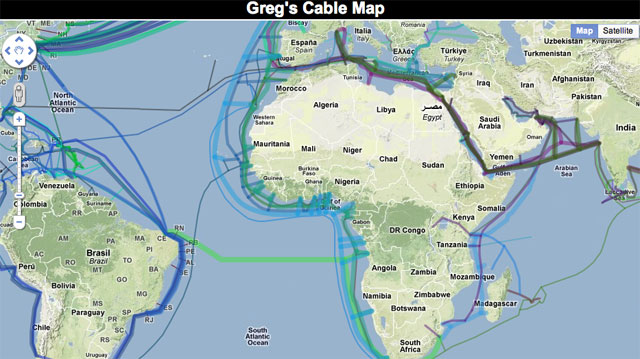
Greg’s Cable Map

Greg's Cable Map

There’s a fascinating interactive map of the world’s undersea communications cables here. It’s also a pretty good guesstimation guide as to where there are, or are likely to be, NSA or subordinate agencies’ (and other non-affiliated intelligence services’) field stations that funnel the data flowing through such cables through computer systems that analyse traffic and content data.

(via Gizmondo)

‘Turning Off’ the Internet

Boing Boing contributors have been doing a fascinating job of documenting the place of the Internet and social media in the ongoing turmoil spreading across Arabic countries. Until recently the focus had been on the use of social media tools by activists, but in the last few days, the empire has struck back. In particular the Egyptian state has effectively ‘turned off’ the Internet, cutting Net access and communications between Egypt and the rest of the world.

What’s particularly interesting is that the rulers of western ‘democracies’ seem to want similar powers. I’ve been writing about the growing movement amongst states to develop powers to split or close the Internet entirely for some time (see here, here and here, for example). Most recently, I reported on French efforts to develop Internet censorship power in wide-ranging circumstances, and as Sean Bonner on BB points out, a bill was introduced into Congress last year by, it’s that man again, Joe Liebermann, to give the USA government even greater powers to cut off civilian access to the Net entirely in the event of a ‘cyber-emergency’.

This is not a drill, people, this is happening…