Canada and Mali

I’m privileged to be supervising some great students at all levels, but Jeff Monaghan is something else*. Not surprisingly for someone who previously worked with the awesomely prolific and engaged, Kevin Walby (now over in Victoria – who may be the young researcher I most admire in surveillance studies), he mainly uses Access to Information and Privacy requests (ATIPs – under Canada’s freedom of information legislation) as a basic method, and as far as I can see he is constantly firing these things off and sorting through them for revealing nuggets. Right now, Jeff is working in the way in which Canadian development aid, like that of many wealthy nations, is becoming increasingly entwined with a security agenda, what he calls ‘security aid’. Anyway, he’s in the news today because one of his ATIPs has revealed that Canada was engaged in planning for military intervention in Mali, of some sort, over a year ago, belying their apparent public reluctance to get involved right now.


Science Fiction post-9/11

I’m writing a piece right now on Science Fiction since 9/11, based around, but not entirely limited to, the themes of security and surveillance. I’ll be giving this as keynote at the Images of Terror, Narratives of (In)security conference in Lisbon on the 23rd and 24th of April this year – I am not sure where I will send it for publication yet. Because of this, I have been reading and rereading a lot of SF, but I thought I’d mention two recent works that have most impressed me. I will probably add more thoughts in the weeks to come on this topic.

intrusion-ken-macleodThe first is Ken MacLeod’s Intrusion (Orbit, 2012).  Ken MacLeod was a welcome participant at Mike Nellis’s excellent split location Glasgow / Jura workshop that marked the 50th anniversary of the publication of George Orwell’s Nineteen Eighty-Four back in 2009, and many of his books have dealt overtly with security and surveillance themes, notably his near-future / alternative world novel, The Execution Channel (Orbit, 2007). Coming out of a period spent not only engaging with surveillance scholars, but more importantly being a Writer in Residence of the UK Research Councils’ Genomics Network, Intrusion takes place in a subtly nightmarish near-future Britain of oppressively caring forced medical intervention (in the form of a compulsory pill to cure genetic illnesses) and ongoing but nebulous terror threats, where even being seen to look too long at a piece of pro-terrorist graffiti is grounds for arrest and ‘torture-lite’ interrogation over where your loyalties lie. For a writer who has a well-deserved reputation as a pretty hardcore materialist and socialist, there are also unexplained hints of myth and magic at the edges of this work, and there is also a strong sense of what architects would call genius loci, the spirit of place, in both its London and Scottish island settings, which make the book all the richer and more satisfying as a piece of fiction. I think it’s his best novel ever, and that is coming from someone who was already a big admirer of MacLeod’s work – all of which is well worth reading.

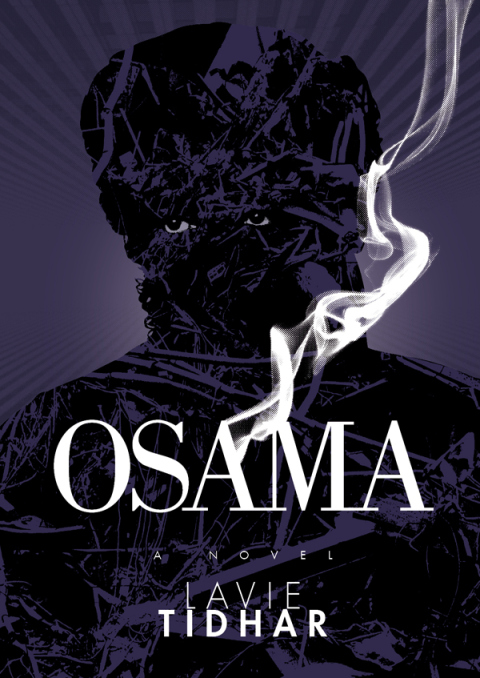
osama_dj_final1

In contrast, Lavie Tidhar’s Osama (PS, 2011) is all edge. It is slippery, slipstreamy and dreamy and reading it generally makes you feel like you’ve been drugged or waterboarded. This novel is dominated by the image of Osama Bin Laden, but not the ‘real’ Bin Laden, for this is a world separate but somehow connected to our own in which 9/11 (and subsequent attacks) never happened. As the novel progresses one realises its alternative earth is profoundly anachronistic, even non-modern: trains still seem to be steam-powered and there is no Internet. In that world, ‘Osama’ is the vigilante protagonist of a series of hard-t0-find cult pulp novels which detail Al-Qaeda’s fictional exploits, but which fill their most fanatical readers in this other world with the belief that somehow the events of the novels are more real than their own. There is a divergence point where everything changed, but it isn’t actually 9/11 at all, it’s much further back and has to do with the Sykes-Pichot agreement which formalized the settlement of the ‘Middle-East question’ in WW1. And Osama Bin Laden, it hints, is inseperable from the history of our own world, inevitable even. Osama is reminiscent of writers like Philip K. Dick, in particular, The Man in the High Castle, and much more so, the surrealism-influenced writers who came out of the 1960s British ‘New Wave’ of SF like J.G. Ballard and Brain Aldiss (I was reminded of that very underrated post-9/11 Aldiss novel, H.A.R.M) and particularly Chistopher Priest, both in terms of his slippy alt-history, The Separation, but also the atmosphere of earlier works like A Dream of Wessex and his ‘Dream Archipelago’ sequence of stories, which he recently added to with The Islanders. But at the same time, Osama is something quite unique, rich with pop cultural allusion, irony and bathos, and frequently seems to invert or counteract its own apparent intentions.

The Internet Must Be Defended (3): Everything is Terrorism?

One of the most ominous developments in the current conflict over Wikileaks has been the move in some quarters to define the publication of leaked information as something more than just ‘irresponsible’ or ‘criminal’ (e.g. ‘theft’ or even ‘espionage’). I have a lot of difficulty with those kinds of labels anyway, but it was only a matter of time before we saw serious, official calls for such activities to be defined as ‘terrorism’.

The Speaker of the Hungarian Parliament, Laszlo Kover, yesterday called for the action of leaking confidential and secret information to be redefined as ‘information terrorism’. He seemed to be referring here not just to Wikileaks but to all ‘online news reporting’, in other words, he is advocating treating those who report on such information as ‘terrorists’ too.

Terrorism, let us not forget, is the use of violence to influence politics, in other words to impose one’s political will through fear of death or injury. There is no way in the world that one can argue rationally that releasing information that allows people to see what happens inside the organisations making claims to rule over us, or act on our behalf, is that kind of violence, indeed it is highly irresponsible to try to associate the term with any processes of nonviolent communication.

The problem is that to many people this probably doesn’t seem unreasonable – people already talk about ‘information war’ as if that meant something clear and comprehensible. But this kind of action would be to extend the definition of terrorism, already stretched to breaking point by legislative changes in the USA, UK and other western countries, into the realm of freedom of speech and the politics of transparency and accountability.

Since 9/11, we have seen a gradual movement, at first indirect and associational as with John Robb’s talk of the ‘open-source insurgency’ back in 2005, and now increasingly overt, to define the advocates of openness and transparency as terrorists. This must be resisted before it takes root in any kind of legislation because ultimately this means that the Internet itself, the communications architecture which supports such activity, is portrayed as the vehicle for such ‘information terrorism.’ This will simply increase the movement of the drive to close the Net away from a crazy, fascistic notion (which it is) towards ‘common-sense.’ It will stifle the development of any genuine global polity.

What to do? Well the first thing is to respond immediately any time something like this is said by any politician or even commentator. This kind of talk should remain in the realm of the ridiculous and the repressive. We need to change the direction of the discourse.

US subversion in Norway

Norway has long been a close ally of the USA. Outside of the EU, but inside NATO, it provided bases and consistent support for the USA during the Cold War, unsurprisingly seeing neighbouring USSR as a serious threat to its interests. Yet… those days would seem to be long gone, at least as far as the US is concerned, if a story recently revealed is to be believed.

According to the Dagbladet newspaper, Norway’s TV2 News reported that 15-20 Norwegians, including ex-police, had been recruited by the US Embassy over 10 years to form a secret group, the Surveillance Detection Unit (SDU) that would apparently monitor terrorist threats in Norway. The group operated from a building near the embassy, and collected information on hundreds of Norwegian citizens, whose details were added to a database called SIMAS (Security Incident Management Analysis System).

This was all done apparently without the Norwegian government’s consent, although according to the report, the US Embassy has admitted carrying out the program. The question is – is this standard US practice, or simple a ‘rogue’ embassy group of bored spooks getting above themselves? The answer is that it is almost undoubtedly the former. SIMAS is the US diplomatic service’s global database. According to a Privacy Impact Assessment (!) submitted by the State Department on the system:

“Security Incident Management and Analysis System (SIMAS) is a worldwide Bureau of Diplomatic Security (DS) web-based application, which serves as a repository for all suspicious activity and crime reporting from U.S. Diplomatic Missions abroad (all U.S. embassies and consulates). Department of State personnel, including Diplomatic Security personnel, regional security officers, and cleared foreign nationals, enter Suspicious Activity Reports (SARs) into SIMAS as a central repository for all physical security incidents overseas. SIMAS Reports typically contain a detailed narrative description of the suspicious activity prompting the report, available suspicious person(s) and vehicle descriptors, and other identification data as may be available (e.g. photographs). Reports also indicate date, time and location of suspicious activity, and may include amplifying comments from relevant Bureau offices.”

The data entered into the system on individuals include:

“Citizenship Status and Information (source-documents)

  • DSP-11 (Passport Application)
  • OF-156 (VISA application)

Biometric Information (source-observation and photography)

  • Gender
  • Race
  • Height
  • Weight
  • Eye Color
  • Skin Tone
  • Hair Color
  • Hair Style
  • Images
  • Age or Estimated Age
  • Body Type (Build)
  • Scars, Marks, & Tattoos

Other (source-personal interview by authorities)

  • Name
  • Address
  • DOB
  • Telephone Number
  • Father’s Name
  • Mother’s Name”

It is supposed to be limited to “suspicious or potentially threatening incidents gathered from observations in the vicinity of a post” in order to protect the embassy, however it seems that far more was going on in the case uncovered in Norway, and it would not be surprising if the SDU was operating as a cover for a range of other intelligence activities.

Update: the Norwegian government is now complaining to the US government about this, saying that it breaks Norwegian privacy laws. But, but… they did a PIA! Surely everything is okay now? Oh, and the US claim that “Norwegian authorities had been informed in advance about the surveillance activities.” Hey, this means someone is lying to us! Surely not… 😉

Everyday prejudices mean Canadians end up on watchlists

Another great audit report from the Office of the Privacy Commissioner here in Canada, investigating the Financial Transactions and Reports Analysis Centre of Canada (Fintrac) has just been released. Fintrac, created in 2001 in the Proceeds of Crime (Money Laundering) and Terrorist Financing Act and now with even more extended powers, operates a databases which is supposed to contain details of those suspected of supporting terrorism or money laundering (often on behalf of major criminal and terrorist groups).

However, there is a good story in The Globe and Mail today which leads on the most worrying aspect identified by the audit, which is that in many cases, the Fintrac database is massively overreliant on unsubstantiated suspicions from low-level functionaries in banks, insurance firms and credit agencies. Some of these ‘suspicions’ were clearly simple prejudice as they appeared to be based entirely on ethnicity. Part of the problem is that there are no clear guidelines as to what constitutes a reasonable suspicion in the legislation.

But being put on the database can have serious consequences, firstly because of the potential penalties involved (up to $2m CAN fines and 5-years imprisonment) and secondly, because the information in the Fintrac database can be accessed by Canadian Security Intelligence Service (CSIS), the Royal Canadian Mounted Police  (the RCMP – Canada’s FBI) or shared with overseas police and intelligence services. In the latter case, as we already know, mounting errors can result in innocent people being subject to ever more harsh treatment including being excluded from countries, placed on no-fly lists or even the UN1267 ‘known terrorists and affiliates’ list, as well as, in the worst cases, opening them up to extraordinary rendition, imprisonment and torture.

Jennifer Stoddart, the current Privacy Commissioner, has a well-deserved reputation getting positive changes made, so let’s hope she can persuade Fintrac to get this sorted out pretty soon.

UK state spy program targets innocent

The headline may not come as any surprise but a damning report has been released on a key strand of the British government’s counterterrrorism strategy, Preventing Violent Extremism (or just ‘Prevent’). £140m (around $200m US) has been allocated to this program but much of it seems to have been devoted not to combatting nascent Islamic extremism (which is the stated aim) but MI5 simply collecting masses of information on entirely innocent British Muslims – information that will be kept until they are 100 years old! Part of this is because of the tenuous nature of the strategy in the first place: how would one define or identify those who are not terrorists but might become so? Will it be, as in cases reported by The Guardian, the student who attends a lecture on the conditions in Gaza or Muslim men with mental health problems? And much of this depends on teachers and lecturers reporting students. Therefore the program would seem inevitably to encourage suspicion and distrust, as Arun Kundnani writes and as the general tone of left and civil liberties critique has reinforced. But opposition has come from all sides: Pauline Neville-Jones, the Conservative shadow security minister, but also former chair of the Joint Intelligence Committee and political director of the Foreign Office, has also condemned the whole approach of New Labour, which she argues is rooted in the identification of discrete ‘communities’ who share similar characteristics. This can of course be the basis of a form of multiculturalism, but at times of increased security and suspicion it seems all to easy for it to morph into what is effectively racial profiling…

UN 1267 and kafkaesque justice

I have just come back from a talk by Abousfian Abdelrazik, a Canadian citizen of Sudanese origin who has just in June returned to Canada after six years in Sudan. He wasn’t there by choice but because he was arrested by the Sudanese intelligence services (NISS) – who have been frequently condemned by Amnesty International and the United Nations High Commissioner for Human Rights – imprisoned and tortured and then prevented from returning by the Canadian government, until a Federal Court Judge, Russel Zinn, ruled in his favour.  He has never been charged with any offence let alone convicted, and it has been made clear on a number of occasions that there is no evidence against him. Furthermore he alleges (and Judge Zinn agreed) that the Canadian Secret Intelligence Service (CSIS) was involved almost every step of the way, including harassing him and his family, and participating in his interrogation in the Sudan – CSIS is, of course, as unacountable as most of the intelligence agencies of supposedly democratic western states.  You can read more about the case here.

Now he’s back, but he is effectively a persona non grata, as since 2006, at the request of the US government, he has been on The Consolidated List established and maintained by the 1267 Committee with respect to Al-Qaida, Usama bin Laden, and the Taliban and other individuals, groups, undertakings and entities associated with them (the ‘UN 1267 List’). This list, established by UN Resolution 1267, and administered by the permanent members of the Security Council (not the General Assembly or other more accountable UN organisations), goes much further than the US ‘No-Fly List’. It is supposedly a list of the most dangerous Al-Qaeda and Taliban members and affiliates and no signatory state is allowed to provide those listed with any financial or material assistance, including services, employment, healthcare and so on. You would think that this extraordinary (and so far as we know, indefinite) punishment would require equally extraordinary proof, but the situation is the opposite: there is no public evidence or accountability offered. It is theoretically possible to get off the list, but appeal is only to the UN 1267 List committee itself, seems to work on the principle of ‘prove that you are not a terrorist’ – an all but impossible task for anyone – and no reason for refusal is published or given to the appellant.

But the list itself is entirely public. On the website, you can find Abdelrazik, listed under ‘Individuals associated with Al-Qaeda’ – and let’s make it clear, no evidence has been offered to suggest that he is in any way associated with that terrorist organisation or its affiliates. The entries are telling in that they are basically a series of ‘known aliases’ of various degrees of apparent strength of evidence (which of course is not provided). Each group of aliases could really be anyone or any number of people for two main reasons. Firstly, there is the acknowledged lack of expertise of western intelligence agencies in Arabic and Muslim countries – just as a random example, see this article from earlier this year which makes clear that the CIA is still massively deficient in all foreign language skills. The second is the fact that any information they do have was in many cases either paid for or obtained by forced confessions through intimidation and torture, which as everyone knows, provides nothing of value and is counterproductive in a wider political sense (in addition to being wrong, of course). And to add another layer of bleak irony, some of this unreliable information is obtained from the very organisations (like NISS) condemned by the UN for their appalling human rights records! Yet a web of certainty and indefinite punitive restriction is being spun around these dubious data.

Judge Zinn in his judgement, compared the situation to that of The Trial by Franz Kafka, and it’s hard to imagine a more apt word for it than kafkaesque. He not only decried the Canadian government’s attitude to this individual case as flawed (as have been the actions of almost all the major western nations in this area), but he argued that the UN 1267 list as a whole was  “a denial of basic legal remedies and untenable under the principles of international human rights” and – I would add – morally indefensible.

The end of the war on photographers?

The UK Home Office has finally issued a circular on Photography and Counter-Terrorism (012/2009) in response to the widespread complaints about police harassment of both professional and amateur photographers in the name of ‘anti-terrorism’ – which I covered here and here. The circular advises police of can and cannot be done under three separate parts of the Terrorism Act 2000: Sections 43 on searches, 44 on authorised area searches and 58A on eliciting and publishing information on members of the police, armed forces or intelligence services, which was introduced as part of the Counter-Terrorism Act 2008. This is of course to be welcomed, even if it is rather late in the day.

On Section 43, they make is clear that the Act “does not prohibit the taking of photographs, film or digital images in a public place and members of the public and the press should not be prevented from doing so in exercise of the powers conferred by section” and that it is the suspicion of being a terrorist that gives the justification for any search, not the fact of taking photographs.

On Section 44, they remind the police that neither the Press nor public can be prevented from taking pictures in an area defined as an ‘authorised area’ by the police, and that officers have no powers to delete pictures or seize film. And finally, on Section 58a, they remind officers that ‘reasonable excuses’ for taking pictures, even of subjects considered sensitive, include tourism, sight-seeing and journalism. Interestingly, however, they do not actually give academic research as an example of reasonable excuse!

Of course, all of this serves to remind us that the Terrorism Act was drawn way too vaguely and widely and gave too much discretion to individual police forces and officers in its interpretation. Earlier this year, Jack Straw promised at several meetings that the government was to review all of the legislation on terrorism and counter-terrorism – perhaps this guidance is a result but it is only about interpretation and does not make or propose any change to the law itself.

Vehicle tracking in Japan: N-system

Back in February, I reported from Brazil about the progress of a proposed RFID-based vehicle tracking system, SINIAV. Of course RFID is not at all necessary for tracking. In the UK, the police have used Automatic Numberplate Recognition (ANPR) systems based on roadside cameras since 1993 in London – following the Provisional IRA bombings of the City and Docklands (see the account in my erstwhile collaborator, Jon Coaffee‘s book, Terrorism, Risk and the City – and since 2005, this has been in the process of being expanded into a nationwide network (see also the official Press Release from the Association of Chief Police Officers concerning the launch here).

What is rather less well-known to the outside world is that Japan developed such an automated camera system far earlier, from the early 1980s. The so-called N-system thereafter was gradually expanded to cover almost all major expressways and strategic urban locations in Tokyo and Osaka. Kabukicho, the entertainment district in Shinjuku, which I have spent some time studying over the last few years and will write about more tomorrow, is surrounded by N-system cameras and it is, I estimate, impossible to drive into this area without your license plate being recorded. These cameras are in addition to the 50 CCTV cameras that cover just about every street within the district. N-system is supposed to have played a major role on snaring suspects from the apocaylptic cult, Aum Shinrikyo, which carried out the Sarin gas attacks on the Tokyo underground in 1995, and who also assassinated top policemen and judges. Aum, now renamed ‘Aleph’, has been under official state surveillance ever since.

The Japanese police are not very forthcoming about N-system, let alone the details of how long data is kept and what it is used for. However one particular lawyer’s office in Tokyo did a very good investigation of the constitutional, legal and practical aspects of N-system back in the late 90s, and the updated pages are available here, including a nice little animation explaining how the system works.

We will hopefully be talking to them before we leave Tokyo. We still have time for a few more interviews here including the East Japan Railways security research lab, the Japanese consumers’ association, the organisation for the welfare of foreign workers, and the Suginami ward community safety people. And I will also just about have time to shoot down to Kobe to talk to Professor Kiyoshi Abe, a friend and collaborator, who is also one of the leading surveillance researchers here.

Met Police finally admit photography is not a crime

After protest and parliamentary questions, The Register reports this week that the London Metropolitan Police have finally got round to reminding their officers that it is not in fact a criminal offence for ordinary people to take photographs or video in public places, nor even to take pictures of police officers. The way that many Met officers had been acting over the past couple of years with harassment of photographers, even tourists in some cases, and arrests under the Terrorism Act,  there appeared to be a deliberate attempt to change or extend the meaning of the law by police policy. This was at the same time that the Met had been running campaigns stating that it was suspicious for anyone to be interested in CCTV. Part of this is also the fault of the Act (and others like it, including the recent Counter-Terrorism Act), which are very broadly drawn and easily subject to extreme interpretation by those who would want to abuse them to attack individual liberties.

This isn’t over yet however; there are many other police forces in the rest of the country and also quasi-police (community support officers, town centre managers etc.) as well as private security, who need to recognise that the public have a right to take photographs in public, and should not be harassed, assaulted or threatened with some non-existent sanction for a perfectly legal pastime.