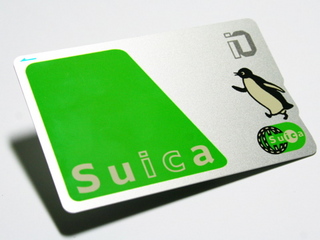
Tokyo Brandscaping and the SuiPo system

Brandscaping is a term used in marketing to describe the metaphorical landscape of brands (either for a particular brand, company or sector), however it is also being used by some researchers, including me, to describe the way in which brands are being infiltrated into urban landscapes, with the ultimate aim of being ‘inhabitable’ perhaps even 24/7 (see for example Disney’s move into urban development with Celebration in Florida).

Contemporary brandscaping makes use of new ambient intelligence, pervasive or ubiquitous computing technologies (‘ubicomp’) and ubiquitous wireless communications to create a landscape in which the consumer is targeted with specific messages directing them to certain consumption patterns. Such communication cans of course be two-way and provide corporations with valuable and very personal data on consumption patterns. As I’ve argued in many presentations over the last few years, ubicomp is necessarily also ubiquitous surveillance (what I call ‘ubisurv’ – hence the name of this blog!) because to work it requires locatability and addressability. Japan, and Tokyo in particular, has been the site for a number of cutting edge experiments in this regard, including the ‘Tokyo Ubiquitous Technology Project’ which embedded 1000 RFID tags which can communicate with RFID-enabled keitai (mobile phones) in upscale Ginza as well as several other pilot schemes around Ueno Park and Shinjuku.

TUTP is not all about marketing surveillance however, part of the scheme has involved ‘Universal Design’ (UD) principles, with one experiment to embed chips in the yellow tactile tiles designed to help guide sight- and mobility-impaired people around the city so that useful access information could be passed through specially-enabled walking sticks. I’m very interested in such experiments as they indicate an alternative direction for ubicomp environments which are about genuinely enabling people who are currently disabled by social and architectural norms, and creating a richer sensory landscape. They show that both surveillance and ‘scary’ technology like RFID chips can be humanised.

Unfortunately in our consumer-capitalist world (and Tokyo is the exemplary city of hyper-consumption), marketing and building brandscapes tends to take priority over enabling the excluded and the disadvantaged. But there are different ways of doing this too, which can be more or less intrusive and consensual. The other day I was talking about the growth in functionality of the Suica smart travel card system. Suica-enabled keitai can now, be used buying all sorts of things and since 2006 there have been a growing number of ‘SuiPo’ (short for ‘Suica Poster’) sites, Suica-enabled advertising hoardings that will, on demand send information to your mobile e-mail address with on particular advertising in which you are interested if you pass your Suica card or phone over a scanner placed next to the poster (see photos below)

The difference between SuiPo and the Ginza RFID scheme however is that it with SuiPo is that it is the consumer who makes the choice whether to activate any particular poster’s additional information system. In this sense it is a development of the i-Mode system in which many keitai can read information from special barcodes embdedded in magazine advertisements. It doesn’t automatically call your phone every time you pass an enabled poster, once you have signed up. Not as high-tech but slightly more consensual. However this will, of course, lead to the accumulation of a lot of data on consumption interests. This potentially generates a massive consumer surveillance tool, because it can be linked up travel patterns (your registered Suica card sends information back on where you go – I was wrong about the absolute differences between London’s Oyster and Tokyo’s Suica systems the other day) and information about consumption.

So will this potential become reality? The page on privacy and data protection on the SuiPo website (as usual the link is hidden away at the bottom of the front page!), is pretty standard stuff except for the legitimate purposes for which the data can be used once you sign up. They are, for those who don’t read Japanese, for:

  1. Sending the specific requested information to you;
  2. Improving services;
  3. Data processing and analysis;
  4. JR East’s promotional marketing; and
  5. JR East customer questionnaires.

Purposes 2 and 3 pretty much allow JR to do anything it likes with the data once you have signed up, and there is no statement as to what can or cannot be done with data once it has been ‘mined’ – analysed and transformed into more useful to the company or other organisations (corporate or state) which might want to buy or access such knowledge. ‘Ubisurv’ indeed…

How Many CCTV Cameras are there in Britain? (Part 6)

BBC’s Newsnight current affairs programme has used the Freedom of Information Act to ask almost 100 Local Authorities in the UK how many video surveillance cameras they operate. There are some really nice graphics here, which demonstrate what a ridiculous number of cameras we have, and particularly the way in which CCTV is becoming seen as ‘normal’ in all areas, not just big cities.

This brings up the discussion we were having earlier in the year with David Aaronovitch of The Times and Paul Lewis of The Guardian (see here, here, here, here and here!), who claimed that members of Surveillance Studies Network had knowingly fabricated figures. In fact these were scenarios and broad guesstimates and never presented as anything more than that. Newsnight in common with most media doesn’t get this either and thinks that its survey means that “there are almost one million fewer CCTV cameras in the UK than previously thought.”

However there survey was only of Local Authorities. It did not cover private systems in public open space or quasi-public space like transport systems (railways, buses and the underground) and shopping malls, let along cameras in private space. The guesstimates made by Clive Norris and Mike McCahill way back in 2001 included all cameras in public space. Norris and Gary Armstrong’s little scenario of being spotted by up to 300 cameras a day most certainly included purely private ones too – as did a real life version of the same kind of scenario conducted by The Times earlier this year – in fact, private cameras covering public space were almost twice as numerous as state ones. So in fact there are probably many more CCTV cameras than “previously thought.” The important thing is that there is almost no control over their proliferation whether nominally ‘public’ or ‘private’ and, as I wrote the other day, almost nothing apart from conscience that seems to be stopping operators from using ‘augmented’ CCTV because extra functionality like audio comes as standard on camera units these days.

For me, of course, the really interesting figures are the international comparative ones: that there are more cameras operated by the average London borough than by the whole metropolis of Tokyo. Yet in other ways, the figures are probably closer – Tokyo is as comprehensively covered as London in terms of public transport. Nothing is quite as clear-cut as it seems if you restrict the research to one type of camera system. Still, thank-you very much to the Newsnight researchers for performing a useful public service!

Big Brother isn’t listening (at least in Maryland)…

Hot on the heals of my earlier post on the subject, I have just received the news that following the publication of the report in The Baltimore Sun, the Maryland Transit Authority have pulled the proposal to use audio surveillance on their buses.

However, an interesting thing to note in this supplementary report by transport correspondent, Michael Dresser, on the paper’s blog, is that the proposal apparently came about because CCTV cameras these days come with sound-recording built in, and that other transit authorities in Cleveland, Denver and Chicago use it. The MTA administrator responsible for seeking the legal opinion on audio surveillance is quoted as saying “It’s something that’s becoming the standard of the industry.”

So, if I am reading this right here, important policy decisions that have major implications for privacy are being treated simply as technical issues because the technologies that are being purchased have the capabilities. It’s only in this case because the MTA sought a legal opinion that we know at all, let alone that anyone objected. So how many other transit, police or urban authorities or commercial venues in how many places are now regularly using the audio capabilities of cameras without ever having considered that this might be a problem? And what other built-in technical capabilities will simply be used in future simply because they are available? What about the Terahertz Wave scanning that I covered earlier on?

In the USA, Big Brother is listening…

Well, according to the Baltimore Sun, the Maryland Transit Authority will be listening if it implements a proposal for recording all conversations between passengers and employees on its buses. This is not the first attempt to introduce audio surveillance of the public. In 2006, in the Netherlands, a microphone system attached to existing CCTV cameras was introduced to supposedly prevent fights by detecting distinctive vocal sounds.

Now, there may well be problems with aggressive or abusive passengers in Maryland (although I’ve also encountered enough abusive drivers in my time!) but that does not mean that any kind of action is justified in the name of preventing or discouraging this. This, as in the Netherlands situation, is a problem of incivility (or ‘respect’ to use Tony Blair’s favourite policy word) but civility develops between people and cannot be imposed by authority or surveillance. What you get by going down this road, if indeed the strategy ‘works’ at all is simply a society of resentful, distrustful, quietude where civility is simply a set of superficial Pavlovian responses not genuinely felt values that people work to create and would want to defend. Problems of incivility are hardly going to he solved by trying to create an even more managed, automated and, fundamentally, desocialised and uncivil society. As the UK’s leading CCTV researcher, Clive Norris, remarked about the UK’s ‘shouting cameras’, introduced as part of the Blair’s ‘Respect Zones’, it is hard to imagine anything much more disrespectful of the public.

What’s particularly interesting in this story too is the way in which one form of surveillance can be used to justify another, producing an internal and self-replicating logic. The thinking is that as buses already have video cameras, then this is just the same thing, right? Stick a notice up saying you’re being recorded and all legal bases are covered. Well, no, I don’t think so. Let’s explore this further. I frequently record conversations that I have. Shocked? Actually, it’s part of my job as a researcher. I interview people and I record the interviews, but I do so with the full consent of the person being interviewed and if they do not want to be recorded, I don’t record them. However, there appears to be no room for consent around mass surveillance at all. It’s becoming clear that the (lack of) regulation of CCTV has set a dangerous precedent here, with consent being regarded as ‘impractical.’ It is really not enough in any accountable system of democracy to assume that the state can assume consent for surveillance measure on the grounds that to seek specific consent would be too hard. And in any case, the ‘acceptance’ of CCTV – even if one believes that the public does indeed ‘accept’ it rather than simply feel a sense of profound disempowerment with regard to video surveillance – does not mean that ‘anything goes’ as far as surveillance is concerned. An already dubious implied consent to one form of monitoring is not the same as consent to all monitoring. And of course, even if you did have some collective majoritarian consent, what does that imply for those in the minority? We already know that surveillance is targeted against minorities, so how can even a standard democratic procedure protect people here? Of course, this is what constitutional protections are for, and in particular in this case, the Fourth Amendment to the US Constitution but the MTA appears to think that the precedent of CCTV means that this does not apply. Round and round we go.

This, in the end, is all about organisational risk management and simply treats the public as sources of risk and as potential offenders, not people with rights, and indeed people who either are generally or, given the respect and space they deserve, would be, good. But risk-thinking seems to override even those things we are used to seeing as foundational of our societies.

Travel cards: Tokyo vs. London

NB: this post is largely incorrect… at least in the fact that actually the systems are much more similar and becoming even more so. I am not going to change the post (because being wrong is part of research and learning), but will direct you to a more recent post here.

Tokyo and London both have pre-paid smart card systems for travel on public transport. They look superficially similar but also have crucial differences.

JR East's Suica card

In fact, first of all, there are several smart cards from different railway companies in Japan. Each of main privatised regional railway companies has one: the most common in Tokyo are the Suica card operated by JR Higashi (East Japan Railways) and the Pasmo card issued by a collection of smaller private railway companies as well as the TOEI subway, bus and Tokyo Metro systems. JR NIshi (JR West) and JR Toukai (JR Central) also have their own cards, ICOCA and TOICA respectively. They are all now pretty much interchangeable and Suica, which is the oldest system in operation since 2001, in particular can now be used for other kinds of payments in station shops and the ubiquitous Lawson chain of konbini (convenience stores) elsewhere in the city. It also now has a keitai denwa (mobile phone) enabled version in which the card is virtually present as a piece of phone software.

Great! It’s convenient, costs no more than buying tickets separately and if you forgot to bring any cash for your morning paper, you can use Suica for that too.

So, just like London’s Oyster card then?

Well, no.

TfL's Oyster card
TfL's Oyster card

The Oyster card, issued by Transport for London, looks pretty much the same and operates along similar technological lines, but because it also requires the user to register using a verifiable name, address and telephone number, with which the card is then associated, it is effectively also a tracking system, which is gradually producing an enormous database of movement surveillance. And of course this has not gone unnoticed to the UK’s police and security services who have reserved the right to mine this database for reasons of ‘national security’ and detection of crime. If you lose your card or have it stolen, then not only do you lose your £3 deposit, you’d better tell the authorities too or you might end up having some criminal activity associated with your name on the database.

Suica cards, on the other hand, can be bought from any ticket machine, require no deposit and no registration, and it doesn’t matter if you lose them, or leave the country, even for several years.

Tokyo and London’s transport systems have both experienced terrorist attacks so there’s no particular reason why Japan’s authorities shouldn’t have demanded a similar database (if you accept the UK’s reasoning). Tokyo also has a far more extensive, complex and multiply-owned transport infrastructure. Surely this must inevitably lead to an insecure and out-of-control system where disaster is inevitable.

So in which of the two cities does the transport system work far more efficiently? And where is that you are actually less likely to be a victim of crime, and feel safer?

I’ll give you a clue – it isn’t London.

USA, EU and UK all investing in advanced biometrics

News from various sources has revealed that the United State, the European Union and the United Kingdom are all preparing to invest further large sums in advanced biometrics and surveillance research.

According to an anonymous message to Slashdot, in the USA, Department of Justice requisitions for the coming year show “$233.9 million in funding for an ‘Advanced Electronic Surveillance’ project, and $97.6 million to establish the ‘Biometric Technology Center.'”  The former is largely to deal with the problems of intercepting Voice-over-Internet Protocol (VoIP) communications – like Skype. The latter is what Slashdot  calls a “vast database of personal data including fingerprints, iris scans and DNA which the FBI calls the Next Generation Identification” for the FBI. In other words, the architecture of the proposed ‘Server in the Sky’ system, which The Guardian revealed last year – for some notes on this and other systems under development, see here.

Meanwhile Owen Bowcott in The Guardian today has a story which puts together various bits and pieces from the EU’s FP7 Security theme research budget and UK security investment. In the UK, there is to be £15 million spent on updating UK biometric security for embassies, and more interestingly other unspecified ‘surveillance’ purposes, and in addition, rolling out of facial recognition systems to more UK airports. As we know, the controlled environments of airports where people are required to look at cameras, are one of the few place where this technology works properly.

This provides a rather tenuous link to the headline of the Guardian story which is an EU-funded study into brain-scanning (yet again) called Humabio (Human Monitoring and Authentication using Biodynamic Indicators and Behaviourial Analysis). There are lots of these about, and one of them may work sooner or later, but it is worth pointing out that people have been putting out ‘we will soon have brain scanning’ stories since the 1980s and like, nuclear fusion, it always seems to be 5 or 10 years in the future. Brain-scanning seems to be the technology of the future… always has been, always will be?

The War on Photographers (continued…)

In the latest dispatch in the British state’s ongoing war on photographers (or was that supposed to be terrorists?), a father and son from Austria have been ‘ordered’ by two policemen to delete pictures of bus and tube stations from their digital camera. Klaus and Loris Matzka were told that it was ‘strictly forbidden’ to take such pictures and the police took their personal details including passport numbers and the addresses of the hotel where they were staying.

This is harassment and intimidation, pure and simple.  Later The Guardian quotes the Metropolitan Police as sating that they “had no knowledge of any ban on photographing public transport in the capital.” This is a curious way to put it. It is not a question of the police’s knowledge of a ban. There is no ban. The police are well aware of this.

The Met in particular, are currently way out at the edge of their powers and pushing the envelope rather too far, but it seems with relative impunity. As I have written before, they seem to think it is suspicious to be interested in CCTV. It is also apparently suspicious (if not ‘strictly forbidden’) to take pictures of almost anything. But there’s much more. This is also the same force that invaded Parliament mob-handed to arrest Conservative MP, Damien Green, for it now seems, entirely political reasons. This is the same force whose officers have been captured on camera beating protestors – and who may have caused a passer-by to die of a heart-attack. This is the same force that keeps tabs on law-abiding protestors nationwide in case they might break the law, and that provides offices to private organisations running their own intelligence operations (ACPO). And, let us not forget, this is the same force whose incompetent surveillance operation resulted in the shooting of an innocent Brazilian man in the mistaken belief that he was a terrorist.

The Metropolitan Police needs to have a serious lesson in the liberties that they are supposed to be protecting, not restricting. Rather than learning the lessons of inquiry after inquiry, officers (and whether it is more than indvidual officers, one cannot say) appear to be out of control and making de facto policy by intimidation. Surely, this cannot be allowed to continue?

Tech regs, not ethics, close London CCTV

Hundreds of CCTV cameras in London will have to be shut down, but this has nothing to do with concerns over privacy, liberty or the surveillance society, it is entirely due to technical regulations.

The cameras, which are mobile road cameras owned by Westminster City Council, used for multiple tasks including anti-crime activities and protest-monitoring, but they are supposed to be for traffic regulation and as such must conform to technical standards set by the Department for Transport (DfT) -in this case, a 720 x 576 pixel picture size (analogue broadcast standard). Westminster’s are 704 x 576!

This might all seem rather petty were it not for two rather important aspects. First of all the case reminds us how surveillance introduced specifically for one area (traffic management) can creep into other areas for which they were never intended or authorized. This can also work in many directions: some of London’s congestion charge cameras were originally installed as anti-terrorism cameras after the IRA attacks of the early 90s.

Secondly, however it also shows, counter-intuitively, how weak is the regulation of CCTV in the UK. The fact is that the cameras have been stopped because of a technical infringement, and indeed there is in general an extensive and growing list of technical regulations and recommendations for CCTV issued by central Government bureaucracy, yet CCTV remains massively under-regulated when it comes to conformity with human rights and civil liberties, let alone for any consideration of the wider and longer-term social impacts of pervasive video surveillance. The closure of this system highlights the powerlessness of the British people in the face of increasingly authoritarian government, not their strength…

(Thanks to Aaron Martin for sending me this one)

Which is worse: no surveillance or incompetent surveillance?

Ok, so I know it is a provocative and incomplete question, but it’s one I am forced to ask this morning as a case in Australia, where a badly implemented video surveillance system in Sydney airport is being blamed for the failure of a court case over a brawl in which a man was killed.

According to reports, the police are quoted as saying that they were “hindered in their search for images of the alleged offenders by an outdated and fragmented surveillance system”. They claim that the four or five different uncoordinated systems in and around the airport, all with different recording locations and formats, make it difficult for them to gather evidence. When you look closer however, it does seem to be the that the only real problem relates to one of the systems which was very old and could not record from more than one of its camera simultaneously.

Although it notes that there are other ‘community concerns’ than just having complete surveillance (of course…), the newspaper seems to be accepting the objectivity of claims that this is a problem of a lack of centralisation. Fear of terrorism is as usual the motivation for this, although the unlikely occurrence of terrorist events and the fact that the incident in question is a biker brawl (i.e. a domestic gang issue) means that this link is tenuous. It also should lead one to question why such a violent disturbance was allowed to progress to the point where someone was killed in an airport. That has very little to do with poor CCTV and much more to do with a failure of more basic security and a lack of care for passengers on the ground more generally. Perhaps the real issue should whether we are becoming so reliant on technological systems of monitoring that we are forgetting the protective purpose of security and the rather more human ways in which this could be improved.

The police apparently also have eye-witnesses, so you have to wonder what the agenda is here. Is it simply a case of police frustration? Would it really help if the systems were all joined up and run centrally? Or is this just a problem with one system? Is this case being used deliberately to try to create a wave of public outrage upon which more intensive joined-up video surveillance can be implemented? I don’t know the answers, but someone in Australia should be asking rather more searching questions than just ‘why don’t the cameras work better?’

(Thanks to Roger Clarke – who does indeed ask difficult questions – for pointing out this story)

Global CCTV datamining project revealed

As a result of an annual report on datamining sent to the US Congress by the Office of the Director of National Intelligence, a research project, Video Analysis and Content Extraction (VACE), has been revealed. The program is aiming to produce an computer system that will be able to search and analyse video images, especially “surveillance-camera data from countries other than the United States” to identify “well-established patterns of clearly suspicious behavior.”

Conducted by the Office of Incisive Analysis, part of the Intelligence Advanced Research Projects Activity (IARPA), the program has apparently been running since 2001,and is merely one of several post-9/11 research projects aiming to create advanced dataveillance systems to analyse data from global sources. How the USA would obtain the information is not specified…

One could spend a long time listing all the DARPA and IARPA projects that are running, many of which are speculative and come to nothing. The report also mentions the curious Project Reynard that I have mentioned before, which aims to analyse the behaviours of avatars in online gaming environments with the aim of detecting ‘suspicious behaviours’. Reynard is apparently achieving some successful results, but we have no real idea at what stage VACE is, and the report only states that some elements are being tested with real world data. This implies that there is nowhere near a complete system. Nevertheless the mentality behind these projects is worrying. It is hardly the first time that the USA has tried to create what Paul Edwards called a ‘closed world’ and these utopian projects which effectively try to know the whole world in some way (like ECHELON, or the FBI’s proposed Server in the Sky) are an ongoing US state obsession.

It is the particular idea that ‘suspicious patterns of behaviour’ can be identified through constant surveillance and automated analysis, that our behaviour and indeed thoughts are no longer our own business. Because it is thoughts and anticipating action that is the ultimate goal. One can see this, at a finer grain, of programs like Project Hostile Intent, a Department of Homeland Security initiative to analyse ‘microexpressions’, supposedly preconscious facial movements. The EU is not immune from such incredibly intrusive proposals: so-called ‘spy in the cabin’ cameras and microphones in the back of every seat have been proposed by the EU-funded SAFEE project, which is supported by a large consortium of security corporations. The European Commission has already hinted that it might try to ‘require’ airlines to use the system when developed.

No doubt too, because of the close (and largely secret and unaccountable) co-operation of the EU and USA on security issues, all the images and recordings would find their way into these proposes databases and their inhuman agents would check them over to make sure we are all passive, good humans with correct behaviours, expressions and thoughts, whether we are in the real or the virtual world…