The downside of Brasilia

on foot, you are immediately confronted by the unpleasant reality of what is to the pedestrian effectively a huge expanse of carpark and highway separating the areas you might want to be. The functional split between the ‘zones’ only makes this worse.

Again, this is urbanism rather than surveillance, but here are some more musings and pictures on the urban form of Brasilia. Yesterday, I posted a lot of conventionally attractive shots of the buildings around the monumental axis of Brasilia. However, leaving aside the wider question of whether Brasilia outside of the planned centre functions as a city, there is a rather less beautiful side to the core.

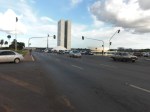
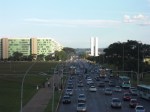
This mainly has to do with the practical consequences of the philosophy behind the plan and particularly with functional separation and transport. As I noted when I first arrived, the city is dominated by roads. 5-lane highways run down either side of the monumental axis, and it is crossed by two major motorways in deep cuttings, with all the attendant slipways. These probably look very attractive as bold curving lines on a plan. They may even function if you are traveling by car (or bus). But on foot, you are immediately confronted by the unpleasant reality of what is to the pedestrian effectively a huge expanse of carpark and highway separating the areas you might want to be. The functional split between the ‘zones’ only makes this worse. Say you are in the hotel zone that I was staying in and you want to go out for a meal and a drink. Well, that’s 30-minutes walk to the nearest residential centre (where most of the evening options are located). Sure, you can take a taxi, but why should you have to? All the sports clubs are in separate ‘club zones’ even further away from either hotel, commercial or residential districts.

Now, okay, so the residential districts have most of their facilities (not including clubs) within walking distance – I said in my first impressions blog entry that I could actually imagine living here with a young family. And I still could. Natives of Brasilia are fanatical about the place. The residential districts work. You don’t really have to go anywhere near the soulless and secured shopping centres or take your chances running across massive motorways with uncaring drivers trying their best to ignore you. There is a simple metro system which runs between the districts and the centre (though it was largely closed for the building of new stations when I was there). You can walk around, between and under the blocks. They don’t appear to be totally obsessed with security in the manner of Sao Paulo or indeed most other large Brazilian cities. The blocks have concierges but not fences, walls and gates. Most of the windows do not even have bars.

But there is a reason and a price for this too. The residential zones are simply not socially mixed. Just about everyone who lives in the big blocks is a government or big corporate office employee. The ordinary workers and the poor live elsewhere entirely, in one of the satellite cities of Brasilia, and are bussed in and out via the busy central bus station every day. At the bus station, you find glimpses of the ‘ordinary Brazil’ – the cheap lanchonetes and pastelerias (in fact probably the best pasteleria I have found in Brazil so far)!, sidewalk vendors of DVDs and knock-off jewelry, the beggars, the hungry and the desperate. In many ways I felt more comfortable there than in the dry Le Corbusian dreamspaces of the government buildings.

Anyway, here’s some pictures of the ‘real Brasilia’ – or what it looks like if you stop focusing on the architecture and take a wider view!


Sao Paulo Metro Surveillance and Security

I spent some time on the Sao Paulo metro system yesterday so I tried to get some pictures of security and surveillance underground… Some things I would have loved to have got pictures of: the military policemen stalking a groups of favela kids through the crowds; the very tired and twitchy officer who looked to be absolutely itching for a fight, who got on the Metro after me; the perfect shot of two policemen standing under a camera. But I didn’t get those ones, so my words will have to do. The main reason is that I have a healthy instinct for self-preservation and taking pictures of men with guns – particularly when they are caressing the handgrip and trigger like it was an intimate part of their anatomy as the twitchy officer was – is a sure way to end up attracting unwelcome and possibly fatal attention. The officers in the stations did notice me taking pictures pretty quickly too – which perhaps suggests both the pervasiveness and the effectiveness of trained human surveillance. Anyway, I only have two shots, one of which was an experiment in a longer take, which didn’t quite come off so I might have to try this again…

I am sure I will have more to say today tomorrow on this after I have met up with Marta Kanashiro, the scholar of surveillance studies from the State University of Campinas.

Transport Surveillance in Brazil (1) SINIAV

One of the items reported on in Privacy International´s assessment of privacy in Brazil was that ¨in November 2006, the Brazilian National Road Traffic Council approved a Resolution adopting a Radio Frequency Identification (RFID) tags in all licensed vehicles across the country.¨ The Conselho Nacional de Trânsito (CONTRAN) is part of the Departemento Nacional de Trânsito (DENATRAN), itself part of the massive new Ministério das Cidades (Ministry of Cities), the product of Lula´s major ministerial reforms designed to shift emphasis and power away from the large rural landowners to the growing numbers of increasingly populous cities.

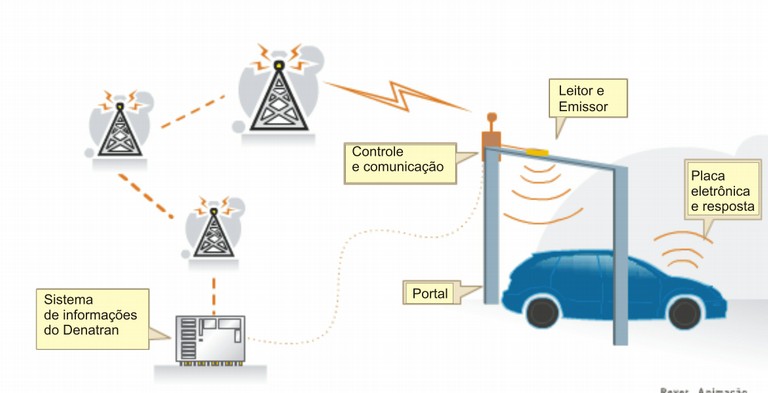
brazao_siniav1The new scheme is called the Sistema Nacional de Identificação Automática de Veículos (SINIAV, or National System for the Automatic Identification of Vehicles). Basically it will put an RFID-tag in every vehicle license plate, in a gradual process. Much like the new ID scheme for people, SINIAV is based on a unique number. In Annex II, Paragraph 3, the resolution provides a breakdown of exactly what will be contained in the tiny 1024-bit chip as follows. The unique serial number (64), and a manufacturer´s code (32), will be programmed in at the factory, leaving a total of 928 programmable bits. The programmable area contains two main sections. The first contains all the personal and vehicular information: place of registration (32), registration number of seller (32) application ate (16), license plate number (88), chassis number (128), vehicle tax number (RENAVAM) (36), vehicle make and model code (16) and finally 164 bits for ´governmental applications´. The remaining 384 bits are split into 6 blocks for unamed ´private initiatives.´

SINIAV system diagram (DENATRAN)

Privacy International note that there is no more than a mention of conformity to constitutional rules on privacy (of which more later). However there is much more that is of concern here. The resolution claims that the data will be encrypted between plate and reader, but the technical specifications are not given to any level of detail (*though there is more information from the Interministerial Working Group on SINIAV, which I haven´t examined in any detail yet). We all know already how easy it is to clone RFID chips. This scheme is supposed to be about security for drivers, but it could easily result in the same kind of identity fraud and consequent necessity of disproving the assumption of guilt created by automated detection systems for car-drivers as for credit cardholders. Could you always prove that it wasn´t your car which was the gettaway vehicle in a robbery in Saõ Paulo, or you driving it, when your actual car was in a car park in Curitiba? Widespread cloning of chips would also render the whole system valueless to government.

RFID chip
RFID chip

Then there is the question of function creep. The chip has spare capacity, and assigned space for unamed functions, state and private. Brazil already has a system of state toll roads (pay-for-use highways), and these chips could certainly be used as part of an automated charging system. That might be very convenient. However what other functions could be thought up, and how might safeguards be built in? As I have already noted, Brazil has no body for protecting privacy or data/information rights so it would be very easy for new more intrusive functionality to be added.

Combining the problems of a movement towards automated fines or changes, and criminality, another major issue would be the one recently revealed in Italy, where a automated red-light camera system was found to have been fixed in order to generate income from fines for corrupt police and a multitude of others.

The final question of course is whether this will all happen as planned or at all. The system would supposedly be complete by 2011. I know of a trial scheme in Saõ Paulo, but on a quick (and very unscientific) straw poll of people who I encountered today at the university here in Curitiba, there is to be no-one who has an RFID license plate or knows someone who does, and there is practically zero awareness even amongst educated professionals. Like the National ID-card scheme, people just don´t think it will go to plan or timetable. That may however, just reflect a (middle-class) Brazilian view of the abilities of the state.

Still, as the Frost and Sullivan market assessment states, all of this turns Brazil into a ‘highly attractive market for RFID suppliers’ which was probably the main motivation and will be the only real outcome.