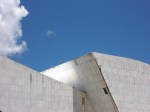
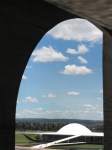
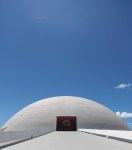
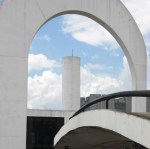
Not surveillance-related, but here’s some of the many, many pictures that I took whilst getting very sunburnt walking around the big open spaces under the huge skies of Brasilia last week. There are a couple more pictures of the Parliament complex in my report from my meeting there last week. My first set of photos of Niemeyer’s work from Sao Paulo can be found here.
I am now in Brasilia, where I have a number of interviews with parliamentarians, and officials from government Ministries and the federal police. The hotel I am staying in is right off the main monumental axis, in the northern hotel district. It is in some ways, the total opposite of where I was in Sampa, being masterplanned, spacious and with visible greenery. But it is a masterplan typical of Le Corbusier and his acolytes, that seems totally lacking in any flexibility or consideration for people not traveling by what they thought would be mankind’s liberation: the private car. So it is almost impossible to walk to a decent bar or cheap restaurant in the evening. You have to get a cab (or a bus if you know where you are going), to another ‘district’ for such things. The spaces are large and clearly designed to be monumental, but actually they fail in both being genuinely impressive and in being accessible. That is not to say that there are not some amazing buildings – of course there are many of Oscar Niemeyer’s greatest creations – but it is a place that looks better from the godlike view of the plan, or the selective gaze of the tourist brochure, than being within it as an ordinary person.
The taxi from the airport took a route through some of the contemporaneously planned and built residential districts. If it wasn’t for the semi-tropical vegetation, it could have been the Netherlands… long lines of similar 60s housing blocks, broken into neighbourhoods, each with its own little row of shops and restaurants, and divided by little parks and other community facilities. The blocks show quite a lot of variation in design and are certainly not all exactly the same, nor are they so large that they become inhuman in scale. With all the trees, and the facilities within walking distance, this really did seem like it wouldn’t be a bad – if not really an exciting – place to live. Which is exactly what I feel about many places in the Netherlands! For today, calm and unexciting is exactly what I need!
Strangely enough however, almost the first thing I came across when I got here was a local-government organised (and state petrochemicals company, Petrobras-sponsored) hip-hop festival, right on the main axis in the shadow of the TV Tower. So as the sun went down (if we could have seen it through the clouds) and the lights of the city blinked behind the hemispheres and towers of the Parliament building, I was getting down (well, tapping my feet) to some phat beats and conscious lyrics about the hardship and violence of life in the ‘periferia’ from the likes of Liberdade Condicional, and other favela stars. This, if nothing else so far, made me feel rather more hopeful for the future. For this evening only, the periferia had come right into the centre and was, symbolically at least, at the heart of Brazilian democracy.
As a fan of utopian urbanism, I couldn’t very well come to Brazil without checking out some of the great Oscar Niemeyer’s work. Next week I will be in Brasilia, but this week in Sao Paulo, I took a few hours out to visit the Memorial da America Latina, a cultural complex built on an old factory site. The overall plan is not that impressive and the whole complex looks a little worn out, but the it was the detail of Niemeyer’s individual buildings that fascinated me, and the external detail at that. The interiors are cool and compelling, but in some you are not allowed to take pictures, and most of the others are filled with ‘stuff’ that reduces the impact of the space.
…it is the adventurous, progressive, social democratic spirit of the New Deal and the World’s Fair that it is most worth revisiting now…
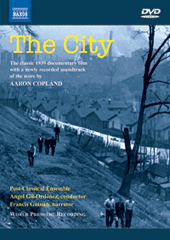
Naxos' rerelease of The City
A post which has little to do with surveillance and security today, but much more to do with another of my interests, in urban futures…
The predominantly classical music company, Naxos, has issued a new version of the classic 1939 documentary, The City, which was released to coincide with the New York World´s Fair. The film is a superb piece of work in many areas – a great script by the legendary urbanist, Lewis Mumford, based on his book, The Culture of Cities, luscious cinematography by Ralph Steiner and and Willard van Dyke and, the reason why Naxos is involved, a brilliant score by Aaron Copeland, which has been re-recorded for this release. It is already available for free download from the Internet Archive (a treasure house of historical material), but of course you won´t get the specially rerecorded score or the extra documentaries that accompany the anyway relatively inexpensive re-release.
A past vision of an urban utopia...
Despite its serious message, the film ultimately shares the optimistic atmosphere of the World’s Fair – see, for example, Andrew F. Wood’s lovely site full of those influential images of progress that so shaped the rest of Twentieth Century’s idea of what the future would look like and then later, should have looked like. Today, it has acquired a new relevance, produced as it was out of that amazing surge of energy in US society resulting from Roosevelt’s solution to the Great Depression, the New Deal. Mumford´s admonition that “the age of rebuilding is here. We must remold our old cities and build new communities, better suited to our needs” (see this article about the movie) has never been more pertinent. As of 2007, we entered an age when the majority of the world’s population is living in cities that are already divided by extremes of wealth and poverty (especially here in Brazil), and a global recession is developing, which should cause humanity to rethink its priorities.
The 1930s saw the best and worst of the drive to utopianism. Some of those paths resulted in the holocaust and the gulags, some led to the unsustainable consumer capitalism we are still trying to revive, but it is the adventurous, progressive, social democratic spirit of the New Deal and the World’s Fair that it is most worth revisiting now.
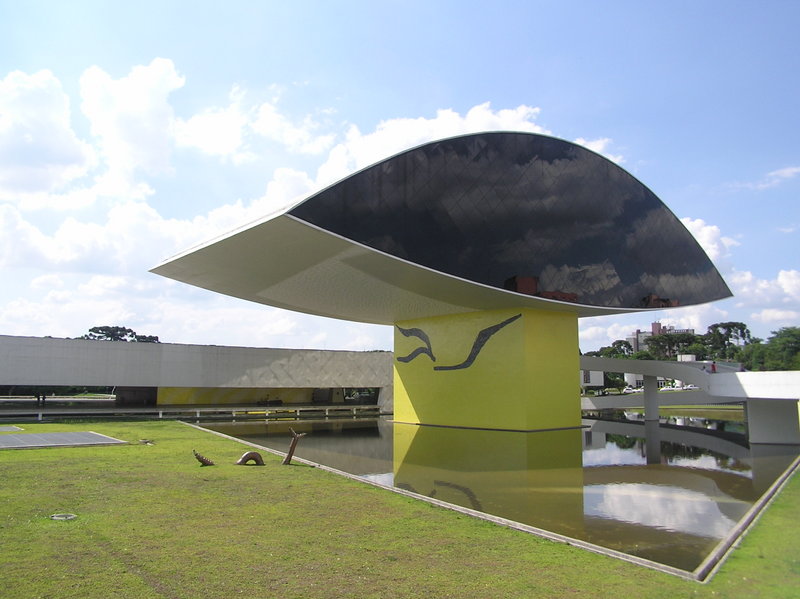
The Niemeyer Museum in Curitiba
Here in Brazil, another nation, like the USA, which struggled throughout the Twentieth Century to fashion itself into a democratic utopia, we can also see this spirit embodied in the gorgeous curves of Oscar Niemeyer‘s fluid Brazilian modernism. Lewis Mumford may be long gone, but Niemeyer is still with us at 101 years old, and still working with the same commitment.
It is a sobering thought that it will not be long before there is no-one left from that generation of urbanists, the generation that was committed to invention, beauty and social progress. Here’s to them…
(thanks to Janet Forbes of York University, Toronto, whose post to a mailing list inspired this reverie)
































 ubisurv