Platform City People

Finally published! I have a chapter, ‘Platform City People’, out in this fully *open access* book, Being Human in the Digital World, edited by Val Steeves and Beate Roessler, from Cambridge. Please read everything in it.

https://www.cambridge.org/core/books/being-human-in-the-digital-world/platform-city-people/00049338349668A16F48038DDCC42769

It’s a piece about how the developers and promoters of what we might call post-smart cities, platform cities or AI cities see the putative inhabitants of these exclusive and exclusionary places. I wrote this quite a while ago now, and in a deliberately accessible style, and more than a little bit polemical, satirical and sarcastic in its tone. I think it still stands up well.

The whole book is here, and it also includes great things from the likes of Frank Pasquale, Julie Cohen and Azadeh Akbari amongst many others…

https://www.cambridge.org/core/books/being-human-in-the-digital-world/D8CC33CF026507F324AF00CEEC7C894C

Global Governance of Post-Smart Cities workshop

I am decompressing after our Global Governance of Post-Smart Cities workshop last week: a fabulous few days of discussion at the intersection of space, cities, political economy, history, media and technology. There was no audience, no preconceived outcome, just some of my favourite scholars brought together for a few gorgeous autumn days in Ottawa to talk about ideas. This is what academia should be about but very rarely is.

The concept of the “post-smart city” is a deliberately provocative term, which I and several others have proposed, and which I am exploring in my current research. What I am trying to capture here is the plethora of different things that seems to be emerging out of the concept of the smart city, e.g. Platform Cities, AI Cities, Super Cities, Cognitive Cities, right through to weirdness like the Network State, and the bringing then together with libertarian and national projects for new cities as permanent experiments. I am thinking of “post-” very much in the sense of “post-modern” or “post-structural” in which the “post-” doesn’t indicate that the thing has been superseded but that it includes and builds on it taking it in new directions. However, I am also thinking of Latour’s critique that “we have never been modern.” Maybe we are in a post-smart situation, but have never really been smart… In any case, as a provocation for discussion, it worked really well in this context.

The main sessions were as follows:

  • “Zones of Interest” – Neoliberal Cities
  • “My Own Private Idaho” – Libertarian Cities
  • “From the Internet, Up” – Platform and Media Cities
  • “Fitter, Happier, More Productive…” – From Smart to AI Cities
  • “Meet the New Boss, Same as the Old Boss” – (Post-)Colonial Cities
  • “Cleaner, Greener, Meaner…” – (Un)Sustainable Cities
  • “A New Life Awaits You in the Offworld Colonies” – Extraplanetary Cities

I originally gave a prompt for each and encouraged the leaders of each session to do what they wanted with the subject. In the end, most adopted a fairly conventional presentation and discussion format, and the discussion was great but I am wondering how to do things even more differently next time:

There was a also a public event, on the first evening of the workshop, Rethinking our Futures in an Age of Crisis, featuring Quinn Slobodian, Ayona Datta, Orit Halphen and Nick Couldry in conversation with me. There will be further reflections and eventually a full report published by CIGI Online.

An enormous thank-you to…

My co-organizers: Vincent Mirza and Azadeh Akbari.

Those who accepted our curious invitation: Rowland Atkinson, Ilia Antenucci, Yung Au, Kelly Bronson, Nick Couldry, Raymond Craib, Federico Cugurullo, Ayona Datta, Mehdi Ghassemi, Orit Halpern, Olivier Jutel, Roger Keil, Casey Lynch, Tim Maughan, Kevin McMillan, Carolyn Prouse, Renée Sieber, Isabelle Simpson, Quinn Slobodian, Alina Utrata, Niloufar Vadiati, Catherine Vandermeulen, Dwayne Winseck, Liam Cole Young.

CSS/Lab and CLTS grads and postdocs: Jennie Day, David Eliot, Zimo Meng, Claire Wang, Aiden Bradley and Gabriella di Biaggi.

Those who wanted to be here but were unable to come because of inequitable visa and immigration systems and the climate of fear: Hend Ali and Ahmed M Eleish.

Our funders: SSHRC-CRSH Connection Grants, the Centre for International Governance Innovation (CIGI), and the Research Center for the Future of Cities, and the Centre for Law, Technology and Society (CLTS), both at the University of Ottawa.

Post-Smart Cities as Digital Authoritarian Polities

I have a short piece out in the excellent new journal, Dialogues on Digital Society, which takes a brief look at the right-wing politics of the Praxis Network State initiative…

https://journals.sagepub.com/doi/10.1177/29768640251377168

My piece is fully open access and free to read, download etc.

This is part of an excellent special issue of almost 50 short pieces on digital authoritarianism by lots of excellent folks, which are being published online first as they are finished. Read them all!

Electoral science fiction and the future of politics

I’ve been thinking and writing a lot about the formal politics of surveillance and control. Last year I edited a massive double issue of Surveillance & Society on the global turn to authoritarianism, and I’ve got a co-authored sociology / media & communication piece going through the peer-review process now about some of this but, as I usually do, I’ve also been thinking about it in terms of science fiction. This blog post may well form the basis for an article in the near-future.

What started me thinking about this specifically this week was the imminent publication of the last volume of Malka Older’s excellent Centenal Cycle out soon, I was scratching my head to think of other titles in the rather obscure sub-genre of electoral science fiction. Here’s what I came up with…

When science fiction deals with politics, it tends to be either in terms of either better (tending to utopian) or worse (tending to dystopian) post-democratic systems. Although one would think that elections could provide tension and drama, they are not that common even in political SF.

The McCarthy Red Scare period in USA did lead to some exceptions. As befits a committed socialist, Isaac Asimov dealt with elections in a famous 1955 short story, ‘Franchise’, in which America takes up Bertolt Brecht’s satirical call for the government to elect a new electorate by replacing them with a single lucky voter who votes via a conversation with a computer. There are fair number of other SF short stories that do dabble in electoral politics, but mainly I will concentrate on novels for this post at least. Robert Heinlein, who was significantly to the right of Asimov and his Futurian comrades, dealt with politics a lot, but rarely elections – the exceptions being a couple of stories also written in the mid-50s, Tunnel in the Sky (1955) and Double Star (1956), which centers on an election campaign, and rigged elections feature in the post-revolutionary society of The Moon is a Harsh Mistress (1966).

Also in the 1960s, while J.G. Ballard wrote short stories about Kennedy and more notoriously, the brilliant satire, ‘Why I want to fuck Ronald Reagan’ (1968), these were more about media than elections per se, in common with all those other New Wave works that were profoundly influenced by the pioneering Canadian media sociologist and public intellectual, Marshall McLuhan. Works of particular note here include Norman Spinrad’s, in retrospect inexplicably notorious, Bug Jack Barron (1969) and John Brunner’s Stand on Zanzibar (1968), which on some days is my favourite ever SF novel.

Of the New Wavers, it was also John Brunner who dealt most effectively with democratic processes, probably because of his active political engagement — he was a committed progressive who was also vice-chair of the Campaign for Nuclear Disarmament (CND) in Britain.  His later novel, The Shockwave Rider (1975) has a referendum campaign as part of its plot, although it is hardly the main focus. Like many political SF novels, it also assumes a global or planetary polity without any real sense of how we would have actually got there.

In the 1980s, Harry Harrison of course had his long-running protagonist stand for election in The Stainless Steel Rat for President (1982), however, in the 1990s there were two highly enjoyable American electoral SF novels , both of which came out of the cyberpunk movement, which was very much political, but generally with a small ‘p’ rather than a big ‘P’. Realistic global politics (or more accurately post-politics) is a consistent feature of cyberpunk worlds. The first of theses novels was Interface (1994) by ‘Stephen Bury’ (Neal Stephenson writing with his uncle, George Jewsbury), in which a presidential candidate who suffers brain damage is fitted with a chip that transmits the findings of opinion polls directly to his mind, creating the perfect entirely un-ideologically committed American populist. I wonder who that reminds us of now…? Around the same time, Stephenson also wrote one of the best post-scarcity political SF works, The Diamond Age (1995). The other great 90s electoral SF novel was Bruce Sterling’s gonzo satire, Distraction (1999) which features American electoral politics gone super-stupid and largely held together by groups of super-smart spin doctors, who act more like gangs or guns-for-hire (they call themselves ‘krews’) than political party loyalists.

Into the 2000s, a lot of realistic politics feature in Kim Stanley Robinson’s novels. His future California trilogy is basically three different alternative futures for the Golden State, and The Mars Trilogy doesn’t really disguise the fact that its largely about contemporary environmental politics on Earth. However, it’s only his ‘Science in the Capital’ trilogy that begins with 40 Signs of Rain (2004), that deals more directly with contemporary government and electoral politics, but unfortunately I would argue that these are his least successful works mainly because they do not make politics, in this case the politics of climate change, very interesting.

However, just recently, we’ve had some interesting political novels that use what one might define as more formal literary political experiments, to bring science fictional life to politic and elections. And all are written by women – yes, you should have noticed a distinct lack of women in this discussion so far, which perhaps mirrors the struggle of women to find their voices in electoral systems.

I am going to include both Jo Walton’s Thessaly sequence that begins with The Just City (2015), precisely because it is deliberately experimenting with anti-democratic and anti-electoral politics as advocated by Plato in his Republic and other works.  We are as the important Belgian political philosopher, Chantal Mouffe has argued, living in an age of ‘anti-politics’, which has led directly to the current resurgence of populist authoritarianism. Walton’s work, however, is much more an exploration of the moral philosophy of Plato rather than contemporary authoritarianism. It also has great characters who are, due to other aspects of the set-up based on the powers of Ancient Greek divinities, drawn from all historical periods. There are also stimulating debates about what counts as human and intelligent and much more. So it has something to say about contemporary politics, but as Emily Dickinson advised, it tells it ‘slant’. Similarly, Ada Palmer’s ongoing Terra Ignota sequence, that started with Too Like the Lightning (2016) presents a kind of post-democratic politics that is also based on formal experiment, this time with the political writings of British enlightenment political philosophers like Thomas Carlyle, but with a similar kind of post-scarcity technological context to that of The Diamond Age. It’s at once brilliant and infuriating, with interesting sexual and gender politics, highly mannered writing and speech consistent with its enlightenment revivalism, unreliable narration and a rather less successful element involving god(s) which I don’t think does always work in the way that Walton’s does. However, by the third volume, the multiple conceits have started to get tired and my heart sank rather than sang when I realized there was going to be a fourth volume. Unfortunately I think the same kind of sequence fatigue is a little in evidence in the third and final volume of Walton’s trilogy, Necessity (2016), but it’s still highly readable.

Finally, we return to Malka Older. Frankly, I have never been more excited by a novel about elections than I was with Infomocracy (2016). It shares the concept of a global polity with many older SF novels, but has a plausible premise for how we get there – to cut a long story short, it’s a kind of Google globalization, somewhat like a fictionalized version of Hiroki Azuma’s General Will 2.0 (2014). Its formal experimental premise is perhaps a little too formal to be entirely possible – the world is divided into political units of exactly 100,000 people (a ‘centenal’) in what seems sometimes like entirely arbitrary ways that do not conform to any historical, geographical or social contexts. But this does serve to highlight the arbitrariness of any political boundaries. Across the world, the particular local political organisations affiliate into broad thematic parties with names like ‘Heritage’, ‘Progress’, ‘Policy First’ or ‘Earth First’ which indicate their general tendencies, and these affiliations get to make strategic decisions at scales above the centenal. The novels follow particular party-affiliated and freelance electoral activists and troubleshooters as they deal with threats to the centenal system from natural disasters, political conspiracies, technological sabotage and more, mainly in Asia in the first novel, and then in Africa in the second, Null States (2017).

The final volume, State Tectonics (2018) is out very soon, and I can’t wait. If you haven’t got into Older (or indeed, Walton or Palmer) yet, you should.

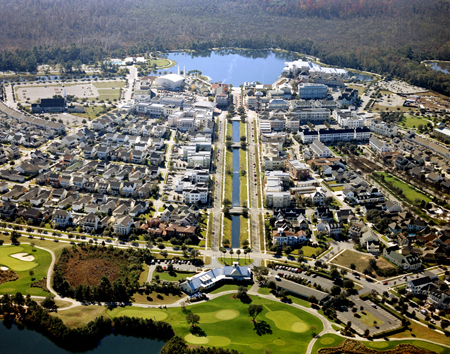
Trouble in paradise

Layout view of Celebration

The town of Celebration in Florida, which is both famous and notorious (depending on your ethical and political persuasions) as the Disney Corporation’s ideology made material, has seen both its first murder and a fatal police shoot-out in the last few days.

First, a 58-year-old man, Matteo Patrick Giovanditto, was found dead in his apartment, apparently murdered, and just days later, one Craig Foushee, a man 52 who had had marital problems, barricaded himself inside his home and fired several shots at police before turning the gun on himself.

Some reports mention that Celebration is the utopian epitome of ‘new urbanism’, except that it has always seemed to me more like a parody of the new urbanism, a version taken to ridiculous and paranoid extremes with its enforced neighbourliness and codes of conduct and property maintenance.

And the apparently unconnected events read like the start of late J.G. Ballard novel – Cocaine Nights or Super-Cannes – with all kinds of poison bubbling under the perfect postmodern surface of this nostalgic, branded ‘retroscape’ (Brown and Sherry, 2003).

‘Friendly’ Surveillance and Intelligent Socks

I missed putting this up last week, but MIT’s Technology Review blogs had a good summary of a talk by Intel’s Justin Rattner, who was arguing for a new era of more ‘friendly’ surveillance. By this he means an emphasis on ubiquitous computing and sensing technologies, or what the Europeans call ‘ambient intelligence’, for personal and personalized assistance and support. He is quoted in the piece as saying “Future devices will constantly learn about you, your habits, how you go about your life, your friends. They’ll know where you’re going, they’ll anticipate, they’ll know your likes and dislikes.” Rattner himself was wearing some new ‘intelligent socks’ (well, sensors in his socks) during the talk, which can sense whether the wearer has fallen or experienced some other unexpected movement. Of course, the problem with this, apart from the issue of whether we want even our socks to anticipate our movements and more, is that the constant stream of data needed to inform the intelligent systems has to go somewhere, and that ‘somewhere’ is ‘the cloud’, i.e. the most intimate data about you, whatever level of security is in place, would be just out there and far more accessible than the forms of biomedical information currently held by, for example, our doctors.

The City as Battlesuit

A really stimulating article by Matt Jones over at Future Metro, my new favourite site, which I have only just discovered thanks to David Barnard-Wills. This manages to combine several of my interests: urban futures, surveillance, security, ubicomp, SF and comics, into one tasty package – I’ll have to check out Matt’s own blog too.

Oscar Niemeyer’s Brazilian Modernism (1)

As a fan of utopian urbanism, I couldn’t very well come to Brazil without checking out some of the great Oscar Niemeyer’s work. Next week I will be in Brasilia, but this week in Sao Paulo, I took a few hours out to visit the Memorial da America Latina, a cultural complex built on an old factory site. The overall plan is not that impressive and the whole complex looks a little worn out, but the it was the detail of Niemeyer’s individual buildings that fascinated me, and the external detail at that. The interiors are cool and compelling, but in some you are not allowed to take pictures, and most of the others are filled with ‘stuff’ that reduces the impact of the space.

Utopian urbanism

…it is the adventurous, progressive, social democratic spirit of the New Deal and the World’s Fair that it is most worth revisiting now…

Naxos´ rerelease of The City
Naxos' rerelease of The City

A post which has little to do with surveillance and security today, but much more to do with another of my interests, in urban futures…

The predominantly classical music company, Naxos, has issued a new version of the classic 1939 documentary, The City, which was released to coincide with the New York World´s Fair. The film is a superb piece of work in many areas – a great script by the legendary urbanist, Lewis Mumford, based on his book, The Culture of Cities, luscious cinematography by Ralph Steiner and and Willard van Dyke and, the reason why Naxos is involved, a brilliant score by Aaron Copeland, which has been re-recorded for this release. It is already available for free download from the Internet Archive (a treasure house of historical material), but of course you won´t get the specially rerecorded score or the extra documentaries that accompany the anyway relatively inexpensive re-release.

A past vision of an urban utopia...

Despite its serious message, the film ultimately shares the optimistic atmosphere of the World’s Fair – see, for example, Andrew F. Wood’s lovely site full of those influential images of progress that so shaped the rest of Twentieth Century’s idea of what the future would look like and then later, should have looked like. Today, it has acquired a new relevance, produced as it was out of that amazing surge of energy in US society resulting from Roosevelt’s solution to the Great Depression, the New Deal. Mumford´s admonition that “the age of rebuilding is here. We must remold our old cities and build new communities, better suited to our needs” (see this article about the movie) has never been more pertinent. As of 2007, we entered an age when the majority of the world’s population is living in cities that are already divided by extremes of wealth and poverty (especially here in Brazil), and a global recession is developing, which should cause humanity to rethink its priorities.

The 1930s saw the best and worst of the drive to utopianism. Some of those paths resulted in the holocaust and the gulags, some led to the unsustainable consumer capitalism we are still trying to revive, but it is the adventurous, progressive, social democratic spirit of the New Deal and the World’s Fair that it is most worth revisiting now.

The Niemeyer Museum in Curitiba

Here in Brazil, another nation, like the USA, which struggled throughout the Twentieth Century to fashion itself into a democratic utopia, we can also see this spirit embodied in the gorgeous curves of Oscar Niemeyer‘s fluid Brazilian modernism. Lewis Mumford may be long gone, but Niemeyer is still with us at 101 years old, and still working with the same commitment.

It is a sobering thought that it will not be long before there is no-one left from that generation of urbanists, the generation that was committed to invention, beauty and social progress. Here’s to them…

(thanks to Janet Forbes of York University, Toronto, whose post to a mailing list inspired this reverie)