
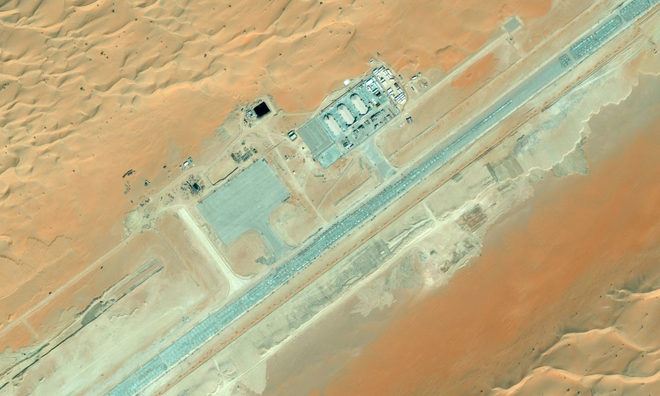
 Wired’s Danger Room blog has published pictures of what may be the hitherto secret CIA drone base in Saudi Arabia, revealed as part the confirmation hearings for John Brenner as proposed Director of the CIA…
Category: Warfare
Obama’s drone wars in question
So much has been happening over the US drone warfare program over the last few weeks that it’s hard to keep up.
First, the United Nations Special Rapporteur for Human Rights and Counter-Terrorism, instigated an inquiry into the targeted killing programs operated by the USA, largely using drones, and focusing on the issue of civilian casualties. The rapporteur, Ben Emmerson, made it clear that the inquiry would pull no punches and might result in war crimes charges against the US, should evidence be discovered of such crimes.
Second, NBC television in the USA revealed a leaked Justice Department document laying out the legal justification for the targeted assassination of US citizens using drones. The full memo is also available from this link and assembles a tortuous argument about how US citizens can be killed by their own government from above if there an “informed, high-level” official decides that the person has “recently” been involved in undefined “activities” threatening a violent attack against the US and “there is no evidence suggesting that he has renounced or abandoned such activities.”
And now, the Washington Post is reporting that the nomination of President Obama’s counter-terrorism guru, John Brennan, to head the CIA, has led to all sorts of revelations and difficult questions for Brennan to answer about the CIA’s targeted assassination program, including the acknowledgement of a secret drone base, at a still undisclosed location, in Saudi Arabia.
A while ago it looked like Obama’s drone strategy was unassailable despite increasing public knowledge via the Bureau of Investigative Journalism and criticisms from groups like the International Committee for Robot Arms Control. Now, this is going mainstream and it’s not looking so good for what former CIA Director, Leon Panetta, called the ‘only game in town’.
Anti-surveillance architecture
 Architecture seems increasing implicated in the generation of a ubiquitous surveillance society, not simply in the relatively longstanding modernist obsession with glass and visibility, but with security increasingly considered not as option but as infrastructure. It was nice to see at least some people concerned with creating anti-surveillance architectures. Two great examples are Deborah Natsios, and Eyal Weizman, and another I recently came across (via The Verge), is Asher J. Kohn, whose Shura City project, aims to create a living environment in an Islamic cultural context, that is protected from drone surveillance. As Kohn states:
“Shura City is constructed to be livable. It is built according to local logic, using local materials, and amenable to local needs. It is meantto be alien – but not hostile – from the outside while homey and familiar from the inside. It is meant to confuse the machines and their distant operators while creating a safe zone forpeople whose lives are being rended by war. Shura City is not about judgment on the survivors or destruction of their persecutors. Shura City is about using architecture to create a space for humanity in an increasingly inhuman sphere.”
Rise of the Drones
Anyone interested in the subject should watch this program from PBS’s Nova strand. It features all kinds of interesting footage including swarming micro-UAVs and the massively high resolution DARPA-developed Argus system…
Canada and Mali
I’m privileged to be supervising some great students at all levels, but Jeff Monaghan is something else*. Not surprisingly for someone who previously worked with the awesomely prolific and engaged, Kevin Walby (now over in Victoria – who may be the young researcher I most admire in surveillance studies), he mainly uses Access to Information and Privacy requests (ATIPs – under Canada’s freedom of information legislation) as a basic method, and as far as I can see he is constantly firing these things off and sorting through them for revealing nuggets. Right now, Jeff is working in the way in which Canadian development aid, like that of many wealthy nations, is becoming increasingly entwined with a security agenda, what he calls ‘security aid’. Anyway, he’s in the news today because one of his ATIPs has revealed that Canada was engaged in planning for military intervention in Mali, of some sort, over a year ago, belying their apparent public reluctance to get involved right now.
Creepy Military Research Projects No.437
 The US Defense Advanced Research Projects Agency (DARPA) has been consistently generating some of the most creepy projects for surveillance and security systems from biomimetic nano-humingbirds to cyborg super-soldiers.
One of the latest is entitled ‘Upward Falling Payloads’ (UFP) and is a call for proposals to develop distributed robotic systems that will ‘hibernate’ at the bottom of the sea potentially for periods of years, and then, when called for, ‘fall upwards’ to the surface to release whatever surveillance or weapons platform they contained. They are particularly interested in merging this kind of platform with UAVs or drones, as the press release says, “an example class of systems might be small unmanned aerial vehicles (UAVs) that launch to the surface in capsules, take off and provide aerial situational awareness, networking or decoy functions.” The language used in the press release is also particularly interesting for its use of post-Fordist supply chain management terms like ‘just-in-time’, a perfect example perhaps of the increasingly hybrid nature of security and neoliberalism in US military policy discourse.
(via boingboing)
North American military drone policy update
The USA has established organized Pacific and Atlantic surveillance UAV squadrons (of 12-24 aircraft each) for the first time, for border and sea lane monitoring. These are a variant of the Northrop-Grumman MQ-4 drones I mentioned the other day, which Japan are also buying. The order establishing the program can be found via Cryptome here. Cryptome has also published the locations of the bases from which they will fly, Ventura Country naval base in California and and Mayport naval base near Jacksonville in Florida.
It is increasingly seeming like UAVs will continue to form the core of Obama’s military strategy, and it seems no coincidence that he has nominated John Brennan, described as the ‘architect’ of his drone policy, to be the new head of the Central Intelligence Agency.
Meanwhile, Canada is more likely to have widespread use of drones by police and the private sector before it gets any military models. It was reported just at the end of last year that the Canadian military drone program is now not likely to be in operation until 2017 and the cost has gone up to over $1Bn (Can). This doesn’t seem to have attracted anything like the attention that has been given to the ingoing farago surrounding the Canadian government’s attempt to purchase US Lockheed F-35 fighter jets, although admittedly that is no estimated as being something in the region of 50 times as expensive…
(Thanks to Chris Prince for keeping me updated on this!)
East Asia Drone Wars

In one of my only posts last year, around this time, I argued that 2012 would be in the ‘year of the drone’ – and it certainly lived up to that. But we’re still only just beginning. This is already the decade of the drone. Unmanned Aerial Vehicles (UAVs) are going to be everywhere in the coming few years (and of course not just in international disputes – I am writing about the spread of domestic surveillance drones for a major report on Surveillance in Canada that we’re producing right now).
Media outlets are reporting that the dispute over maritime territory between China and Japan is ramping up through the use of UAVs. At the moment both countries rely heavily on conventional naval or fisheries surveillance vessels, which are limited in terms of speed of deployment and numbers. However, surveillance drones could enable a more consistent presence over the disputed islands (and more importantly the sea around them, whose fisheries and below seabed mineral resources are the real underlying issue here).
However, there are big differences in the politics and the political economy of each state’s strategic trajectory here. Japan is relying on its longstanding ‘alliance’ with the USA, and is likely to purchase US-made Northrop-Grumman Global Hawks, further emphasizing the military dependency Japan still has on the USA. China, on the other hand, is speeding up development of its own UAVs, in multiple different models. US industry sources seem more worried by alleged breaches of intellectual property rights in the drones’ design than by strategic issues – but of course, China has almost certainly had access to both hardware and software from downed US drones, which is all part of what some analysts are terming a ‘drone race’ with the USA.

But this isn’t just about surveillance. Like the USA’s models, many of China’s UAVs are armed or can be weaponized very easily, and again like the USA, China has also been looking to export markets – most recently, Pakistan has been discussing the purchase of several armed drones from China, following the distinct lack of success in its own UAV development program.
The Global Hawks that Japan is buying are not armed, but this doesn’t mean that Japan is acting less aggressively here or will not in future used armed drones. Despite the post-WW2 US-imposed but popular ‘pacifist’ constitution of the country, the recent return to power of rightist PM Shinzo Abe might will mean both more heated rhetoric over territorial claims and attempts to increase the of the country’s self-defence forces: a review of Japanese military spending – with a view to increasing it – was announced just yesterday.
Drones would seem to be a politically popular choice in this regard as they do not involve putting Japanese lives at risk, or at least not directly; however the longer term outcomes any drone war in East Asia would not likely favour a Japan whose regional economic and political power is influence declining relative to China’s.
On the Internet, no-one knows you’re a dog
So the (now rather old) joke goes. In fact, this joke is now often seen as an example of how people early on in the history of the Internet misunderstood it. People, the argument goes, are just people on the Net, pretty much the same way they are in real life. No technological determinism here, no siree.
However there is increasing evidence that this new ‘common knowledge’ is dead wrong, but it isn’t necessarily individual ‘dogs’ pretending to be humans online, it is whole organised packs (don’t worry, I won’t take this metaphor any further). Various sources have been reporting the development call by the US military for software development to create artificial posters on Internet forums, chatrooms, and news sites. The US state it seems has woken up to the possibilities of what is often called ‘astroturfing’, the creation of fake grassroots movements, with fake members.
George Monbiot, a leading British investigative journalist with The Guardian newspaper knows about astroturfing more than most. He frequently writes about climate change denialists, and the comments under his stories are always filled with pseudonymous critics who seem to pop up every time the word ‘climate’ is mentioned and their responses often appear to be scripted and organised. He’s been digging deeper, and while his investigations are still ongoing, he has provided a useful summary of recent development here.
As well as the corporate interests (tobacco, oil, pharma etc.) it’s also worth pointing out that other states are far ahead of the US on this. China notoriously has its so-called ’50-Cent Party’, students and others who are recruited by the state and paid by the message to counter any anti-Chinese or pro-Tibetan, pro-Taiwan or pro-Uighur sentiment. Their early efforts were laughably obvious, but are becoming more and more subtle. Israel is open in its backing of such ‘online armies’, and advocates the use of a particular software tool, called Megaphone, which enables its users to respond quickly and widely to any reports or discussion seem as against the interests of the Israeli state.
Anonymity is also used by these organised groups as a form of individual intimidation through other ‘open’ channels, especially of those who lack the resources and sometimes the low cunning to be able to respond effectively. One is Freedom of Information legislation. In the area of climate change denial, we saw this with the systematic and organised petitioning of the University of East Anglia’s Climate Research Unit, in which FoI requests were really a form of harassment. More recently, as I have just heard from Chris Parsons, two professors from Ottawa, Errol Mendes and Amir Attaran, seen as ‘liberal’ and critical of the Canadian government, have similarly found themselves the subject of a huge upsurge in FoI requests, many of which seem to be deliberately requesting very intimate information. This would appear to be Freedom of Information as intimidation.
There are several responses one could have to this. One would be to withdraw from more public and open forms of interaction, to batten down the hatches, retreat into extreme forms of privacy. This would be a mistake: it really would, as some of the more alarmist reports have proposed, mean the death of Web2.0. The other would be to take the Anonymous route, to ferret out the spies and the fakes. This could be done with better forum and comment software, but would mean a lot of hacking effort and knowledge. How is a chatroom supposed to go up against the power of states and corporations? The real risk with this, as with more low-tech forms of ‘exposure’, is that we help create a culture of suspicion in which moles and spies are everywhere, and genuine political interaction is chilled. It may be coincidental, but it is not unrelated, that we are seeing a growing attention being called to this kind of thing just as we have seen the power of social media in the uprisings across the Arab world. In this area at least privacy is not the answer, a more radical political openness and transparency may well be required to facilitate the kind of social trust that can keep Web2.0 growing and changing in a positive direction.
New Book – Surveillance and Control in Israel/Palestine
 The Surveillance Studies Centre says: Congratulations to Elia Zureik, David Lyon, Yasmeen Abu-Laban and all the contributors on their new book Surveillance and Control in Israel/Palestine, now available from Routledge. The book is an edited collection of papers from the research workshop, States of Exception, Surveillance and Population Management: The Case of Israel/Palestine, organized by The New Transparency Project in Cyprus, December 2008.
ISBN: 978-0-415-58861-4
TABLE OF CONTENTS
Preface – Elia Zureik, David Lyon and Yasmeen Abu-Laban
Part I: Introduction
1. Colonialism, Surveillance and Population Control: Israel/Palestine – Elia Zureik
Part II: Theories of Surveillance in Conflict Zones
2. Identification, Colonialism and Control: Surveillant Sorting in Israel/Palestine – David Lyon
3. Making Place for the Palestinians in the Altneuland: Herzl, Anti-Semitism, and the Jewish State – Glenn Bowman
Part III: Civilian Surveillance
4. Ominous Designs: Israel’s Strategies and Tactics of Controlling the Palestinians during the First Two Decades – Ahmad Sa’di
5. The Matrix of Surveillance in Times of National Conflict: The Israeli-Palestinian Case – Hillel Cohen
6. The Changing Patterns of Disciplining Palestinian National Memory in Israel – Tamir Sorek
Part IV: Political Economy and Globalization of Surveillance
7. Laboratories of War: Surveillance and US-Israeli Collaboration in War and Security – Steven Graham
8. Israel’s Emergence as a Homeland Security Capital – Neve Gordon
9. From Tanks to Wheelchairs: Unmanned Aerial Vehicles, Zionist Battlefield Experiments, and the Transparency of the Civilian – Nick Denes
Part V: Citizenship Criteria and State Construction
10. Legal Analysis and Critique of Some Surveillance Methods Used by Israel – Usama Halabi
11. Orange, Green, and Blue: Colour-Coded Paperwork for Palestinian Population Control – Helga Tawil-Souri
12. “You Must Know Your Stock”: Census as Surveillance Practice in 1948 and 1967 – Anat E. Leibler
Part VI: Surveillance, Racialization, and Uncertainty
13. Exclusionary Surveillance and Spatial Uncertainty in the Occupied Palestinian Territories – Ariel Handel
14. “Israelization” of Social Sorting and the “Palestinianization” of the Racial Contract: Reframing Israel/Palestine and The War on Terror – Yasmeen Abu-Laban and Abigail B. Bakan
Part VII: Territory and Population Management in Conflict Zones
15. British and Zionist Data Gathering on Palestinian Arab Land Ownership and Population during the Mandate – Michael Fischbach
16. Surveillance and Spatial Flows in the Occupied Palestinian Territories – Nurhan Abujidi
17. Territorial Dispossession and Population Control of the Palestinians – Rassem Khamaisi
Part VIII: Social Ordering, Biopolitics and Profiling
18. The Palestinian Authority Security Apparatus: Biopolitics, Surveillance and Resistance in the Occupied Palestinian Territories – Nigel Parsons
19. Behavioural Profiling in Israeli Aviation Security as a Tool for Social Control – Reg Whitaker
 ubisurv