
Spain vs. Google or Freedom of Expression vs. the Right to Be Forgotten

Several outlets are reporting today, the interesting clash between Spanish courts and Google. The argument is over whether Google should carry articles that have been challenged by Spanish citizens as breaching their privacy. An injunction was won in the courts by the Spanish data protection commissioner over publication of material that is being challenged under privacy legislation.

Clearly there are two main issues here. One is the specific issue of whether Google, as a search engine, can be considered as a publisher, or as it claims, simply an intermediary which publishes nothing, only linking to items published by others. This is important for Google as a business and for those who use it.

But the other is a more interesting issue which is the deeper question of what is going on here which is the struggle between two kinds of rights. The right to freedom of expression, to be able to say what one likes, is a longstanding one in democracies, however it is almost nowhere absolute. The problem in a search-engine enabled information age, is that these exceptions, which relate to both the (un)truth of published allegations (questions of libel and false accusation) and of privacy and to several other values, are increasingly challenged by the ability of people in one jurisdiction to access the same (libellous, untrue or privacy-destructive) information from outside that jurisdiction via the Internet.

In Spain, the question has apparently increasingly been framed in terms of a new ‘right to be forgotten’ or ‘right to delete’. This is not entirely new – certainly police records in many countries have elements that are time-limited, but these kinds of official individually beneficial forgettings are increasingly hard to maintain when information is ‘out there’ proliferating, being copied, reposted and so on.

This makes an interesting contrast with the Wikileaks affair. Here, where it comes to the State and corporations, questions of privacy and individual rights should not be used even analogically. The state may assert ‘secrecy’ but the state has no ‘right of privacy’. Secrecy is an instrumental concept relating to questions of risk. Corporations may assert ‘confidentiality’ but this is a question of law and custom relating to the regulation of the economy, not to ‘rights’.

Privacy is a right that can only be attached to (usually) human beings in their unofficial thoughts, activities and existence. And the question of forgetting is really a spatio-temporal extension of the concept of privacy necessary in an information society. Because the nature of information and communication has changed, privacy has to be considered over space and through time in a way that was not really necessary (or at least not for so many people so much of the time) previously.

This is where Google’s position comes back into play. Its insistence on neutrality is premised on a libertarian notion of information (described by Erik Davis some time ago as a kind of gnostic American macho libertarianism that pervades US thinking on the Internet). But if this is ‘freedom of information’ as usually understood in democratic societies, it does have limits and an extreme political interpretation of such freedom cannot apply. Should Google therefore abandon the pretence of neutrality and play a role in helping ‘us’ forget things that are untrue, hurtful and private to individuals?

The alternative is challenging: the idea that not acting is a morally ‘neutral’ position is clearly incorrect because it presages a new global norm of information flow presaged on not forgetting, and on the collapse of different jurisdictional norms of privacy. In this world, whilst privacy may not be dead, the law can no longer be relied on to enforce it and other methods from simple personal data management, to more ‘outlaw’ technological means of enforcement will increasingly be the standard for those who wish to maintain privacy. This suggests that money and/or technical expertise will be the things that will allow one to be forgotten, and those without either will be unable to have meaningful privacy except insofar as one is uninteresting or unnoticed.
Facebook face-recognition

Reports are that US users can now use an automated face-recognition function to tag people in photos posted to the site. To make it clear, this is not the already dubious practice of someone else tagging you in a photo, but an automated service – enter a picture and the system will search around identifying and tagging.

As a Facebook engineer is quoted as saying:

“Now if you upload pictures from your cousin’s wedding, we’ll group together pictures of the bride and suggest her name… Instead of typing her name 64 times, all you’ll need to do is click ‘Save’ to tag all of your cousin’s pictures at once.”

Once again, just as with Facebook Places, the privacy implications of this do not appear to have been thought through (or more likely just disregarded) and it’s notable that this has not yet been extended to Canada, where the federal Privacy Commissioner has made it very clear that Facebook cannot unilaterally override privacy laws.

Let’s see how this one plays out, and how much, once again, Facebook has to retrofit privacy settings…

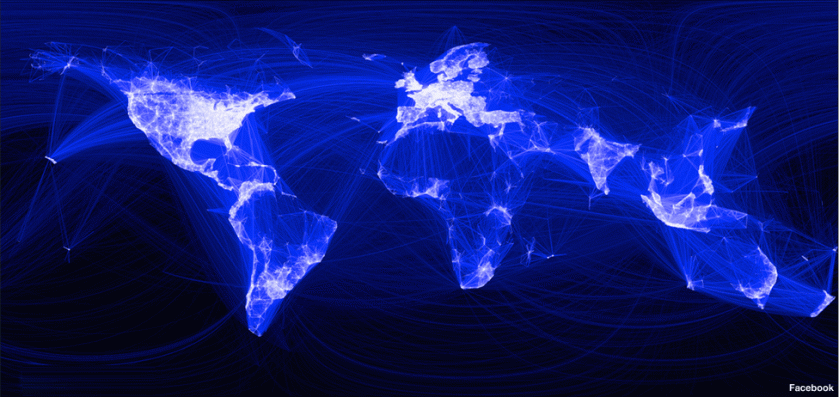
A map of the Facebook world

This is a map of Facebook’s world. It was created by Paul Butler, an intern working for the company. It seems quite clearly influenced by those NASA Earth at night images, or those cybergeography maps of Internet connection, and it’s not surprising that the distribution of points is similar.

Butler’s view of this is that:

“It’s not just a pretty picture, it’s a reaffirmation of the impact we have in connecting people, even across oceans and borders.”

Well, yes and no. If you are a flag-waving Facebook utopian or an uncritical naif, then yes, that’s what it could be. But all maps are political and express political economies. For a Facebook executive, this is a map of markets, both current and unexploited. For anyone interested in the ‘digital divide’ and global social justice, this is yet another map of global inequalities, of power, and of uneven access to resources: Africa is still ‘the dark continent’ in the way this data is visualized. Politically, it is also a map of a particular kind of American-centred global power. Whilst it reflects the rise of India and Brazil to some extent (South Americans tend to use other social networking tools like Orcut) or , it also shows how disengaged from this nexus are Russia and China, which have their own networks (and in the latter case, signifcant control over social networking). But essentially, you can see this as a map of contemporary US influence as much as anything.

And, of course, finally, it is also Facebook saying to all of us: “We know where you live!” 😉

The Internet Must Be Defended (3): Everything is Terrorism?

One of the most ominous developments in the current conflict over Wikileaks has been the move in some quarters to define the publication of leaked information as something more than just ‘irresponsible’ or ‘criminal’ (e.g. ‘theft’ or even ‘espionage’). I have a lot of difficulty with those kinds of labels anyway, but it was only a matter of time before we saw serious, official calls for such activities to be defined as ‘terrorism’.

The Speaker of the Hungarian Parliament, Laszlo Kover, yesterday called for the action of leaking confidential and secret information to be redefined as ‘information terrorism’. He seemed to be referring here not just to Wikileaks but to all ‘online news reporting’, in other words, he is advocating treating those who report on such information as ‘terrorists’ too.

Terrorism, let us not forget, is the use of violence to influence politics, in other words to impose one’s political will through fear of death or injury. There is no way in the world that one can argue rationally that releasing information that allows people to see what happens inside the organisations making claims to rule over us, or act on our behalf, is that kind of violence, indeed it is highly irresponsible to try to associate the term with any processes of nonviolent communication.

The problem is that to many people this probably doesn’t seem unreasonable – people already talk about ‘information war’ as if that meant something clear and comprehensible. But this kind of action would be to extend the definition of terrorism, already stretched to breaking point by legislative changes in the USA, UK and other western countries, into the realm of freedom of speech and the politics of transparency and accountability.

Since 9/11, we have seen a gradual movement, at first indirect and associational as with John Robb’s talk of the ‘open-source insurgency’ back in 2005, and now increasingly overt, to define the advocates of openness and transparency as terrorists. This must be resisted before it takes root in any kind of legislation because ultimately this means that the Internet itself, the communications architecture which supports such activity, is portrayed as the vehicle for such ‘information terrorism.’ This will simply increase the movement of the drive to close the Net away from a crazy, fascistic notion (which it is) towards ‘common-sense.’ It will stifle the development of any genuine global polity.

What to do? Well the first thing is to respond immediately any time something like this is said by any politician or even commentator. This kind of talk should remain in the realm of the ridiculous and the repressive. We need to change the direction of the discourse.

The Internet Must Be Defended (2): a Transparency (R)evolution?

(A few more random rabble-rousing thoughts: Part 1 here)

For a few years now there has been a tendency (and no, it’s not an organised conspiracy – most of the time), to try to contain the uncontrolled development of the Internet by many different states and non-state organisations. Here’s some examples:

1. China has basically created its own island system, that could potentially be entirely disconnected from the rest of the Net and still function. Within this system it can censor sites, control the flow of information and so on. This is not a case of an isolated authoritarian state: the system has been created largely by western hardware and software developers.

2. The development of new ways of accessing information – through Web apps, branded social networking software and so on – means that increasingly users are experiencing the Net (and more specifically the Web) through controlled corporate channels.  The Web is in many ways the most immediately vulnerable feature of the Net.

3. There is a worldwide movement by states, pressured by the USA and others, to put into law restrictive new measures that redefine all information as intellectual property, introduce digital locks, and more widespread end-user licensing etc. (i.e. moving the software model of property rights to all information objects). This is equivalent perhaps to the ‘enclosure’ of the commons in C17th Britain, which underlay the rise of private capital.

4. Under the guise of counter-terrorism or fighting organised crime, states, again pressured by the USA but some entirely of their own volition, are introducing comprehensive surveillance measures of online communications – it started with traffic analysis and is moving increasingly to content too. This also leverages the trend identified in 2. Relationship modelling is where it’s at now. Basically, it isn’t so much that your digital doubles sitting in multiple databases, but they are walking and talking on their own to others, whether you like it or not, and it is the nature and quality of their interactions that is being monitored.

Wikileaks is a thread because it represents the opposite of these trends to closure and the retaking of control of the Internet. It’s not because Wikileaks is itself particularly threatening, it’s the fact that it is making visible these underlying trends and may cause more people to question them.

The character of Julian Assange has nothing really to do with this – except insofar as his prominence has only made Wikileaks, and the nascent opposition to this retaking control of the Internet, vulnerable because people in general can’t tell the difference between a person and an idea and will often think an idea is discredited if a person is – and individuals are very easy to discredit, not least because of the amount of information now available to intelligence services about people means that their vulnerabilities and proclivities can be easily exploited. A lot of people who are genuinely interested in openness and transparency were already questioning the need for this supposed ‘leader’ and I suspect that we will soon see (multiple) other alternatives to Wikileaks emerging.

I would suggest that people who think this is melodramatic are usually speaking either from a position of ignorance of the broad range of trends that are coalescing around the Wikileaks issue, or are simply baffled by the redefinition of politics that is occuring around information and are seeking certainty in the old institutions of nation-state and corporations – institutions that ironically were once themselves so threatening to what was seen as a natural order.

But why should we care? I have heard some people argue that the Wikileaks issue is someway down their list of political priorities. But it shouldn’t be. This issue underlies most other attempts to have any kind of progressive politics in an information age. We already have an economically globalized world. Political power is also increasingly globalized. Yet, what we have in terms of systems of accountability and transparency are tied to archaic systems of nation-states with their secrecy and corporations with their confidentiality. Yet for almost all the founders of the enlightenment, free information was crucial – whether it was for the operation of free markets or the success of politics. In other words, without transparency, there can never be a real global polity to hold the new global institutions to account. And then all your other political concerns will remain limited, local and without significant impact.

If you want a world where your political influence is limited to a level which no longer matters, then sure, don’t support Wikileaks.

But if you actually care about being able to have some degree of accountability and control at a level that does, then you absolutely should support Wikileaks against the measures being taken to destroy it. At least sign the Avvaaz petition. Sure, we don’t know what form any emergent global polity can or will take – and maybe one of the fascinating things about such an open, ‘Wiki-world’ is that no one person or group will be able to determine this – but we certainly know what the alternative looks like, and whilst it may not be ‘a boot stamping on human face forever’, it is most certainly a firm paternal hand on our shoulder.

The Internet Must Be Defended!

As I am just putting the finishing touches on a new issue of Surveillance & Society, on surveillance and empowerment, the furore over the Wikileaks website and it’s publication of secret cables from US diplomatic sources has been growing. Over the last few days, Julian Assange, the public face of the website and one of its founders has been arrested in London on supposedly unrelated charges as US right-wing critics call for his head, the site’s domain name has been withdrawn, Amazon has kicked the organization off its US cloud computing service, one of Assange’s bank accounts has been seized, and major companies involved in money transfer, Paypal, Visa and Mastercard, have all stopped serving Wikileaks claiming that Wikileaks had breached their terms of service.

At the same time, hundreds of mirror sites for Wikileaks have been set up around the world, and the leaks show no sign of slowing down. The revelations themselves are frequently mundane or confirm what informed analysts knew already, but it is not the content of these particular leaks that is important, it is the point at which they come in the struggle over information rights and the long-term future of the Internet.

The journal which I manage is presaged on open-access to knowledge. I support institutional transparency and accountability at the same time as I defend personal privacy. It is vital not to get the two mixed up. In the case of Wikileaks, the revelation of secret information is not a breach of anyone’s personal privacy, rather it is a massively important development in our ability to hold states to account in the information age. It is about equalization, democratization and the potential creation of a global polity to hold the already globalized economy and political elites accountable.

John Naughton, writing on The Guardian website, argues that western states who claim openness is part of freedom and democracy cannot have it both ways. We should, he says, ‘live with the Wikileakable world’. It is this view we accept, not the ambivalence of people like digital critic, Clay Shirky, who, despite being a long-term advocate of openness seemingly so long as the openness of the Internet remained safely confined to areas like economic innovation, cannot bring himself to defend this openness when its genuinely political potential is beginning to be realised.

The alternative to openness is closure, as Naughton argues. The Internet, created by the US military but long freed from their control, is now under thread of being recaptured, renationalized, sterilized and controlled. With multiple attacks on the net from everything from capitalist states’ redefinition of intellectual property and copyrights, through increasingly comprehensive surveillance of Internet traffic by almost all states, to totalitarian states’ censorship of sites, and now the two becoming increasingly indistinguishable over the case of Wikileaks, now is the time for all who support an open and liberatory Internet to stand up.

Over 30 years ago, between 1975 and 1976 at the Collège de France, Michel Foucault gave a powerful series of lectures entitled Society Must Be Defended. With so much that is social vested in these electronic chains of connection and communication, we must now argue clearly and forcefully that, nation-states and what they want be damned, “The Internet Must Be Defended!”

Problems with Crowdsourcing Surveillance

Bruce Schneier has a nice little piece which is saying similar things to what I’ve been saying over the last couple of years on the subject of ‘crowdsourcing’ or opening closed-circuits of surveillance. He critiques the Internet Eyes scheme and Texas Border Watch and others. This is also the subject of the paper, ‘Opening Surveillance?’ that Aaron Martin of LSE and I presented at the S&S conference in London in April, and which will hopefully be coming out in the journal’s conference special early next year…

Will Augmented Reality just be really, really boring?

BoingBoing draws my attention to a video produced by London firm, Berg, with the London office of Japanese advertising agency, Dentsu. Cory Doctorow, who posted this one, and who I usually find to be bang on the money, comments that it presents an imagination of ‘Augmented Reality’ that isn’t ‘an advertising hell’. That may be true, but it’s hardly an inspiring vision of the future of such a potentially empowering technology.  For a start, most of what is shown isn’t really ‘AR’ at all, just ways of displaying social media on different kinds of surfaces so you can’t escape from it – and in fact, Berg/Dentsu do term it ‘incidental media’. To me, AR, if it is to be anything useful at all, means a heightened sensory environment, and one that should start with providing ways for those already disadvantaged to experience the city. Bill Mitchell called the last book of his City of Bits trilogy, Me++, and AR should really create a City++. The dreary corporate Berg/Dentsu future isn’t anyway near this, in fact it’s a City–, it’s reality reduced to endless news and personal updates. If it’s not hell, it’s more like a meaningless limbo… I know that many visions of the future go way over the top, but this is so timid and unimaginative, it just makes the future look boring.

US military crowdsourcing communications

Marketing site, Brandchannel, reports on a US Army program, the Joint Tactical Radio System (JTRS or ‘Jitters’), which they say is going to crowdsource video surveillance on the battlefield. Actually, if you watch the embedded video piece from the US Army itself, you’ll see that the program is much more fundamental than this, it is about integrating different radio systems and trying to make the best use of scarce EM bandwidth in order to allow all kinds of more efficient communications – which would of course include video surveillance data or any other kind of data sent over wireless.

However, all is not what Brandchannel thinks. According to Global Security, the JTRS program was already in trouble back in 2005 and rumours of its demise continued to circulate – Wired’s Danger Room reported on this back in 2007. It is still in existence but has been scaled back, the contractors have switched and the costs have risen to more than $1Bn.

The latest bit of boosterism, and claims from the JTRS people that the system will include the ability for troops to access surveillance images from military UAVs and could be in place by 2014, comes therefore in this context, and also in the context of the hacking of US military surveillance drones by insurgents using cheap Russian TV downloading software. One of the really interesting things about this is how the context of military expertise is changing: one of the key justifications for all this is the concept that US troops will already be familiar with handheld devices and streaming video etc. Network-centric warfare turns out to be no different from kids using their iPhones  to watch movies… if, of course, it ever actually works.

Facebook owns patent on location-based social networking

Via Boingboing: Facebook has been awarded a ‘broad’ US patent on location-based social networking services. This seems curious when Foursquare, Gowalla, Google Latitude and many others were doing this long before Facebook, but it seems that Facebook applied for this patent back in 2007, so even though they weren’t doing it before others, in the way the patent system works, they can claim they were thinking about doing it before others.

Facebook seems to be moving strongly to consolidate its hold on social networking and it clearly sees its location-based service, Places, and such like as being the guarantee of its future success. In short, it seems intent on creating a ‘brandscape’ which recombines the virtual and the material producing a seamless data-stream on the lives of its users for it to exploit.