Blackberry and the London Riots

I’ve been in the papers and on radio and TV a bit in the last few days here in Canada, talking about the London Riots, both as a ‘token Brit’ and a surveillance expert. I’m happy to talk about my feelings as someone from Britain and I’ve made it clear to people that I am neither a technical nor a legal expert, but the conversation inevitably ends up in those domains and others which are really outside my expertise – and I’ve had to be careful what I say.

I’ve generally stuck to three lines:

1. That these riots don’t provide simple moral lessons, they are neither politically-motivated or just about ‘crime’, but they do have roots and implications which are profoundly political – this is about consumerism, class, inequality and exclusion.

2. That you can’t blame Blackberry. That’s like blaming the postal service for hate-mail. The problems for RIM here are twofold: bad public relations from being associated with rioting, and how much it is prepared to sacrifice the privacy of its users to help UK police in an effort to counter the bad PR.

3. That all the UK investment in video surveillance didn’t help stop these riots (see my previous posts).

People like Chris Parsons are the kinds of people that the media need to talk to about the technical issues, and there’s a really fantastic and detailed post from his blog here on Blackberry and security and privacy issues. On legal issues, there’s no-one better than Michael Geist on things like lawful access. His website is here. Michael writes a regular column for the Toronto Star and I was quite amused that when the Star called me yesterday, I had to remind them to talk to him about lawful access issues! The best sociological piece I have seen on the causes is from Zygmunt Bauman.

That said, here’s some links – There’s a podcast here on the Financial Post, which also has a good discussion with Tamir Israel of CPIC.

On the more social side here, syndicated in lots of local and regional papers.

And the usually strangely edited piece in my local paper, the Kingston Whig-Standard, here, also featuring my colleague, Vince Sacco.

London Riots and Video Surveillance, Pt.2

My last post was about the lack of any apparent deterrence of rioting from CCTV. However that’s not to say that video surveillance is proving of no use to the authorities. However the way it is being used says a lot about both the limits of CCTV and the general problem of analysis of video images.

As part of ‘Operation Withern’, the investigation into the rioting, the Metropolitan Police have set up a special section of their website, London Disorder Images, as well as on Flickr, which is essentially crowdsourcing the identification of suspects. Despite being the most well-resourced police force in the UK, the Met lacks the resources, time and expertise to analyse and identify everyone it wishes to identify itself, and with widespread popular anger about the riots, they are banking on opening up the process of surveillance and identification as being more efficient and effective – and they may well be right.

Of course, with the problems of lighting, angle, distances, and image quality, the images vary in identifiability – and bear in mind that the few posted so far are probably amongst the best ones – and no doubt there will be many misidentifications. And, in addition, hundreds of people are already being processed through magistrates courts without much need to video evidence. But it is a tactic we are seeing more and more in many places (e.g. Toronto, following the G20 disturbances).

London Riots and Video Surveillance, pt.1

 A really interesting map on the website of the US monthly, The Atlantic, illustrating the relationship between density of video surveillance cameras (CCTV) and recent incidence of rioting in London. There are many things one can get even from a simple map like this. It’s worth noting in particular that Wandsworth and Harringey are the residential boroughs with the highest concentration of CCTV, and have been hit by rioting. There are also places with both greater and less than average density of CCTV which have not had rioting.
 
Whilst you have to be careful not to mistake correlation for causality, and bearing in mind that this is not a statistically tested verdict, the main tentative conclusion one can draw is that there seems to be no relationship between the presence and density of CCTV and the occurence of rioting. This might seem like  a fairly weak statement, but it is yet more evidence that CCTV has little deterrent effect on crime of this sort (and of course, the rioting is not only explicable as ‘crime’ anyway).
CCTV_boroughs.jpg
 

Norway, After the Event

I grew up in Norway until I was about 7, and so it’s hardly surprising that I’ve been thinking a lot about the country and its people following the recent attacks. I’ve spent some time over the last few days reading the manifesto of the self-confessed killer, but I’m not going to spend any time going over that farago of confused reactionary stupidity here.

What I am primarily interested in is how the country reacts, especially as we are now coming up to ten years after the 9/11 attacks -and the world is still living in the aftermath not only of the attacks themselves but of the reaction of the US and its subordinates. Surveillance Studies, along with many other research fields has documented and analyzed the turn to righter security and increased surveillance, and the corresponding weakening of longstanding individual liberties and collective rights.

But, if Norway’s Prime Minister, Jens Stoltenberg, has anything to do with it, Norway will not be going down the same destructive, counter-productive and vengeful path. Even though he himself and many people he knew were the targets of the attack, he has been emphasizing since that Norway should not compromise its openness and democratic values, on the contrary they should strengthen their commitment to those ideals.The New York Times today quotes him as saying:

“It’s absolutely possible to have an open, democratic, inclusive society, and at the same time have security measures and not be naive. […] I think what we have seen is that there is going to be one Norway before and one Norway after July 22 […] But I hope and also believe that the Norway we will see after will be more open, a more tolerant society than what we had before.”

Let’s hope so. My thoughts remain with the families and friends of the victims, and all the people of Norway. I’ll write more about the wider European reaction tomorrow or over the weekend.

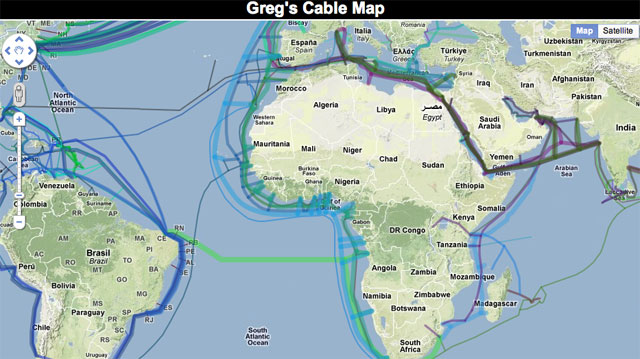
Greg’s Cable Map

Greg's Cable Map

There’s a fascinating interactive map of the world’s undersea communications cables here. It’s also a pretty good guesstimation guide as to where there are, or are likely to be, NSA or subordinate agencies’ (and other non-affiliated intelligence services’) field stations that funnel the data flowing through such cables through computer systems that analyse traffic and content data.

(via Gizmondo)

Will the Global South overtake the North in transparency?

At a time when liberal democracies in the Global North seem increasingly paranoid and cutting down both on personal freedoms and government accountability, could nations from the Global South seize the moment to become the new pace-setters on open government?

There are plenty of good examples from Latin American, but it’s in Africa that the real changes are occurring. Yes, that’s the same Africa often stereotyped as the home of endless war, corruption, military coups and dictators. Kenya, in fact, which the pessimists were portraying as being on the brink of collapse and authoritarianism after election violence a few years ago. But now, Kenya is pushing forward with massive changes in the way its government operates with an increasing tendency towards open information and other accountability initiatives, as a Guardian story is reporting.

Cynics will argue that this is just pandering to a new urban middle class, with only 26% of Kenyans having home Internet access. However, like many countries in Africa, the communications revolution us predominantly mobile and almost 65% of Kenyans have mobile telephones and will be able to access mobile versions of the new sites.

Increasing ‘popularity’ of drones

National Public Radio (NPR)  in the US broadcast an interesting short piece on the spread of drones or Unmanned Aerial Vehicles (UAVs). Drones of all sizes are now increasingly used by national and local states – I think ‘popular’ is the wrong word as most people have no idea that they are so widespread or even that they are likely to be operating at all. There’s also a longer piece by Barbara Ehrenreich on the more general issue of robotic warfare on the Guardian’s Comment is Free site today.

According to my sources in the UK, they have just started flying Reaper drones out of RAF Northolt over London, in preparation for the 2012 London Olympics.

Globalization

At the other end of the scale from my last post on miniaturization, I came across this extraordinarily forthright editorial in a Portuguese newspaper, lambasting the international financial ratings agencies, Moody’s, Standard & Poor and Fitch Ratings and calling them ‘You Bastards’. I happened to have been just writing about these bodies for my next book and a chapter on ‘Globalization and Surveillance’, in the forthcoming International Handbook of Surveillance Studies. Why I am writing about these organisations? Let me quote from my draft chapter:

“this process most certainly is surveillance as conventionally understood within Surveillance Studies and it is perhaps the single most important form of surveillance operating in the world today at the global level. The reason lies in the outcomes of such profiles and ratings. If individual credit-scoring (re)produces comparative (dis)advantage and embeds poverty and class distinctions, then credit-scoring at the global scale can condemn whole national populations to economic marginality and set an inescapably negative context for individual and collective life chances. This is especially the case for those sections of national populations whose jobs, incomes and livelihoods are still tied into the national economy, as opposed to members of the increasingly footloose transnational ruling class. These ratings systems so affect economic decision-making that even minor changes to the credit scores of governments can effectively undermine national government policy, making states that have any substantial international debt – and that is almost every state in the world – ultimately responsible not to their electorates but to the demands of the rules of competition in finance capitalism.”

The problem is, of course, that people and governments only really notice these organisations, let alone complain about them or fight back against them, when their nation-state is downgraded in the ratings. The surveillance power of these bodies needs to be challenged by those who are not (yet) negatively affected if there is to be any change. And you never know, that might yet happen, as apparently the European Commission is considering how it might control these agencies.

Miniaturization

I am doing a bit of work on the ‘vanishing of surveillance’ right now – looking at the decreasing size of sensors, the hiding of surveillance platforms through biomimetics, and so on.

So I was very interested in news reported on Boing Boing today about a pinhead-sized camera with no conventional lens etc. that is mainly designed for applications that do not require detail. The inventors are talking about medical applications, but once again, the agency funding this is DARPA, the US Defense Department’s research organisation.