UK Control Orders to be replaced by Surveillance Orders

There has been a lot of speculation in the last couple of weeks about the fate of the ‘Control Orders’ that have been placed on various people (largely British Muslims) who are strongly suspected by the authorities of involvement with terrorism, but who have not committed any crime that would likely lead to a successful prosecution. These orders tend to amount to forms of curfewing or house arrest without trial, and banning them from using all forms of telecommunications, and needless to say, have been immensely controversial with civil liberties groups arguing that they subvert the rule of law, and that if there is evidence of terrorist activity people should be investigated and charged with such offenses. This has also been a test case for the willingness of the Conservative- LibDem coalition to take onboard key Liberal Democrat priorities and to go further in rolling back the creeping authoritarianism that characterised the final years of the New Labour regime.

So what will replace them? Speculation had centred around the replacement of the order with a system that allowed suspects to move around relatively freely but placed them under intensified ongoing surveillance. Now the BBC is claiming that it has details of what are likely to be called ‘Surveillance Orders’. These, they say, will give the security services the power to:

  • Ban suspects from travelling to locations such as open parks and thick walled buildings where surveillance is hard;
  • Allow suspects to use mobile phones and the internet but only if the numbers and details are given to the security services;
  • Ban suspects travelling abroad; and
  • Ban suspects meeting certain named individuals, but limited to people who are themselves under surveillance or suspected of involvement in terrorism.

Some of this is hardly new: those suspected of involvedment in football hooliganism in the UK have been subject to travel bans since the 1980s, and it seems to be from this that precendent is taken for at least this part of the new place. It is also almost funny that certain locales are seemingly specified as being difficult for surveillance – and I know this won’t be in the actual Bill – but, surely it is actually quite useful for real terrorists to know this? 😉

But this is all very interesting not least because it uses ‘surveillance’ as a supposed replacement for ‘control’, or as something synonymous with increased freedom. That may be so in physical terms, but the constant monitoring suggested under these new orders creates something very far from freedom. However in many ways it constitutes simply an intensified version of the kind of low-level constant monitoring or mass surveillance that is characteristic of contemporary surveillance societies. It is not so much that there are the ‘unwatched’ and the ‘watched’ rather there is a spectrum of surveillance between the lightly and heavily monitored. The new ‘Surveillance Orders’ would merely seem to push the dial for an individual into the category of heavy monitoring.

Surveillance and Empowerment

I’ve just spent my Saturday getting the new issue of Surveillance & Society out…

8(2): Surveillance and Empowerment
http://www.surveillance-and-society.org/ojs/index.php/journal/issue/current

edited by Torin Monahan, David J. Phillips and David Murakami Wood

  • James P Walsh – From Border Control to Border Care: The Political and Ethical Potential of Surveillance.
  • Katie Shilton – Participatory Sensing: Building Empowering Surveillance
  • Priscilla M Regan and Valerie Steeves – Kids R Us: Online Social Networking and the Potential for Empowerment
  • Dean Wilson and Tanya Serisier – Video Activism and the ambiguities of counter-surveillance
  • Marko M Skoric, Jia Ping Esther Chua, Meiyan Angeline Liew, Keng Hui Wong, and Pei Jue Yeo – Online Shaming in the Asian Context: Community Empowerment or Civic Vigilantism?
  • Ariane Ellerbrok – Empowerment: Analyzing Technologies of Multiple Variable Visibility
  • Gwen Ottinger – Constructing Empowerment through Interpretations of Environmental Surveillance Data
  • Anders Albrechtslund and Louise Nørgaard Glud – Empowering Residents: A Theoretical Framework for Negotiating Surveillance Technologies

+ all the usual book reviews

Coming soon: our forthcoming issues on ‘Surveillance, Marketing and Consumption’, and our ‘Global Surveillance Society?’ Conference specials.

Surveillance & Society | the international journal of surveillance studies
http://www.surveillance-and-society.org/ojs/index.php/

Internet doit être défendu! (4)

I write this addition to my ongoing series of thoughts on the implications of the Wikileaks scandal, en Francais because according to Le Point, the the Assemblée Nationale has passed a bill, Loppsi 2, which, amongst other things, in its Article 4, allows the French government to ban particular websites, and essentially to ‘filter’ the Internet. The Bill of course has ‘good intentions’, in this case, it is aimed at paedophiles, but the wording is such that it allows a far wider use against “la cybercriminalité en général”. Regardless, as the article points out: “Les expériences de listes noires à l’étranger ont toutes été des fiascos,” in other words such bills have generally been a complete failure as in most cases the state’s technology and expertise cannot deliver what the law allows.

However, I am left wondering what makes this any different from what China does, and what moral right the French state now has to criticise Chinese censorship or indeed any other regime that is repressive of information rights. And of course, what other very reasonable ‘good intentions’ could be drawn upon for closing the Net – opposing ‘information terrorism’, par example?

Facebook face-recognition

Reports are that US users can now use an automated face-recognition function to tag people in photos posted to the site. To make it clear, this is not the already dubious practice of someone else tagging you in a photo, but an automated service – enter a picture and the system will search around identifying and tagging.

As a Facebook engineer is quoted as saying:

“Now if you upload pictures from your cousin’s wedding, we’ll group together pictures of the bride and suggest her name… Instead of typing her name 64 times, all you’ll need to do is click ‘Save’ to tag all of your cousin’s pictures at once.”

Once again, just as with Facebook Places, the privacy implications of this do not appear to have been thought through (or more likely just disregarded) and it’s notable that this has not yet been extended to Canada, where the federal Privacy Commissioner has made it very clear that Facebook cannot unilaterally override privacy laws.

Let’s see how this one plays out, and how much, once again, Facebook has to retrofit privacy settings…

New Report on Social Control

There is an interesting new report out from the Geneva-based organisation, the International Council on Human Rights Policy (ICHRP)*, called Modes and Patterns of Social Control. It has a lot of overlap in content and analysis with the book I am writing at the moment, which is great in that it means I am not alone in what I am thinking. The authors include a fellow surveillance CRC, Stephane Leman-Langlois, and Clifford Shearing, one of the pioneering figures in our understanding of surveillance today.

*disclaimer: I am an advisor on another ICHRP project on Surveillance and Privacy that has just started.

The New North American Perimeter

Canadians have been angered to discover recently that a deal to create a new US-Canada perimeter security initiative has been going on behind their backs. This plan has been some time in the making, as we uncovered during our current research on border security. In particular, alliances of major corporations and US and Canadian government organisations have been planning together in the Security and Prosperity Partnership (SPP) and the North American Competitiveness Council (NACC) – who back in 2007 produced a document, Building a Secure and Competitive North Anerica (pdf), that seems to prefigure exactly what this ‘new’ soon to be announced plan will contain.

And already the state public relations machines have rumbled into place to prevent dissent. The government clearly has nothing but contempt for the Canadian Charter rights that this deal will damage (most notably those around information and privacy). And there seems to be no doubt that this deal will further embed US security priorities in Canadian-US relations, and effectively add an inner core of security to the economic layer of NAFTA (excluding Mexico, of course… no doubt the perimeter will continue exclude them, even while we exploit their cheap labour and resources). Indeed the ‘success’ of NAFTA (read: the success of NAFTA for business elites) is one of the reasons given for supporting this so-far unseen plan by five former Canadian ambassadors to Washington in an Opinion piece in the Globe and Mail today.

This first volley from the big guns seems to have come straight from the Ottawa PR stategy. There are references to ‘common sense’ and the ‘reassertion of sovereignty’ and attacks on ‘bellyaching’ and ‘knee-jerk anti-Americanism’. Indeed it is worth quoting the final paragraph in full because it is a masterpiece of old-fashioned continentalist propaganda combined with post-9/11 fear-stoking:

“Knee-jerk anti-Americanism is an indulgence without purpose in today’s interconnected, interdependent world. Our future economic prosperity relies on an efficient border, and we should welcome any agreement that smoothes the way for jobs and growth while toughening up our borders to security threats against both our countries.”

In this worldview, asserting sovereignty means giving it up, ‘interconnected and interdependent’ means allied with the USA rather than all the other multiplicity of friendships Canada had carefully crafted around the world prior to the Harper era, and security threats to the USA are seen as one and the same as those to Canada. In other words, we should hitch our wagon more firmly to Washington and prevent any return to that ‘indulgent’ Canadian emphasis on global security, peace-building, human development and human rights – you know, the values that once gained Canada respect around the world.

It’s quite eye-opening in a way to see former representatives of the Canadian state to the USA openly acting as US assets in Canada, clearly trying to educate the Canadian public in how to think and how to behave towards their rulers (sorry, slip of the tongue, of course I meant ‘neighbours’), and trying to preempt and predefine reaction to a plan that we haven’t even seen yet not least because people like this seem to think that Canadians don’t deserve to have a say in something that amounts to nothing less than the future sovereignty of their country.

(thanks to Harrison Smith for the NACC document and David Lyon for pointing out the Opinion piece)

A map of the Facebook world

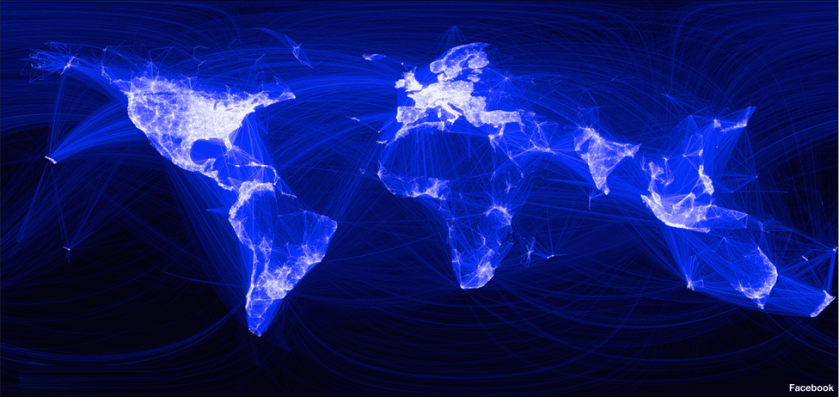
This is a map of Facebook’s world. It was created by Paul Butler, an intern working for the company. It seems quite clearly influenced by those NASA Earth at night images, or those cybergeography maps of Internet connection, and it’s not surprising that the distribution of points is similar.

Butler’s view of this is that:

“It’s not just a pretty picture, it’s a reaffirmation of the impact we have in connecting people, even across oceans and borders.”

Well, yes and no. If you are a flag-waving Facebook utopian or an uncritical naif, then yes, that’s what it could be. But all maps are political and express political economies. For a Facebook executive, this is a map of markets, both current and unexploited. For anyone interested in the ‘digital divide’ and global social justice, this is yet another map of global inequalities, of power, and of uneven access to resources: Africa is still ‘the dark continent’ in the way this data is visualized. Politically, it is also a map of a particular kind of American-centred global power. Whilst it reflects the rise of India and Brazil to some extent (South Americans tend to use other social networking tools like Orcut) or , it also shows how disengaged from this nexus are Russia and China, which have their own networks (and in the latter case, signifcant control over social networking). But essentially, you can see this as a map of contemporary US influence as much as anything.

And, of course, finally, it is also Facebook saying to all of us: “We know where you live!” 😉

The Internet Must Be Defended (3): Everything is Terrorism?

One of the most ominous developments in the current conflict over Wikileaks has been the move in some quarters to define the publication of leaked information as something more than just ‘irresponsible’ or ‘criminal’ (e.g. ‘theft’ or even ‘espionage’). I have a lot of difficulty with those kinds of labels anyway, but it was only a matter of time before we saw serious, official calls for such activities to be defined as ‘terrorism’.

The Speaker of the Hungarian Parliament, Laszlo Kover, yesterday called for the action of leaking confidential and secret information to be redefined as ‘information terrorism’. He seemed to be referring here not just to Wikileaks but to all ‘online news reporting’, in other words, he is advocating treating those who report on such information as ‘terrorists’ too.

Terrorism, let us not forget, is the use of violence to influence politics, in other words to impose one’s political will through fear of death or injury. There is no way in the world that one can argue rationally that releasing information that allows people to see what happens inside the organisations making claims to rule over us, or act on our behalf, is that kind of violence, indeed it is highly irresponsible to try to associate the term with any processes of nonviolent communication.

The problem is that to many people this probably doesn’t seem unreasonable – people already talk about ‘information war’ as if that meant something clear and comprehensible. But this kind of action would be to extend the definition of terrorism, already stretched to breaking point by legislative changes in the USA, UK and other western countries, into the realm of freedom of speech and the politics of transparency and accountability.

Since 9/11, we have seen a gradual movement, at first indirect and associational as with John Robb’s talk of the ‘open-source insurgency’ back in 2005, and now increasingly overt, to define the advocates of openness and transparency as terrorists. This must be resisted before it takes root in any kind of legislation because ultimately this means that the Internet itself, the communications architecture which supports such activity, is portrayed as the vehicle for such ‘information terrorism.’ This will simply increase the movement of the drive to close the Net away from a crazy, fascistic notion (which it is) towards ‘common-sense.’ It will stifle the development of any genuine global polity.

What to do? Well the first thing is to respond immediately any time something like this is said by any politician or even commentator. This kind of talk should remain in the realm of the ridiculous and the repressive. We need to change the direction of the discourse.

New Report on UN ‘Blacklisting’

There is a new report out from the European Centre on Constitutional and Human Rights (ECCHR) on blacklisting practices, particularly the UN’s , after 9/11. The report by Gavin Sullivan and Ben Hayes, suggests that the UN 1267 list of supposed Taliban and Al-Qaeda members and supporters in particular, which I have described as ‘kafkaesque’ in the past here, is:

“beyond the powers of the Security Council. While international terrorism remains an atrocious crime … it does not justify the exercise by the Security Council of supranational sanctioning powers over individuals and entities. “