Haven’t done one of these for a while – this one, which seemed appropriate in all sorts of ways right now, came from AcidCow via Harrison Smith…
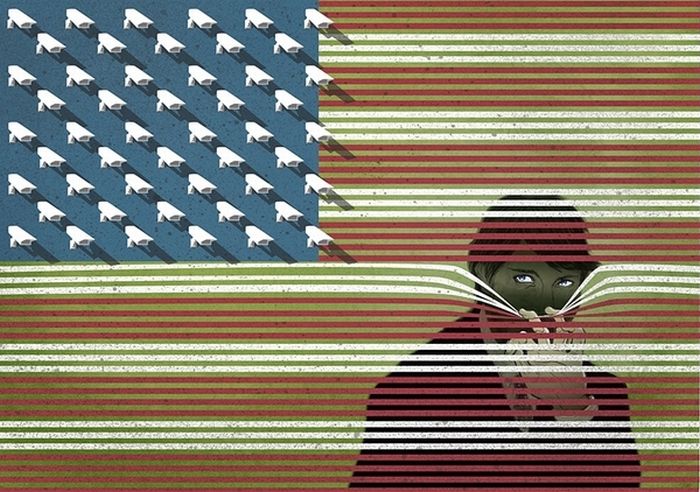

Haven’t done one of these for a while – this one, which seemed appropriate in all sorts of ways right now, came from AcidCow via Harrison Smith…
There was a really interesting piece posted this week on the blog, zunguzungu, which analyzes an early essay written by Wikileaks frontman, Julian Assange. The essay which is available on Cryptome (pdf) – itself a precursor of Wikileaks – is a very well-crafted and argued piece which reveals Assange as a radical idealist for a new transparent society, whose aim is ultimately to destroy the need for Wikileaks itself by making secretive government impossible. Very worth reading.
A marketing consultancy has estimated that the global border security market, including Unmanned Aerial Vehicles (UAVS), Unmanned Ground Vehicles (UGVs) and perimeter surveillance is due to hit $15.8bn in 2010. Without any sense of irony whatsoever, the company calls the border security market “one of the most exciting emerging markets within the global defence and security marketplace.”
They ask questions like:
“Which regional border security marketplaces offer the most significant growth opportunities? What are the prospects for European and North American defence and security companies seeking business opportunities in the Middle East? How is spending on different types of border security technology likely to be affected as government budgets come under intense pressure? What is the status of the Secure Border Initiative Network (SBInet) or ‘virtual fence’ along the US-Mexico border? To what extent is public opinion driving government policy on border security? What effect is the economic downturn having on illegal immigration?”
To know their answers to these questions though, you’ll have to pay £1499.00 (or $2,418.00 US)! Clearly they believe that the market for reports on border security is also pretty ‘exciting’…
The BBC reports that the UK Home Office has been forced by the European Union to accept input from civil and digital rights groups over the revision of its Regulation of Investigatory Powers Act (RIPA) – I’ve posted lots on RIPA here in the past, so it’s worth doing a search of this site for some of the backstory.
The u-turn was apparently sparked by the EU’s report on the Phorm debacle (see also here) which, amongst other things concluded that the UK was in breach of the Privacy Directive for having no adequate complaints procedure or systems of legal redress for those who believe they have been subject to illicit surveillance. Amongst the little nuggets in this story is the fact that since its creation in 1986, the Interception Commissioner has upheld four complaints. Yes, four. 4.
The consultation has also been extended to the 17th of December, so get writing if you haven’t already made your views known. You can find the consultation document here (pdf).
Using Freedom of Information requests, Big Brother Watch in the UK has managed to get hold of figures from many British local governments on how much they spend on CCTV surveillance systems.
According to the Press Association, the annual spend by 336 local councils on the installation and operation of CCTV cameras over a three year-period from 2007/08 and 2009/10 totalled £314,835,170.39 (around $400M US). That’s a large amount of money in an ‘age of austerity’… however it is still not complete as there are another 80 local governments who did not respond to the requests. Interestingly there were still some local governments, albeit only 15, who still did not operate public-area CCTV. That’s not to say that the local police forces in those areas did not, however. There are some cities in Britain, the exception rather than the rule, like Newcastle for instance, where police own and operate public CCTV cameras. I am not sure if these are the types of councils making the claims, and I will have to look at all the figures in greater detail.
The top ten spenders on CCTV over the three years were listed as:
Half of the top ten are London boroughs, outside of the centre of London, showing that CCTV is still diffusing outwards from the heavily surveilled core around the financial centre of the City of London and the government district of Westminster. Not surprisingly, the diffusion is also continuing primarily to the major urban centres beyond London, and the case of Sandwell perhaps shows that the greater Birmingham area is going through a similar process seen in London. In any case, public area video surveillance is not going away in the UK any time soon, and the new government will have to, at some time, demonstrate what it actually meant by introducing greater regulation of CCTV.
The ongoing Wikileaks revelations have been fascinating, but the latest round, those of US diplomatic cables, are perhaps the least revealing thus far. Basically, there’s a lot of the usual personal opinion and gossip that one would expect and the unsurprising revelations that the US gathers information on its allies as well as its enemies. The only really challenging insight is that Saudi Arabia want Iran dealt with far more urgently, it seems, than Israel. But then, even that is hardly unexpected given the religious and political gulf between those two states.
The more important thing for the longer-term is the process going on here, the fact that nation-states, even powerful ones, no longer seem to be able to have complete control over the information that they generate. Potentially, this is not about international relations at all or about any one particular nation-state, but potentially challenges the asymmetrical relationship between all nation-states the their peoples. Of course, there are already right-wing US politicians scrambling to label Wikileaks as a terrorist organisation, which just shows how corrupted the use of the idea of ‘terrorism’ has become, but below this, it demonstrates the very real fear of losing control amongst the political elite. The problem is that, with the current wave of nationalism sweeping the USA, such desperate sentiments play well to the gallery…

I am going to be away this week in San Francisco (it’s a hard job but someone’s gotta do it…) at the American Society for Criminology conference. Anyway, I currently have no working laptop it is unlikely I’ll be posting here until at least next weekend.
Two of the major pilots’ unions in the USA are advising their members not to submit to body scans. There have also been a number of cases of people refusing to cooperate with the new (and so far unofficial) more intense TSA ‘pat-downs’ (including ‘testicular cupping’ for men…) for those who decide not to be scanned. Geek website, Boing Boing, has been documenting the growing movement against body scanning, including T-shirts, no-fly days and the like, however it seems rather optimistic to suggest, as they do, that the action of the unions will hasten the inevitable end of the scanners following some talk that they do not detect internal objects in the body and earlier demonstrations that they may not even be that good at finding some external objects. In fact, it seems more likely that not only will they eventually become mandatory sooner rather than later, but that the technical limitations of the current scanners will prompt their replacement by more advanced models that are now already being tested, which do detect internal foreign objects.
Well, I will soon have up close and personal experience of just what is going on when I fly to San Francisco tomorrow… wish me luck!

Police in Manchester, UK, have axed a tethered surveillance balloon that cost them 80,000 GBP (around $130,000 US). The supposedly covert balloon – if a large white blimp with ‘POLICE’ written on the side in big blue letters can be called ‘covert’ – had been intended to be used for monitoring of public order at large-scale events. However it was a victim of a more conventional Manchester problem – bad weather. Apparently it did not function very well in wet and windy weather. One would have thought that this might have occurred to the police of a notoriously wet and windy town…
This might seem like a victory for anti-surveillance forces, but of course, this will only increase the pressure for more versatile and weather-proof aerial surveillance, i.e. the micro-UAVs (or camera drones) that several other forces have already purchased, not to mention the more expensive powered high-level surveillance airships of the kind specified in the secret South-Coast Partnership report on drone surveillance.
There has been some good coverage (and some less good) coverage of the new ICO surveillance update report, to which we (founder-members of the Surveillance Studies Network) contributed the background research.
There are national press stories in The Guardian, The Daily Telegraph and the Daily Mail, in regional papers like The Yorkshire Post, and in trade publications like Computer Weekly, The Register, and Public Service.
Although some of the reports get things wrong, and The Daily Mail’s in particular is a masterpiece of selective quotation and context-removal, the response has generally got the main points that we intended to get across. These include the points that the change of government in Britain with its rhetoric of rolling back surveillance doesn’t necessarily affect a great deal of what the state does beyond those headline measures like scrapping ID cards and the National Identity Register; and, even more importantly, both transnational data sharing between states and surveillance by the private sector are intensifying and spreading regardless. We do highlight some particular surveillance technologies and practices but these are largely emblematic in this report – it was not a large survey like the 2006 orignal – so although we talk about drone cameras, Google Latitude and Facebook Places, ubiquitous computing, e-borders and new workplace monitoring practices, we are not trying to say that these are the only games in town.
 ubisurv