Manchester Surveillance Blimp Axed

The axed Manchester Police drone (Guardian)

Police in Manchester, UK, have axed a tethered surveillance balloon that cost them 80,000 GBP (around $130,000 US). The supposedly covert balloon – if a large white blimp with ‘POLICE’ written on the side in big blue letters can be called ‘covert’ – had been intended to be used for monitoring of public order at large-scale events. However it was a victim of a more conventional Manchester problem – bad weather. Apparently it did not function very well in wet and windy weather. One would have thought that this might have occurred to the police of a notoriously wet and windy town…

This might seem like a victory for anti-surveillance forces, but of course, this will only increase the pressure for more versatile and weather-proof aerial surveillance, i.e. the micro-UAVs (or camera drones) that several other forces have already purchased, not to mention the more expensive powered high-level surveillance airships of the kind specified in the secret South-Coast Partnership report on drone surveillance.

UK Media on the New ICO Surveillance Report

There has been some good coverage (and some less good) coverage of the new ICO surveillance update report, to which we (founder-members of the Surveillance Studies Network) contributed the background research.

There are national press stories in The Guardian, The Daily Telegraph and the Daily Mail, in regional papers like The Yorkshire Post, and in trade publications like Computer Weekly, The Register, and Public Service.

Although some of the reports get things wrong, and The Daily Mail’s in particular is a masterpiece of selective quotation and context-removal, the response has generally got the main points that we intended to get across. These include the points that the change of government in Britain with its rhetoric of rolling back surveillance doesn’t necessarily affect a great deal of what the state does beyond those headline measures like scrapping ID cards and the National Identity Register; and, even more importantly, both transnational data sharing between states and surveillance by the private sector are intensifying and spreading regardless. We do highlight some particular surveillance technologies and practices but these are largely emblematic in this report – it was not a large survey like the 2006 orignal – so although we talk about drone cameras, Google Latitude and Facebook Places, ubiquitous computing, e-borders and new workplace monitoring practices, we are not trying to say that these are the only games in town.

New ICO Surveillance Report

The UK Information Commissioner is reporting to Parliament on the state of surveillance, based on an update report on developments since 2006 authored by Surveillance Studies Network members (including me).

On Thursday 11th November, Christopher Graham, the UK Information Commissioner, sent his report on the state of surveillance and recommendations for action to the House of Commons Home Affairs Committee. His report includes the SSN-authored ‘An Update to a Report on the Surveillance Society’, on which it is based.

The update report, co-authored by Charles Raab, Kirstie Ball, Stephen Graham, David Lyon, David Murakami Wood and Clive Norris, was written in the first half of 2010. It features a review of UK surveillance since they wrote the 2006 ‘Report on the Surveillance Society’ for the Information Commissioner’s Office. The new report focuses on developments in information collection, processing and dissemination, and on the regulatory challenges posed by these surveillance developments.

The Commissioner’s overview and recommendations, and the SSN update report, can be viewed here. I’ll put something up about what I think about his recommendations later after I have had a chance to read them…

Problems with Crowdsourcing Surveillance

Bruce Schneier has a nice little piece which is saying similar things to what I’ve been saying over the last couple of years on the subject of ‘crowdsourcing’ or opening closed-circuits of surveillance. He critiques the Internet Eyes scheme and Texas Border Watch and others. This is also the subject of the paper, ‘Opening Surveillance?’ that Aaron Martin of LSE and I presented at the S&S conference in London in April, and which will hopefully be coming out in the journal’s conference special early next year…

Spying on Your Neighbours

One of the characteristics one would expect in a ‘surveillance society’ is that surveillance would become seen as a more ‘normal’ reaction to problems at all levels of society. So we start to see instructive stories about surveillance in all kinds of unexpected places. The ‘Home and Garden’ section of the Seattle Times newspaper carries a very interesting report this week on the use of relatively low-cost surveillance systems (some involving digital movement detection) used by ordinary middle-class homeowners to monitor their property and more specifically to catch their neighbours doing very unneighbourly things, such as tossing dog faeces into their gardens or trying to peek in through their windows.

In most of these cases, it seems the surveillance is primarily about defending property and based around specific observed anti-social behaviours. So, is this just a question of the legitimate defence of property rights and privacy (the legal view) or is this any kind of a social problem? I think it is certainly more complicated than just being a question of individuals empowering themselves with technology to do the right thing.

There is a big unvoiced problem behind all of this which is the decline of civility, neighbourliness and trust. It seems that most of the problems are interpersonal ones and would be ideally best resolved not through the secret gathering of information to inform a police investigation, public prosecution or private legal action, but through communication with the neighbours concerned. Richard Sennett, Jane Jacobs and many others have observed that we live increasingly in a ‘society of strangers’. The turn to surveillance not as a last resort but as a ‘natural’ first option, would seem to me not only a recognition of this, but a contribution to the wider problem. We don’t trust our neighbours so we watch them. But in watching them we diminish any remaining trust we had in them, and certainly they lose any trust they had in us.

This adds up. It is social not just interpersonal. It means people accept the diminution of general rights of privacy in public spaces and justifies the intrusion of all kinds of agencies into the lives of individuals and groups. This is only encouraged by government campaigns to watch out for suspicious activity, corporate pleas to all of us to be permanently on guard against ‘identity thieves’, ‘hackers’ and of course, celebrity magazines and websites that encourage a voyeuristic interest in the intimate lives of others.

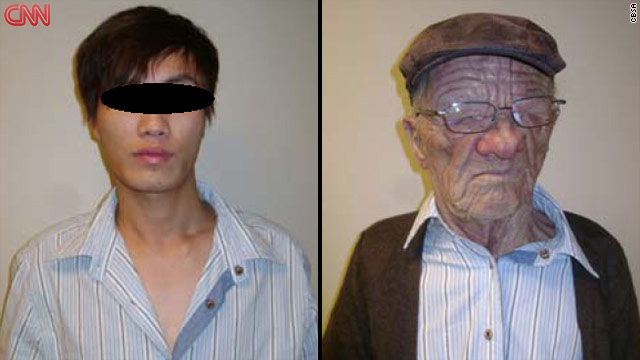
Disguised man allowed to board flight to Canada

An effective disguise (CNN)

CNN has an exclusive today on a young Chinese man who boarded an Air Canada flight from Hong Kong disguised as an old white man. During the flight he removed the mask and then claimed asylum on landing in Canada.

No-one outside of the man concerned and the Canadian Border Security Agency knows much more about this right now. The disguise looks pretty impressive. And he had a boarding pass for a man of the correct age and origins. Of course some people will try to spin this as a ‘security threat’ story, or make it about terrorism. But really this says far more about the desperation of those trying to claim asylum faced with the rather kafkaesque logic of such systems, which tend to assume that claimants can use legal means to escape from situations where their life might be in danger…

Not everything is about the (still relatively small) risk of terrorism and nor should we overreact or organise or always try to reorganise our societies on the basis of that risk. Canada has a historically-deserved reputation as a humane refuge for those in need. This should be defended.

Real-world invisibility a step closer?

Following news the other day of real-time video surveillance erasure capabilities, an even more potent way of vanishing from the eye of surveillance is being reported on by the BBC this week (although the BBC feels the add to this rather startling science story with references to a derivative but popular children’s fantasy series). For the more scientifically literate who want to avoid the drivel, you can go straight to the research paper here.

Progress is apparently being made on making more flexible ‘metamaterials’, that is materials that can bend light around them, rendering them effectively invisible. Up until recently such materials had been inflexible, but flexibility means that a wider range of applications are possible.

Anyway, it gives me a good excuse to put up another image from the fantastic Dutch artist, Desiree Palmen, who takes a rather more painstakingly old-skool approach to invisibility.

US subversion in Norway

Norway has long been a close ally of the USA. Outside of the EU, but inside NATO, it provided bases and consistent support for the USA during the Cold War, unsurprisingly seeing neighbouring USSR as a serious threat to its interests. Yet… those days would seem to be long gone, at least as far as the US is concerned, if a story recently revealed is to be believed.

According to the Dagbladet newspaper, Norway’s TV2 News reported that 15-20 Norwegians, including ex-police, had been recruited by the US Embassy over 10 years to form a secret group, the Surveillance Detection Unit (SDU) that would apparently monitor terrorist threats in Norway. The group operated from a building near the embassy, and collected information on hundreds of Norwegian citizens, whose details were added to a database called SIMAS (Security Incident Management Analysis System).

This was all done apparently without the Norwegian government’s consent, although according to the report, the US Embassy has admitted carrying out the program. The question is – is this standard US practice, or simple a ‘rogue’ embassy group of bored spooks getting above themselves? The answer is that it is almost undoubtedly the former. SIMAS is the US diplomatic service’s global database. According to a Privacy Impact Assessment (!) submitted by the State Department on the system:

“Security Incident Management and Analysis System (SIMAS) is a worldwide Bureau of Diplomatic Security (DS) web-based application, which serves as a repository for all suspicious activity and crime reporting from U.S. Diplomatic Missions abroad (all U.S. embassies and consulates). Department of State personnel, including Diplomatic Security personnel, regional security officers, and cleared foreign nationals, enter Suspicious Activity Reports (SARs) into SIMAS as a central repository for all physical security incidents overseas. SIMAS Reports typically contain a detailed narrative description of the suspicious activity prompting the report, available suspicious person(s) and vehicle descriptors, and other identification data as may be available (e.g. photographs). Reports also indicate date, time and location of suspicious activity, and may include amplifying comments from relevant Bureau offices.”

The data entered into the system on individuals include:

“Citizenship Status and Information (source-documents)

  • DSP-11 (Passport Application)
  • OF-156 (VISA application)

Biometric Information (source-observation and photography)

  • Gender
  • Race
  • Height
  • Weight
  • Eye Color
  • Skin Tone
  • Hair Color
  • Hair Style
  • Images
  • Age or Estimated Age
  • Body Type (Build)
  • Scars, Marks, & Tattoos

Other (source-personal interview by authorities)

  • Name
  • Address
  • DOB
  • Telephone Number
  • Father’s Name
  • Mother’s Name”

It is supposed to be limited to “suspicious or potentially threatening incidents gathered from observations in the vicinity of a post” in order to protect the embassy, however it seems that far more was going on in the case uncovered in Norway, and it would not be surprising if the SDU was operating as a cover for a range of other intelligence activities.

Update: the Norwegian government is now complaining to the US government about this, saying that it breaks Norwegian privacy laws. But, but… they did a PIA! Surely everything is okay now? Oh, and the US claim that “Norwegian authorities had been informed in advance about the surveillance activities.” Hey, this means someone is lying to us! Surely not… 😉

Will Augmented Reality just be really, really boring?

BoingBoing draws my attention to a video produced by London firm, Berg, with the London office of Japanese advertising agency, Dentsu. Cory Doctorow, who posted this one, and who I usually find to be bang on the money, comments that it presents an imagination of ‘Augmented Reality’ that isn’t ‘an advertising hell’. That may be true, but it’s hardly an inspiring vision of the future of such a potentially empowering technology.  For a start, most of what is shown isn’t really ‘AR’ at all, just ways of displaying social media on different kinds of surfaces so you can’t escape from it – and in fact, Berg/Dentsu do term it ‘incidental media’. To me, AR, if it is to be anything useful at all, means a heightened sensory environment, and one that should start with providing ways for those already disadvantaged to experience the city. Bill Mitchell called the last book of his City of Bits trilogy, Me++, and AR should really create a City++. The dreary corporate Berg/Dentsu future isn’t anyway near this, in fact it’s a City–, it’s reality reduced to endless news and personal updates. If it’s not hell, it’s more like a meaningless limbo… I know that many visions of the future go way over the top, but this is so timid and unimaginative, it just makes the future look boring.

Eye See You

An interesting health story carried by the BBC today made me think, as usual, of the other possible surveillance implications. The story is about a new implant that has been developed to aid people with certain kinds of visual disorders. Effectively a digital processor deals with signals passing into the eye and communicates with the brain. This may indeed be a breakthrough for those people, but what it also made me think is how this might be adapted to turn a person into a covert ‘walking camera’: the unit is powered by a battery worn externally by the ear, and this could look like a hearing aid or a music player etc. The wireless connection required to send these internal signals elsewhere is (relatively speaking) no big deal…

This would be a step beyond (or away from) the open and visible eye-cameras employed by Eyetap’s Steve Mann or more recently Rob Spence, who lost an eye and replaced it with an eyeball camera.