US wiretapping information release

From Chris Parsons:

“Christopher Soghoian, a PhD Candidate at Indiana University, has released the information on US wiretap/pen register information along with documents received through FOIA that are inquiring into the costs that telecommunications carriers demand for the two aforementioned services. He also has full recordings of sessions from (the closed door) ISS World: Intelligence Support Systems for Lawful Interception, Criminal Investigations and Intelligence Gathering. An executive summary of his draft thoughts are below, followed by a link to the full piece he’s written. He has made available his recordings and the responses to his FOIA requests to the public at large, all accessible at the link below.

Executive Summary

Sprint Nextel provided law enforcement agencies with its customers’ (GPS) location information over 8 million times between September 2008 and October 2009. This massive disclosure of sensitive customer information was made possible due to the roll-out by Sprint of a new, special web portal for law enforcement officers.

The evidence documenting this surveillance program comes in the form of an audio recording of Sprint’s Manager of Electronic Surveillance, who described it during a panel discussion at awiretapping and interception industry conference, held in Washington DC in October of 2009.

It is unclear if Federal law enforcement agencies’ extensive collection of geolocation data should have been disclosed to Congress pursuant to a 1999 law that requires the publication of certain surveillance statistics — since the Department of Justice simply ignores the law, and has not provided the legally mandated reports to Congress since 2004.”


Manu Luksch

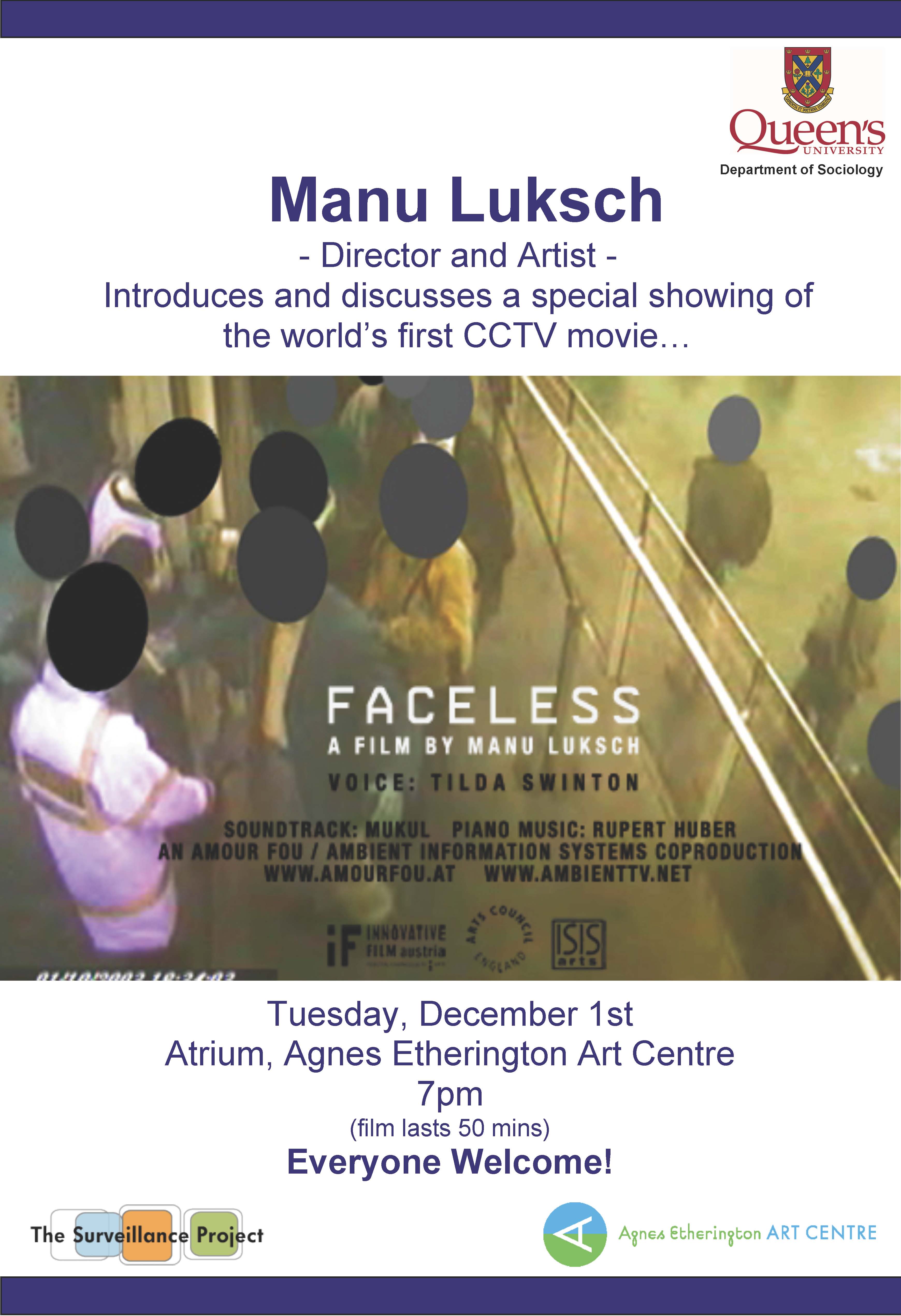
I am hosting the London-based Austrian new media artist and film director, Manu Luksch, here at Queen’s for a couple of days. On Tuesday 1st December, she is giving a presentation on her work on censorship in Iran and then in the evening, she is introducing and discussing her film, Faceless, a movie composed entirely of ‘found’ video surveillance footage (see the poster, below). You can find out more about her work on her website. She’ll be going on from here to Montreal…

More 1984

After Tim Robbins’ Actors’ Gang version, here’s another one to add to the list of interesting adaptations of George Orwell’s totemic tale of totalitarianism, Nineteen Eighty-Four. If you are in the UK, you might be able to catch Blind Summit’s puppet theatre version, 1984, which looks very interesting indeed.

I hope it gets picked up and taken overseas too…

(thanks to our man with his eye on the London theatre, Aaron Martin…)

UK Home Secretary posts response to HGC Report

The UK Home Secretary, Alan Johnson, has posted a comment piece on The Guardian website as a response to the Human Genetics Commission Report on the UK police National DNA Database (NDNAD). It basically says, there’s a long history of balancing security and liberty, we’ve got it right and we won’t be changing anything – all padded out with a lot of nothing. Johnson seems like a decent person (unlike many recent holders of this office) and it seems a shame that he’s reduced to producing this substandard waffle in defence of the indefensible. I do wonder what it would take to convince this government, which is now clearly on its last legs, that they were wrong about anything…

The Vancouver Statement on the 2010 Winter Olympics

Following recent discussion, a number of leading surveillance researchers have signed and issued the following ‘Vancouver Statement’ of which I did the first draft (followed by multiple revisions from many hands!). If you are a researcher who has done any work on mega-event security and surveillance, and agree with the statement, you are encouraged to send your name and affiliation to Adam Molnar at UVic. It is being press-released and hopefully discussed in the BC Legislative Assembly.

The Vancouver Statement of Surveillance, Security and Privacy Researchers about the Vancouver 2010 Olympic Winter Games

As researchers from Canada and the wider world, who are conducting research on the global security dynamics of mega-events, we agree:

  • that the Olympic Games should be a celebration of human achievement, friendship and trust between people and nations.

However, having analysed past and planned Olympics and other mega events, from a variety of historical and international perspectives, we recognise:

  • that recent Games have increasingly taken place in and contributed to a climate of fear, heightened security and surveillance; and
  • that this has often been to the detriment of democracy, transparency and human rights, with serious implications for international, national and local norms and laws.

Therefore, we ask the City of Vancouver, the Province of British Columbia and the Government of Canada:

  • to moderate the escalation of security measures for Vancouver 2010 and to strive to respect the true spirit of the event;
  • to be as open as possible about the necessary security and surveillance practices and rationales;
  • to withdraw temporary bylaws that restrict Charter rights of freedom of speech and assembly;
  • to work constructively with the Provincial and Federal Privacy Commissioners;
  • to respect the rights of all individuals and groups, whether they be local people or visitors, and pay particular attention to the impacts on vulnerable people;
  • to conduct a full, independent public assessment of the security and surveillance measures, once the Games are over, addressing their costs (financial and otherwise), their effectiveness, and lessons to be learned for future mega-events;
  • not to assume a permanent legacy of increased video surveillance and hardened security measures in the Vancouver/Whistler area, and to have full and open public discussion on any such proposed legacy.

We hope that these recommendations will contribute to a unique and positive Olympic legacy by which Vancouver, British Columbia and Canada will be remembered for setting the highest ethical standards.

For further information, contact:

Richard Smith, tel: 778-782-5116; or Colin Bennett

And there’s now more on Richard’s blog!

UK DNA Database Criticised by Report

The UK’s DNA database, already under fire by the European Court of Human Right for retaining samples and data from innocent people, has now been lambasted in a report by the government’s own genetics watchdog. The Human Genetics Commission.

The report, called Nothing to Hide, Nothing to Fear? contains a numbers of serious criticisms, most notably the finding that police forces around Britain are routinely arresting people simply in order to obtain their DNA. Almost a million innocent people, including many children, are now on the database, and the ECHR ruling has finally prompted the government to make some minor concessions, such as keeping the DNA of innocent people for 6 years as opposed to 12, but there appears to have been no fundamental change in police practice, nor any change in the instructions given to local forces on best practice.

It’s main recommendations are:

  1. that there should be a parliamentary debate about the recording of what it calls ‘unconvicted’ people;
  2. that because the purpose of the database has shifted over time, there should be constraints set out in new primary legislation;
  3. that “robust evidence of the ‘forensic utility’ of the database should be produced to justify the resource cost and interference with individual privacy it represents”; and,
  4. that there should be an independent oversight board and appeals board to consider removal of profiles; and transparency over data and other issues.

These are all laudable,  but I really start to question their judgement in using the term ‘unconvicted people’. British law has always worked on the principle of ‘innocent until proven guilty’. People are therefore ‘innocent’ until they have a conviction. The term ‘unconvicted’ seems to imply that innocence is no longer an assumption, and that the working hypothesis is that everyone is either guilty or not yet (therefore, potentially) guilty. This is what results from the normalisation of surveillance in everyday life, and it’s one thing we warned most strongly against in our own Report on the Surveillance Society back in 2006. When even critical reports start using language that reflects the worldview of the people they are criticising, you have to be concerned.

Calling people ‘unconvicted’ and not ‘innocent’ matters.

Helmet cams – self-protection or surveillance?

I am a cyclist, and for a while now I have been thinking about the increasing numbers of my fellow cyclists in the UK who are filming their everyday rides to work, and often posting the results online on sites like youtube. This has become more obvious as something particular since i have moved to Canada where very few cyclists seem to do this. There are more and more discussions on online cycling forums and even dedicated areas for swapping videos, tips and camera stories. This practice seems to have started amongst mountain-bikers and other extreme sports enthusiasts, but the use of handlebar or helmet-mounted cameras on ordinary commuting rides has a very different purpose. For most it appears to originate in a desire for self-protection. Cyclists are more aware than most of bad driving and how vulnerable you can feel when people cocooned in large mobile chunks of metal and glass are doing stupid things around you at high speed.

But as a surveillance studies specialist as well as a cyclist, I have more mixed feelings. We’ve been studying the way in which surveillance has come to be perhaps the primary way in which the state organises itself, and how crucial it as become to capital, to the organisation of labour and materials. We have also identified the way in which increasingly ubiquitous surveillance affects social relations, how it is implicated both as a reaction to, and as a driver of, the decline of social assurance, of trust. We’ve talked about the dehumanising effects of surveillance: the loss of dignity, privacy, of how memory and the mollifying effects of forgetting are replaced by constant recording. We have predicted the decreasing size and cost of surveillance devices, of their growing mobility, independence and even ‘democratization’ (or at least wider spread), and seen those predictions happen at even greater speed than most had anticipated.

The surveillance society has spawned reactions: there has been anti-surveillance (smashing of cameras, protests, mapping of paths of least surveillance etc.), situationalism and play, there has been ‘sousveillance’ with activists turning the gaze back on the watchers, and there has been guerilla and vigilante surveillance, with groups citizens using the increasingly cheap surveillance equipment for their own personal and political ends from the Texas Minutemen watching the US border for illegal immigrants to my cyclist friends.

My real concern, I suppose, is whether the use of surveillance by ordinary people is some kind of empowering self-protection, or whether it is simply another step further into a surveillance society. The answer, I think, is that it is both. Certainly the cyclists don’t see it as the latter, but people, even the most intelligent, rarely see themselves as part of a trend that many would regard as negative. Some do recognise the connection but have no problem with it. The same ‘nothing to hide. nothing to fear’ rhetoric is trotted out, but usually by people who are too naive to understand the implications of what they are saying, too self-centered to realise that it isn’t just about them, or too boring to be able to even imagine what they might ever do anything interesting enough to come to the attention of anyone watching. The use of helmet cams does however, have an in inherent and implied politics: it does make it very difficult to construct any coherent politics of state CCTV if you are yourself involved in surveillance on an everyday basis. How can you complain about the number of cameras in your high street, when you make videos of drivers who have annoyed you and put them online?

I’ll be posting more about this as I think of it.

Olympic surveillance legacies

David Loukidelis, the Information and Privacy Commissioner of British Columbia, speaking today at The Surveillance Games workshop, has made it quite clear that his office does not want the Winter Games to leave a legacy of securitization in the city or indeed, fear (as the Assistant Federal Privacy Commissioner, Chantal Bernier, put it), in the consciousness of its residents. In particular he argued that the 600 (yes, 600) cameras that are being installed at the Olympic venues and beyond should not be allowed to remain after the games. I hope that his office is able to deliver on this view, but I doubt that it will. As Kevin Haggerty and Phil Boyle have noted, security architecture is now an actual deliverable of the Olympics, and as many other researchers have shown, such architecture, including in particular CCTV but also adjusted local or national laws on the thematic and spatial limits of protest and freedom of expression (which, as Michael Vonn of the BCCLA and Chris Shaw, a leading anti-games activist, are describing at this very moment in the conference, are themselves often illegal and unconstitutional) tends not only to persist but to act as a kind of Trojan Horse for an expanded surveillance. And as Vonn’s group has also shown – the city is building a permanent CCTV control centre as part of the security architecture for the Games, and you don’t do that for cameras that are going to be removed.

The Surveillance Games

I’ll be off the next few days at ‘The Surveillance Games’ conference in Vancouver.

Coincidentally, the local police have recently announce that they will be buying the same kind of sonic weapons we saw being used against protestors at the Pittsburgh G8 meeting. Except they want us to call them ‘megaphones’ and claim they won’t use them aggressively*. I think we still need to call a weapon a weapon. Just think, with such rebranding the police could get over their recent little problem with tasers too: just call them ‘joy-buzzers’ (just with a whole lot more ‘joy’...). The urban arms race that such mega-events always spark off as manufacturers push their latest toys to anxious governments, of course just adds another layer of bitter irony to the fact that Canada also intends to ignore its own call for global truce during the Games… it seems that you don’t even need the actual gesture for gesture politics these days.

*Even if these devices were just megaphones, this purchase would in any case be rather ironic given that Vancouver city has banned protestors from using any amplification devices by amending their bylaws in July 2009.

Everyday prejudices mean Canadians end up on watchlists

Another great audit report from the Office of the Privacy Commissioner here in Canada, investigating the Financial Transactions and Reports Analysis Centre of Canada (Fintrac) has just been released. Fintrac, created in 2001 in the Proceeds of Crime (Money Laundering) and Terrorist Financing Act and now with even more extended powers, operates a databases which is supposed to contain details of those suspected of supporting terrorism or money laundering (often on behalf of major criminal and terrorist groups).

However, there is a good story in The Globe and Mail today which leads on the most worrying aspect identified by the audit, which is that in many cases, the Fintrac database is massively overreliant on unsubstantiated suspicions from low-level functionaries in banks, insurance firms and credit agencies. Some of these ‘suspicions’ were clearly simple prejudice as they appeared to be based entirely on ethnicity. Part of the problem is that there are no clear guidelines as to what constitutes a reasonable suspicion in the legislation.

But being put on the database can have serious consequences, firstly because of the potential penalties involved (up to $2m CAN fines and 5-years imprisonment) and secondly, because the information in the Fintrac database can be accessed by Canadian Security Intelligence Service (CSIS), the Royal Canadian Mounted Police  (the RCMP – Canada’s FBI) or shared with overseas police and intelligence services. In the latter case, as we already know, mounting errors can result in innocent people being subject to ever more harsh treatment including being excluded from countries, placed on no-fly lists or even the UN1267 ‘known terrorists and affiliates’ list, as well as, in the worst cases, opening them up to extraordinary rendition, imprisonment and torture.

Jennifer Stoddart, the current Privacy Commissioner, has a well-deserved reputation getting positive changes made, so let’s hope she can persuade Fintrac to get this sorted out pretty soon.