I’ve been invited back to the British Parliament (yes, I know – I’m surprised they keep asking me back too!). This time it is to address a meeting of the Parliamentary & Scientific Committee on the subject of “Security Technology and Individual Freedom” in April, just after I get back from Brazil.
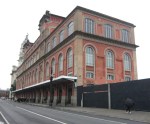
Yesterday, I met up with Brazilian surveillance researcher, Marta Kanashiro, and she showed me around the Luz area of the old centre of Sao Paulo, where she has been working. Luz was once a grand colonial district around the railway station designed by British architect, Charles Driver, in brick and iron, but it lost its importance in the mid-Twentieth Century as the station ceased to be the terminal for the coffee trade. The area acquired notoriety as home to a police headquarters where opponents of the dictatorship where tortured, and as a centre for prostitution, violence and drugs.
In more recent years there has been a real effort by the city authorities to reclaim the area which, despite being in many ways a laudable project, has been controversial both for its effects on the poor, and for its treatment of memory and the particular history of the place. On one side of Parque da Luz, the formal gardens in front of the station, is the Museum of Portuguese language, yet on other side of the station, all memory of the victims of police oppression and torture has been erased with the restoration of the police building.
In the park itself, the park authorities installed CCTV (the story of which can be read in Marta’s article in Surveillance & Society), but they haven’t tried to drive out the prostitutes, many of whom were still standing forlornly under the tall trees in the driving rain as we visited. However, according to Marta, they have tried to persuade the women to dress more respectably in keeping with the desired new image of the the neighbourhood! At one point the prostitute’s union was more involved in the management of the park, as were other community organisations, however the building in the centre of the park where these groups used to meet is now closed for refurbishment and it is unclear whether it will still be available in the same way afterwards. Another building in the corner of the part, next to the rather ramshackle security rooms, has already been restored, and where once the plans and documents about the park were on public display, now the place is prettier but empty.
The Luz regeneration has plenty in common with revanchist redevelopment in many other big cities around the world, and there are big questions about what happens to the already excluded population of the area as the regeneration spreads. There are two contrasting visions for the centre from two different but very similar-sounding organisations: Viva O Centro and Forum Centro Vivo. Both want regeneration – everyone does – but they have entirely different approaches to how it should be done. The former is an association of mainly businesses and police, similar to the Business Improvement Districts (BIDs) which are common in US and British city centres. It is behind a lot of the current redevelopment and has the ear of the city authorities. The latter is a group of academics and community activists who want a more democratic and participatory process, and who hold a lot of local events, cultural and political. They also accuse Viva O Centro of either actively or tacitly encouraging intimidation and violence (which has certainly taken place) against the poor population of the area. It is another reason why the attempt to erase of the memory of the brutality of the dictatorship is so important: it is a memory that needs to be constantly refreshed as the actions are echoed and repeated.
shelter
Prostitution
Forget?
(A very big ‘thank-you’ to Marta Kanashiro for her time and patience! All mistakes in this account, as usual, are my own…)
It is disturbing that… the default position for state officials seems to be that surveillance is a normal, even required part of everyday life.
Ok, there are some things about surveillance that are arguable, some things that are good, but some things are just wrong.
The Guardian today is reporting the story of Nick Gibson who is taking over the tenancy of a pub in Islington in north London. The police have insisted that he will not receive the licence he needs to run the pub unless he installs CCTV and is prepared to hand over footage to them whenever they want. Mr Gibson complained to his Member of Parliament, Emily Thornberry (not Thornhill as The Guardian claims), but she is apparently a spineless New Labour loyalist who has no time for niceties like civil liberties. She refused to represent him on the grounds that other local residents ‘want more CCTV’.
It is one thing to want to install CCTV if you run a business. Your customers can chose whether to patronise your establishment or not. It is however, entirely another matter to be quasi-legally blackmailed into installing it by police. There is no law that mandate the installation of surveillance cameras an in fact there is no statutory basis for CCTV at all in the UK – it is something that the Lords committee report on surveillance recommended as a matter of urgency. The police are simply abusing their right to impose licensing conditions to make local policy. The installation of CCTV is not a matter of ‘common-sense’, it is an ethical judgement, and police should not be be able to override the ethical judgement of individuals by edict in this way.
This is a very worrying case, because it shows that there is a kind of cozy ‘common-sense’ authoritarianism developing in the UK. It is disturbing that despite all the research, including that of the Home Office and the Association of Chief Police Officers, showing that CCTV has very limited utility, the default position for state officials seems to be that surveillance is a normal, even required part of everyday life.
If mass surveillance (through CCTV and huge databases) is often ineffective, then surely targeted surveillance, through judicially-approved orders warranting the use of high-tech secret cameras, listening devices and tracking, must at least ‘work’. However, The Canberra Times reports that in Australia at least, this does not appear to be the case.
In fact out of 311 such warrants issued in 2007-8, just 86 individuals were prosecuted and only 10 criminal convictions resulted. Now we don’t know exactly why this was in each case, however it does suggest that Bill Rowlings, the Civil Liberties Australia chief executive is right to describe the conviction rates as “appallingly low” indicting that the many if the warrants for targeted surveillance are “fishing expeditions” by the police, rather than backed by serious evidence.
It would be interesting to see how the Australian figures compare to those available for similar countries, particularly the UK (if indeed the figures are available and comparable).
I spent some time on the Sao Paulo metro system yesterday so I tried to get some pictures of security and surveillance underground… Some things I would have loved to have got pictures of: the military policemen stalking a groups of favela kids through the crowds; the very tired and twitchy officer who looked to be absolutely itching for a fight, who got on the Metro after me; the perfect shot of two policemen standing under a camera. But I didn’t get those ones, so my words will have to do. The main reason is that I have a healthy instinct for self-preservation and taking pictures of men with guns – particularly when they are caressing the handgrip and trigger like it was an intimate part of their anatomy as the twitchy officer was – is a sure way to end up attracting unwelcome and possibly fatal attention. The officers in the stations did notice me taking pictures pretty quickly too – which perhaps suggests both the pervasiveness and the effectiveness of trained human surveillance. Anyway, I only have two shots, one of which was an experiment in a longer take, which didn’t quite come off so I might have to try this again…
movement
entrance
I am sure I will have more to say today tomorrow on this after I have met up with Marta Kanashiro, the scholar of surveillance studies from the State University of Campinas.
As a fan of utopian urbanism, I couldn’t very well come to Brazil without checking out some of the great Oscar Niemeyer’s work. Next week I will be in Brasilia, but this week in Sao Paulo, I took a few hours out to visit the Memorial da America Latina, a cultural complex built on an old factory site. The overall plan is not that impressive and the whole complex looks a little worn out, but the it was the detail of Niemeyer’s individual buildings that fascinated me, and the external detail at that. The interiors are cool and compelling, but in some you are not allowed to take pictures, and most of the others are filled with ‘stuff’ that reduces the impact of the space.
Top story on many news channels today is the collision of a US Iridium telecommunications satellite with an obsolete Russian military satellite. Iridium is an interesting company that is almost permanently bankrupt (due to the rise of GPS-enabled mobile telephones) yet whose largest single customer is the US Department of Defense, which uses a Hawaii-based gateway for a secure network using NSA-approved handsets.
The Phased Array Radar pyramid at RAF Fylingdales (Yorkshire CND)
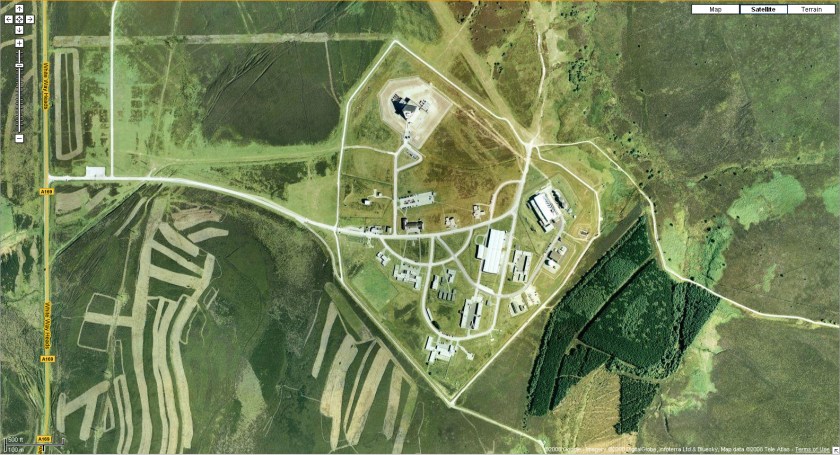
Even more interesting however is that the story mentions the obscure work of the Space Surveillance Network or SPACETRACK, formerly operated by US Space Command (USSPACECOM), now along with all of that influential body’s operations, part of US Strategic Command (USSTRATCOM). This global network of 25 bases using Phased-Array Radar and other tracking systems includes the RAF station at Fylingdales in North Yorkshire.
Satellite view of RAF Fylingdales (Cryptome)Debris in Low Earth Orbit (NSA Orbital Debris Program Office)
SPACETRACK continually watches earth orbit for new objects, which are then added to the US space catalogue. It also tracks debris fields, which are increasing in number and becoming more of a hazard for new space craft, and therefore problems for both military and civilian communications, weather, mapping and surveillance systems. This collision would seem to have been in relatively low orbit which causes the most problems. Cleaning up earth orbit would be a very good idea, but few people seem to have any serious ideas as to how it might be done. Some even argue that such a clean-up could destroy a valuable source of historical information!
Brazil can’t really be called a surveillance society… talk of surveillance is just science fiction. It doesn’t mean anything to the people at the bar.
Back at the bar last night I got talking with the regulars – in the limited way I can manage to in Portuguese – about all sorts of things particularly the upcoming carnival – I’m invited – and the football: Brazil beat Italy yesterday in a friendly match. But it was how these ordinary guys – one is a factory worker, one works in an office, and another runs his own one-man business that seems to do anything and everything to do with IT – talked about fear and danger, security and safety, in the city that really interested me. We got talking about where they lived, and the centre of Sao Paulo and how they felt in each place. I told them what I had been advised about not going out at night here, and despite the fact that we were all out at night, Milton, the IT guy, a chunky black man in his 40s, agreed that this wasn’t bad advice for the centre. The area, he said, was full of thieves and drug-addicts, and whilst anyone would be safe amongst friends (and here he gestured expansively to include me and practically everyone else at the bar), even he wouldn’t want to spend much time alone. Milton is from out east – he’s a Corinthians fan; the centre-west is Palmeiras territory, and the red Metro line goes from one to the other – and in his own neighbourhood he says he doesn’t have much to worry about, although of course he has security. Everyone has security. You have to. Joao, the fat, slightly lugubrious office worker, nods in silent agreement.
I tell them I’d quite like to talk to some women. This prompts laughter and a lot of nudging and punching of arms: of course you do, don’t we all? No, no, I mean I’m interested in what women think about all this – what about her? I ask, gesturing to a handsome black women probably about the same age as Milton. Carla? No, you don’t want to talk to her. Not without paying. Open your eyes! (he makes an eye-opening signal with his right hand). Of course I could see that Carla wasn’t just here for fun. And that’s exactly why I wanted to talk to her. She agreed with the guys about the danger, but added that it was much worse for her, not because she was working nights, but because she was black. Being a black woman in Brazil is not good. Everyone, she said, pinching the skin of her forearm, just sees the colour of your skin. especially if you are on your own. With her white friend, people don’t care. I told her that some people think that Brazil isn’t racist or dangerous for black people. She laughed and not in a happy way. Those people didn’t know her life. I asked her if Lula had changed things – it is something I try to ask everyone at some point – in particular with the Programa Bolsa Familia since Carla had told me she has three kids, one grown up and two still at home. She shook her head. No. Nothing. Nothing has changed. It may be pessimistic or cynical but it’s what everyone seems to be thinking apart from the government and the World Bank.
All this bar talk might be casual and fueled by beer (and it is often difficult to understand exactly what people are saying) but it is a useful corrective to the formal interviews and other research I am doing here. It also tends to add to my growing certainty that Brazil can’t really be called a surveillance society at all in terms of how people experience their lives and relationships with the state. Talk of surveillance is just science fiction. It doesn’t mean anything to the people at the bar. The reality is all about danger (not risk in the bland sociological terminology, but actual danger) and security.
surveillance can be a weapon of the weak and perhaps right wrongs committed by representatives of the state…
Sometimes surveillance ends up rebounding on those who are usually on the other side of the camera. Videos from citizens can hold violent officers to account, as in the Rodney King incident. But occasionally, CCTV cameras themselves will catch a violent cop out, as is alleged to have happened in New York in the case of Officer David London’s arrest of Robert Morgenthau, a Iraq-war veteran suffering from PTSD. According to the New York Times, video footage from a CCTV system in the building where the arrest occurred shows Officer London repeatedly beating and kicking Mr Morgenthau.
Ironically, London’s lawyer claims that “oftentimes the videotape is the beginning of the story, not the end.” This isn’t usually the attitude that the police have to CCTV footage of a crime!
Now of course, this kind of thing is also sightly uncomfortable for anti-CCTV activists too. In some ways, it shows CCTV failing of course (it didn’t deter Officer London from assaulting Mr Morgenthau), but it also shows that surveillance, and not particularly countersurveillance or sousveillance just surveillance, can be a weapon of the weak and perhaps right wrongs committed by representatives of the state. We shouldn’t forget that surveillance, whether we object to it generally or in particular cases, is not always about repression; it often has caring intent and can result in the right thing being done.
Is the title of a great bit of semi-undercover photography by Simon Hoegsberg, who took pictures from the same place on a railway bridge in Berlin over the course of 20 days taking pictures of people walking past, and then stitched them all together into one 100 metre-long span, which you can scroll online. Some noticed the photographer, most didn’t and it is a curiously moving piece of observation, perhaps particularly for me because I did see someone die jumping from a railway platform in front of the train I was supposed to be getting last year in Germany.