In Brazil, the almost universal perception amongst the middle and upper classes is that human rights defenders are simply defending criminals…
I spent some time yesterday talking to people from the justice program at Conectas, a collection of organisations that works on the unpopular issue of human rights in Brazil. Conectas also has a global south program that works more broadly in the developing world, and publishes the excellent journal, Sur.
I say that human rights is unpopular, which may sound surprising, but talking to the valiant lawyers and organisers at the Instituto Pro Bono, which provides lawyers to those who can’t afford them, mainly prisoners, and Artigo 1o, which brings civil actions against the state on behalf of prisoners killed or injured by police and prison staff, I was immediately reminded of the depth of the social divisions, and the sheer mutual ignorance of people in different social classes here in Brazil.
In part, I was told, the gap has to do with the experience of the dictatorship that came to and end from 1985. Human rights had grown in opposition to the dictatorship, and once the end came, many wealthier people started to wonder why people still needed these apparently strange and special rights in a ‘free society’. The almost universal perception amongst the middle and upper classes is that human rights defenders are simply defending criminals, end of story. The Artigo 1o staff told me that they regularly receive hate-mail and threatening or angry telephone calls. The Instituto Pro Bono is still battling to have its lawyers even accepted in courts in many states in Brazil. Bar associations are opposing them on the grounds that they take business away from defence lawyers! Neither organisation gets any more than a tiny proportion of its income from Brazil; most comes from the European Union and the USA.
Almost everything you need to know about what drives Sao Paulo (Nineteenth Century business federation building in the heart of the city - the other side of the entrance says INDUSTRIA)
Partly too there is a partially Catholic Christian legacy of accepting one’s ‘natural’ social place and waiting for what one deserves after death. However there are also questions of geography. And sociospatial variety leads to different relationships and different attitudes by the ruling classes in different parts of the country. In Sao Paulo, the poorer areas, and the favelas – I was reminded of course that there are both and many, many very poor people are not living in illegal settlements – are largely peripheral. This means that they can be ignored by the rich. Sao Paulo is also a mercantile city absolutely dedicated to making money and many of the rich seem to regard the masses of poor as simply ‘failed entrepreneurs’ whose fate is their own fault. This contrasts with Rio, where rich and poor are thrust right up against each other, with favelas running right into the heart of the city. The poverty cannot be ignored, but instead it is crushed, repressed by the actions of groups like the Autodefesas Comunitárias, (illegal ‘community self-defence’ groups).
Welcome to the other Sao Paulo! ("REVENGE - Intruders will die" says the graffiti)
Of course such mass violence does occur in Sao Paulo too – Artigo 1o is currently looking for funding (not a lot in relative terms BTW – please contact me if you have about $6000 US to spare!) to publish their report into the mass battles between police and organisations of ex-prisoners and criminals, which resulted in the extra-legal execution of hundreds of people by the police. However, in general, the staff of Artigo 1o argued, the relationships are different.
(there was a lot more, but I will write about issues around security and surveillance later)
These are just some pictures of the neighbourhood. Off the main streets, it’s generally a decaying but still lively place, full of tiny shops, with a few hotels and a major specialism in motorbikes…
Nor surprisingly there is very little surveillance in the area around the hotel, except the old fashioned kind and you better be sure that people are watching you from the little shops and street corners. However when you head down the Av. Sao Joao into the financial district, it’s a different story. I was cautious about taking obvious pictures of police and security guards, let alone the serious security inside the bank entrances (metal detectors, scanners, guards etc.) because I just don’t know what kind of trouble that would bring, but here’s a flavour.
One of the purposes of my project here is to differentiate what is the product of globalising forces (or indeed generator of such forces), and what is more specific and particular to each of the countries and cities that I am examining. If you skim Mike Davis and Daniel Bertrand Monk´s 2007 collection, Evil Paradises, you can certainly come away with the overall impression that everything bad in the world is down to neoliberal capitalism. But actually, many of the contributors to that book, particularly Tim Mitchell on the reasons why the state and private capital are so entangled in Egypt and Mike Davis himself on Dubai, are quite careful about describing the particular historical roots and contemporary developments that have led to the situations they observe. I am trying to do the same.
As I wrote last week, the private security industry here in Brazil is obvious and ubiquitous. It is easy to see this simply as part of a trend towards privatisation, and the growth of personal, community and class-based responses to risk and fear that is pretty much the same, or is at least in evidence, all over the world. However, there are several factors here that point internally and backwards in time. The first was made clear to me reading James Holston´s superb 2008 book Insurgent Citizenship, which is both an excellent ethnographic study of contemporary conflicts over housing and land in Saõ Paulo and an illuminating historical account of the roots of such conflicts in the development of citizenship, property rights and order in Brazil from its foundation.
Brazilian National Guard troops in the C19th
Holston makes a comparison between the foundation of Brazil and the other, and in many ways superficially similar, federal state in the Americas, the USA. He argues that whilst the USA consolidated itself within a smaller territory before expanding west, Brazil arrived as a massive fully-formed state. In consequence, the USA developed a form of governance that expanded with the territory, and this included centrally-determined land surveying and an emphasis on small townships to control territory and organise development. Brazil on the other hand, being basically divided between highly administered colonial towns and practically no administration at all elsewhere, had ´an incapacity to consolidate itself´ (65). The state therefore depended on large landowners, and in particular after the creation of the National Guard (1831), which was delegated to these property owners, these landowners also acquired a military-police power. Effectively, this conflation of private interest and the law, or coronelismo, was built into the governing structure and culture of Brazil.
One of the thousands of private security firms...
It is a masterly analysis but Holston´s one slight error, I think, is to call this ´a nationwide privatisation of the public´ (66). It is hard to argue this when the public had never really yet existed in anything like the idealised sense in which it is used by political scientists – in other words the nature of the ´public´ in Brazil was always pre-defined by the private, and by the power of the private, rather than the other way around. In other words, what has happened since, off and on, has been a struggle by the more democratic and progressive interests in Brazil to bring the private into the public. You can see this right up to the present day with the struggles by the state to prohibit and eradicate the so-called Autodefesas Comunitárias, the authoritarian paramilitary groups that have emerged in Rio and other cities in recent years. The struggle is essentially one of creating the ´public´.
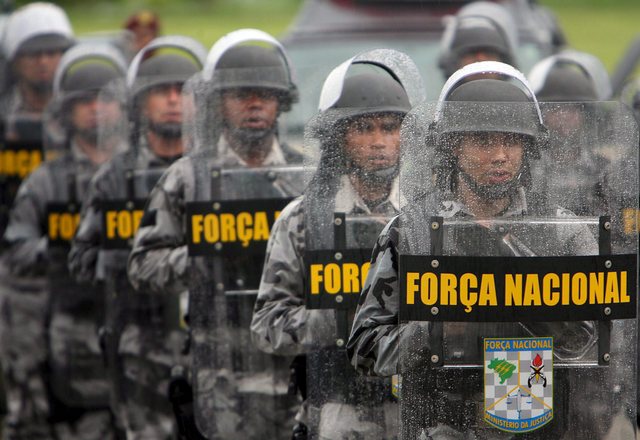
Members of the elite Brazilian National Public Security Force in training, 2007 (EPA/Antônio Lacerda)
The ADC issue highlights another historical reason for the dependence on and trust in, private security in Brazil. The reason is simply that the law is not trusted. Judges and courts have long been perceived as essentially tools of privilege and the official police in their various forms are not trusted by many people of all social classes. The former, as with coronelismo, goes way back into the post-colonial period, but the latter is also a particular legacy of the dictatorships (which can also be seen as the ultimate private control of the public), the last of which only ended in 1985. This leaves Lula´s government, the first that can really claim to be at all progressive, with several major problems: making an untrusted police more trustworthy whilst at the same time increasing their effectiveness and equipment; regulating the thousands of private security firms and, if possible, reducing the dependence of property-owning Brazilians upon them; and finally, and most importantly, dealing with the massive underlying inequalities, that are also a product of what Holston calls the the inclusive but inegalitarian nature of Brazil´s constitution and subsequent socio-economic development. The latter subject is outside the scope of my project, but I will be continuing to delve into the differentiations and intersections between segurança pública and segurança privada whilst I am here.
One of the items reported on in Privacy International´s assessment of privacy in Brazil was that ¨in November 2006, the Brazilian National Road Traffic Council approved a Resolution adopting a Radio Frequency Identification (RFID) tags in all licensed vehicles across the country.¨ The Conselho Nacional de Trânsito (CONTRAN) is part of the Departemento Nacional de Trânsito (DENATRAN), itself part of the massive new Ministério das Cidades (Ministry of Cities), the product of Lula´s major ministerial reforms designed to shift emphasis and power away from the large rural landowners to the growing numbers of increasingly populous cities.
The new scheme is called the Sistema Nacional de Identificação Automática de Veículos (SINIAV, or National System for the Automatic Identification of Vehicles). Basically it will put an RFID-tag in every vehicle license plate, in a gradual process. Much like the new ID scheme for people, SINIAV is based on a unique number. In Annex II, Paragraph 3, the resolution provides a breakdown of exactly what will be contained in the tiny 1024-bit chip as follows. The unique serial number (64), and a manufacturer´s code (32), will be programmed in at the factory, leaving a total of 928 programmable bits. The programmable area contains two main sections. The first contains all the personal and vehicular information: place of registration (32), registration number of seller (32) application ate (16), license plate number (88), chassis number (128), vehicle tax number (RENAVAM) (36), vehicle make and model code (16) and finally 164 bits for ´governmental applications´. The remaining 384 bits are split into 6 blocks for unamed ´private initiatives.´
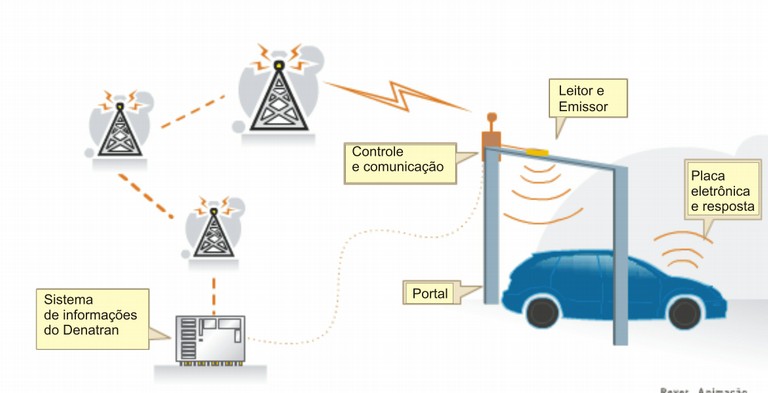
SINIAV system diagram (DENATRAN)
Privacy International note that there is no more than a mention of conformity to constitutional rules on privacy (of which more later). However there is much more that is of concern here. The resolution claims that the data will be encrypted between plate and reader, but the technical specifications are not given to any level of detail (*though there is more information from the Interministerial Working Group on SINIAV, which I haven´t examined in any detail yet). We all know already how easy it is to clone RFID chips. This scheme is supposed to be about security for drivers, but it could easily result in the same kind of identity fraud and consequent necessity of disproving the assumption of guilt created by automated detection systems for car-drivers as for credit cardholders. Could you always prove that it wasn´t your car which was the gettaway vehicle in a robbery in Saõ Paulo, or you driving it, when your actual car was in a car park in Curitiba? Widespread cloning of chips would also render the whole system valueless to government.
RFID chip
Then there is the question of function creep. The chip has spare capacity, and assigned space for unamed functions, state and private. Brazil already has a system of state toll roads (pay-for-use highways), and these chips could certainly be used as part of an automated charging system. That might be very convenient. However what other functions could be thought up, and how might safeguards be built in? As I have already noted, Brazil has no body for protecting privacy or data/information rights so it would be very easy for new more intrusive functionality to be added.
Combining the problems of a movement towards automated fines or changes, and criminality, another major issue would be the one recently revealed in Italy, where a automated red-light camera system was found to have been fixed in order to generate income from fines for corrupt police and a multitude of others.
The final question of course is whether this will all happen as planned or at all. The system would supposedly be complete by 2011. I know of a trial scheme in Saõ Paulo, but on a quick (and very unscientific) straw poll of people who I encountered today at the university here in Curitiba, there is to be no-one who has an RFID license plate or knows someone who does, and there is practically zero awareness even amongst educated professionals. Like the National ID-card scheme, people just don´t think it will go to plan or timetable. That may however, just reflect a (middle-class) Brazilian view of the abilities of the state.
Still, as the Frost and Sullivan market assessment states, all of this turns Brazil into a ‘highly attractive market for RFID suppliers’ which was probably the main motivation and will be the only real outcome.
Every year, Privacy International publishes a kind of index of privacy. The methodology is qualitative and has a strong element of subjectivity based on PI´s campaigning objectives (for example my colleague, Minas Samatas, finds their assessment of Greece as the best country in Europe in this regard, ludicrous). There are also problems with the equivalence of the all the different categories, both in terms of whether all the surveillance identified is even ethically ´bad´ anyway, and in the adding up of categories to conclude that you can lump together the USA, UK, Russia and China. However, it remains a good focus for discussion and no-one else does anything similar.
Let´s see what they concluded about Brazil. Brazil ends up in the 3rd worst category overall, with a ´systematic failure to uphold safeguards´. In particular, PI condemned:
the role of the courts in weakening constitutional rights of data protection (something I will be coming back to next week);
the lack of a privacy law;
the lack of habeus data provisions;
the lack of a regulatory of personal data and privacy;
an overly simplistic test for the legailty of communications interception;
the new ID law;
recent Youtube censorship;
increasing workplace surveillance, which has only been partially addressed by the courts;
widepsread private interception of intenet and e-mail traffic;
that fact that ISPs are required to keep and hand over traffic data to police;
the extensive road transport surveillance using RFID.
However they also noted:
the protection of the right to privacy of children under a 1990 law; and
the fact that bank records are protected under the constitution, and warrants are required to seize them
I will be going through their country in report in more detail next week and using this as one of the bases for the questions I will ask NGO representatives and parliamentarians in the weeks after wards.
The claim that Brazil is a surveillance society, or at least uses surveillance in the same fundamental organising way as the UK or Japan does, is based on the bureaucracy of identification around entitlement and taxation, rather than policing and security.
My previous post on the subject of whether Brazil was a surveillance society put one side of an argument I am having with myself and colleagues here: that the use surveillance in Brazil is fundamentally based on individual (and indeed commodified and largely class-based) security, rather than surveillance as fundamental social organising principle (as one might legitimately claim is the case in Britain). Now, I deliberately overstated my case and, even as I was posting, my argument was being contradicted by colleagues in the same room!
So here´s the counter-argument – or at least a significant adjustment to the argument. In most nation-states, entering into a relationship with the state involves forms of surveillance by the state of the person. This relationship is more or less voluntary depending on the state and on the subject of the relationship. In most advanced liberal democracies, the nature of surveillance is based on the nature of citizenship, particularly:
the ability of citizens to establish claims to entitlement, the most fundamental to most being a recourse to the law (to protect person and property), secondly the ability to case a vote, and more something that is generally more recent in most states, the right to some kind of support from the state (educational, medical, or financial);
the ability of the state to acquire funds from citizens through direct or indirect taxation, to support the entitlements of citizens, and to maintain order.
I am not going to consider law and order, or indeed electoral systems, here but rather I will concentrate on the way that surveillance operates in an area I had previously begun to consider: the bureaucracy of identification around state-citizen relations particularly in the areas of entitlement and taxation. The claim that Brazil is a surveillance society, or at least uses surveillance in the same fundamental organising way as the UK or Japan does, is based on this rather than policing and security.
There are two broad aspects: on the one side, taxation, and on the other, entitlement. I´ll deal first with the latter (which I know less about at the moment), in particular in the form of Lula´s Programa Bolsa Família (PBF, or Family Grant Program), one of the cornerstones of the socially progressive politics of the current Brazilian government. The PBF provides a very simple, small but direct payment to families with children, for each child, provided that the children go to school and have medical check-ups.
Of course these requirements in themselves involve forms of surveillance, through the monitoring of school attendance by children – for which there is a particular sub-program of the PBF called Projeto Presença (Project Presence) with its own reporting systems – and epidemiology and surveillance of nutrition through the Ministério de Saúde (Ministry of Health). However underlying the entitlement is massive compulsory collection of personal information through the Cadastro Único para Programas Sociais (CadÚnico, or Single Register for Social Programs), set up by Lula´s first administration to unify the previous multiple, often contradictory and difficult to administer number of social programs. This is, of course a database system, which as the CadÚnico website states, ¨funciona como um instrumento de identificação e caracterização socioeconômica das famílias brasileiras¨ (¨functions as an means of identification and socioeconomic caracterization of Brazilian families¨). Like most Brazilian state financial systems, CadÚnico is operated through the federal bank, the Caixa Econômica Federal (CAIXA). The CadÚnico database is founded on ¨um número de identificação social (NIS) de caráter único, pessoal e intransferível¨ (¨a unique, personal and non-transferable Social Identification Number or NIS¨). I am unclear yet how this NIS will relate to the new unique identification system for all citizens.
The PBF Card
Entitlement is demonstrated with (yet another!) card, the patriotic yellow and green Cartão PBF. Like the CPF card, this is a magnetic strip card rather than a smart card, and is required for all transactions involving the PBF. Also like the CPF, but unlike many other forms of Brazilian ID, it has nothing more than the name of the recipient and the CadÚnico number printed on it. In this case the recipient is generally the mother of the children being claimed for, a progressive and practical measure shared with other family entitlement programs in Brazil.
Happy smiling PBF cardholders!
The PBF card in itself may not be enough to claim as you would still need at least the Registro Geral (national ID) card to prove that you are the named holder of the PBF card. The card itself may be simply designed to generate a sense of inclusion, as the pictures of happy smiling PBF cardholders on the government websites show consistently emphasise, although of course, like so many other markers of entitlement to state support, it could also become a stigma.
The information collection to prove entitlement is quite extensive, and here I have translated roughly from the website:
house characteristics (number of rooms; construction type; water, sewerage and garbage systems);
family composition (number of members, dependents like children, the elderly, those with physical handicaps);
identification and civil documents of each family member;
educational qualification of each family member;
professional qualifications and employment situation;
income; and
family outgoing (rent, transport, food and others).
Although PBF is a Federal program, the information is collected at the level of individual municipalities, and there is thus the potential for errors, differences in collection methods, delays and so on to hamper the correct distribution of the money. So each municipality is required to have a committee called the Instância de Controle Social (Social Control Authority) which, whilst it may sound sinister to anglophone ears, actually refers to the control of civil society over the way that the government carries out its social programs. This is also quite a lot of information of the most personal kind and whilst, unlike in many countries there is no central authority of Commissioner for Data Protection in Brazil, there is particularly for PDF, an Observatório de Boas Práticas na Gestão do Programa Bolsa Família (Observatory for Best Practice in the Management of the PBF), which has a whole raft of measures to safeguard and protect the data, correct errors etc (what has been called habeus data principles). Effectively, this is a case of knowing exactly quis custodis ipsos custodes!
Now of course, such a large database of information about the most vulnerable people in society has the potential to be misused by a less progressive or even fascist government. Marxist analysis of early welfare systems has tended to colour our views of such programs as being solely about the management of labour on behalf of capital and the control of the working classes by the state to prevent them from more revolutionary action. For more recent times in Surveillance Studies, John Gilliom´s book, Overseers of the Poor, showed how much Federal assistance programs in the USA could impact negatively upon the lives of claimants, particularly women, in the Appalachian region, and revealed the everyday forms of resistance and adaptation that such women used to make the programs function better for them. I will have to examine more detailed anthropological studies of the PBF to see whether similar things are true of the Brazilian program. I don´t want to get too much into the effectiveness of this program now, although I am trying to examine the correlation of the PBF with apparently declining crime rates in Brazilian cities, but it is worth noting that the World Bank rates it as one of the most successful ways of dealing with extreme poverty in the world. As a general observation, it does seem that only those who object to redistributive policies full stop (or just dislike Lula himself) or those who think it does not go far enough, have any serious complaint about the PBF. But there is far more to consider here…
…the Brazilian driving licence is a goldmine of personal information…
I spent a little while over the last couple of days examining the actual material identity documents currently required in Brazil. Here are some pictures with a little explanation. There will be a lot more in the final article!
The first is the simplest but in many ways the most important to life-chances. This is the Cadastro de Pessoas Físicas (CPF) (Register of Physical (or Natural) Persons) card (or Taxpayer’s Card).
‘Pessoas Físicas’ is a a piece of legalese that is draws a distinction between humans and other ‘legal persons’, like corporations or governments. The CPF number is issued to all those who pay tax and is essential if one wants any formal work. The actual document is a blue plastic card like old-style credit cards, which also has a machine readable magnetic strip on the back.
The number is also required for many other government transactions, and it is, apparently a major disaster if you lose the card, or if for some reason, your CPF number is rescinded (which can happen if you don’t pay tax in Brazil for more than a year, for example if you are abroad, without explanation). Many people who live in the favelas, and who are involved in the shadow economy do not have a CPF, which is a severe obstacle to social inclusion.
The second document is the Registro Geral (General Registry) (ID) card, a double-sided piece of thick paper, just larger than a credit card. It is oriented vertically at the front and horizontally at the back.
As I noted in the first post I made on this subject, the RG card cross-references the CPF and also birth certification (it lists the full names of both mother and father and city and state of origin). This card is the one that is being replaced by the new RIC smartcard ID system.
Finally, we have the Carteira Nacional de Habilitação, the driving licence which, despite its name, is issued at state rather than national-level. The colour and format differs from state-to-state, however they all have pretty much the same level of information (a lot!) and cross-identification with other forms of ID. This one is from Paraná, which is a paper usually folded in half horizontally. It is specifically forbidden to laminate it.
The Brazilian driving licence is a goldmine of personal information. Partly this is because the licence had been intended to be a unifying piece of identification (a practice typical of ‘autocentric’ cultures!), containing all the information on both the CPF card and the RG card, and more. This will now not be the case following the issuing of the new RIC cards, so it will be interesting to see if the quantity of information on these licences will be reduced or, if not, what the justification will be for having this much visible personal information on one paper document.
Murder rates in Brazil and São Paulo (The Economist, 2008)
Most people tend to think of Brazilian cities as divided and violent, with especially high rates of gang-related gun deaths in and around the favelas. Certainly that was the impression I was starting to get. However, there was an excellent piece last year in The Economist on falling murder rates in Brazilian cities. Yes, that´s right, I said falling murder rates. And not just falling, plummeting.
However, as the article points out, the decline is largely due to a halving of the murder rate in Brazil´s second city, São Paulo. The Economist put this down to a combination of: tighter gun control; better policing (including community policing initiatives and a large new Murder Squad, which ¨uses computer profiling to spot patterns and to act preventively¨); and, a relative decline in the youth demographic as the baby-boom cohort of children born after the mass immigration from the 1970s ages – the gangsters are getting older and getting out of crime, and there are slightly fewer young recruits to replace them. But one note of caution is that this may all be the temporary result of one particular gang gaining a dominant and unchallengable position. My view (not The Economist´s) is that if this latter development is a genuinely long-term trend, it could either result in a move to more legal community development activities by the gang (as has happened in some US cities) or a more stable but persistant pattern of criminality such as that in exhibited by the endemic gang-cultures of Southern Italy or in Japan…
Of course, I should also note that these figures are official ones from the Ministry of Health and I have no idea yet how reliable are the collection or categorisation methods for crime statistics used by the Brazilian authorities.
Just a quick post to say that I’ve arrived in Curitiba safely – the Brazilians seem to have the nice kind of border controls that now seem long gone in the UK. It is raining incredibly hard now, and we already had a massive electrical storm that knocked out power in our neighborhood for a couple of hours.
Note: this post was interrupted by another power cut last night!

 I say that human rights is unpopular, which may sound surprising, but talking to the valiant lawyers and organisers at the Instituto Pro Bono, which provides lawyers to those who can’t afford them, mainly prisoners, and Artigo 1o, which brings civil actions against the state on behalf of prisoners killed or injured by police and prison staff, I was immediately reminded of the depth of the social divisions, and the sheer mutual ignorance of people in different social classes here in Brazil.




















 ubisurv