Cameras against Corruption

One of the things that was intriguing me about the recent meteorite strikes in Russia was how come there was so much video footage available from inside cars. And not surprisingly some other surveillance researchers were thinking the same thing, and it was Gemma Galdon Clavell who provided the answer: apparently many Russians have dashboard-mounted cameras largely as a form of protection against corrupt cops and officials as well as scammers pretending to be cops and officials and worse.

This article from Radio Free Europe explains at least some of this.

Update: I should warn people not to watch the video links from that piece unless you want to see actual nasty accident footage. It’s not pleasant at all.

Miniaturization

I am doing a bit of work on the ‘vanishing of surveillance’ right now – looking at the decreasing size of sensors, the hiding of surveillance platforms through biomimetics, and so on.

So I was very interested in news reported on Boing Boing today about a pinhead-sized camera with no conventional lens etc. that is mainly designed for applications that do not require detail. The inventors are talking about medical applications, but once again, the agency funding this is DARPA, the US Defense Department’s research organisation.

Tech regs, not ethics, close London CCTV

Hundreds of CCTV cameras in London will have to be shut down, but this has nothing to do with concerns over privacy, liberty or the surveillance society, it is entirely due to technical regulations.

The cameras, which are mobile road cameras owned by Westminster City Council, used for multiple tasks including anti-crime activities and protest-monitoring, but they are supposed to be for traffic regulation and as such must conform to technical standards set by the Department for Transport (DfT) -in this case, a 720 x 576 pixel picture size (analogue broadcast standard). Westminster’s are 704 x 576!

This might all seem rather petty were it not for two rather important aspects. First of all the case reminds us how surveillance introduced specifically for one area (traffic management) can creep into other areas for which they were never intended or authorized. This can also work in many directions: some of London’s congestion charge cameras were originally installed as anti-terrorism cameras after the IRA attacks of the early 90s.

Secondly, however it also shows, counter-intuitively, how weak is the regulation of CCTV in the UK. The fact is that the cameras have been stopped because of a technical infringement, and indeed there is in general an extensive and growing list of technical regulations and recommendations for CCTV issued by central Government bureaucracy, yet CCTV remains massively under-regulated when it comes to conformity with human rights and civil liberties, let alone for any consideration of the wider and longer-term social impacts of pervasive video surveillance. The closure of this system highlights the powerlessness of the British people in the face of increasingly authoritarian government, not their strength…

(Thanks to Aaron Martin for sending me this one)

How many cameras are there in Britain?

The truth is that no-one knows exactly how many cameras there are in Britain or indeed in any country in the world

I’ve been having an interesting little private exchange with a David Aaronovitch of The Times newspaper, who seems to think he has uncovered a terrible conspiracy… and I think I am about to be accused (tomorrow) of being ‘cavalier’ with the truth and of misleading the public. Interestingly enough this is going to be in the same newspaper that was the only one that tried to rubbish the Information Commissioner back in 2006 when we published our Report on the Surveillance Society and indeed were actively lobbying against his reappointment. I suppose someone has to argue the establishment case…

What David has been e-mailing me about is the validity of figures concerning the number of CCTV cameras in Britain that journalists have been happily spreading about for the last ten years. These figures are the ‘4.2million CCTV cameras in Britain’, and the ‘person can be captured on 300 different cameras in a day.’ He seems to think that it is an urgent matter of national importance if these old figures aren’t ‘accurate’ or apply to the average person. Well, they were and are purely indicative – they aren’t ‘accurate’ and never were, and the latter one doesn’t apply to a typical Briton and neither Clive Norris, whose figures they are, nor myself, nor any other credible surveillance studies academic that I know, has ever claimed that they are and do.

The first figure derives from what Professor Norris openly described as a ‘guesstimate’ in his working paper with Mike McCahill on CCTV in London that was done for the EU’s UrbanEye project. Based on a casual count of cameras in one small neighbourhood in London in around 2000 (not the City of London where cameras were much more concentrated even then) it aimed to get a very loose handle on the scale of the spread of CCTV in Britain. The police at the time claimed that the real figure was in hundreds of thousands, but they were only talking about public cameras, and they had just as little idea of the extent of CCTV.

The other figure that of 300 cameras a day came from a little fictional vignette that Professor Norris and Dr Gary Armstrong wrote for their book, The Maximum Surveillance Society, which came out back in 1999. It was simply designed to illustrate how many cameras a person could possibly be caught be in any one day. I was thinking it would actually be very hard for this to be that likely even now, except perhaps in the very core of global cities like London, but then there are over 300 cameras on the university campus where I am currently, and I haven’t even started on all the private cameras, the public cameras in the city, the traffic cameras, the cameras in the buses, banks, shops, cafes, restaurants, bars, in the hotel etc. etc. I would estimate that I am caught by around 100 cameras when I am out and about here and this isn’t even a city that considers itself to be particularly ‘under surveillance.’

The truth is that no-one knows exactly how many cameras there are in Britain or indeed in any country in the world. We deliberately used words like ‘may’ or ‘can be’ in reference to these figures in our Report on the Surveillance Society because they are so rough, so inaccurate – and we were quite clear that this was not in any case a report about CCTV; if anything we tried to downplay CCTV and get to other technologies and techniques, such as dataveillance and RFID, and more importantly the way connections and links are being made, and boundaries blurred. ‘Millions’ may be about as accurate as we can guess for the UK. But does it matter if there are 1 million, 4.2 million or 10 million? Not hugely. It matters as one crude indicator of a surveillance society, but even then, the number of cameras is a very crude measure and more cameras does not necessarily mean more comprehensive coverage or better pictures, or more ‘control’. For example, would it be worse or better if I was only seen by one camera in a day, but that camera was there all the time and I was constantly being assessed on my performance (as for example is the case with many workers in call centres)? The Guardian today seems to understand this – in its report on the high-tech control room in Westminster, it clearly states that ‘no-one knows’ how many cameras there are (before quoting some even more made-up figure than ours!).

I know the media likes its easy numbers, but an old saying about not being able to see the wood for the trees comes to mind… As a researcher, I am more interested in characteristics of the wood than the specific number of trees. Now if there were no trees at all or very few, that would matter. And in my current comparative project it has some importance as one of the many indicators of what constitutes a surveillance society that I am looking into. So in a couple of year’s time I may have more of an idea of from any cameras there really are in Britain. One of the things I am trying to do during my current project is develop better ways of assessing ‘how much surveillance’ there is, and what it means. Because that is the important issue – meaning. Does it matter if there were 1/6 or 1/7 or 1/8 of the population of the former East Germany who were recruited as informers? You’ll find all those as educated guesses in the literature. What matters was that there was a culture of informing that pervaded every action. It was a society that became increasingly based on deception and distrust.

The key questions with CCTV are:

  1. first of all, why are there any cameras, and particular any cameras in public space, at all? Surely there was a line crossed when the first use of CCTV occurred. What was the reasoning?
  2. why did CCTV spread so quickly to so many places, and was so little contested?
  3. why is CCTV now considered so ‘normal’ in Britain?
  4. connected to this, why do the myths of CCTV’s effectiveness continue to be spread when all of the evidence shows a small and very limited impact on crime?
  5. what kind of a society does pervasive CCTV create? what are the social effects? what kind of social and cultural responses are there?

etc.

Unfortunately the media doesn’t seem to like depth or uncertainty. Maybe that was our real mistake – to overestimate the intelligence of the media. I have asked them for a right of reply – I am more than happy to debate the issue in public. Let’s see if that happens…


Austin no longer the coolest city in the USA

The latest city to fall for the current wave of government enthusiasm for surveillance that is sweeping the USA is, unfortunately, the city of Austin… Sorry Austin – unless you people do something about this, you are off my list of cool cities…

Austin, Texas… lone island of sanity and liberalism in a less-than-liberal state. With its laid-back attitude, massive urban bat population, superb music scene and reputation for weirdness, it must for some time have been a candidate for coolest city in the States.

Austin... no longer cool

Well no longer. The latest city to fall for the current wave of government enthusiasm for surveillance that is sweeping the USA is, unfortunately, the city of Austin, whose authorities have voted to install a CCTV system. The local newspaper, The Daily Texan, jauntily informs us that the city has voted to sacrifice privacy for security: that does not sound like the attitude of a confident, hip place. Sorry Austin – unless you people do something about this, you are off my list of cool cities!

Seriously, though: Austin is not a city with an especially high crime rate, nor has it seen any massive recent increase in crime – even if CCTV was any good at reducing crime, which we know from the multiple assessments done in the UK and elsewhere that it isn’t. Yet Police Chief Art Acevedo is quoted as praising CCTV in the UK, specifically in London. Perhaps he has been reading too much of the hype and hasn’t read the British government’s own assessments of CCTV (conducted under the auspices of the Home Office)?

So why the sudden urge to install cameras? Could it be because of the lure of federal funding from the Department of Homeland Security? It could be. Austin has acquired $350,000 to install cameras, and what set of city fathers turns down cash (whatever it is for)? That was one of the main lessons of the expansion of CCTV in Britain in the 1990s and of course cities are now paying the long-term price of their enthusiasm as they struggle to find the money to monitor and maintain their camera systems. Chief Acevedo seems to have no worries about this though – this techno-evangelist is already talking about automation and computer recognition systems. He really sounds like a guy who has started to believe the sales pitches at all those law enforcement technology trade fairs…

More CCTV stories: from Jerusalem to Cambridge

CCTV cameras are seen as the answer to anything and everything. It’s not much more than a form of magical thinking.

Two contrasting CCTV stories today.

On the one hand, we have a seemingly typical story of civic authorities wanting to install cameras, right down to the lazy, cliched, headline: ‘Smile, you’re on surveillance camera’ – how many times have we seen variations on that one? The cameras are proposed to arrest a decline in custom at a busy city market except… that the city is Jerusalem, and the market is the Mahane Yehuda market, a favoured target for suicide bombers. Now, I am not entirely sure how cameras will stop a determined suicide bomber, who by definition isn’t really that bothered about being seen committing a crime, but this is just an extreme case of underlying causes being missed. There are the usual civil rights concerns raised, and the effectiveness of cameras questioned. But suicide bombing isn’t just some unavoidable fact of life, it’s directly related to the ongoing repression by Israel of the Palestinian territories… a clear case of sticking plaster for a mortal wound if ever I saw one.

Here as in many cases, CCTV cameras are seen as the answer to anything and everything. It’s not much more than a form of magical thinking.

On the other hand, we see the town of Cambridge, Massachusetts, voting against allowing Homeland Security cameras to be used. It’s another extreme case of course. You could hardy find a more comfortable and safe middle-class town with a higher concentration of liberal intellectuals – they even had a former head of ACLU speaking at the meeting. It must be positively terrifying to be a city councilor in the face of informed opposition like that. Of course the story is replete with all kinds of ironies, not least the city representative who argues that the city voted against it only because there hasn’t been enough public participation!

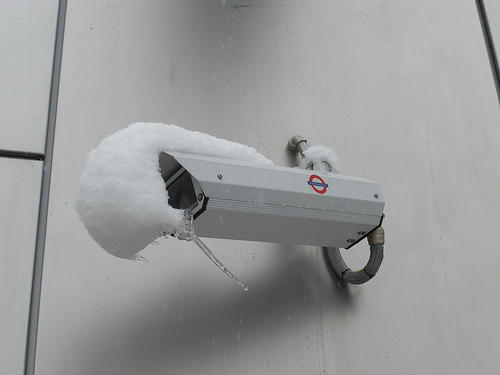
However, as the article also notes, the cameras are already installed, they just aren’t switched on. Perhaps, like this snowbound camera photographed yesterday in London, their ‘magic’ will work anyway and everyone will be happy…

They can see through snow, you know. London CCTV camera (by Almost Wiity on boingboing)
They can see through snow, you know. London CCTV camera (by Almost Witty on boingboing.net)

Corrupting automated surveillance

OK, so automated surveillance systems are always right, aren’t they? I mean, they wouldn’t allow systems to be put into place that didn’t work, would they?

Image from t-redspeed system (KRIA)

That was probably the attitude of many Italians who were supposedly caught jumping red lights by a new T-redspeed looped-camera system manufactured by KRIA. However, the BBC is reporting today that the system had been rigged by shortening the traffic light sequence, and that hundreds of officials were involved in the scam that earned them a great deal of money.

Now, the advocates of automated surveillance will say that there was nothing wrong with the technology itself, and that may be true in this case, but technologies exist within social systems and, unless you try to remove people altogether or by developing heuristic systems – both of which have their own ethical and practical problems – then these kind of things are always going to happen. It’s something those involved in assessing technologies for public use should think about, but in this case it seems they had thought about it, and their only thought was how much cash they could make…

CCTV in Canada

News from Queen’s University’s Surveillance Project that the Surveillance Camera Awareness Network (SCAN), a stellar group of Canadian Surveillance Studies scholars, has released the first phase of its report on Camera Surveillance in Canada.

The report shows that public space CCTV is still relatively rare in Canada, with only 14 cities having implemented it. It argues that despite the lack of evidence for any effectiveness, and the absence of proper informed consent to schemes, the vast majority of the public support cameras largely on the basis of an ill-defined hope that they ‘work’.

My view is that the conditions for a British-style expansion would seem to be in place, were it not for the very different and much more activist role of Privacy Commissioners, informed by research like this, in questioning the need for CCTV. Let’s hope Britain’s role as an experimental surveillance guinea pig for the world will at least teach people elsewhere something…

The authors also mentioned that there is a surveillance series in the Ottawa Citizen that began Wednesday January 29. It features many surveillance studies academics from SCAN and more, and the first piece is really very good.

As another part of the series, the Citizen has adapted the 2016 scenarios that Kirstie Ball and I wrote for the Report on the Surveillance Society for the ICO back in 2006. They have pushed a load of things together so that it doesn’t quite makes sense, but never mind…