What is rather less well-known to the outside world is that Japan developed such an automated camera system far earlier, from the early 1980s. The so-called N-system thereafter was gradually expanded to cover almost all major expressways and strategic urban locations in Tokyo and Osaka. Kabukicho, the entertainment district in Shinjuku, which I have spent some time studying over the last few years and will write about more tomorrow, is surrounded by N-system cameras and it is, I estimate, impossible to drive into this area without your license plate being recorded. These cameras are in addition to the 50 CCTV cameras that cover just about every street within the district. N-system is supposed to have played a major role on snaring suspects from the apocaylptic cult, Aum Shinrikyo, which carried out the Sarin gas attacks on the Tokyo underground in 1995, and who also assassinated top policemen and judges. Aum, now renamed ‘Aleph’, has been under official state surveillance ever since.
The Japanese police are not very forthcoming about N-system, let alone the details of how long data is kept and what it is used for. However one particular lawyer’s office in Tokyo did a very good investigation of the constitutional, legal and practical aspects of N-system back in the late 90s, and the updated pages are available here, including a nice little animation explaining how the system works.
We will hopefully be talking to them before we leave Tokyo. We still have time for a few more interviews here including the East Japan Railways security research lab, the Japanese consumers’ association, the organisation for the welfare of foreign workers, and the Suginami ward community safety people. And I will also just about have time to shoot down to Kobe to talk to Professor Kiyoshi Abe, a friend and collaborator, who is also one of the leading surveillance researchers here.
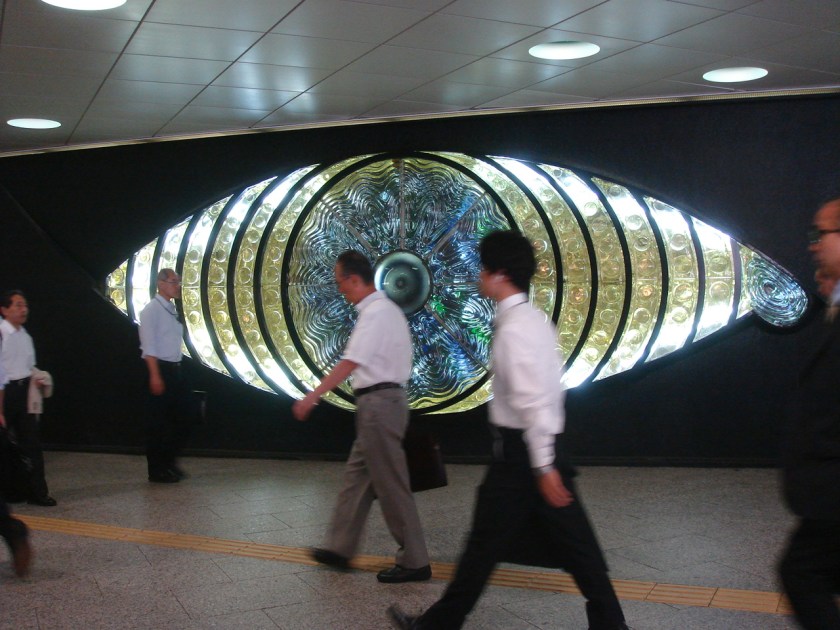
Somebody's watching you... office workers walk past an installation in Shinjuku station, Tokyo
We’ve met with several Japanese surveillance studies researchers whilst out here this time. I mentioned Ogura Toshimaru already the other day, but we also had a long meeting the week before with Hino Kimihiro, a researcher into bohan machizukuri (community security development), and government advisor on security planning. Dr Hino has been carrying out a number of research projects on both ‘designing out crime’ and on the effectiveness and public acceptability of CCTV in Japan. I hadn’t come across this research before as my contacts here were mainly in social sciences and law and Dr Hino tends to publish in urban planning journals and is not connected to other Japanese surveillance researchers. His work is very interesting and reminiscent of that of Martin Gill or Farrington and Welsh in the UK. It is a shame, that just like those researchers who have carried out analyses of CCTV for the UK Home Office, his assessments tend to be ignored by the government. Dr Hino’s latest project is to assess the trials of a new movement recognition system in Kawasaki city. I hope he can come to the January Camera Surveillance workshop at Queen’s University, Ontario, or the April Surveillance & Society conference in London (details coming soon!).
I also met today with Tajima Yasuhiko, a professor of media law in the School of Journalism at Jochi (Sophia) University in Tokyo. Professor Tajima has been one of the most important critical voices in the debate about surveillance in Japan, and has bridged the academic and activist world, being involved with legal action against juki-net and Google StreetView. We had a productive conversation about the politics of surveillance in Japan and the prospects for critical voices to be heard. He wasn’t optimistic that they would be, and neither am I after our meeting at the Prime Minister’s IT Strategic JQ the other day, however I am also convinved that in many ways Japan has not yet gown as coordinated and centralised a route on issues of security and surveillance as has the UK. There is, so far as I can see, no real attempt to link up things like juki-net or other databases and the anshin anzen (or bohan) machizukuri agenda, and i-Japan, national and local police, and wider community security agendas do not really coordinate at all. This is due to the lack of an obvious ‘threat’ like that of terrorism in the UK, around which such coordination can occur. The government half-heartedly tries to get people worried about North Korea, but really they aren’t, and ‘ageing society’, whilst a phrase used to justify almost anything (including central databases) is a worry, it does not generate the fear that comes with the war on terror.
We also considered the relative weakness of Japanese civil liberties organisations and the failure of the mainstream media to pick up on issues of privacy and surveillance. There seems to be some effort now to try to coordinate various organisations to push for an explicit constitutional protection for privacy (rather than the rather vague inclusion of such an idea in a wider notion of the ‘pursuit of happiness’), but whilst I can see that being happily accepted after the government has got its central database(s), I can’t see it being done in time to alter either this trajectory or the way in which the database(s) are built.
We met yesterday with member of the Campaign Against Surveillance Society (AKA Kanshi-No!) a small but active organisation formed in in 2002 in response to the Japanese government’s jyuminkihondaichou network system (Residents’ Registry Network System, or juki-net). plans and the simultaneous introduction of police video surveillance cameras in Kabukicho in Tokyo. We had a long and detailed discussion which would be impossible to reproduce in full here, but I did get much more of a sense of what in particular is seen as objectionable about past and current Japanese government actions in this area.
The main thrust of the argument was to do with the top-down imposition of new forms of control on Japanese society. This they argued was the product of the longtime ruling Liberal Democratic Party’s neo-liberal turn and has thus been some time in the making. It is not a post-9/11 phenomenon, although they were also clear that the G-8 summit held in Hokkaido in 2008 used many of the same forms of ‘community action’ in the name of preventing terrorism as are used in the name of anzen anshin (safety) or bohan (security) from crime in Japanese cities everyday.
However, they argued that this might be a product of neo-liberalism, but the forms of community security were drawn from or influenced by a much older style of governance, that of the Edo-period mutual surveillance and control of the goningumi (five family groups). (this is actually remarkably similar to the argument that I, David Lyon and Kiyoshi Abe made in our paper in Urban Studies in 2007!). Thus the mini-patoka and wan-wan patrol initiatives in Arakawa-ku were seen as as much a part of an imposed state ordering process as the more obviously externally-derived CCTV-based form of urban governance going on in Shunjuku.
Underlying all this was the creation of an infrastructure for the surveillance society, juki-net. They were certainly aware of the way that juki-net had been limited from the original plans, and indeed they regarded these limits as being the major success of the popular campaign against the system, however they argued that the 11-digit unique number now assigned to every citizen was the most important element of the plans and this remained and could therefore serve as the foundation for future expansion and linking of government databases. They pointed to the way that the passport system had already been connected.
Kanshi-no! were also concerned, in this context, about the development of plans for experimental facial recognition systems to be used in Tokyo (at a location as yet unrevealed). This would imply the development of a national database of facial images, and a further extension of the personal information held by central government on individuals.
So was this all in the name of puraibashi (privacy) or some wider social concerns of something else? Certainly, privacy was mentioned, but not as much as one would expect in an interview with a British activist group on the same issues. I asked in particular about the decline of trust and community. The argument here was that community and any lingering sense of social trust had already been destroyed and that CCTV cameras and other surveillance measures were not responsible in themselves. However, from an outside perspective it does seem that there is more of a sense of social assurance and community, even in Tokyo than there is in the UK. I do wonder sometimes when people (from any country) refer back to some time when some idealised ‘trust’ or ‘community’ existed, when exactly it was! Rather than a particular time, it seems to be a current that either asserts itself or is suppressed of co-opted into the aims of more powerful concerns in particular times and places.
I asked at one point what immediate change or new laws Kashi-no! would want, and the answer was quite simple: no new laws, just for the state to respect the constitution which they said already made both CCTV cameras and juki-net illegal (although of course the Supreme Court recently disagreed).
(Thank-you to the two members of Kanshi-no! for their time and patience with my questions)
The link between urban regeneration or redevelopment and the introduction of video surveillance has been well documented by many different authors in Britain, in particularly Roy Coleman in Reclaiming the Streets. It seems that the link is strong in Tokyo too. This new CCTV scheme in the front of Nippori railway station in Arakawa-ku is not only clearly part of the social and spatial restructuring of this area, it is an essential part of the new image, with the new entranceway celebrating the security cameras as much as the area’s name. This is the area we were told by Shinjuku officials had only three cameras, whereas in fact it has the princely total of ten! In retrospect the Shinjuku people seemed to be rather condescending towards Arakawa-ku.
We had an enlightening interview, which will give me much to analyse later, with three senior officers from the Seikatsu Anzen Bu (literally, ‘Everyday Life Safety Division’) of the Keisicho (Tokyo Metropolitan Police). Interestingly, this division that was created as a result of the Seikatsu Anzen Jourei (Governor Ishihara’s 2003 Tokyo Metropolitan Government ordinance) and which deals with all the community security and safety initiatives, including CCTV, is separate from the Chiki Bu (the community division) that is responsible for the koban neighbourhood police box system.
Like almost everyone in authority we have met here, the police were convinced that they were not doing surveillance in using the cameras. They also confirmed that almost all of the CCTV systems operated by shoutenkai (shopkeepers’ associations) are not monitored and are simply recorded. They also stressed their deep concern for privacy and the rights of citizens and said that data from the police-operated cameras – of which there are around 150 in Shinjuku (the largest system with 50 cameras in the Kabukicho entertainment district), Shibuya, Ikebukuro, Roppongi and Ueno – was only kept for 7 days unless there was a specific reason to retain it. This is a legal requirement not just a police guideline. The police cameras are monitored both in local stations and in a central control room, but we were told that it was strictly forbidden for us to visit (unlike every other city in which I have done research) as everyone who enters has to be pre-enrolled in the police iris-scan security database.
We talked a lot about the history of the development of CCTV and of community safety initiatives in Tokyo, and Governor Ishihara’s absolutely central role in backing video surveillance became very clear (it’s a shame he has so far refused an interview with us!). What was also particularly interesting was that the police themselves did not think that apparently obvious ‘trigger events’ were as important as it might seem. For example, they claim that the police only really began considering the use of CCTV cameras not after the Aum Shinrikyo sarin gas attacks on the Tokyo underground but because of the influence of G8 summit security. One officer specifically mentioned the Gleneagles summit (which was just starting when terrorists attacked the London transport system), but this was in 2005, well after the TMG had already introduced CCTV, and after which the Tokyo police have not introduced a lot more cameras. So I don’t quite understand their point. It may become clearer once I have the complete transcripts… They also claimed that it was the Tokyo police rather than Japan Railways themselves or the Tokyo Metro authority who insisted on installing CCTV in the Tokyo transport network after the Aum attacks.
The officers talked a lot about community involvement. They dismissed the objections to their public space CCTV systems for several reasons, not least as I have already mentioned that they were not doing ‘surveillance’, but more importantly because they claimed to have done extensive consultation with local community groups, businesses etc. The claimed that they could not do anything without this support. This may have been true for Kabukicho, which was undoubtedly afflicted by an influx of Chinese gangs in the 1990s, but we heard from the local government of another ward that is being lined up for one of the new volunteer-based child safety camera systems being introduced from 2010 that they were given no choice by the police, and that local people were not happy about it. The problem is that this local authority don’t want to be interviewed further about this as they are in a rather delicate position over this new system.
(Thank-you very much to the officers from the Seikatsu Anzen Bu for giving us their time)
Far from the skyscrapers and bright lights of Shinjuku, where we had our last interview on community security and safety development (anzen anshin machizukuri), Arakawa-ku is a defiantly shitamachi (‘low-town’ or working class) area to the north-east of Tokyo just north of Ueno and outside the Yamanote-sen JR railway loop line that has for much of the last 40 years defined the boundaries of the richer parts of the city.
Bordering the Ara river and split by the Sumida river, it was traditionally a marshy place liable to flooding. It was also a place with a large buraku (outcaste) population and Minowa (in the north of the ward) contains the mournful Jokan-ji (or Nagekomi – ‘thrown-away’) temple, where prostitutes who died in the Yoshiwara pleasure district were cremated. The place has been hit hard by disaster. It was levelled twice in the the Twentieth Century, first by 1923 Kanto daishinsai (Great Kanto Earthquake) and then again by the firebombing in the last years of WW2.
Nevertheless, its rough, industrious, hardworking spirit has continued, and these days, despite the march of secure manshon (high-rise housing) down the post-war avenues, it remains a place full of small industrial units, especially recycling businesses and clothing wholesalers and manufacturers in Nippori, small bars and family restaurants, and lots of ordinary housing, even some of the last remaining dojunkai (early concrete public housing) constructed after the earthquake. It’s also the starting point of the last remaining tramway (streetcar line) in Tokyo, the Toden Arakawa-sen. I like it a lot and it’s where my wife and I have lived in Tokyo in the past, and where we still stay when we return (there will be more pictures in a later post).
It was natural then to turn our attention to the place as a case-study area, mainly because it is so different from Shinjuku and the other areas that have gained so much attention from the Tokyo Metropolitan Government’s recent initiatives. We met with three officials from the Community Safety section of the local administration: the boss and two guys who had been seconded from the city police and the fire service respectively. The boss was full of enthusiasm for the direction that Arakawa-ku has taken, which although they don’t use the term ‘machizukuri‘ is far more about real community involvement than some places that do.
The HQ of Arakawa community safety
Arakawa has no comprehensive CCTV strategy, although the police do consult with the developers of large new buildings on its installation. That’s not to say that they don’t have a certain degree of ‘CCTV envy’ of those places with the latest high-tech gadgets that Arakawa can’t afford, but they are not dazed by the glamour of cameras and are realistic about both the limitations of CCTV and the appropriateness of such systems for their city. Instead they concentrate on using and enhancing the natural surveillance capacities of the local communities. They make a great deal of use of volunteers, retired police officers and ordinary local people, who do their own patrols, including the delightful wan-wan (‘woof-woof’) patrol which, judging from the posters, involves mainly older female residents and very small dogs! Participation in the various community initiatives is encouraged through the use of techniques like professional rakugo (traditional comic monologue) performances in schools and community centres. They also run community patrols in miniature versions of police patoka (patrol cars), which not only look more friendly but unlike the US-style police cars can get through much narrower streets.
The cute community patrol cars
However these diverse community projects are being stitched together in quite an innovative way, with the use of small anzen anshin sutashion (security and safety stations), which are a bit like community versions of the police koban, the miniature two-person police boxes which dot the city. Indeed the officials referred to them as minkan koban (‘people’s koban’). These small help stations, staffed mainly by ex-police don’t just provide ‘security’ information, they also deal with social security in the broader sense, offering help for older people with benefits, for example. In almost all cases, they have replaced koban that were closed by the police. So one could argue that this is essentially the local authority being forced to pick up the bill for services that used to be provided by the police and at the same time is actually losing real police service. However, the strategy overall is a valiant attempt to make ‘community safety’ less an issue of exclusionary security and more one of inclusivity and community development, more a natural and intimate part of everyday life that does not involve new forms of external control.
Of course, crime isn’t really a massive issue here anyway. Arakawa has consistently had the second or third lowest crime rates of all the 23 Tokyo wards. But even since the introduction of these initiatives, crime has fallen still further from the relative high point it reached a few years ago. And hardly a CCTV camera in sight…
CCTV cameras prevent crime, do they? Well, they certainly don’t if it’s the cameras being stolen! This was in Florida, and I seem to remember that back in the mid-90s when video surveillance was first on the rise in the UK, this kind of thing was no uncommon…
Anyway, I know one should never condone crime, but with all the same ill-informed pro-CCTV propaganda being spread in the USA as was used in the UK back then, I am at least enjoying the irony…
BBC’s Newsnight current affairs programme has used the Freedom of Information Act to ask almost 100 Local Authorities in the UK how many video surveillance cameras they operate. There are some really nice graphics here, which demonstrate what a ridiculous number of cameras we have, and particularly the way in which CCTV is becoming seen as ‘normal’ in all areas, not just big cities.
This brings up the discussion we were having earlier in the year with David Aaronovitch of The Times and Paul Lewis of The Guardian (see here, here, here, here and here!), who claimed that members of Surveillance Studies Network had knowingly fabricated figures. In fact these were scenarios and broad guesstimates and never presented as anything more than that. Newsnight in common with most media doesn’t get this either and thinks that its survey means that “there are almost one million fewer CCTV cameras in the UK than previously thought.”
However there survey was only of Local Authorities. It did not cover private systems in public open space or quasi-public space like transport systems (railways, buses and the underground) and shopping malls, let along cameras in private space. The guesstimates made by Clive Norris and Mike McCahill way back in 2001 included all cameras in public space. Norris and Gary Armstrong’s little scenario of being spotted by up to 300 cameras a day most certainly included purely private ones too – as did a real life version of the same kind of scenario conducted by The Times earlier this year – in fact, private cameras covering public space were almost twice as numerous as state ones. So in fact there are probably many more CCTV cameras than “previously thought.” The important thing is that there is almost no control over their proliferation whether nominally ‘public’ or ‘private’ and, as I wrote the other day, almost nothing apart from conscience that seems to be stopping operators from using ‘augmented’ CCTV because extra functionality like audio comes as standard on camera units these days.
For me, of course, the really interesting figures are the international comparative ones: that there are more cameras operated by the average London borough than by the whole metropolis of Tokyo. Yet in other ways, the figures are probably closer – Tokyo is as comprehensively covered as London in terms of public transport. Nothing is quite as clear-cut as it seems if you restrict the research to one type of camera system. Still, thank-you very much to the Newsnight researchers for performing a useful public service!
Now, there may well be problems with aggressive or abusive passengers in Maryland (although I’ve also encountered enough abusive drivers in my time!) but that does not mean that any kind of action is justified in the name of preventing or discouraging this. This, as in the Netherlands situation, is a problem of incivility (or ‘respect’ to use Tony Blair’s favourite policy word) but civility develops between people and cannot be imposed by authority or surveillance. What you get by going down this road, if indeed the strategy ‘works’ at all is simply a society of resentful, distrustful, quietude where civility is simply a set of superficial Pavlovian responses not genuinely felt values that people work to create and would want to defend. Problems of incivility are hardly going to he solved by trying to create an even more managed, automated and, fundamentally, desocialised and uncivil society. As the UK’s leading CCTV researcher, Clive Norris, remarked about the UK’s ‘shouting cameras’, introduced as part of the Blair’s ‘Respect Zones’, it is hard to imagine anything much more disrespectful of the public.
What’s particularly interesting in this story too is the way in which one form of surveillance can be used to justify another, producing an internal and self-replicating logic. The thinking is that as buses already have video cameras, then this is just the same thing, right? Stick a notice up saying you’re being recorded and all legal bases are covered. Well, no, I don’t think so. Let’s explore this further. I frequently record conversations that I have. Shocked? Actually, it’s part of my job as a researcher. I interview people and I record the interviews, but I do so with the full consent of the person being interviewed and if they do not want to be recorded, I don’t record them. However, there appears to be no room for consent around mass surveillance at all. It’s becoming clear that the (lack of) regulation of CCTV has set a dangerous precedent here, with consent being regarded as ‘impractical.’ It is really not enough in any accountable system of democracy to assume that the state can assume consent for surveillance measure on the grounds that to seek specific consent would be too hard. And in any case, the ‘acceptance’ of CCTV – even if one believes that the public does indeed ‘accept’ it rather than simply feel a sense of profound disempowerment with regard to video surveillance – does not mean that ‘anything goes’ as far as surveillance is concerned. An already dubious implied consent to one form of monitoring is not the same as consent to all monitoring. And of course, even if you did have some collective majoritarian consent, what does that imply for those in the minority? We already know that surveillance is targeted against minorities, so how can even a standard democratic procedure protect people here? Of course, this is what constitutional protections are for, and in particular in this case, the Fourth Amendment to the US Constitution but the MTA appears to think that the precedent of CCTV means that this does not apply. Round and round we go.
This, in the end, is all about organisational risk management and simply treats the public as sources of risk and as potential offenders, not people with rights, and indeed people who either are generally or, given the respect and space they deserve, would be, good. But risk-thinking seems to override even those things we are used to seeing as foundational of our societies.
Fascinating and disturbing news from the MIT Technology Review blog that a team of researchers appears to have cracked the problem of how to produce cheap, effective Terahertz Wave (TW) cameras and receivers. TW are found between infrared and microwave radiation, and produce what we called in A Report on the Surveillance Society, a ‘virtual strip search’, as they penetrate under layers of clothing but not much further, and can thus produce images of the body ‘stripped’ of clothing. Thus far, they’ve been used on an experimental basis in some airports and not really any further afield.
This is largely because of the way that TW waves have been detected up until now has basically been a bit of a kludge, a side-effect of another process. This has meant that TW equipment has been generally quite large and non-portable (amongst other things).
However one Michel Dyakonov of the University of Montpellier II in France has followed up theoretical work he did in the 1990s, with a new larger team, to show that tiny (nanoscale) ‘field effect transistors’ can – and they are still not quite sure how exactly – both produce and detect TW. The details are in Technology Review, but the crucial thing for those interested in surveillance is that:
the output is ‘good enough for video’; and
‘they can be built into arrays using standard silicon CMOS technology’ which means small, cheap (and highly portable) equipment. This could be an add-on to standard video cameras.
I’m getting a genie-out-of-bottles feeling with this, but is it really as damaging to personal privacy as it feels? Does this really ‘reveal’ anything truly important? Or will it become something to which we rapidly become accustomed, and indeed with with which we quickly get bored? In some cultures, specially those that regard covering the body and modesty as being god-given, this is clearly going to present massive challenges to social and moral norms. It seems to me that there is also an immediate conflict with current constitutional and legal rights in several jurisdictions, not least the US Fourth Amendment right not to be subjected to warrantless searches and the European Convention Article Eight on the right to privacy.
But it seems that unless such a technology is banned, or at least particular commercial implementations, we’re about to cross another Rubicon almost before we’ve noticed it has happened. Ironically bans on technology can only really be effective in states where intensive surveillance and state control of behaviour is practiced. In other places, I am not sure banning can be effective even if it were desirable, as in reality, a ban simply means reserving the use of the technology to criminals, large corporations which can afford to flout laws, and the state.





 CCTV cameras prevent crime, do they? Well,
  ubisurv