I’m very interested in the way in which surveillance and control appear at the intersection of material and virtual worlds, and a topic that has been appearing in marketing articles recently, ‘geofencing’ is causing me some concern. According to Wikipedia (as of 213/11/05), a geo-fence is a virtual perimeter for real-world geographic areas. It seems to be largely connected to mobile commerce and the ongoing desire of marketers to be able to sell to capture customers dynamically, on the move in real-time (see also the piece by myself and Kirstie Ball on ‘Brandscapes of Control’ from earlier this year). There have also been uses of this kind of technology in parole-violation monitoring and child-protection, where alerts can be sent if a device carried by the users strays outside a certain area.
However there is also another aspect of geofencing that works slightly differently: this has been highlighted recently by Russia Today, which reported on discussion at the International Association of Chiefs of Police (IACP) conference into attempts by US police departments, hardware manufacturers and service providers to block users from certain services based on geographical location or particular events. This would essentially make the kinds of actions taken by the Egyptian authorities during the Arab Spring in closing Internet access more dynamic and targeted. So, the example used by RT is protestors trying to organize using Facebook could find that they were unable to access the social media site in particular places etc.
As we use the Internet and Social Media more in more intimate ways to organize all aspects of our lives, the question of not just monitoring but restriction becomes ever more pertinent. If the tracking of objects and people in real-time in order to permit (and speed up) or restrict (or slow down) flows, is one of the key current goals of surveillance, then this interface between virtual and material becomes particularly important and one to which we need to pay a lot more attention.
In changing its rules so that we can no longer exlude our private data from searches, Facebook has now gone too far down the lines of exploiting our apathy and/or good will, and I will very soon be deactivating my Facebook account. This has been a long road, and Facebook has gradually encroached further and further on the unacceptable in its quest to squeeze every possible drop of commercial value out of the personal data of its users.
It’s always difficult to leave a system that feels as if it has become central to your social life, but this is exactly the feeling that Facebook relies on for its users not to leave, however much they exploit them. As Kirstie Ball and I wrote in our piece ‘Brandscapes of Control’ earlier this year:
“It should be recognised… that brandscapes remain both an emerging apparatus and an attractive apparent solution to risk and complexity in a world where data underpins everything from purchase to social relations, and where those data are too numerous and complex for any individual to parse. Thus it is not so much a ‘logic prison’ (Mitchell, 2003) but, if it is analogous to confinement at all, it is an affective prison, not because one openly emotionally identifies with it, but because it begins to mark the boundaries of emotional range and becomes simply too inconvenient or uncomfortable to be without. Outside the brandscape, the world might seem not just dangerous but also painful, dull, limited and lacking in content: the dead, heavy ‘meatspace’ of William Gibson’s retired cyberspace jockeys in the Sprawl Trilogy, or the reality without compulsory drugs in Huxley’ Brave New World” (Murakami Wood and Ball, Marketing Theory, 2013 – but you can find a pre-proof verison on academia.edu).
Maybe I should pay more attention to my own work! However, it’s undeniable that social networking adds something positive to life. The questions are what you are prepared to give up for that or, if that is a question you refuse to accept is necessary, whether there is a better socio-economic model for social networking than relying on basically sociopathic corporations to provide it for us. I have tried to persuade people to join Diaspora but it’s too badly designed and unattractive to use easily. Linked In is dull, but for professional notifications etc., it works just fine and that’s all I use it for. I do have a Twitter account, though I’ve hardly used it and in general they’ve shown themselves to be a little more concerned with users’ rights and feelings. Maybe I’ll have to look at Google+ again, but Google isn’t fundamentally better than Facebook just not quite as bad.
And, in the end, all of these corporate systems are entirely infliltrated by National Security Agency surveillance systems and so Brazil’s suggestion of a non-US internet is interesting here as are murmerings about a DiY version, mesh-nets that would link together on a more ad-hoc basis. I’ll be writing about some of these suggestions soon. But in the meantime, it will soon be ‘So long, Facebook…’
Wired has a feature article about Facebook’s new search tool. The big problem with it is that its vomit-inducing fawning over Facebook’s tech staff. In trying to make this some kind of human interest story – well, actually the piece starts off with Mark Zuckerberg’s dog, you see, he is human after all – of heroic tech folk battling with indomitable odds to create something amazing – what in science fiction criticism would be called an Edisonade – it almost completely muffles the impact of what a piece like this should be foregrounding, which is about what this system is, what is has been programmed to do and where it’s going.
And this is what Graph Search does, very simply: it is a search engine that will enable complex, natural language interrogation of data primarily but not limited to Facebook. So instead of trying to second-guess what Google might understand when you want to search for something, you would simply be able tell you what you ask. And because this is primarily ‘social’ – or about connection, and you should have already given up enough information to Facebook to enable it to ‘graph’ you so that it knows you, the results should supposedly be the kind if things you really wanted from your query. Supposedly. An FB developer in the article describes this as “a happiness-inducing experience” and further says, “We’re trying to facilitate good things.” However what this ‘happiness’ means, just like what ‘friendship’ means in the FB context, and what “good” means, just like the use of ‘evil’ in Google’s motto, is rather different than how we might understand such a term outside these contexts.
In the article, one example demonstrated by the developer is as follows:
[He] then tried a dating query — “single women who live near me.” A group of young women appeared onscreen, with snippets of personal information and a way to friend or message them. “You can then add whatever you want, let’s say those who like a certain type of music,” [he] said. The set of results were even age-appropriate for the person posing the query.
So when Mark Zuckerberg is quoted in the article saying that Graph Search is “taking Facebook back to its roots”, he seems to mean creeping on girls, as was, let us not forget, the main intention of the early Harvard version. Doesn’t this generate exactly the concern that the notorious ‘Girls Around Me’ app encountered? As the title of my favourite tumblr site has it, this isn’t happiness. Or it’s the happiness of the predator, the pervert and the psychopath.
But more fundamentally, this isn’t about privacy, or even online stalking. In fact, in many ways, both are side-issues here. This is about control and access: control over my information and how I access other information, not just on Facebook but in general. To me, the plans outlined for Graph Search look worrying, even outside of my idea of what would constitute happiness, because they have nothing to do with how I use Facebook or how I would want to use it. I don’t use Facebook as my gateway to the Web and I am never going to. As Eli Pariser pointed out in The Filter Bubble a couple of years back, that would both be limiting of my experience of the Web (and increasingly therefore of my communications more broadly) and give one organisation way too much power over both that experience and the future of the Web. But this does seem to be how Facebook wants it to be, and further, I suspect that, just like Bill Gates before him with his .NET initiative and other schemes, and just like the walled garden locked-in hardware that Apple produces, Zuckerberg is more interested in Facebook colonizing the entire online experience, or layering itself so entirely, tightly and intimately over the online world that the difference between that world and Facebook would seem all but invisible to the casual user.
These developments are dramatic enough in themselves. Never mind fluffy stories of heroic techies and their canine sidekicks.
Having been strongly criticised over its ‘Places’ feature for its lack of understanding of the concept of ‘consent’ in data protection, and why ‘opt-in’ is better for users than ‘opt-out’ when it comes to new ‘services’ (i.e: ways they can share your data with other organisations), Facebook is doing it again.
Between today and tomorrow, the new Facebook feature called “Instant Personalization” goes into effect. The new setting shares your data with non-Facebook sites and it is automatically set to “Enabled”.
To turn it off: Go to Account>Privacy Settings>Apps & Websites>Instant Personalization>edit settings & uncheck “Enable”.
(Or of course, you can just ‘Turn Off All Platform Apps” too!)
The really important thing is that if your Facebook Friends don’t do this, they will be sharing info about you as well. So, copy this and repost to yours…
Reports are that US users can now use an automated face-recognition function to tag people in photos posted to the site. To make it clear, this is not the already dubious practice of someone else tagging you in a photo, but an automated service – enter a picture and the system will search around identifying and tagging.
As a Facebook engineer is quoted as saying:
“Now if you upload pictures from your cousin’s wedding, we’ll group together pictures of the bride and suggest her name… Instead of typing her name 64 times, all you’ll need to do is click ‘Save’ to tag all of your cousin’s pictures at once.”
Once again, just as with Facebook Places, the privacy implications of this do not appear to have been thought through (or more likely just disregarded) and it’s notable that this has not yet been extended to Canada, where the federal Privacy Commissioner has made it very clear that Facebook cannot unilaterally override privacy laws.
Let’s see how this one plays out, and how much, once again, Facebook has to retrofit privacy settings…
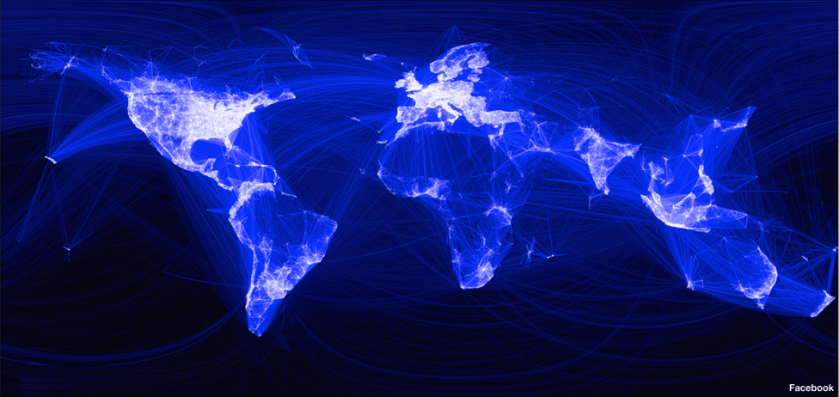
“It’s not just a pretty picture, it’s a reaffirmation of the impact we have in connecting people, even across oceans and borders.”
Well, yes and no. If you are a flag-waving Facebook utopian or an uncritical naif, then yes, that’s what it could be. But all maps are political and express political economies. For a Facebook executive, this is a map of markets, both current and unexploited. For anyone interested in the ‘digital divide’ and global social justice, this is yet another map of global inequalities, of power, and of uneven access to resources: Africa is still ‘the dark continent’ in the way this data is visualized. Politically, it is also a map of a particular kind of American-centred global power. Whilst it reflects the rise of India and Brazil to some extent (South Americans tend to use other social networking tools like Orcut) or , it also shows how disengaged from this nexus are Russia and China, which have their own networks (and in the latter case, signifcant control over social networking). But essentially, you can see this as a map of contemporary US influence as much as anything.
And, of course, finally, it is also Facebook saying to all of us: “We know where you live!” 😉
Via Boingboing: Facebook has been awarded a ‘broad’ US patent on location-based social networking services. This seems curious when Foursquare, Gowalla, Google Latitude and many others were doing this long before Facebook, but it seems that Facebook applied for this patent back in 2007, so even though they weren’t doing it before others, in the way the patent system works, they can claim they were thinking about doing it before others.
Facebook seems to be moving strongly to consolidate its hold on social networking and it clearly sees its location-based service, Places, and such like as being the guarantee of its future success. In short, it seems intent on creating a ‘brandscape’ which recombines the virtual and the material producing a seamless data-stream on the lives of its users for it to exploit.
Wel, Facebook has finally been forced to grow up and develop a sensible approach to personal data. Previously, as I have documented elsewhere, the US-based social networking site had pretty much assumed ownership of all personal data in perpetuity. However it has now promised to develop new privacy and consent rules and ways of allowing site users to chose which data they will allow to be shared with third parties.
So why the sudden change of heart? Well, it’s all down to those pesky Canucks. Yes, where the USA couldn’t bothered and where the EU didn’t even try, the Canadian Privacy Commissioner, Jennifer Stoddart, had declared Facebook to be in violation of Canada’s privacy laws. And it turns out that in complying it was just easier for Facebook to make wholesale changes for all customers rather than trying to apply different rules to different jurisdictions.
This suggests an interesting new phenomenon. Instead of transnational corporations being able to always seek out a country with the lowest standards as a basis for compliance on issues like privacy and data protection, a nation with higher standards and an activist regulator has shown itself able to force such a company to adjust its global operations to its much higher standard. This is good news for net users worldwide.
However, we shouldn’t rejoice too much: as Google and Yahoo have shown in the case of China, in the absense of any meaningful internal ethical standards, a big enough market can still impose distinct and separate policies that are far more harmful to the interests of individual users in those nations.
It is hard to say anything about Facebook that hasn’t been said elsewhere. Of course, the decision to reverse its attempt to change its terms, which would have made it nigh on impossible for members to remove material they had posted, is a good one. Effectively what it would have done is made Facebook the owner of all personal data posted on the site.
The campaign against it was of course organised through Facebook groups! That in itself should have been enough to persuade Facebook’s young owners of the power and passion generated by the system they had created. But I don’t think they really do understand it, or indeed very much about the implications of what they are doing at all. I mentioned their youth. Last time Facebook got into trouble, it was because of comments made by their ‘Marketing Director’ (age: 24) at Davos, which were (apparently erroneously) taken by the press to indicate that Facebook was going to sell personal data.
Now, I know that it’s not cool and probably won’t make me popular to knock youth at a time where youth is everything (despite the fact that the word is ageing) – Fast Company last month had snowboarder Shaun White as its cover star in a story full of fawning admiration about how rich he had become by telling big companies about the youth market. But at least White seems to have his head screwed on – maybe it’s a class thing? Facebook’s owners on the other hand need to grow up a bit. They need to learn a bit more about the value of some rather old-fashioned fundamental rights, particularly privacy, and strop treating the system they have created as the personal spare-time sophomore project as which it began. I think that they just didn’t appreciate how people would view their proposals.
There is a serious issue here. Privacy is something that you only start to truly truly understand as you get older. Partly this is because your mistakes and your secrets get more serious and more potentially damaging as you get older! But, as I have said before, most of those are nobody’s business but your own and no-one benefits from forced transparency – honesty and conscience are also profoundly personal matters. It has been argued that the ‘youthfulness’ of the Net has encouraged a general carelessness with privacy. I am not sure that is entirely true, as Facebook users have shown – they care. But it’s the careless and – let’s face it – privileged youth of many of these new entrepreneurs, the fast companies, which is more concerning. Most are not success stories from the wrong side of the tracks, who have learned ‘the hard way’.
The threat of legal action from EPIC, which was preparing to take them to the Federal Trade Commission might have concentrated minds in this regard. Maybe it was just the threat itself – EPIC have a strong record in these kinds of cases and have taken down Microsoft and Doubleclick. However I would like to think that the arrogance and energy of youth might be tempered with a bit more maturity and consideration in the future. If only, as I’ve said before, because Facebook is no longer a fresh young company in Web 2.0 terms and could easily be eclipsed by the next big thing. Perhaps they can hire someone more ‘real’ like Shaun White to tell them how privacy rights and user control of information would be like, totally rad, dude…
Woah man, I am so stoked about privacy... (Shaun White, not actually advising Facebook on privacy, pictured for Fast Company)
On a more serious note, EPIC put a lot of time and money into protecting privacy in the USA and they do a damn good job, and in cases like that of Facebook they are having a positive affect the world over, so give them some money!
the mixture of assumptions seems dangerous: a lack of genuine understanding combined with categorical friendship (analogous to categorical suspicion, the basis of profiling in policing) and technologies that unless actively adjusted all the time for all of those massive number of connections, allow you to be utterly exposed…
I’ve just seen that Google has launched its Latitude service, which allows you (once you register and add your phone number) to be tracked by all your ‘friends’, and correspondingly, for you so see your ‘friends’ – if they have signed up. I put the words friends in inverted commas with some sadness because the word seems to have become increasingly meaningless in the age of Facebook when accumulating ‘friends’ seems to have become a competitive sport. This is not entirely irrelevant to Latitude for reasons we will come to in a minute.
There are various questions about this.
A colleague comments that like many other tracking services, the way it is set up he assumed you could access the project if you just had access to someone else’s phone and a computer (or WAP/3G phone) at the same time. Perfect for a over-protective or suspicious parent, a suspicious, husband, wife, boyfriend, girlfriend – or anyone else for that matter.
The privacy policies are a mixture of Google’s standard (and already questionable) privacy statement and a new set of policies on ‘location privacy’, which state that:
“Google does not share an individual person’s location with third parties without explicit permission. Before someone can view your location, you must either send a location request by adding them as a friend or accept their location request and choose to share back your location.”
You can also change settings so that your location can be automatically tracked, manually selected, or hidden. If you are signed out of the service, you will not be on any map either. You can also change settings for specific friends, including hiding your location from them, share only the city you are in, or removing them from your Latitude list.
Now this all sounds very good, even fun – although it could be a recipe for all kinds of suspicions and jealousies – but it all depends on what the nature of ‘friendship’ means to the person using the service. Friendship no longer seems to require personal knowledge but simply matching categories. I was writing earlier about the loss of trust in South Korea, but the reformation of trust that occurs through social networking seems not to require the dense networks of interdependence in real life that traditional forms of social trust were built on. It doesn’t seem like a substitute, the mixture of assumptions seems dangerous: a lack of genuine understanding combined with categorical friendship (analogous to categorical suspicion, the basis of profiling in policing) and technologies that unless actively adjusted all the time for all of those massive number of connections, allow you to be utterly exposed, laid bare in time and space.
The most extreme examples of this personal surveillance are not in the relatively comfortable worlds that tech enthusiasts inhabit but firstly, in conflict zones – after all ‘I know where you live’ has always been one of the most terrifying and chilling expressions you can hear in such circumstances (see Nils Zurawski’s article on Northern Ireland in Surveillance & Society) and now it could be in real time; and secondly, in authoritarian, or even just paranoid countries. Here, real-time location data could be a goldmine for intelligence services, and it is not as if Google and Yahoo and others have bravely resisted the attempt of, for example, the Chinese government to suborn them to its illiberal requirements.
Now, perhaps this makes me sound very conservative. I’ve never joined a single social networking service – like, how Twentieth Century is that?! – but I am also sure that this service will be both used and abused in all kinds of ways, some that we expect and some that we don’t. It might be a tool for overprotective parents, for jealous lovers, for stalkers and even for killers; but it will also be a tool for new forms of creativity, deception, performance and play.
Or it could be just utterly pointless and no-one will bother using it at all.
(thanks to simon for the heads up. As it happens, Surveillance & Society currently has a call for papers out on ‘Performance, New Media and Surveillance’, to be edited by John McGrath and Bill Sweeney)



 ubisurv