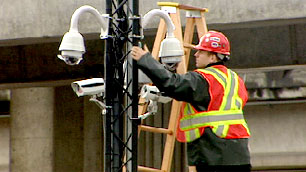
A city worker installs video surveillance cameras outside GM Place in downtown Vancouver. (CBC)
As the CCTV cameras are going up, Vancouverites are starting to become more concerned now about what the legacy of increased security and surveillance will be after the Olympics. Although the initial promises were that the cameras would be taken down afterwards, with the money that has been put into building a swish new control room, it seems unlikely that the authorities will want to ‘waste’ this investment. As we warned in our Vancouver Statement in November, it seems as if the Games have become a globe-trotting Trojan horse for the video surveillance industry.
if this appointment is any sign of what is to come… this is going to be war on the favelas.
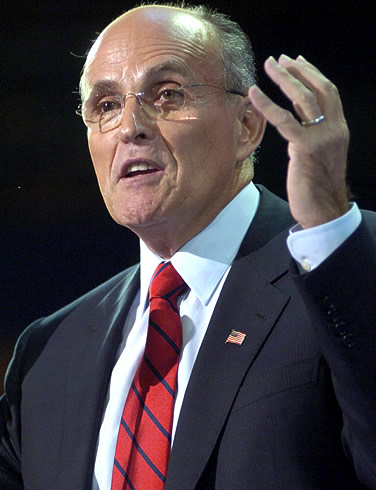
So, with Rio de Janeiro now hosting the FIFA World Cup in 2014 and the Olympics in 2016, and a huge set of social problems providing big obstacles to a PR success and the place climbing the world rankings of ‘global cities’, who have the right-wing administration of Governor Sergio Cabral and Mayor Eduardo Paes appointed to advise them on security?
As I’ve argued before, Giuliani’s macho urban politics have inspired the new tough choque de ordem (shock of order) approach that has flourished under Paes undermining the previous progressive social measures of former Mayor Cesar Maia, in particular the Favela Bairro program that attempted to make the illegal settlements in which the excluded minority of Rio’s population live, into normal functioning neighbourhoods. Cabral and Paes have turned this back into an ongoing confrontation, which is costing lives and livelihoods, and if this appointment is any sign of what is to come, the World Cup and the Olympics are going to mean more than just the usual high security and surveillance exhibition that these mega-events have become – this is going to be war on the favelas and war on the poor.
(As ever, thanks to my eyes in Rio, Paola Baretto Leblanc, for the link).
Following recent discussion, a number of leading surveillance researchers have signed and issued the following ‘Vancouver Statement’ of which I did the first draft (followed by multiple revisions from many hands!). If you are a researcher who has done any work on mega-event security and surveillance, and agree with the statement, you are encouraged to send your name and affiliation to Adam Molnar at UVic. It is being press-released and hopefully discussed in the BC Legislative Assembly.
The Vancouver Statement of Surveillance, Security and Privacy Researchers about the Vancouver 2010 Olympic Winter Games
As researchers from Canada and the wider world, who are conducting research on the global security dynamics of mega-events, we agree:
that the Olympic Games should be a celebration of human achievement, friendship and trust between people and nations.
However, having analysed past and planned Olympics and other mega events, from a variety of historical and international perspectives, we recognise:
that recent Games have increasingly taken place in and contributed to a climate of fear, heightened security and surveillance; and
that this has often been to the detriment of democracy, transparency and human rights, with serious implications for international, national and local norms and laws.
Therefore, we ask the City of Vancouver, the Province of British Columbia and the Government of Canada:
to moderate the escalation of security measures for Vancouver 2010 and to strive to respect the true spirit of the event;
to be as open as possible about the necessary security and surveillance practices and rationales;
to withdraw temporary bylaws that restrict Charter rights of freedom of speech and assembly;
to work constructively with the Provincial and Federal Privacy Commissioners;
to respect the rights of all individuals and groups, whether they be local people or visitors, and pay particular attention to the impacts on vulnerable people;
to conduct a full, independent public assessment of the security and surveillance measures, once the Games are over, addressing their costs (financial and otherwise), their effectiveness, and lessons to be learned for future mega-events;
not to assume a permanent legacy of increased video surveillance and hardened security measures in the Vancouver/Whistler area, and to have full and open public discussion on any such proposed legacy.
We hope that these recommendations will contribute to a unique and positive Olympic legacy by which Vancouver, British Columbia and Canada will be remembered for setting the highest ethical standards.
David Loukidelis, the Information and Privacy Commissioner of British Columbia, speaking today at The Surveillance Games workshop, has made it quite clear that his office does not want the Winter Games to leave a legacy of securitization in the city or indeed, fear (as the Assistant Federal Privacy Commissioner, Chantal Bernier, put it), in the consciousness of its residents. In particular he argued that the 600 (yes, 600) cameras that are being installed at the Olympic venues and beyond should not be allowed to remain after the games. I hope that his office is able to deliver on this view, but I doubt that it will. As Kevin Haggerty and Phil Boyle have noted, security architecture is now an actual deliverable of the Olympics, and as many other researchers have shown, such architecture, including in particular CCTV but also adjusted local or national laws on the thematic and spatial limits of protest and freedom of expression (which, as Michael Vonn of the BCCLA and Chris Shaw, a leading anti-games activist, are describing at this very moment in the conference, are themselves often illegal and unconstitutional) tends not only to persist but to act as a kind of Trojan Horse for an expanded surveillance. And as Vonn’s group has also shown – the city is building a permanent CCTV control centre as part of the security architecture for the Games, and you don’t do that for cameras that are going to be removed.
*Even if these devices were just megaphones, this purchase would in any case be rather ironic given that Vancouver city has banned protestors from using any amplification devices by amending their bylaws in July 2009.
Most people will probably have heard the announcement that Rio de Janeiro has been awarded the 2016 Olympic Games. While I am pleased that Brazil has beaten the USA in particular in this race in the sense that it shows a slight shift in global power balances towards the global south, I am very concerned as to how the current right-wing administration of both the city and region of Rio will deal with the ‘security’ issues around this mega-event. The Pan-American Games, which Rio hosted in 2007 led to the violent occupation by military police of several particularly troubled favelas (informal settlements), and the new administration has already shown its authoritarian tendencies with the Giuliani- wannabe ‘choque de ordem’ (shock of order) policies that involve building demolition, crackdowns on illegal street vendors (i.e. the poor) and more recently, the building of walls around certain favelas, and most recently the unwelcome imposition of CCTV cameras on favelas that were just starting to enjoy improvements in trust between police and community. The favelas that line the main highways into the city from the international airport were already slated for such ghettoization, and the Olympics will only make this more likely to happen and more quickly – just as has happened in South Africa, similarly afflicted by race and class-based social conflict, during the various international meetings and summits there in recent years. Foreign delegates and tourists don’t like to see all that nasty poverty, do they?
I will write more on this later (I am on the road right now…).
The connection between what are often called ‘mega-events’ (international summits, major sporting competitions etc.), securitization, and he intensification of surveillance is becoming a very interesting area and one which we wrote about in our recent book on urban resilience. I am writing some further stuff on this with Kiyoshi Abe on how mega-events have been managed in Japan.
It seems that in general, such events are either used as ‘test-beds’ for new technologies and procedures which are then either continued afterwards (as with The Olympic Games and CCTV in Greece in 2004 and The FIFA World Cup and video surveillance in Japan/Korea in 2002), or become ‘islands’ of temporary exemption where normal legal human rights protections are reduced or removed and whole areas of public space are often literally, fenced off (as in Rio de Janeiro for the Pan-American Games of 2007, whose model will apparently be extended to include walling off the poor favelas in time for the 2014 FIFA World Cup). There’s going to be a very interesting conference on The Surveillance Games later this year to tie in with the Vancouver Winter Olympics.
Now The Guardian newspaper is reporting that the London Olympics 2012 may make use of a proposal originally designed to stop the proliferation of unofficial commercial advertising near games venues in order to prevent protest. The legislation even allows police to enter private houses to seize material.
Of course the government say that they have no plans to use it in this way, but it’s interesting to see the way in which the ‘standards’ being imposed by such travelling cicuses of globalization tend to end up looking more like the authoritarian regime in Beijing (host of the highly securitized 2008 Olympics) than the supposedly liberal west, whilst at the same time promoting a very controlled but highly commercialized environment. Even the original purposes of the 2006 law (necessary for London to host the Games) are an interesting reflection of the massive corporate interests involved in the Olympics, for which they apparently need a captive and docile audience.
…despite Britain’s reputation as a surveillance society… the USA is now eclipsing the UK. The post-9/11 surveillance surge has seen to that.
Back in the USA again. Chicago has been featuring a lot this week for its CCTV system. Newspapers generally offered glowing assessments of its capabilities based around homey anecdotes of pretty harmless incidents ‘solved’ by CCTV – in this case the stories, for example those in the Chicago Sun-Times and the New York Times, featured a theft from a Salvation Army kettle, which sounds like it is straight from a Mayoral press release. It is depressingly poor journalism and once again, all very reminiscent of the situation in the UK in the 1990s before academic and even government assessments dampened the enthusiasm for CCTV. There’s also a depressing naivety (and factual incorrectness) about the insistence from the authorities and from some ‘experts’ that these cameras have nothing to do with human rights like privacy as they are all in public spaces.
But there is one very important difference. Chicago, with massive investment from the Department for Homeland Security, has gone much further than most UK cities, not only in coverage but also in capabilities. First of all, Daley and police-chief Orozco have promised that “We’re going to grow the system until we eventually cover one end of the city to the other” in other words they do want, as the Chicago Sun-Times subheading claims, ” a camera on every street corner.”
The particular innovation that the city is pushing here is the linking up of the law-enforcement aspects with emergency services through something called Computer-Aided Dispatch (CAD). This is system that uses a live Geographic Information System to match camera location to reported incident location, so that when an incident is called in via 911, the nearest cameras can immediately turn to picture the scene. This is part of what Chicago calls ‘Operation Virtual Shield’, a fibre-optic cable system which links the cameras with other biological and chemical weapons-detection system in a “homeland security grid.’’
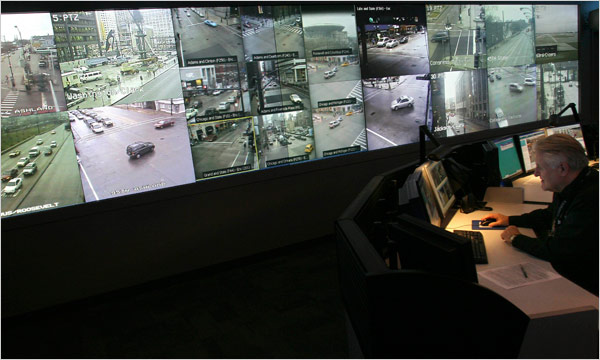
The Chicago control room (New York Times)
As part of the work we did for our latest book, Jon Coaffee Pete Rogers and I visited and analysed several different cities in the UK to assess their emergency-response and surveillance systems. While most had intentions to use the cameras for more active emergency-response purposes and particular local police were starting to try to install override systems for the multiple local camera systems that exist in the UK in the case of citywide emergencies (like a mass evacuation). And in particular, Manchester (whose high-tech control room looks like the Chicago one as seen in the NYT (picture above) and also often features in media PR for CCTV) has gone further down the Chicago route than most. But they still don’t come close. Britain’s systems are fragmented, ageing, generally not integrated with other functions and certainly don’t link to other kinds of sensors. Britain has introduced some stupid authoritarianism like the infamous ‘shouting cameras’ mostly as part of the Respect (sic) Zones initiative. But despite Britain’s reputation as a surveillance society I suspect that in terms of advanced integrated cameras systems, the USA is now eclipsing the UK. The post-9/11 surveillance surge has seen to that.
There’s two other points worth noting here. The first is that Chicago is bidding for the Olympics in 2016. I can almost hear multiple researchers in surveillance studies around the world, releasing a collective ‘of course!’. Mega-events like the Olympics, the World Cup – there will be a fantastic conference on this theme in November this year in Vancouver – or other non-sporting ones like world summits or the G-8 conference are often the trigger for the introduction of repressive measures and new surveillance systems. This was true in Japan (where state CCTV was first introduced because of the soccer World Cup in 2002), in South Africa (for various major world summits), and in Athens for the Olympics in 2004. Mayor Daley wants the city to be 100% free from the possibility of terrorist attack. Laving aside the actual impossibility of that desire, how far will he go to get there?
Well, the last Olympic venue, Beijing, might give some indication. For it is actually the plans in authoritarian, non-democratic China that seem most similar to what is going on in Chicago. Even the names have an eerie reminiscence: China’s Golden Shield, Chicago’s Virtual Shield. That is trivial, however the substance is not. The Chinese government, as Naomi Klein has written, is installing massive and comprehensive camera systems in every major city in China. It is also, of course, linking this system into its infamous Internet monitoring operation, with the ultimate aim of being able to track individuals in real and virtual space. Of course, the US, like most other nations is now trying to control Internet use too and the NSA already keeps massive data banks of communications traffic information as well as doing real-time monitoring as recent revelations have, once again, shown. But, it’s different in the USA isn’t it? The USA wouldn’t link up all these systems, would it? The Land of the Free? The home of democracy? I wouldn’t bet against it…

 ubisurv