The additional issue is that PCSOs are not even proper trained police officers in the first place, yet they increasingly seem to be under the impression that they can make the kind of judgements that senior police officers should be making. There need to be some changes to UK law here (amongst many of course!) – one to replace Section 44 of the Terrorism Act, since it seems clear that it can’t be interpreted appropriately, and secondly, the powers of PCSOs need to more carefully delineated and restricted.
Cabral, who is otherwise all in favour of video surveillance, did everything he could to stop this law, but in vain. The reason that the pro-police governor is so against this particular law and order measure is that the cameras are supposed to be installed not simply to ‘protect’ police officers but also to prevent abuse of power, corrupt practice and police violence against suspects. This is a huge issue in Rio (and Brazil more generally), and we saw a good example of this recently with the inhumane actions by officers after the fatal assault on Evandro, the founder of Afro-Reggae.
However, I do wonder how officers will take this development, how the cameras will be used in practice, and how many of them will conveniently experience technical failures at important moments…
(Thanks to Paola Barreto Leblanc for the heads up)
The UK’s DNA database, already under fire by the European Court of Human Right for retaining samples and data from innocent people, has now been lambasted in a report by the government’s own genetics watchdog. The Human Genetics Commission.
The report, called Nothing to Hide, Nothing to Fear? contains a numbers of serious criticisms, most notably the finding that police forces around Britain are routinely arresting people simply in order to obtain their DNA. Almost a million innocent people, including many children, are now on the database, and the ECHR ruling has finally prompted the government to make some minor concessions, such as keeping the DNA of innocent people for 6 years as opposed to 12, but there appears to have been no fundamental change in police practice, nor any change in the instructions given to local forces on best practice.
It’s main recommendations are:
that there should be a parliamentary debate about the recording of what it calls ‘unconvicted’ people;
that because the purpose of the database has shifted over time, there should be constraints set out in new primary legislation;
that “robust evidence of the ‘forensic utility’ of the database should be produced to justify the resource cost and interference with individual privacy it represents”; and,
that there should be an independent oversight board and appeals board to consider removal of profiles; and transparency over data and other issues.
These are all laudable, but I really start to question their judgement in using the term ‘unconvicted people’. British law has always worked on the principle of ‘innocent until proven guilty’. People are therefore ‘innocent’ until they have a conviction. The term ‘unconvicted’ seems to imply that innocence is no longer an assumption, and that the working hypothesis is that everyone is either guilty or not yet (therefore, potentially) guilty. This is what results from the normalisation of surveillance in everyday life, and it’s one thing we warned most strongly against in our own Report on the Surveillance Society back in 2006. When even critical reports start using language that reflects the worldview of the people they are criticising, you have to be concerned.
Calling people ‘unconvicted’ and not ‘innocent’ matters.
Research in the UK has shown that police forces in Britain are continuing to add the DNA – and incidentally the fingerprints, although this is never mentioned – of innocent people to the DNA database despite the European Court of Human Rights ruling that it was illegal (and the government’s promise to accept the ruling). According to The Guardian newspaper today, 90,000 innocent people have been added to the National DNA database (NDNAD) since a the court ruling and the Association of Chief Police Officers (ACPO) – incidentally, a private organisation – is still telling chief constables to continue with this collection. On the other hand the process of removing individual profiles has been painfully slow: only 611 DNA profiles of innocent people have been removed, and all as a result of individual challenges in court. It seems that the police are determined to drag their feet as long as possible and, in fact, break the law quite openly. Hardly a good example…
Now in Europe, national police databases systems, the Schengen Information System (SIS) on immigration and border control, the files of Europol and more, are planned to be integrated following the Prüm Treaty and the so-called ‘Stockholm Programme’ (now in preparation for European Council vote in December this year).
As the organisers make clear, this does not just concern people convicted of any crime, but all immigrants, political protestors arrested at demonstrations, all the many entirely innocent people included on the UK’s National DNA Database – or any other national police database that includes data on the innocent, etc. What’s more, as a result of pre-existing (and originally secretly negotiated) agreements with the USA, the data will also be shared with the FBI and other US intelligence agencies.
So – first of all, protest! In what ever way you can. And secondly, as the campaign suggests:
“to anyone who would like to know what the police (think they) know about you, or simply to register your dissent, we recommend exercising your right to access your own data by sending a request for information to the relevant police authority in your country. The digest received in response will help to give us an idea of the full extent of police access to citizen data, as well as serving as a starting point for getting your data out of the computer systems, by legal or political means.”
I always enjoy stories where those who advocate surveillance and say things like ‘nothing to hide, nothing to fear’ are then caught by surveillance (see for example, this story). In the first place, it shows how bogus and hypocritical that insidious argument is, but in the second place, it can be just really funny. So this week’s amusing surveillance story is provided by a local TV story posted on YouTube, which supposedly shows a team of Lakehead, Florida, cops who were supposed to be raiding the house of suspected drug-dealer, indulging in a nine-hour Nintendo Wii bowlathon… all caught on the householder’s home CCTV system – and now spreading virally all over the world. Ooops…
There are serious issues here though. Of course there is the whole question of 4th Ammendment violation (if you are in the USA), but more generally it raises the question of whether the use of surveillance can itself become a method of resistance to surveillance and of holding the state, private corporations, and indeed other citizens, to account, or whether a society of mutual and reciprocal surveillance (or a ‘transparent society’, as David Brin called it) is one in which we want to live. As surveillance becomes more and more ubiquitous, and in the absense of mass citizen movements to tear down the cameras, it sometimes seems like the only option we have left.
Mega-events are often the time for some surveillance / control / security innovation and experimentation by states. In what seems to be a rather unwelcome first, the Pittsburgh police have used a military sonic canon to clear protestors off the streets at the G20 summit. These devices are among many so-called ‘sub-lethal weapons’ (see the article by Steve Wright here) that have been gradually migrating from military to civilian use for a number of years – see for example the ongoing debate over the use in the UK of the ultrasonic ‘Mosquito’ device, which is supposed to target young people; its makers rather cynically advertise it as ‘so effective that they tried to ban it’.
The Guardian today has an interesting report on how women are getting to more senior positions in the police in Rio de Janeiro and changing the way policing is done as a result. I reported on my own observation of this back in April, an whilst there are many bright young female officers who want to do things differently, the top echelons of Brazilian policing are still a long way from being feminized and these young guns may not ever get much higher up to where policy is made. There’s also suspicions that such officers are being used largely for their PR value and to defend the police against being just another macho gang.
Of course, there’s more going on than just in the police. A whole generation of men lost to the drugs war has left women in more influential positions within community organisations in the favelas of Rio – we met several during our research. Considering the lack of effective state surveillance and the relative increase in power and local knowledge of these women both in community associations and the police in Brazil, I jokingly referred to them as ‘not so much Big Brother as Big Mothers’…
Over the last two weeks, we’ve talked to all kinds of police. We’ve talked to officers, both senior and junior from the Policia Militar (PM), the state-level equivalent of the French ‘gendarmerie’ or Italian ‘carabinieri’, including some who have been rebranded as ‘Policia Communitaria’; we’ve met guys from BOPE (the Rio-specific special operations group within the PM here) – and hopefully we will meet their Commander today; we’ve interviewed the Subchefe of the Policia Civil (PC), the detectives, again based at state-level; and we’ve visited the headquarters of the Guarda Municipal (GM), the relatively recently-formed city police. I haven’t talked to the firefighters, another military-state legacy, who are still an armed force, although a report from the State parliament in January recommended that they be disarmed. Back when I was in Brasilia, I also had a meeting with the Policia Federal (PF), the Brazilian ‘FBI’, another post-dictatorship development, who operate at federal level.
It is a confusing organisational landscape, and not just for me. Throughout the interviews with all the different representatives, very different perspectives emerged on what is important in policing, which force is more important and for what purpose, to what extent the current system works, and what would be the best way forward. Corruption was also something that came up time and time again, with everyone arguing that their force was improving and dealing with this, but hinting that there was still a problem with other kinds of police. There was lots of talk of ‘new generations’ of officers free from the taint of the past. But at the same time it was quite clear on the ground that people from all social classes still do not trust any of the police in general, even when they have established quite positive personal working relationships with officers in their own community.
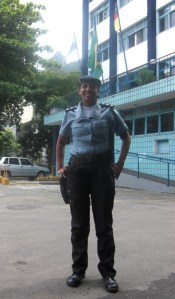
Cesar Couto Lima, Diretor de Operacoes of the Guarda Municipal
The GM are less than twenty years old and they ‘know their place’ in the hierarchy of police: at the bottom. They are not true ‘professional police’ in the sense that they have only three months basic training, followed by some specialist extra work. They are really somewhere between police and a private security force that just happens to be employed by the city – their commanders at the top level are however, ex-PM. They do, however, have a growing field of responsibility, acting both as a kind of protective and preventative force on the ground in the city centre and as a street-level agency of the ‘eyes on the street’ form of surveillance.
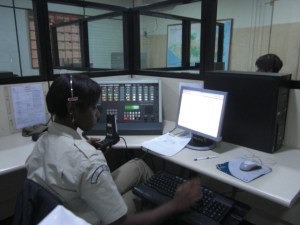
Operator in the Guarda Municpal emergency control room
They also act as the emergency services co-ordination, and this role will increase and be better integrated and funded in future. They are largely disarmed, though not because as many believe, the law prevents them from being armed. This is a strategic decision based on keeping a clear line between them and the PM. This is also the reason why they have a different uniform (in Rio a kind of unflattering beige) from the PM (blue). In our interview with the Director of Operations, Cesar Couto Lima, we were told that in the past, the uniforms had been the same colour but that this had been changed under the last mayor, Cesar Maia, to prevent GM officers from being shot by criminals in the mistaken belief that they were PM. They now have a very low rate of injury and death. The Dir Ops also wants to increase the numbers and in the very long term for the GM to be the be the main police force of a disarmed and less violent city.
It is a fine aspiration, however the new Mayor Eduardo Paes, has apparently suggested that the uniform is changed back to blue and that there should be more arming of the GM. The Dir Ops is utterly opposed to both, and I think he sees it as a deliberate ploy to give the impression of more PM around – the State Secretary for Security has already announced a plan to increase the numbers of PM in Rio by thousands, as we found out when we visited his office. The officers we met at the GM were generally pleasant, relaxed people, however the GM is not immune from corruption. I have heard allegations of extortion from street traders, the poor and criminals, in much the same way as gets reported of the two main forces, and indeed of death threats to officers who refuse to get involved with such practices. Any generalised or regular arming of the GM would only increase the temptation to act on the new power in an irregular way, and also, with so many weapons in the hands of relatively poorly paid and untrained officers lead to greater numbers of killings and a further channel for criminals to obtain weapons.
Ricardo Martins, the Subchefe of the Policia Civil would also like to see a demilitarisation of the police in the long-term. He argued that basically, the PM should be gradually abolished and absorbed into a purely civil police. He was also strongly in favour of more ‘intelligence-led’ and surveillance-based solutions, rather than force of arms or numbers. According to him, the expansion of the video surveillance system in the city was essential and absolutely necessary if the city was to be ready for the 2012 soccer World Cup (to be held across Brazil) and more particularly for the 2016 Olympics, for which the city is a frontrunner. All the senior officers an officials with whom we talked agreed that currently it was nowhere near ready. The GM also agreed with the expansion of CCTV, although they seemed to think that they would have a greater role in operating the systems in future, talking of plans for neighbourhood control rooms integrated with the emergency services control system. Neither the PC, nor more importantly, the Superintendente de Commando e Controle of the State, Claudio de Almeida Neto, gave any indication that this was the direction in which things were proceeding. Indeed the Superintendente was quite clear that there was a greater centralisation, co-ordination and professionalisation of video surveillance operations taking place through his office and his control room, which is in the old ‘Centro do Brasil’ railway station. The office of the Secretary of State for Security seemed not to be that interested in surveillance at all, and commented that it was very expensive, which suggests that the funds for the expansion of the video surveillance system that all expect, whoever they think will be running it, may not be quite as lavish as they believe or would want. I will write more about this later. The PC, however has the reputation of being the most corrupt of all the forces. Subchefe Martins pointed to the internal investigations branch as evidence of the effectiveness of their fight against corruption. Other interviewees were not as easily impressed!
Capitao Pricilla, Head of Santa Marta Community Police initiative
So where should policing in Rio go? One way forward was obvious when we interviewed Capitao Pricilla, the current ‘star’ of the PM, who heads up the Community Policing initiative in Morro Santa Marta. Capitao Pricilla is a PR-dream: attractive, articulate, intelligent, convincing in her arguments, and clearly dedicated to her work with the community. She is everything you would hope a new generation of younger PM officers would be, and she clearly stated that she is part of a new generation. And she is popular too. As we talked with her, officers would constantly come over just to say ‘hello’ and older women in particular, would treat her like a TV celebrity. Now, of course I am wary of the way in which such charisma would make her an obvious choice to head such an operation, which is much promoted as ‘the way forward’ in the media. However there have been many ‘ways forward’ before which have come to nothing and Rio is constantly making and destroying innovative initiatives before they even have a chance to have a real effect. The Santa Marta initiative probably cannot be replicated in many favelas, like Prazeres, where there is a more intimate relationship with the ‘parallel power’ of the traffickers. But Capitao Pricilla seems like the real deal. Let’s hope that she and officers like her get the support they need and are not undermined by the violence and corrupt practices of so many of their colleagues. It’s a utopian hope perhaps, and Rio is still going to need the other far more aggressive hand of the other attempt to get around corrupt practice in the PM, the BOPE – about whom I will write more after our visit today – as much as it needs the helping hand of Community Policing initiatives for a while. It is that large and less articulate mass of PM and PC officers who have no interest in doing anything different, and the equally corrupt politicians who prevent change for their own selfish reasons, that are the main barrier to any organisational change.
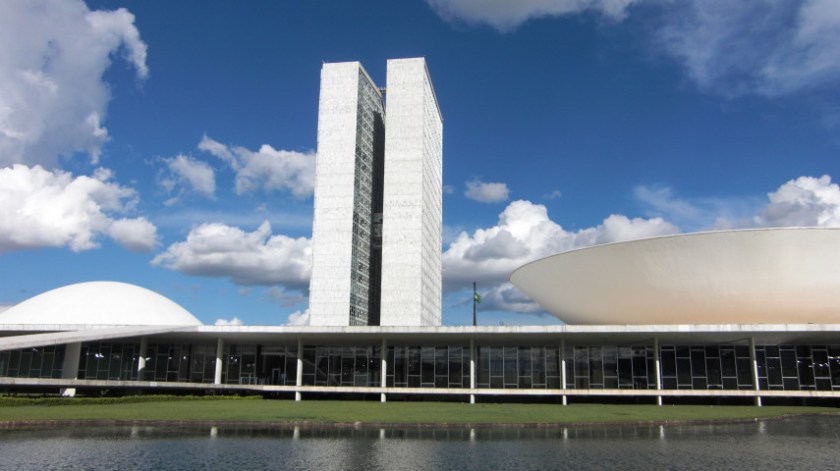
I had a great meeting at the architecturally stunning Camara dos Deputados (the Brazilian equivalent of the British House of Commons or the House of Representatives in the USA), which almost made up for the fact that it was the only one of the three scheduled interviews that I had arranged that actually went ahead… it really does look like I will have to come back.
The parliamentary buildings in Brasilia, originally laid out by Lucio Costa. The Camara dos Deputados, by Oscar Niemeyer, is to the right.
This meeting took place in the Comissao de Direitos Humanos e Minorias (the Commission for Human Rights and Minorities) and was with Federal Deputy and committee member, Pompeo de Mattos, the secretary of the Commission, Marcio Marques de Araujo, and Hebe Guimareas-Dalgaard, who works in the International Relations office and who served as translator.
The meeting covered all sorts of background issues around security in Brazil, and concentrated on Deputado de Mattos’s specialities in this area, which are in justice and drug-trafficking issues. Again, I won’t do more than summarize a few immediately important things here. There was a lot of talk of police corruption and some hair-raising stories of the ways in which military police officers in particular has become involved in selling equipment and ammunition, and of course the autodefesas communitarias that I have mentioned before. Interestingly though, it was the deputy’s opinion that the military police, despite having a ‘culture of violence’ inherited from their role as enforcers of the military dictatorship, were less corrupt (in an everyday way) than the civil police. The latter are even lower down the police food-chain and correspondingly more poorly paid and equipped.
The inadequacies of the civil police has led many Mayors of larger towns and cities to introduce so-called ‘Municipal Guards’ – basically private security given some official status. They have few powers but are basically there to increase the visibility of security, a kind of prophylactic community policing. The problem is however that the official police and the massive private security sector are thoroughly intermixed already. Many officers moonlight as private security guards, which leads to all kinds of conflicts of interest.
Deputado de Mattos was certainly not obsessed with the inadequacies of the police however. Serious and organized crime associated with drug-trafficking paralyzes the everyday life of poorer areas of large cities in Brazil. Despite the fears of the rich over crime, it is the poorest that suffer most. He described the drug gangs as being the major obstacle to any positive change in Brazilian cities. However he didn’t see any militaristic solution – fighting a war against the drug gangs would only lead to more violence. The only solution to the problems of both crime and the poverty from which it emerges is social inclusion. The favelados must be provided with the same opportunities and infrastructure as everyone else. The need schools, hospitals, transport, and so on. Programs like Bolsa Familia, however well-intentioned, make no fundamental difference, he argued – contradicting, as most people with whom I have talked have done, the assessment of external organisations like the World Bank.
However providing such opportunities is not easy, and not just because of the costs. The drug-gangs actively resist any attempt by the state to introduce services, to the extent of intimidating or even killing construction workers. And this shouldn’t be in any way romanticized as some kind of popular resistance of the poor to the imposition of unwanted state interference – this is an attempt to maintain the rule of fear and violence. Somehow, one can never get away from the security issue in Brazil.
Leaving the Camara dos Deputados, looking past the parliamentary buildings up towards the Esplanada dos Ministerios, with all the government Ministries lined up in identical blocks.
(Thanks to Deputado Pompeo de Mattos, who as you will see if you check out his website is quite a character. He is fiercely proud of his southern ‘gaucho’ roots, and writes poetry to that effect. He is also – and I don’t say this very often of politicians – a genuinely nice guy. Thanks also to Marcio Marques de Araujo and to Hebe Guimares-Dalgaard without whom the meeting would have been impossible).





 ubisurv