The mainstream Bazilian media outlet, O Globo, is reporting that Fabiano Atanázio da Silva (AKA ‘FB’ or ‘Urubu’), allegedly a leader of the Amigos dos Amigos (‘Friends of Friends’) on Morro de Macaros, who recently tried to take control of the neighbouring favela, Morro São João, resulting in many deaths and even bringing down a police helicopter, had also installed a video surveillance system in his favela, which monitored the entrances of the favela and watched the movements of police and residents. So, it seems that it is clearly the traficante gangs who were first to install CCTV in the favelas of Rio for the purposes of helping to maintain a violent authority over the local area. The form of surveillance is what Bruno Latour perceptively called ‘oligoptic’ – a spatially limited vision but one which is very powerful within its limits. And of course, given the massive extent of private security and both legal and illegal surveillance equipment available in Brazil, it’s hardly surprising that gangs with disposable cash would invest in security like this. However, what is particularly interesting is that by doing the same thing and installing a video surveillance system in Santa Marta against the wishes of the local community, the military police are seen as effectively operating like a gang. This isn’t such a startling statement and was one which was quite frequently put to us by community representatives who we interviewed in the favelas of Rio earlier this year.
(thanks, again, to the invaluable Paola Barreto Leblanc for the information).
As my collaborator in Rio de Janeiro, Paola Barreto Leblanc, points out to me, it isn’t just the police (see previous posts here and here) who have been installing surveillance cameras in the favelas. Accoring to UOL, in September 2008, the military police found a whole clandestine CCTV system of 12 cameras, and a control room hidden behind a false wall, in Parada de Lucas, a favela in the Zona Norte of the city. The cameras covered all the entrances to the favela. The system was allegedly operated by a drug-trafficking gang but since the room was, according to the reports, destroyed in the police attack, and no one was captured, it is hard to verify the story… however it is not surprising that a major illegal commercial operation would seek to have early warning of police (and other gang) raids in this way. Indeed, this system may well have been the reason why no traficantes were caught in the raid in question. From the interview we did earlier in the year, it seems clear that the favelas have intense human surveillance systems of mutual observation, whether they are gang-controlled, community-controlled or police-‘pacified’ morros. Very little goes on in the crowded informal settlements that almost everyone will not know about. Of course, the nature of the power-structure within the favela will determine to whose benefit such knowledge works. CCTV in a context like this can be seen as a sign of insecurity and weakness. Perhaps the Parada de Lucas gang felt that they were losing their grip, and the cameras in Santa Marta installed by the military police certainly seem to indicate a lack of trust in the community and the civil pacification measures – investment, infrastructure development, regular meetings and confidence-building – so far undertaken.
A couple of weeks ago, I found out that the military police had installed surveillance cameras in the favela of Santa Marta, in Rio de Janeiro, Brazil, which I visited back in April. This is the first time such police cameras have been put into such informal settlements in Rio. My friend and colleague, Paola Barreto Leblanc, sent me this link to these youtube broadcasts from a local favela TV company, in which residents discuss their (largely negative) views of the cameras.
There is also a poster that has been put up around the area produced by the Community Association and other local activist and civil society groups – see here – which reads as follows in English:
SANTA MARTA , THE MOST WATCHED PLACE IN RIO
At the end of August, the inhabitants of Santa Marta were surprised to learn from newspapers and TV that nine surveillance cameras would be installed in different areas of the favela. A fear of being misinterpreted paralysed the community.
Many of the people of the city, and some in the Moro itself support this initiative. However, we are a pacified favela, so why do they keep treating us as dangerous?
Walls, three kinds of police, 120 soldiers, cameras – this is no exaggeration. When will we be treated as ordinary citizens instead of being seen as suspects?
Wall: 2 million Reais, Cameras, half a million Reais. How many houses could this amount of money build? How many repairs to the water and sewage system?
The last apartments built in Santa Marta are 32 square metres. The Popular Movement for Housing [an NGO] says that the minimum size should be 42 square metres. Other initiatives have gone with 37 square metres. So why don’t we stand up and demand this minimum standard? This should be our priority!
When will the voice of the inhabitants of this community be heard?
We need collective discussion and debate.
Fear is paralysing this community and preventing criticism. But the exercise of our rights is the only guarantee of freedom.
“Peace without a voice is fear”
We want to discuss our priorities. We want to know about and be involved in the urban development project in Santa Marta.
Leading the new Community Police efforts in Santa Marta was Capitao Pricilla, an indomitable and well-liked young female officer of the Military Police, one of several rising female officers with a new approach, and we heard from residents how trust was being rebuilt between police and community because of her. At the same time, there were storm clouds on the horizon as the city administration was insistent on cracking down still further with its policies of choque de ordem (the shock of order), which involved harassing illegal street vendors from the favelas, and demolishing illegally-built buildings, and also building walls along the edges of some favelas. The word ‘ghetto’ was mentioned on more than one occasion by our interviewees and in more casual conversations.
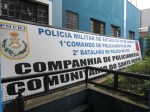
Now, just last month, the Military Police have decided to install seven CCTV cameras in Santa Marta, in different areas of the community. This has prompted complaints of invasion of privacy, an there have already, my sources report, been protests about this in he favela, but it seems that this is coming from further up the chain of command than Capitao Pricilla and the community police. She isn’t mentioned at all by the article in O Globo, despite being a bit of a PR star, and instead the justification for the cameras is given by one Coronel José Carvalho, who also stated that there are plans to put cameras into the other two areas currently being targeted for development, the famous Cidade de Deus, and the much less well-known and more distant favela of Batan. This also contradicts what I was being told by the Commnder of the police central CCTV control room we visited, which is quoted as being one of the places where the cameras will be monitored. What is interesting is the cameras seem to be being treated by police almost as a tool of urban warfare: a Major Orderlei Santos talks about their experimental use for determine the deployment of officers in the favela.
Could the old macho, male, approach to policing as a war on the poor be trumping the new trust being developed by community policing? I hope not, but everything points that way.
(thanks once again to Paola and David for keeping me in touch…)
Over the last two weeks, we’ve talked to all kinds of police. We’ve talked to officers, both senior and junior from the Policia Militar (PM), the state-level equivalent of the French ‘gendarmerie’ or Italian ‘carabinieri’, including some who have been rebranded as ‘Policia Communitaria’; we’ve met guys from BOPE (the Rio-specific special operations group within the PM here) – and hopefully we will meet their Commander today; we’ve interviewed the Subchefe of the Policia Civil (PC), the detectives, again based at state-level; and we’ve visited the headquarters of the Guarda Municipal (GM), the relatively recently-formed city police. I haven’t talked to the firefighters, another military-state legacy, who are still an armed force, although a report from the State parliament in January recommended that they be disarmed. Back when I was in Brasilia, I also had a meeting with the Policia Federal (PF), the Brazilian ‘FBI’, another post-dictatorship development, who operate at federal level.
It is a confusing organisational landscape, and not just for me. Throughout the interviews with all the different representatives, very different perspectives emerged on what is important in policing, which force is more important and for what purpose, to what extent the current system works, and what would be the best way forward. Corruption was also something that came up time and time again, with everyone arguing that their force was improving and dealing with this, but hinting that there was still a problem with other kinds of police. There was lots of talk of ‘new generations’ of officers free from the taint of the past. But at the same time it was quite clear on the ground that people from all social classes still do not trust any of the police in general, even when they have established quite positive personal working relationships with officers in their own community.
Cesar Couto Lima, Diretor de Operacoes of the Guarda Municipal
The GM are less than twenty years old and they ‘know their place’ in the hierarchy of police: at the bottom. They are not true ‘professional police’ in the sense that they have only three months basic training, followed by some specialist extra work. They are really somewhere between police and a private security force that just happens to be employed by the city – their commanders at the top level are however, ex-PM. They do, however, have a growing field of responsibility, acting both as a kind of protective and preventative force on the ground in the city centre and as a street-level agency of the ‘eyes on the street’ form of surveillance.
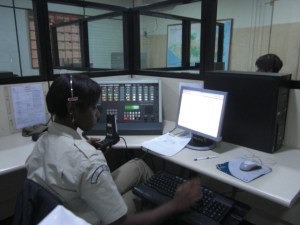
Operator in the Guarda Municpal emergency control room
They also act as the emergency services co-ordination, and this role will increase and be better integrated and funded in future. They are largely disarmed, though not because as many believe, the law prevents them from being armed. This is a strategic decision based on keeping a clear line between them and the PM. This is also the reason why they have a different uniform (in Rio a kind of unflattering beige) from the PM (blue). In our interview with the Director of Operations, Cesar Couto Lima, we were told that in the past, the uniforms had been the same colour but that this had been changed under the last mayor, Cesar Maia, to prevent GM officers from being shot by criminals in the mistaken belief that they were PM. They now have a very low rate of injury and death. The Dir Ops also wants to increase the numbers and in the very long term for the GM to be the be the main police force of a disarmed and less violent city.
It is a fine aspiration, however the new Mayor Eduardo Paes, has apparently suggested that the uniform is changed back to blue and that there should be more arming of the GM. The Dir Ops is utterly opposed to both, and I think he sees it as a deliberate ploy to give the impression of more PM around – the State Secretary for Security has already announced a plan to increase the numbers of PM in Rio by thousands, as we found out when we visited his office. The officers we met at the GM were generally pleasant, relaxed people, however the GM is not immune from corruption. I have heard allegations of extortion from street traders, the poor and criminals, in much the same way as gets reported of the two main forces, and indeed of death threats to officers who refuse to get involved with such practices. Any generalised or regular arming of the GM would only increase the temptation to act on the new power in an irregular way, and also, with so many weapons in the hands of relatively poorly paid and untrained officers lead to greater numbers of killings and a further channel for criminals to obtain weapons.
Ricardo Martins, the Subchefe of the Policia Civil would also like to see a demilitarisation of the police in the long-term. He argued that basically, the PM should be gradually abolished and absorbed into a purely civil police. He was also strongly in favour of more ‘intelligence-led’ and surveillance-based solutions, rather than force of arms or numbers. According to him, the expansion of the video surveillance system in the city was essential and absolutely necessary if the city was to be ready for the 2012 soccer World Cup (to be held across Brazil) and more particularly for the 2016 Olympics, for which the city is a frontrunner. All the senior officers an officials with whom we talked agreed that currently it was nowhere near ready. The GM also agreed with the expansion of CCTV, although they seemed to think that they would have a greater role in operating the systems in future, talking of plans for neighbourhood control rooms integrated with the emergency services control system. Neither the PC, nor more importantly, the Superintendente de Commando e Controle of the State, Claudio de Almeida Neto, gave any indication that this was the direction in which things were proceeding. Indeed the Superintendente was quite clear that there was a greater centralisation, co-ordination and professionalisation of video surveillance operations taking place through his office and his control room, which is in the old ‘Centro do Brasil’ railway station. The office of the Secretary of State for Security seemed not to be that interested in surveillance at all, and commented that it was very expensive, which suggests that the funds for the expansion of the video surveillance system that all expect, whoever they think will be running it, may not be quite as lavish as they believe or would want. I will write more about this later. The PC, however has the reputation of being the most corrupt of all the forces. Subchefe Martins pointed to the internal investigations branch as evidence of the effectiveness of their fight against corruption. Other interviewees were not as easily impressed!
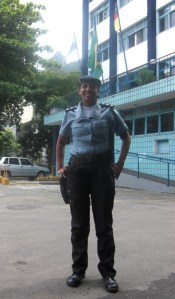
Capitao Pricilla, Head of Santa Marta Community Police initiative
So where should policing in Rio go? One way forward was obvious when we interviewed Capitao Pricilla, the current ‘star’ of the PM, who heads up the Community Policing initiative in Morro Santa Marta. Capitao Pricilla is a PR-dream: attractive, articulate, intelligent, convincing in her arguments, and clearly dedicated to her work with the community. She is everything you would hope a new generation of younger PM officers would be, and she clearly stated that she is part of a new generation. And she is popular too. As we talked with her, officers would constantly come over just to say ‘hello’ and older women in particular, would treat her like a TV celebrity. Now, of course I am wary of the way in which such charisma would make her an obvious choice to head such an operation, which is much promoted as ‘the way forward’ in the media. However there have been many ‘ways forward’ before which have come to nothing and Rio is constantly making and destroying innovative initiatives before they even have a chance to have a real effect. The Santa Marta initiative probably cannot be replicated in many favelas, like Prazeres, where there is a more intimate relationship with the ‘parallel power’ of the traffickers. But Capitao Pricilla seems like the real deal. Let’s hope that she and officers like her get the support they need and are not undermined by the violence and corrupt practices of so many of their colleagues. It’s a utopian hope perhaps, and Rio is still going to need the other far more aggressive hand of the other attempt to get around corrupt practice in the PM, the BOPE – about whom I will write more after our visit today – as much as it needs the helping hand of Community Policing initiatives for a while. It is that large and less articulate mass of PM and PC officers who have no interest in doing anything different, and the equally corrupt politicians who prevent change for their own selfish reasons, that are the main barrier to any organisational change.
We visited two very different communities today, Santa Marta and Santa Teresa, but despite their differences, in both places we met with an equally impressive community representative.
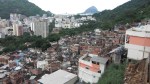
Morro Santa Marta is a relatively small favela that climbs the steep slope below the peak known as Dona Marta (which is why the favela is often incorrectly called ‘Dona Marta’), above Botafogo, and just on the other side of the hill from the much wealthier neighbourhood of Laranjeiras. Santa Marta is well-known largely because it is perceived as a success story, indeed as we were being taken around he community, journalists from Globo TV were embarking on a month-long series of features and interviews with different members of the community, and representatives were scouting the place as a location for the ‘Red Bull Down’ urban downhill mountain biking series (see this description of a related event in Puerto Rico)… in short, Santa Marta is fashionable.
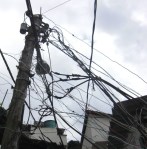
It is also the target for a number of state interventions; indeed I don’t think I have seen as many different workers from as many different agencies in one place at one time anywhere in Brazil. There were transportation workers on the newly-finished cliff railway, there were workers from the planning department shoring up recently-constructed houses to prevent landslides, there were electric company workers struggling to make sense of the maze of cables, there were refuse workers, and at the base of the favela there was a load of people from the new Motorola-sponsored Digital Santa Marta initiative that is wirelessing the whole neighbourhood. It seemed that various government interests badly want Santa Marta to continue improving, and that a lot is riding on this.
However, as we soon discovered, there is a more complex and fragile reality underlying the business and the superficially sheen of hype. Our guide for the morning was Sonia Oliveira, one of the directors of the community association, and a resident for many years. As we ascended the railway with her, we met her son, and other people, like Luis Gustavo, who she had known since he was a baby… it was clear that Sonia was well-known and well-liked. And who wouldn’t like her? Sonia is a strong woman with a calm, determined presence and an insight matched by the realism of experience.
The key to Santa Marta’s success so far has been the combination of many years of careful community work, combined more recently with a determined effort by a particular battalion of the BOPE (military police special operations) to drive out drug traffickers and secure the community, under Commandate Priscilla, who we will hopefully meet next week. It is not as if the community is any more sympathetic to the police than anyone else in Rio, but the relationship between the people involved here is clearly a special one. And whilst the police still do not understand the community fully – there are still frequent complaints of harassment of young men and the closing down of parties – there is some evidence that they are learning and changing to a small but important extent. One problem now is that the wider context of the ‘choque de ordem’, which is basically a rather more aggressive version of the famous New York ‘zero tolerance’ policy, is threatening to roll back these small improvements in trust and understanding. The police hassle unlicensed stall-holders, which is how most favelados make their living, they stop taxi drivers for checks of insurance and licensing, and of course, they threaten, and indeed carry out the threats, to demolish illegally constructed buildings – which is of course, potentially any piece of the favela. However, for Sonia, the over-assertiveness of ‘choque de ordem’ policing is outweighed by a far greater another fear – which is what happens if the political climate changes, or financial or strategic reviews mean that the BOPE are forced to withdraw from Santa Marta. If they do, she argues, the traffickers will return, and it will be worse than before, as not only will they take control of the community, but they will ‘punish’ it for collaborating with the authorities.
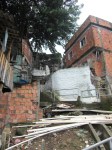
And things must continue here. In many ways they have hardly started. There might be a lot of activity but the favela remains lacking in infrastructure, especially sewage and healthcare. Most of the self-built constructions remain precarious and a severe risk to their inhabitants and those below in the case of heavy rains and consequent landslides. And the understanding of neighbouring communities is far from guaranteed. One might think that neighbours would be grateful that the traffickers are gone and even make efforts to integrate Santa Marta further into the city, but Laranjeiras in particular has been causing all sorts of problems for the favela, in particular over the construction of a school and creche at the top of the neighbourhood. The problem was basically that the school can be seen over the top of the hill, and this led to the fear that Santa Marta would begin to spread over the top and down to the back gates of the expensive apartments and villas of this rather exclusive community inhabited by people like Governor Sergio Cabral. In fact, unlike several other favelas, Santa Marta is not expanding at all. It is becoming a more mature and controlled community, and it is rather ironic that it is at this stage of its development, that it becomes an object of fear and concern for its richer neighbours. The argument has been resolved for now, and the school stays, indeed it is the temporary home of the battalion and the community police, who get a good overview of the neighbourhood from its commanding position. The lack of expansion of Santa Marta has not stopped the State from starting the construction of a wall along its west side. As Sonia says, there is no need to make favelados feel like they are living in a ghetto…
Paulo Oscar Saad was against the building of the school, indeed he is against the expansion of any illegal community into the hills of the area, but in truth this is the only real substantive grounds for disagreement between the leader of the Santa Teresa community association and those in Santa Marta. Santa Teresa is however, an entirely different place. Once a hillside retreat for the rich, its crumbling mansions have for a while now been occupied by an eclectic mixture of artists, academics and other bourgeois but generally progressive people. For many years it served as a kind of cultural centre for the surrounding poorer neighbourhoods, including the many favelas, with favelados mixing with the artists in the bohemian bars and cafes.
However, this mixture has been undermined by three main developments. The first is the aforementioned illegal building, which threatens the very stability of the hillsides which support Santa Teresa. It isn’t just what one would recognise as ‘favelas’ either; many of the illegal buildings are constructed by relatively or even very wealthy people, and often on land reforested precisely to prevent landslides after two previously disastrous deluges in the 1960s and 1980s. The second is the change in the nature and intensity of crime in Santa Teresa. The neighbourhood had always put up with a certain amount of petty theft and pickpocketing, but the arrival of cocaine (and more recently, crack) and in particular the arming of the drug gangs has led to an increase in both actual serious crime and fear. Finally, the gentrification of Santa Teresa is threatening to destroy the easy-going and bohemian atmosphere of the hillside on which it is based. It is an old story, seemingly destined to be endlessly repeated in similar communities all over the world. The old bars and cafes close, and the new upmarket establishments exclude the poor either overtly by policy or implicitly through price. The fear of crime has also driven many residents into the arms of private security companies, who have gated several dead-end streets and equipped them with guardposts. The signs say they are legal; the Community Association says that they are not. In fact the latter are correct. Paulo, like some other I have talked to here, is sure that the private security companies are intimately linked to the militias and indeed to the criminal gangs, all of which reinforce each other in an ongoing spiral of criminality and securitisation. However it is not as if the police (of any kind) or the politicians can be trusted to deal with the situation. According to the community association leader, the police are entirely corrupt and the politicians are fashion-driven media slaves. The only hope lies in bottom-up community power, yet the community is increasingly divided, and even the remaining assets that make Santa Teresa what it is are being cashed in: the wonderful antique tram system that rattles up the hillside is being privatised and its future is uncertain…
It seems that both community leaders are scared of losing what they have and battling to keep their neighbourhoods alive, inclusive and connected, but both are being hampered by uncertainty and contradictory policies and developments at levels which they cannot seems to influence. The future of Rio depends on people like this being supported not undermined by the state at its various levels (which still do not appear to know what each is doing, let alone look like working together). Oh, and I almost didn’t mention surveillance… that’s because like almost everyone else on the ground here, surveillance is seen as a frippery of the rich and something which has no practical use or meaning for the reality of their lives. There is also a strong sense of freedom too: and things like CCTV are seen as a definite infringement of that liberty. The more I get to know people and places here, the more I am certain that Brazil is nothing like a surveillance society and the changes that it would take to become one would be almost inconceivable in scale and cost.
redemption?
public face
Laranjeiras
Santa Marta Digital
police
School
Sonia
tangle
Inside
funicular
wall
Santa Marta
Note: there are photos of Santa Teresa in the next post and there will be more later this week.








 ubisurv