Leaving Sao Paulo

It’s my last morning here in Sao Paulo. I have to say that, with the greatest respect to my friend and Sao Paulo native, Rodrigo, I am not going to be sorry to leave. A lot of what I thought when I arrived here hasn’t changed. This is big, dirty, noisy, exhilarating city with an unapologetic commercial drive, and all the divisions and human debris that this creates. In many ways, it reminds me of Osaka in Japan, but the extremes are greater. The problem is that the huge divisions can’t be ignored if you are in any way sensitive to human suffering, and the suffering here cries out from every raw-smelling homeless man sleeping on the street, from the ragged kids sorting through rubbish at night, from the women selling themselves in the parks, stations – well, everywhere. Certainly, these things are part of city life in many places in the world, and there are many far, far poorer places, but there is something profoundly saddening, depressing, about the gulf between the helicopter-chauffeured elite and the people on the street in O Centro, and especially in the ignorance and indifference – which I have not only been told about but have seen. By the end of just one week, during which I have tried to be as much a part of the place as I could, when I have spent time talking to everyone from human rights groups to people in ordinary bars, I feel like retreating, curling into a ball in the corner of my room.
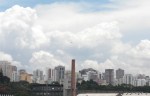
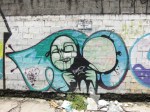
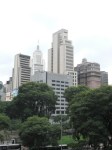
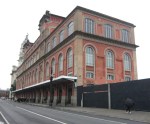
So thank-you, Sampa, but I am not sorry to be leaving. Here are some pictures of the hundreds I took, of aspects booth good and bad…

Gentrification and Control in the Old Centre of Sao Paulo

Yesterday, I met up with Brazilian surveillance researcher, Marta Kanashiro, and she showed me around the Luz area of the old centre of Sao Paulo, where she has been working. Luz was once a grand colonial district around the railway station designed by British architect, Charles Driver, in brick and iron, but it lost its importance in the mid-Twentieth Century as the station ceased to be the terminal for the coffee trade. The area acquired notoriety as home to a police headquarters where opponents of the dictatorship where tortured, and as a centre for prostitution, violence and drugs.

In more recent years there has been a real effort by the city authorities to reclaim the area which, despite being in many ways a laudable project, has been controversial both for its effects on the poor, and for its treatment of memory and the particular history of the place. On one side of Parque da Luz, the formal gardens in front of the station, is the Museum of Portuguese language, yet on other side of the station, all memory of the victims of police oppression and torture has been erased with the restoration of the police building.

In the park itself, the park authorities installed CCTV (the story of which can be read in Marta’s article in Surveillance & Society), but they haven’t tried to drive out the prostitutes, many of whom were still standing forlornly under the tall trees in the driving rain as we visited. However, according to Marta, they have tried to persuade the women to dress more respectably in keeping with the desired new image of the the neighbourhood! At one point the prostitute’s union was more involved in the management of the park, as were other community organisations, however the building in the centre of the park where these groups used to meet is now closed for refurbishment and it is unclear whether it will still be available in the same way afterwards. Another building in the corner of the part, next to the rather ramshackle security rooms, has already been restored, and where once the plans and documents about the park were on public display, now the place is prettier but empty.

The Luz regeneration has plenty in common with revanchist redevelopment in many other big cities around the world, and there are big questions about what happens to the already excluded population of the area as the regeneration spreads. There are two contrasting visions for the centre from two different but very similar-sounding organisations: Viva O Centro and Forum Centro Vivo. Both want regeneration – everyone does – but they have entirely different approaches to how it should be done. The former is an association of mainly businesses and police, similar to the Business Improvement Districts (BIDs) which are common in US and British city centres. It is behind a lot of the current redevelopment and has the ear of the city authorities. The latter is a group of academics and community activists who want a more democratic and participatory process, and who hold a lot of local events, cultural and political. They also accuse Viva O Centro of either actively or tacitly encouraging intimidation and violence (which has certainly taken place) against the poor population of the area. It is another reason why the attempt to erase of the memory of the brutality of the dictatorship is so important: it is a memory that needs to be constantly refreshed as the actions are echoed and repeated.

(A very big ‘thank-you’ to Marta Kanashiro for her time and patience! All mistakes in this account, as usual, are my own…)

Sao Paulo Metro Surveillance and Security

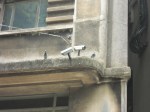
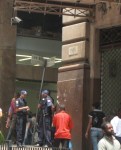
I spent some time on the Sao Paulo metro system yesterday so I tried to get some pictures of security and surveillance underground… Some things I would have loved to have got pictures of: the military policemen stalking a groups of favela kids through the crowds; the very tired and twitchy officer who looked to be absolutely itching for a fight, who got on the Metro after me; the perfect shot of two policemen standing under a camera. But I didn’t get those ones, so my words will have to do. The main reason is that I have a healthy instinct for self-preservation and taking pictures of men with guns – particularly when they are caressing the handgrip and trigger like it was an intimate part of their anatomy as the twitchy officer was – is a sure way to end up attracting unwelcome and possibly fatal attention. The officers in the stations did notice me taking pictures pretty quickly too – which perhaps suggests both the pervasiveness and the effectiveness of trained human surveillance. Anyway, I only have two shots, one of which was an experiment in a longer take, which didn’t quite come off so I might have to try this again…

I am sure I will have more to say today tomorrow on this after I have met up with Marta Kanashiro, the scholar of surveillance studies from the State University of Campinas.

Oscar Niemeyer’s Brazilian Modernism (1)

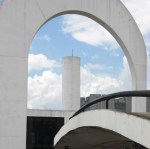
As a fan of utopian urbanism, I couldn’t very well come to Brazil without checking out some of the great Oscar Niemeyer’s work. Next week I will be in Brasilia, but this week in Sao Paulo, I took a few hours out to visit the Memorial da America Latina, a cultural complex built on an old factory site. The overall plan is not that impressive and the whole complex looks a little worn out, but the it was the detail of Niemeyer’s individual buildings that fascinated me, and the external detail at that. The interiors are cool and compelling, but in some you are not allowed to take pictures, and most of the others are filled with ‘stuff’ that reduces the impact of the space.

Bar talk

Brazil can’t really be called a surveillance society… talk of surveillance is just science fiction. It doesn’t mean anything to the people at the bar.

Back at the bar last night I got talking with the regulars – in the limited way I can manage to in Portuguese – about all sorts of things particularly the upcoming carnival – I’m invited – and the football: Brazil beat Italy yesterday in a friendly match. But it was how these ordinary guys – one is a factory worker, one works in an office, and another runs his own one-man business that seems to do anything and everything to do with IT – talked about fear and danger, security and safety, in the city that really interested me. We got talking about where they lived, and the centre of Sao Paulo and how they felt in each place. I told them what I had been advised about not going out at night here, and despite the fact that we were all out at night, Milton, the IT guy, a chunky black man in his 40s, agreed that this wasn’t bad advice for the centre. The area, he said, was full of thieves and drug-addicts, and whilst anyone would be safe amongst friends (and here he gestured expansively to include me and practically everyone else at the bar), even he wouldn’t want to spend much time alone. Milton is from out east – he’s a Corinthians fan; the centre-west is Palmeiras territory, and the red Metro line goes from one to the other – and in his own neighbourhood he says he doesn’t have much to worry about, although of course he has security. Everyone has security. You have to. Joao, the fat, slightly lugubrious office worker, nods in silent agreement.

I tell them I’d quite like to talk to some women. This prompts laughter and a lot of nudging and punching of arms: of course you do, don’t we all? No, no, I mean I’m interested in what women think about all this – what about her? I ask, gesturing to a handsome black women probably about the same age as Milton. Carla? No, you don’t want to talk to her. Not without paying. Open your eyes! (he makes an eye-opening signal with his right hand). Of course I could see that Carla wasn’t just here for fun. And that’s exactly why I wanted to talk to her. She agreed with the guys about the danger, but added that it was much worse for her, not because she was working nights, but because she was black. Being a black woman in Brazil is not good. Everyone, she said, pinching the skin of her forearm, just sees the colour of your skin. especially if you are on your own. With her white friend, people don’t care. I told her that some people think that Brazil isn’t racist or dangerous for black people. She laughed and not in a happy way. Those people didn’t know her life. I asked her if Lula had changed things – it is something I try to ask everyone at some point – in particular with the Programa Bolsa Familia since Carla had told me she has three kids, one grown up and two still at home. She shook her head. No. Nothing. Nothing has changed. It may be pessimistic or cynical but it’s what everyone seems to be thinking apart from the government and the World Bank.

All this bar talk might be casual and fueled by beer (and it is often difficult to understand exactly what people are saying) but it is a useful corrective to the formal interviews and other research I am doing here. It also tends to add to my growing certainty that Brazil can’t really be called a surveillance society at all in terms of how people experience their lives and relationships with the state. Talk of surveillance is just science fiction. It doesn’t mean anything to the people at the bar. The reality is all about danger (not risk in the bland sociological terminology, but actual danger) and security.

(All the names in this piece have been changed…)

Human Rights in Brazil

In Brazil, the almost universal perception amongst the middle and upper classes is that human rights defenders are simply defending criminals…

I spent some time yesterday talking to people from the justice program at Conectas, a collection of organisations that works on the unpopular issue of human rights in Brazil. Conectas also has a global south program that works more broadly in the developing world, and publishes the excellent journal, Sur.

ipbI say that human rights is unpopular, which may sound surprising, but talking to the valiant lawyers and organisers at the Instituto Pro Bono, which provides lawyers to those who can’t afford them, mainly prisoners, and Artigo 1o, which brings civil actions against the state on behalf of prisoners killed or injured by police and prison staff, I was immediately reminded of the depth of the social divisions, and the sheer mutual ignorance of people in different social classes here in Brazil.

In part, I was told, the gap has to do with the experience of the dictatorship that came to and end from 1985. Human rights had grown in opposition to the dictatorship, and once the end came, many wealthier people started to wonder why people still needed these apparently strange and special rights in a ‘free society’. The almost universal perception amongst the middle and upper classes is that human rights defenders are simply defending criminals, end of story. The Artigo 1o staff told me that they regularly receive hate-mail and threatening or angry telephone calls. The Instituto Pro Bono is still battling to have its lawyers even accepted in courts in many states in Brazil. Bar associations are opposing them on the grounds that they take business away from defence lawyers! Neither organisation gets any more than a tiny proportion of its income from Brazil; most comes from the European Union and the USA.

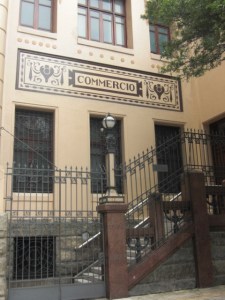
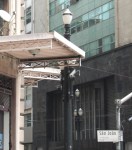
Everything you need to know about what drives Sao Paulo (Nineteenth Century Building in the heart of the city)
Almost everything you need to know about what drives Sao Paulo (Nineteenth Century business federation building in the heart of the city - the other side of the entrance says INDUSTRIA)

Partly too there is a partially Catholic Christian legacy of accepting one’s ‘natural’ social place and waiting for what one deserves after death. However there are also questions of geography. And sociospatial variety leads to different relationships and different attitudes by the ruling classes in different parts of the country. In Sao Paulo, the poorer areas, and the favelas – I was reminded of course that there are both and many, many very poor people are not living in illegal settlements – are largely peripheral. This means that they can be ignored by the rich. Sao Paulo is also a mercantile city absolutely dedicated to making money and many of the rich seem to regard the masses of poor as simply ‘failed entrepreneurs’ whose fate is their own fault. This contrasts with Rio, where rich and poor are thrust right up against each other, with favelas running right into the heart of the city. The poverty cannot be ignored, but instead it is crushed, repressed by the actions of groups like the Autodefesas Comunitárias, (illegal ‘community self-defence’ groups).

Welcome to Sao Paulo! ("REVENGE - Intruders will die" says the graffiti)
Welcome to the other Sao Paulo! ("REVENGE - Intruders will die" says the graffiti)

Of course such mass violence does occur in Sao Paulo too – Artigo 1o is currently looking for funding (not a lot in relative terms BTW – please contact me if you have about $6000 US to spare!) to publish their report into the mass battles between police and organisations of ex-prisoners and criminals, which resulted in the extra-legal execution of hundreds of people by the police. However, in general, the staff of Artigo 1o argued, the relationships are different.

(there was a lot more, but I will write about issues around security and surveillance later)

Finding my feet and losing my head in Sao Paulo

It is my firm belief, yet to be disproved, that any urbanist worthy of the name can find a decent bar within 24 hours of their arrival in any city on the world, and preferably less. Read Ernest Hemingway’s Paris: A Moveable Feast. It’s Chapter 1. No-one knew bars like Hemingway. In Sao Paulo, as in Paris even today, it would be impossible to fail this challenge. I found mine this evening right next to a more famous bar at the corner of Sao Joao and Ipiranga which has started to believe its own mythology and therefore lost everything that once made it a bar worth celebrating in song, and I settled in to watch and learn.

I’ve already got so used to joking with barmen and concierges about my poor Portuguese that it’s almost like an icebreaker. The bar was haphazard, white tiles, and giant freezers which got the beer down to an appreciably glacial degree of cool, decent salgados and two grades of chili source to accompany them (hot and really hot – no-one has the first choice, of course).

Bars are human sociality at their most basic, their most primate-like. I once worked on a zoological expedition studying monkeys in Kalimantan, and there is very little I’ve seen in bars that I haven’t seem being done by other primates (apart from the serving of cold beers, which explains most of what happens in bars that you don’t see in monkey groups). The forced-together bonhomie, the silence amongst the mostly male clientele as some particularly fine example of the female of the species walks by (and that happens an awful lot in Brazil), the arguments about sport and politics, the group-dominance by alpha-males – at least in the absence of any alpha-females – it’s all there and it’s all – excepting the beer and the salgados – monkey.

It makes one depressed and optimistic at the same time. You know that anywhere that humans go, somewhere in the universe, there’s going to be a bar just like this. And yet, it makes you wonder whether we will ever manage to solve the enigma of cities, a solution that will bring in those shadowy figures who lurk just beyond the reach of the bright lights of the bar – the stick-thin figure of the beggar-woman who passed me twice this evening, the guy selling lottery tickets at the last minute, the prostitutes and thieves who have been driven to these ends because of the city, because their existence and the existence of the city don’t quite seem to coincide in the same way, the same spacetime. There’s a reason good urbanists need to find a good bar. It isn’t always for the same reasons as everyone else.

Sao Paulo Surveillance and Security

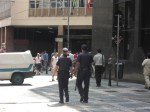
Nor surprisingly there is very little surveillance in the area around the hotel, except the old fashioned kind and you better be sure that people are watching you from the little shops and street corners. However when you head down the Av. Sao Joao into the financial district, it’s a different story. I was cautious about taking obvious pictures of police and security guards, let alone the serious security inside the bank entrances (metal detectors, scanners, guards etc.) because I just don’t know what kind of trouble that would bring, but here’s a flavour.

Touchdown in Sao Paulo

The centre of Sao Paulo not a place for those who don’t like the scent of human beings together or being touched and jostled. The streets smell of piss and sweat and there are boys begging and running and men lying in boarded-up doorways or just on the sidewalks, with their dogs or without…

It’s hot and wet and I’m lying on a bed in a hotel which is a good 2 stars short of the 4 that it claims to have, in a neighbourhood in which the only stars you’ll see are if you’re lying in the gutter. And many are.

I’m sorry to go gonzo on y’all but on first impressions that is the way I will have to write it. Sao Paulo is the kind of city that seems to have that effect. I’ve only really come here to talk to a few social organisations and to see Rio’s great rival, but it’s hard to know what to make of it. Flying into Congohas, we cut through the low clouds to the spectacle of this endless sprawl of towers and factories and suburbs and favelas and highways thrown together with as little sense or plan as any place I’ve been in Asia. Like Tokyo or Mumbai it’s just too big to take in or apprehend even from the air, although you can’t avoid the scalar indicators of class divisions – both vertical and horizontal. The airport is one of those which has been drowned in this rising sea of humanity which makes the final descent pass with a feeling of rooftop-skimming alarm, which a slight sideways jolt on the infamously greasy runway surface – a plane skidded out of control here in July 2007, killing 187 people – does little to allay.

We make it safely down. As we are heading to the terminal I see my first helicopter, another reminder of the social extremes of this place where the super-rich just don’t let their feet be soiled by the streets any more and which has the largest private helicopter use outside of New York.A taxi to the centre – they tell me there aren’t any buses though I am sure there are, and I won’t be making that mistake again!. The highway that snakes deeper into the city is hemmed in with rotting stone and concrete and every space that hasn’t been walled off has been reclaimed and is packed tight with self-constructed dwellings in various stages from shack to house. Occasionally huge voids are opened up – precursors to a further gentrification, some new fortified tower condominium – and the archaeology of the city is laid bare: a splash of colonial colour, deco curves and the confident lines of Brazilian modernism, all cut neatly and disrespectfully for some tower block with a European name and not a hint of Indio or African heritage. Brazil might not be an overtly racist culture in many ways, but ‘whiteness’ remains the shade of aspiration…

Then a sharp left off the highway and we are in the old centre. The taxi driver knows the map but he doesn’t know the area, and out path is blocked by a Sunday market. I take a mental note – I’ll be back later. We get to the hotel, which pleasingly is not anything like the priggish image on the website and if it is ‘perfect for business’, it certainly doesn’t look like the kind of business you do with a briefcase… This turns out to be exactly what O Centro is all about. I get out and head back towards the market for a pastel com queijo and a cool caldo de cana com limao, and just to wander amongst the fruit and veg sellers. This place is much more obviously mixed than Curitiba. The faces of the vendors are a whole range of darker shades, the accents more varied, tougher and more incomprehensible!

The toughness isn’t just in the voices of the stallholders though. The is a brash, hard city. The centre of Sao Paulo not a place for those who don’t like the scent of human beings together or being touched and jostled. The streets smell of piss and sweat and there are boys begging and running and men lying in boarded-up doorways or just on the sidewalks, with their dogs or without. Sleeping, drunk, dead – who knows? The market is winding down, an at the ends of the street, amidst the sickly sweet decaying piles of vegetable leaves and squeezed sugarcane pulp, several middle-aged whores work the last few departing customers. They half-heartedly ask me if I want something. I just smile and politely say no thank-you very much, which seems to amuse them. I don’t suppose they get or expect much of that sort of interaction. This sets a theme. There are women working the car parks, women on the street, women trying to entice any likely-looking customers into a seedy-looking film theatre for ‘fantasia’. Turning a corner suddenly the street is full of younger men standing around with largely older guys passing by. It’s only after the second transvestite offers me something else that I realise I’ve entered another kind of business district, which happily filters into a much more ordinary a relaxed set of gay bars and pastelarias. There seems to be some kind of club open, with another very tall transvestite on the door, but the queue outside seems to be mostly teenagers. I’ve only been a few blocks and this isn’t even (apparently) the really lively part of SP…

Cutting back to the Praca da Republica, there’s another much bigger market winding down, this one more of a craft-type affair with lots of wiry men and women selling hats and carvings and a whole avenue of dealers in stones and minerals and, outside the entrance to the Metro, food stalls selling either Japanese yakisoba or cream cakes. Neither appeals, and as it looks like rain, I head into a bar. Sao Paulo against Botafogo is on the TV but not too loudly and no-one seems interested, the beer is cheap and the woman behind the bar is singing to herself so I stay and sip the cold lager and watch the rain come down and the passing beggars and freaks and drunks and I am thinking that I am just a few hundred yards from Parque da Luz where the city has installed public-space CCTV, and it might be the beer but just makes me want to laugh. It just seems so tiny, so pathetic a gesture, how can it possibly do anything to this roiling mass of humanity with its desires and suffering and joy and desperation.

I’ve touched down in Sao Paulo.