At the Instituto de Segurança Pública

Paola and I had a very productive interview with Colonel Mario Sergio de Brito Duarte, the Director President of the Institute for Public Security (ISP) in Rio de Janeiro. The ISP is a state-level organisation with multiple functions including research on public security and the compilation of crime statistics; professional development for the police services (and also more broadly to encourage greater cooperation and coordination between military and civil police); and community involvement and participation in the development of security policy. The Colonel gave us an hour and a half of his time to explain his view on a wide range of issues around crime, security, the problems of the favelas, and the potential for surveillance, social interventions and policing in solving these problems.

As with many senior police (and military) officers with whom I have talked over the years, the Colonel is an educated, thoughtful man who has strong views based in his experiences as a front-line officer with the Policia Militar in Rio (including some years in BOPE, the special operations section) – as detailed in his book, Incursionanda no Inferno (Incursions into the Inferno). Despite how the title may sound, he was far from being gung-ho or authoritarian in his views, emphasising throughout, as with almost everyone I have talked to, that socio-economic solutions will be the only long-term guarantee of public security in Rio. And he certainly had no sympathy for the illegal actions of militias, despite understanding why they emerged and continued to be supported by some sections of the community.

However, it was also clear to him that current policies like Mayor Eduardo Paes’ ‘choque de ordem’ strategy which involves demolitions of illegally-built houses in the favelas, was absolutely necessary as well. He spent some time outlining his view of the history of how drug gangs infiltrated and gained control of many favelas, an in particular the importance of their obtaining high quality small arms – though he was vague on exactly where these arms came from – I have, of course, heard allegations from other interviewees that corrupt soldiers and policemen were one common source of such weapons.

From the point of view of surveillance studies, it was notable how profoundly indifferent the Colonel appeared to be towards he growth of surveillance, and in particular CCTV cameras. He argued that they might be a useful supplement to real policing, but he certainly did not appear to favour a UK-style ‘surveillance society’ – of which, at least in Rio, there seems little sign as yet. He was similarly indifferent towards other central state social interventions like the Programa Bolsa Familia (PBF), and initiatives like ID cards – of course they might help in some way, but he certainly made no attempt to ague, as the UK government has done, that such technology will make a big difference to fighting crime and terrorism (indeed it was interesting that ‘terrorism’ was not mentioned at all – I guess that, when you have to deal with the constant reality of poverty, drugs and fighting between police and gangs, there is no need to conjure phantasms of terror). Even so, the Colonel recognised that the media in Rio did create fantasies of fear to shock the middle classes, and that this sensationalism did harm real efforts to create safer communities.

There was a lot more… but that will have to wait until I have had the whole interview transcribed and translated. In the meantime, my thanks to Colonel Mario Sergio Duarte and to the very nice and helpful ISP researcher Vanessa Campagnac, one of the authors of the analysis of the Rio de Janeiro Victimisation Survey, who talked to us about more technical issues around crime statistics.

The Shock of Order: Building and Demolition in Rio de Janeiro

I may have been slightly worried about the most recent drugs war that was going on as I arrived, but as usual this appears to have been exaggerated by the press who largely serve the richer, middle-class community, and who appear to want to have their fears stoked on a regular basis. The ‘war’ is a trafficker conflict that involves traffickers based in the large favela of Rocinha, who belong to the Comando Vermelho (CV, Red Command) the oldest and largest of the prison-based umbrella groups of Rio drug traffickers, attacking another favela, Ladeira dos Tabajaras, whose traffickers are backed by the ‘Amigos Dos Amigos’ (ADA, ‘Friends of Friends’). This kind of thing is happening on and off all the time, but what made it a concern of the paranoid middle class in this case, was geography: in order to get to Ladeira dos Tabajaras, the Rocinha gang had to go through the rich high-rise area of Copacabana… to say that it is exaggerated is not to say that it is not dangerous: 8 people have so far been killed, but they are all traffickers and, I believe, all killed following police raids into the favelas.

It is probably no coincidence that this display of force by the Rocinha traffickers is happening just as the city government of Rio has started to implement a policy of the current Mayor, Eduardo Paes, known as ‘choque de ordem’ (the ‘shock of order’), which involves sorties into communities like Rocinha largely to enforce planning regulations by destroying recent illegally built constructions, which are pushing the favelas even further up into the hills. In the last few days, this policy has resulted in the demolition of one particular controversial building, the Minhocão in Rocinha. This was due to start on the 17th, but was halted by a judicial decision, before going ahead in recent days.

There is more than a degree of irony here. The purpose of these demolitions is supposedly to enforce urban planning regulations and ‘protect Rio’. The Secretary for Public Order, Rodrigo Bethlem, is quoted by O Dia as saying (in my translation):

“We cannot permit an entrepreneur to come into Rocinha to build and make easy money by exploiting people. We cannot allow Rio De Janeiro to be destroyed by speculators, who want to make money without following any rules and who aim only at profit.”

Yet, I only have to glance out of my window here to see the towers of the Centro, built by wealthy speculators, which have almost completely destroyed the beautiful Parisian-style boulevards and belle epoque architecture that used to be ‘Rio’. And turning the other way, the coastline it dominate by the secure condominiums long the beaches, which I am pretty sure were not constructed out of the kindheartedness of developers, and whose development no doubt involved corruption at higher levels of urban government. Looking uphill, I can see the often dubiously if not illegally-constructed houses of the rich that cut into the edges of the National Park.

Can we look forward to the demolition of all of these disfigurements of Rio? Of course not… and the reason is obvious. The demolitions in Rocinha are about power projection. Local state policy towards the favelas goes in waves that alternate between socio-economic solutions and violent authoritarianism. For all its negative aspects, many people who are concerned with social justice here recall with some nostalgia the progressive populism of Leonel Brizola who was mayor in the 1980s. His administrations installed infrastructure, built schools and improved houses in the poorest areas.

The current administration of Eduardo Paes is taking a very different and harder line, concentrating on law and order, a stance which was laid out clearly during the Pan-American Games when the police effectively occupied several of the favelas in an Israeli-style security operation. There would be nothing wrong with this if it were backed by some kind of progressive social imagination too – some favelas like Dona Marta, which I will be visiting later this week, have apparently been transformed through a combination of strong control and surveillance with real social improvements.

Instead there are apparently plans to further marginalise favela residents by building a wall along the major highway from the international airport into the city, so that all the city’s elite can feel so much more secure, and of course, visitors will not have to even see the favelas (some or Rio’s most miserable) which line the route… there’s more than a whiff of Israeli tactics about this too. Whether by building or by demolition, urban planning seems to be currently used as a weapon against the favelas and their inhabitants.

Flying Down to Rio

ariasI’m off to Rio de Janeiro on Thursday… as most people will be aware, Rio is far a long way from the romantic Hollywood-generated image of sun-kissed decadence. It is perhaps the most extremely divided city in the world. The richest parts have a higher standard of living than almost anywhere else and the poorest parts barely cling to the hillsides and to any kind of an existence. I have been reading Enrique Desmond Arias’ enlightening Drugs and Democracy in Rio de Janeiro (amongst many other books) in preparation, and right on cue, a major drugs war has apparently broken out between trafficking gangs in the Copacabana area…

I am going to be interviewing state and community representatives, and carrying out mapping exercises to assess the state of surveillance and security in several different neighbourhoods of varying social classes. The drug war is making me a little nervous, but in many ways it is an ideal time to be asking the kinds of questions I need to ask. Of course reading a book like Arias’, you tend to get anthropology-envy, but I just have to remember that my study is a very different kind of research. I am still trying to get a feel for the kinds of indicators that would enable us to make serious comparisons between the intensities and forms of surveillance across cultures and nations – and I am still very much at the beginning of the project. Some of these indicators might seem common sense and obvious but some are not, and some may not even be in any way ‘measurable’…

My fantastic temporary Research Assistant is Paola Barreta Leblanc – she has created a mash-up of my current schedule here (it will get more complex!).

Wish me luck!

Surveillance in Latin America

For the last three days, I’ve been at the Surveillance, Security and Social Control in Latin America symposium, organised by Rodrigo Firmino at PUCPR (with help from Fernanda Bruno, Marta Kanashiro, Nelson Arteaga Botello and myself). The conference was the first to be held on surveillance in Brazil and will be the start of a new network of surveillance researchers in Brazil and more widely across Latin America.

All of the presenters had something interesting to say and I learned a lot from the event, however it is worth noting some individual presentations and sessions that were really insightful. There were great keynotes from David Lyon, Luiz Antonio Machado da Silva and Nelson. Two sessions stood out for me: one on Rhetorics of Crime and Media which had an exceptional central presentation by Paola Barreta Leblanc, a film-maker and currently a student of Fernanda Bruno’s. Her paper (and films) on the way in which we impose narrative onto CCTV images argued cogently that we see CCTV with a (Hollywood) cinema-trained eye and consequently overestimate (or over-interpret) what we are seeing. The other papers in the session were also good, in particular Elena Camargo Shizuno on Brazilian police journal of the 1920s and how they trained the vision of middle and upper-class Brazilians of the time through a combination of reportage, fiction, and advocacy. The session as a whole left me with many new questions and directions of thought.

The other really sparky session was on the last day and was on the Internet and Surveillance. The first paper was from was Marcelo de Luz Batalha on police repression of community and activist networks at the State University of Campinas, which linked nicely into concerns I have been following here on the surveillance of activist networks in the UK. Then there was Hille Koskela’s theoretically sophisticated and searching paper on the Texas-Mexico border webcam system (that I noted back in January) which explored the ways in which this participatory surveillance system both succeeded and failed in inculcating an attitude of patriotic anti-outsider watchfulness and responsibilization of citizens. Finally there was an interesting if not entirely successful film from Renata Marquez and Washington Cancado which used Charles and Ray Eames’ famous Powers of Ten, one of my favourite bits of pop-science ever, as an inspiration for an exploration of the uneven gaze of Google. They provoked some very interesting thoughts on the ‘myopia’ of the new ‘god-like’ view we are afforded through interactive global mapping systems. I think their approach could be very fruitful but it is still missing some key elements – having talked to them, I am convinced they will turn this into something really excellent. I have asked them and Paula to submit their work to Surveillance & Society’s special on Performance, New Media and Surveillance, because I think both are exactly the kind of explorations we are looking for. If Fernanda Bruno’s excellent paper on participatory crime-mapping has been part of this session, it would have been perfect! See Fernanda’s thoughts on the seminar over at her blog – she was also Twittering throughout the event but I’m afraid I just can’t get on with Twitter!

Other memorable papers included Danilo Doneda’s on the new Brazilian ID system, which sparked our post-conference considerations on where to go with this new network, which will probably be a project on Identification, Citizenship and Surveillance in Latin America. Nelson Arteaga Botello has already generously agreed to host the next symposium on this theme in Mexico City next March! Fernando Rogerio Jardim gave a passionate paper on the the SINIAV vehicle tracking pilot in Sao Paulo and I was most impressed with the careful Gavin Smith-style CCTV control-room ethnography by one of Rodrigo Firmino’s students, Elisa Trevisan, and Marta Kanashiro and Andre Lemos both gave insightful presentations too – I’ve already come to expect both care and insight from Marta in the short time that I’ve known her. I hope we’ll be able to work more closely together in the future. Let’s see…

The event as a whole was a great start for the study of surveillance in Latin America, despite the disappointing lack of Spanish-language interest. This is just the beginning, and the new networks of scholars here will grow. I was just happy to be there a the start and play a small role. As for my keynote, I took the opportunity to do something a bit different and instead of doing my usual tech-centred stuff, I gave a talk on the emotional response to surveillance and how this might form the basis for reconstructing (anti-)surveillance ethics and politics. I have no idea whether it really worked or what people got out of it…

Brazilian church sends mixed signals on security

CNBB 2009 Campaign on 'Fraternity and Public Security'

One organisation I haven’t mentioned much since I have been in Brazil is one of the most important, influential and yet always controversial: the Catholic Church. Brazil was one of the centres of the Liberation Theology movement and these activist priests, unlike the church hierarchy in many Catholic countries, never sided with the dictatorships. Liberation Theology remains a major influence and movement within the Brazilian church and it is no surprise to see the fraternal organisation of the Conferência Nacional dos Bispos do Brasil (National Conference of Bishops of Brazil or CNBB) taking their campaign theme for this year as Public Security.

However, at the same time, the Church in Brazil seems to be clamping down on dissent and on those priests who are too outspoken on behalf of the poor and the victims of violence and insecurity. Today, the BBC is reporting that Father Luiz Couto, who is from the north-east and a colleague of President Lula (he’s a Workers’ Party federal deputy), has been suspended by the Church for advocating the use of condoms for public health and having a liberal attitude to gay rights.

Couto has however also been for many years a serious campaigner against unofficial ‘death squads’ and Autodefesas Communitárias. It seems to be at the very least bad timing by the church to suspend him just after announcing their year of campaigning on public security. He has my support and my sympathy. The Church needs to live up to what the CNBB are proposing this year and focus more on the realities of the big social questions that bedevil Brazil and not shoot themselves in the foot by suspending their best members over what should be matters of opinion on personal morality.

Austin no longer the coolest city in the USA

The latest city to fall for the current wave of government enthusiasm for surveillance that is sweeping the USA is, unfortunately, the city of Austin… Sorry Austin – unless you people do something about this, you are off my list of cool cities…

Austin, Texas… lone island of sanity and liberalism in a less-than-liberal state. With its laid-back attitude, massive urban bat population, superb music scene and reputation for weirdness, it must for some time have been a candidate for coolest city in the States.

Austin... no longer cool

Well no longer. The latest city to fall for the current wave of government enthusiasm for surveillance that is sweeping the USA is, unfortunately, the city of Austin, whose authorities have voted to install a CCTV system. The local newspaper, The Daily Texan, jauntily informs us that the city has voted to sacrifice privacy for security: that does not sound like the attitude of a confident, hip place. Sorry Austin – unless you people do something about this, you are off my list of cool cities!

Seriously, though: Austin is not a city with an especially high crime rate, nor has it seen any massive recent increase in crime – even if CCTV was any good at reducing crime, which we know from the multiple assessments done in the UK and elsewhere that it isn’t. Yet Police Chief Art Acevedo is quoted as praising CCTV in the UK, specifically in London. Perhaps he has been reading too much of the hype and hasn’t read the British government’s own assessments of CCTV (conducted under the auspices of the Home Office)?

So why the sudden urge to install cameras? Could it be because of the lure of federal funding from the Department of Homeland Security? It could be. Austin has acquired $350,000 to install cameras, and what set of city fathers turns down cash (whatever it is for)? That was one of the main lessons of the expansion of CCTV in Britain in the 1990s and of course cities are now paying the long-term price of their enthusiasm as they struggle to find the money to monitor and maintain their camera systems. Chief Acevedo seems to have no worries about this though – this techno-evangelist is already talking about automation and computer recognition systems. He really sounds like a guy who has started to believe the sales pitches at all those law enforcement technology trade fairs…

Battle lines being drawn in UK surveillance debate

there appears to be a gathering of forces and a drawing of battle lines amongst the ‘big beasts’ of security policy in the UK…

securitystrategybannerThe UK’s Institute for Public Policy Research (IPPR), the influential think-tank that was behind the New Labour project, has released a report on intelligence and national security that argues that privacy and human rights will have to take second place in the War on Terror. The report, National Security Strategy, Implications for the UK Intelligence Community, is written by former civil service security and intelligence coordinator, David Omand, is part of the IPPR’s Commission on National Security in the 21st Century, whose rather unimpressive launch event I attended last year.

The Guardian newspaper’s story on this is trying to build this up into an ‘end of privacy’ / ‘end of civilisation as we know it’ story and Omand certainly comes down firmly on the side of security over liberty. He recognises that his arguments are contrary to ours and go “against current calls to curb the so-called surveillance society.” But he is not actually making a total ‘by any means necessary’ argument. Even the Guardian’s own report quotes his rather qualified statement that “in some respects [new intelligence methods] may have to be at the expense of some aspects of privacy rights.”

The report is simply not as strong or even as interesting as The Guardian‘s story suggests. Most of it is simply a description of how intelligence works (and not even a very comprehensive or insightful one at that). Much, as we predicted in our recent book (see My Publications), it tries to set the creation of ‘resilience’ as a key rationale for reducing civil liberties, as if resilience in itself was a good thing that needed no justification when in fact it is being used as a bland container for all sorts of questionable policies – from the use of torture and imprisonment without trial to the everyday use of intrusive high-tech surveillance. The references to the political controversies over surveillance are rather cursory and don’t really say much other than that people are worried and really they shouldn’t be. These are just the usual ‘trust us, we know what we are doing’ and ‘these are exceptional circumstances’ arguments that we have heard many times before, and they are as weak and old-fashioned coming from Omand as from anyone else.

It is worth noting that there appears to be a gathering of forces and a drawing of battle lines amongst the ‘big beasts’ of security policy in the UK. I reported yesterday on David Blunkett’s conversion to the cause of limiting surveillance society, and a few days ago, Stella Rimington, the former Head of the Security Service, MI5, condemned the current government’s approach to liberty and security in even stronger terms, arguing that the approach that Omand typifies would lead to ‘a police state’.

Surveillance has finally become an issue on which it is becoming less possible to be unengaged, apathetic or even neutral. That in itself is a good thing, however it does not guarantee a good outcome even if more major public figures suddenly discover their enthusiasm for liberty once they leave office. However, I hope this reflects a split which is growing within the current government too – normally when retired politicians and civil servants speak out, they are conscious of the way in which they speak on behalf of friends and colleagues who feel they cannot be so candid.

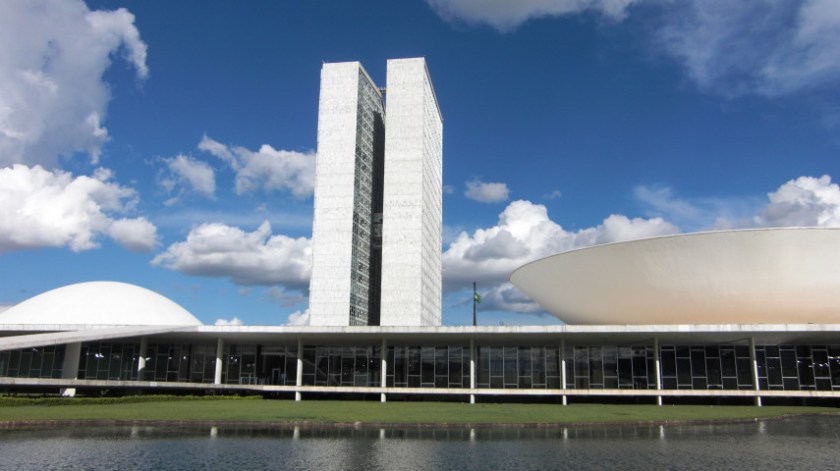
At the Camara dos Deputados

I had a great meeting at the architecturally stunning Camara dos Deputados (the Brazilian equivalent of the British House of Commons or the House of Representatives in the USA), which almost made up for the fact that it was the only one of the three scheduled interviews that I had arranged that actually went ahead… it really does look like I will have to come back.

The parliamentary buildings in Brasilia, originally laid out by Lucio Costa. The Camara dos Depuados, by Oscar Niemeyer, is to the left.
The parliamentary buildings in Brasilia, originally laid out by Lucio Costa. The Camara dos Deputados, by Oscar Niemeyer, is to the right.

This meeting took place in the Comissao de Direitos Humanos e Minorias (the Commission for Human Rights and Minorities) and was with Federal Deputy and committee member, Pompeo de Mattos, the secretary of the Commission, Marcio Marques de Araujo, and Hebe Guimareas-Dalgaard, who works in the International Relations office and who served as translator.

The meeting covered all sorts of background issues around security in Brazil, and concentrated on Deputado de Mattos’s specialities in this area, which are in justice and drug-trafficking issues. Again, I won’t do more than summarize a few immediately important things here. There was a lot of talk of police corruption and some hair-raising stories of the ways in which military police officers in particular has become involved in selling equipment and ammunition, and of course the autodefesas communitarias that I have mentioned before. Interestingly though, it was the deputy’s opinion that the military police, despite having a ‘culture of violence’ inherited from their role as enforcers of the military dictatorship, were less corrupt (in an everyday way) than the civil police. The latter are even lower down the police food-chain and correspondingly more poorly paid and equipped.

The inadequacies of the civil police has led many Mayors of larger towns and cities to introduce so-called ‘Municipal Guards’ – basically private security given some official status. They have few powers but are basically there to increase the visibility of security, a kind of prophylactic community policing. The problem is however that the official police and the massive private security sector are thoroughly intermixed already. Many officers moonlight as private security guards, which leads to all kinds of conflicts of interest.

Deputado de Mattos was certainly not obsessed with the inadequacies of the police however. Serious and organized crime associated with drug-trafficking paralyzes the everyday life of poorer areas of large cities in Brazil. Despite the fears of the rich over crime, it is the poorest that suffer most. He described the drug gangs as being the major obstacle to any positive change in Brazilian cities. However he didn’t see any militaristic solution – fighting a war against the drug gangs would only lead to more violence. The only solution to the problems of both crime and the poverty from which it emerges is social inclusion. The favelados must be provided with the same opportunities and infrastructure as everyone else. The need schools, hospitals, transport, and so on. Programs like Bolsa Familia, however well-intentioned, make no fundamental difference, he argued – contradicting, as most people with whom I have talked have done, the assessment of external organisations like the World Bank.

However providing such opportunities is not easy, and not just because of the costs. The drug-gangs actively resist any attempt by the state to introduce services, to the extent of intimidating or even killing construction workers. And this shouldn’t be in any way romanticized as some kind of popular resistance of the poor to the imposition of unwanted state interference – this is an attempt to maintain the rule of fear and violence. Somehow, one can never get away from the security issue in Brazil.

Leaving the Camara dos Deputados, looking past the parliamentary buildings up towards the Esplanada dos Ministerios, with all the government Ministries lined up in identical blocks.

(Thanks to Deputado Pompeo de Mattos, who as you will see if you check out his website is quite a character. He is fiercely proud of his southern ‘gaucho’ roots, and writes poetry to that effect. He is also – and I don’t say this very often of politicians – a genuinely nice guy. Thanks also to Marcio Marques de Araujo and to Hebe Guimares-Dalgaard without whom the meeting would have been impossible).

At the Departamento de Policia Federal

Both human rights advocates and the police seem to be strongly in favour of the new RIC system as a means of social inclusion and to replace the chaotic and corrupt identification system based in individual Brazilian states at present, which allows anyone with any other form of ID to get a state Registro Geral card in each different state.

Departemento de Policia Federal, Brasilia
Departamento de Policia Federal, Brasilia

I have just come back from a very productive interview with Romulo Berredo, from the Director-General’s office at the Departamento de Policia Federal (DPF), who are the Brazilian equivalent of the FBI. There was a lot covered and I couldn’t hope to reproduce it all here. There were however a number of immediately interesting aspects.

The first was more evidence that the whole basis on which identity cards and database issues are being considered here is entirely different from the UK. Now I know this represents a police, and a state, view, but so far, both Brazilian human rights advocates and the police seem to be strongly in favour of the new Registro de Identidade Civil (RIC) system. This is both as a means of social inclusion and to replace the chaotic and corrupt identification system based in individual Brazilian states at present, which allows anyone with any other form of ID to get a state Registro Geral card in each different state. It is fairly easy to acquire 27 different identities in Brazil at present. And identification is important here. The great fear that many people seem to have – indeed it was called a ‘cultural’ characteristic by Berredo – is not the use of identification by the state as a form of control or intrusion but as a guarantee against the anonymity that would allow abuses by the state or indeed by other malicious persons. It provides a metaphysical and material kind of certainty and stability. The legacy of the last dictatorship was not so much an East German-style nightmare of knowledge and order but of corrupt and arbitrary rule.

It is this latter legacy which also drives the divisions between the different police forces in Brazil. The states-based Policia Militar (Military Police) and Policia Civil are both tainted in different ways by associations with authoritarian rule, and the former particularly with extra-legal execution and torture, and they continue to be regarded with caution, suspicion or even hatred by many Brazilians. The other police forces are also suspicious of the growing role of the DPF, which is often seen in terms of a power struggle not rational subsidiarity. Ironically then it is the states-based police forces that are dragging their heels over plans to create the kinds of national databases of criminal information that the UK has, and not for any libertarian reasons. In fact the DPF seem far more concerned with protecting human rights and defending the idea of citizenship, and because they are tasked with anti-corruption investigations have even arrested Senators and Judges, something unheard of even ten years ago. Of course those very same Senators and Judges are now fighting back, in a manner rather similar to Berlusconi in Italy, trying to alter the law to give immunities and protections. For example, handcuffing of arrested suspects was always normal until it happened to a Senator arrested for corruption. The Senate suddenly became interested in the ‘human rights’ of arrested suspects and passed a law limiting the use of handcuffs! Corruption at every level is still an enormous problem here, though Berredo argued that it was largely associated with those who had retained power from the years of the dictatorship.

The concentration on inclusion and joining-up government where it is clearly much needed does however lead to some gaps in thinking. The creation of new databases brings with it new duties and new potential problems of data-handling. As the privacy and data-protection law expert, Danilo Doneda, pointed out to me the other day, Brazil is in an almost unique position in not having any kind of regulator for privacy and information / data rights. He argued it was because the authorities just don’t see the need. Berredo confirmed this. He claimed that the DPF were trusted by the public – and relative to other police forces, that is certainly true! – and that they had to carry out their duties appropriately or they would lose that trust. It sounds nice, but it isn’t a good-enough (or legally-sound) basis for the protection of data-rights.

It all confirmed once again that Brazil is not yet a surveillance society – the state does not yet have the capabilities. There is no national database of fingerprints (even for convicted criminals) for example. But as Berredo said, it is moving in that direction. He was keen that there should be be limits. I liked the fact that he used this word. ‘Limits’ is a word that I found that the neither the UK government nor the European Commission seem to like, and they seem very unwilling to say what limits might be. However Berredo was quite clear that a technologically-driven surveillance future in which individuals could be tracked – he used the example of Google Latitude – was not one which he wanted to see. He recognised that he was both a policemen (at work) and a private citizen (at home) and that he, as much as anyone else, valued his privacy.

(Thank-you very much to Delegado Romulo Barredo of the DPF, for his openness, time and patience, and also to Agent Alessandre Reis, for his help)

Britain ‘risks a police state’

Following the damning reports of the House of Lords Constitution Committee and yesterday, the International Commission of Jurists, now Stella Rimington, ex-Head of the security service, MI5, has warned that Britain risks becoming a police state. In an internview with the Spanish newspaper La Vanguardia reported by the Daily Telegraph, Ms Rimington attacked government plans for the National Identity Register and the soon-expected plans for a database of all communications (delayed from last year). If even ex-heads of the security service are now asking the government to change direction, in addition to civil liberties experts, independent judges, and just about everyone else, their stock of excuses must be rapidly diminishing. The current cabinet must know that their actions smack of the desperation of a failing government desperately searching for votes in being ‘tough on crime and terrorism’… but they seem to be locked into a trajectory of ever-increasing surveillance and security that they cannot justify but cannot escape. You do wonder who is actually advising them that this is all a good idea…