
The same team that did the influential Report on the Surveillance Society for the UK Information Commissioner’s Office (ICO) back in 2006 will be doing a follow-up report on the state of surveillance in the UK for the ICO and the national Parliament this year. Many of the things discussed in that report, which I coordinated, have been accelerating and intensifying, most obviously things like airport body-scanning and the use of drone surveillance cameras, but other things have stalled or slowed, for example the implementation of the ID card regime and more widespread use of RFID tags outside of inventory systems. We’ll be assessing the state of play and making some recommendations as a result. The project this time will be led by Professor Charles Raab in Political Science at Edinburgh University, and one of the world’s leading experts on privacy regulation, and will also include Dr Kirstie Ball of the Open University Business School, Professor Clive Norris of the Centre for Criminological Research at Sheffield, Professor Steve Graham from the Global Urban Research Unit (my old place) at Newcastle University – all in the UK – as well as myself and Professor David Lyon here at the Surveillance Studies Centre at Queen’s University, in Ontario. It will be great to be back working with the whole team again, and I hope we can contribute to a more focused debate and some real changes to UK policy and practice. We shall see…
Tag: surveillance society
UK’s secret national flying camera strategy
If there was any doubt left, it seems the British government has finally given up all pretense of trying to balance civil liberties and security. A plan has been revealed by The Guardian newspaper for a national strategy for surveillance by Unmanned Aerial Vehicles (UAVs). And we are not just talking the micro-helicopter UAVs used by many UK police forces already, but 22m-long airships, the G22, which can stay airborne for many hours. The military drones will require special certification for civilian use.
And of course, these devices are supposed to be in place for the 2012 Olympics, but even in the documentation secured under the Freedom of Information Act (FoIA), it is made very clear that the drones will be used for a multiplicity of ‘routine’ operations, including from orders and fisheries activity to conventional policing and even “[detecting] theft from cash machines, preventing theft of tractors and monitoring antisocial driving… event security and covert urban surveillance” as well as all the kinds of activities that the already controversial Regulation of Investigatory Powers Act (RIPA) covers, including “fly-posting, fly-tipping, abandoned vehicles, abnormal loads, waste management”.
If this wasn’t bad enough, the whole thing has been developed in secret with the British governments favourite arms manufacturer, BAe Sytems, is projected to run as a public-private partnership due to the massive expense, and it has even been suggested that the surveillance data could be sold to private companies, according to The Guardian.
And the ‘selling’ of this to the public has already begun. Some suggestions of the use of high-flying drones had been made by Kent police, who had claimed it would be to “monitor shipping and detect immigrants crossing from France”. However, as The Guardian goes on to show this was a ruse which was part of long-term PR strategy to divert attention away from civil liberties issues. One 2007 document apparently states, “There is potential for these [maritime] uses to be projected as a ‘good news’ story to the public rather than more ‘big brother’.”
It’s really hard to say anything polite about these plans, the way they have been developed, and the complete lack of interest in or concern for the British public’s very real and growing fear of a surveillance state in the UK.
A footnote: almost as soon as this news was revealed, the British government raised the terrorist threat level to ‘severe’, without providing any indication that was any specific threat. Now, this may be entirely coincidental (and there are a couple of high-level meetings on Yemen and Afghanistan strategy in London next week), but if the threat level was much higher, the British public might suddenly be more amenable to the introduction of something to protect them from this ‘severe’ threat, like, say, flying drone cameras, don’t you think?
Europe’s Surveillance State
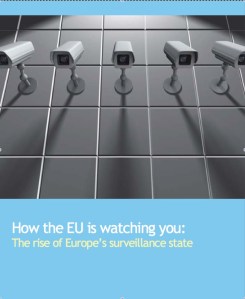
I have just got hold of a new report by UK-eurosceptic think-tank, Open Europe, called How the EU is Watching You: the Rise of Europe’s Surveillance State, which whilst it isn’t as startling as the NeoConPanopticon report from the Trilateral Institute and Statewatch, does some to collect some useful information together in one place. Crucially the report points out the same thing as Will Webster and I did in our paper in JCER a couple of months ago, that this isn’t just a case of ‘European’ bad practice being imposed on the UK, but just as much UK bad practice being exported and generalised throughout Europe.
One interesting footnote is how the discourse of opposition and analysis is changing. A few years ago, and still in academia, the idea of the ‘surveillance society’ was the dominant way of describing the situation, but now there is once again an increasing focus on the ‘surveillance state’ or the ‘database state’. This is partly, I think because there are an increasing number of right-libertarian and anti-state or small-state groupings openly opposing increasing surveillance – for example, the new Big Brother Watch in the UK, and they tend to emphasise the state’s role (or in this case, the role of an organisation they regard as an unaccountable superstate). This also reflects the growing opposition from the UK in particular. This is particularly interesting because in the past, the idea of the ‘surveillance state’ was mainly a historical term to do with the development of repressive political policing, especially that involved in colonial counter-insurgency – see, for example, Alfred McCoy’s new book, Policing America’s Empire, on the role of the US occupation of the Philippines in the co-evolution of US and Filipino state surveillance practices – or in the totalitarian regimes of the former Eastern Bloc.
The landscape today is much less obviously one of state control. Indeed one could see these developments as a result of the retreat of the power of the individual state and an attempted reconfiguration of state-power of a new kind at a supranational level. And, this power is crucially dependent, as it has been since the end of WW2 on the private sector. The military-industrial complex is now a security-industrial complex and security is no longer anywhere near being simply state business.
UK opposition plans to roll back ‘the surveillance state’
The Conservative Party Shadow Justice Minister, Dominic Grieve has launched a brief report outlining the opposition’s plans to introduce a new attitude to surveillance in the UK, and reverse many of the current Labour government’s policies. And it is mostly good, insofar as it goes. But, it is where it doesn’t go that is the problem.
The main measures include things we already knew, like a pledge to scrap the National Identity Register (NIR) and ID card scheme, and proposals to limit the proliferation of central databases and control the National DNA Database (NDNAD). However the Tories also want to abolish the Contact Point children’s database, restrict Local Government’s rights under the Regulation of Investigatory Powers Act (RIPA), strengthen the powers and functions of the Information Commissioner’s Office (ICO) and require mandatory Privacy Impact Assessment (PIA) for all new legislation or other state proposals.
So far so good – and these are all things I have proposed myself at various times – but there are also some very weak or pointless elements. First of all, the attitude to the private sector is predictably laissez-faire. Though the report includes a long list of the data losses that plagued the Labour government over the last few years, they fail to note how many of them involved private sector contractors or partners. And their only real mention of the private sector is to suggest that the ICO consults with industry on ‘guidelines’ and the possibility of introducing a ‘kitemark’ (a kind of stamp of approval). These are both pretty much worthless and tokenistic efforts. The Tories, as much as Labour, fail to appreciate that contemporary threats to privacy come as much from the private sector as the public. Unfortunately recognising and dealing with this would require a rather more robust attitude to private business than either of the UK’s two main parties are prepared to muster right now. This, I guess, is the reason why the Tories talk about ‘the surveillance state’ as opposed to ‘the surveillance society’ (the term used by ourselves and the ICO).
Secondly, there is no proposal to do anything to control or roll-back the most obvious and intrusive aspect of the UK’s surveillance society, the vast number of CCTV cameras and systems operated by everyone from the police down to housing associations and schools. In fact there is not a single mention of CCTV or public space surveillance in the report. Rather than missing an elephant in the room, this is more like failing to notice a whale in your bathtub…
Finally, there is the suggestion to introduce a right to privacy as part of a ‘British Bill of Rights’. Certainly what privacy means in British law needs to be clarified and strengthened, but actually this could be done through amending the existing Human Rights Act to make it better reflect the European Court’s already published views on the interpretation of Article 8 of the European Directive. Unfortunately, the Tories are stupidly ideologically opposed to doing anything to strengthen the HRA, and in fact their proposed ‘British Bill of Rights’ is a rag-bag collection of populist proposals that will instead replace the most progressive change to British law for some decades.
Finally, there is no mention of any changes to the pernicious Terrorism Act or Counter-Terrorism Act, that have further undermined the presumption of innocence and other longstanding foundations of British citizenship. There’s no mention of previous legislation that restricted traditional freedoms like the Criminal Justice and Public Order Act. In fact, there’s every reason to believe that the Conservative Party will be just as willing to clamp down on such freedoms in the name of the war on terror, or crime, or anti-social behaviour as the Labour Party, and no reason to suppose that they deal honestly with the underlying issues – which would mean, of course, telling people things that they don’t want to hear.
Controlling the outsiders
One of the most interesting meetings we had in our last week here in Japan was with two representatives from the Japan Civil Liberties Union (JCLU) and the association to defend the rights of foreign migrant workers. One thing that has always been clear to me from being a gaikokujin (or more casually, just gaijin – foreigner) in Japan is how distinct is this status. I’m a white, western European and therefore at the top of the list of acceptability in foreigners in Japan, but even so I’ve had some interesting experiences, including having two police squad cars and 5 officers deal with the matter of my ‘suspicious’ bicycle (an experience that practically all resident foreigners have had at one time or another), and just the other day I was stopped at the train station by two plain-clothes police officers, who started off quite strong, but then backed down and started mumbling apologies about ‘looking for someone’ when they realised my (Japanese) wife was just behind me. It was pretty obvious that they were conducting an immigration sweep – i.e. just stopping anyone who ‘looked foreign’ to check their immigration status.
This gave me just a tiny taste of what life can be like here for those whose immigration status is problematic. And, as the campaigners told us, this is an increasing number of people who have come to Japan because of the wealth and opportunities and because, whisper it, Japan needs immigrants. Like so many advanced industrial nations, Japan is a hyper-ageing society, with an increasingly unbalanced population pyramid. There are not enough working age Japanese people to support the increasing number of retirees, and government schemes to encourage people to have more children simply haven’t worked. The problem is that successive Japanese governments have refused to recognise the implications. The rules now make provision for ‘skilled’ immigrants, but not for those who are ‘unskilled’ and it is actually those in this latter category that Japan needs. In practice this is demonstrated by the increasing numbers of foreign delivery and construction workers in Tokyo as well as those working in the shadier areas of the ‘night economy’ – doormen, bar staff, masseurs, prostitutes etc.. The same politicians who deny the need for immigrants are probably having their personal ‘needs’ serviced by Filipino or Vietnamese women and this hypocrisy colours all the mainstream political debate about the place of foreigners in Japan, especially in Tokyo where Mayor Ishihara has never disguised his nationalist views in this area.
So, whilst the politicians refuse to deal with reality, the police are enforcing the law as it is. We have spent some time, whilst we are here (and I have gathered data on previous visits) in the night city of Kabukicho in Shinjuku. This time I was taken out to bars in the old post-war neighbourhood of Golden Gai by Professor Tonoma, who formerly led both Shinjuku-ku and Tokyo city planning bodies, and we also talked to Shinjuku community safety officers, and to the Kabukicho Town Manager, who runs the day-to-day operations of the body trying to improve Kabukicho’s image, Kabukicho Renaissance.
Kabukicho of course is famous as the first place that the Tokyo police installed CCTV, ostensibly to deal with Chinese gangs, but according to what we learned from these visits and from talking to the campaigners, as crime has declined (as it has nationally – it’s probably nothing to do with the cameras), the cameras and intensive policing (raids etc.) have been used largely to curb illegal migrant workers. And the authorities seem to make no distinction between the gangsters and the mainly South-east Asian women who work in the bars and massage parlours. They are all visa-overstayers. There is no attempt to treat the women as people in need of help and support at all. Of course this all inflates the crime figures and makes it easy to paint what the police always term ‘foreign crime’ (whatever the exact nature or seriousness of the crime) as a growing threat, as it becomes proportionally a larger part of shrinking crime rates (which were already low by global standards to begin with).
Now there is a new threat to this already massively targeted population. The inclusion of foreigners on the jyuminhyo (residents’ registry), combined with the digitisation and networking of this registry through juki-net, means that the authorities will be able to correlate residency and immigration status much more easily – the residency information for foreigners will be linked to the Houmusho (Ministry of Justice), which has entry records, and now fingerprints and facial photos too, following post-9/11 reforms. Of course, resident skilled foreigners wanted to be in the residents’ registry. They argued that not being on it was itself a form of discrimination and meant further difficulties in terms of things like buying property. However the inclusion of foreigners now opens up new forms of discriminatory practice against those who are already the most disadvantaged in Japanese society, the kinds of foreigners who more high-status ‘official’ foreigners do not generally recognise as kin to them at all.
Japan’s surveillance society, like most, is therefore a profoundly uneven one. Every society has its Others, and surveillance is deployed both to distinguish those Others and to control them. In each of the cities I have been studying the Others are different populations. In London, the Others are (at the moment) the resident Muslim community (or more particularly, ‘radicalised’ young Muslims). Here the surveillance combines repression and ‘caring’ programs to bring the disaffected back into the mainstream. In Rio de Janeiro, the Others are the urban poor, the favelados. They are largely simply excluded – walls protect the rich in their homes, and now walls are being built around the poor communities. In Tokyo, the Others are foreigners, but there are gradations of Otherness, and effectively still aping the western ‘scientific racism’ that it acquired during the Meiji period modernisation at the end of the nineteenth century, Japan’s Others are poor Blacks and Asians (for many on the right here, the Japanese are not ‘Asian’ at all, but something unique). Just as the British state is struggling with the legacy of its particular colonial and post-colonial approach to immigration, and the Brazilian state with a history of years of differentiated citizenship, the Japanese state has still not yet really come to terms with the prospect of the mixing of people at all.
Japanese surveillance studies researchers
We’ve met with several Japanese surveillance studies researchers whilst out here this time. I mentioned Ogura Toshimaru already the other day, but we also had a long meeting the week before with Hino Kimihiro, a researcher into bohan machizukuri (community security development), and government advisor on security planning. Dr Hino has been carrying out a number of research projects on both ‘designing out crime’ and on the effectiveness and public acceptability of CCTV in Japan. I hadn’t come across this research before as my contacts here were mainly in social sciences and law and Dr Hino tends to publish in urban planning journals and is not connected to other Japanese surveillance researchers. His work is very interesting and reminiscent of that of Martin Gill or Farrington and Welsh in the UK. It is a shame, that just like those researchers who have carried out analyses of CCTV for the UK Home Office, his assessments tend to be ignored by the government. Dr Hino’s latest project is to assess the trials of a new movement recognition system in Kawasaki city. I hope he can come to the January Camera Surveillance workshop at Queen’s University, Ontario, or the April Surveillance & Society conference in London (details coming soon!).
I also met today with Tajima Yasuhiko, a professor of media law in the School of Journalism at Jochi (Sophia) University in Tokyo. Professor Tajima has been one of the most important critical voices in the debate about surveillance in Japan, and has bridged the academic and activist world, being involved with legal action against juki-net and Google StreetView. We had a productive conversation about the politics of surveillance in Japan and the prospects for critical voices to be heard. He wasn’t optimistic that they would be, and neither am I after our meeting at the Prime Minister’s IT Strategic JQ the other day, however I am also convinved that in many ways Japan has not yet gown as coordinated and centralised a route on issues of security and surveillance as has the UK. There is, so far as I can see, no real attempt to link up things like juki-net or other databases and the anshin anzen (or bohan) machizukuri agenda, and i-Japan, national and local police, and wider community security agendas do not really coordinate at all. This is due to the lack of an obvious ‘threat’ like that of terrorism in the UK, around which such coordination can occur. The government half-heartedly tries to get people worried about North Korea, but really they aren’t, and ‘ageing society’, whilst a phrase used to justify almost anything (including central databases) is a worry, it does not generate the fear that comes with the war on terror.
We also considered the relative weakness of Japanese civil liberties organisations and the failure of the mainstream media to pick up on issues of privacy and surveillance. There seems to be some effort now to try to coordinate various organisations to push for an explicit constitutional protection for privacy (rather than the rather vague inclusion of such an idea in a wider notion of the ‘pursuit of happiness’), but whilst I can see that being happily accepted after the government has got its central database(s), I can’t see it being done in time to alter either this trajectory or the way in which the database(s) are built.
Varieties of anti-surveillance activism in Japan
Although some progressive activists would like it to be otherwise, anti-surveillance feeling is not confined to the left, indeed in many countries, like the USA, libertarian individualist right-wing anti-surveillance activism is perhaps more common. And it seems that such a position is not unusual in Japan either.
Having returned from a weekend of hot springs, fine sake-tasting and eating way too much, today we met with the Mayor of the Suginami ward of Tokyo, Hiroshi Yamada, a prominent figure in the anti-juki-net campaign, and a also one of the leaders of a group of right-wing figures trying to promote a new nationalist grouping at that end of the Japanese political spectrum. But this new right is not at all a simple matter of ‘back to the 1930s’ that some commentators would have you believe. Yes, this group – which also includes the Mayors of major cities including Yokohama and Nagoya as well as popular journalists like Yoshiko Sakurai – has very conservative, revisionist views, on Japanese history, but in many ways they have far more in common with the new US libertarian right in their rejection of large state and high taxes, and in other areas too, for example Sakurai has rather unscientific views on climate change!
Part of the this libertarian outlook is the rejection of state intrusion into the private lives of individuals. Mayor Yamada saw the juki-net system as part of unwelcome movement towards a more top-down society, concentrating power at the centre. He was very clear that the state’s ability to collect information on the individual should be based on what the individual wanted to give up, not on what the state thought it needed (this is very much the opposite of what the Prime Minister’s IT Strategic HQ said to us last week). He was also most concerned about the risks posed by large databases, both as an attractive target to external hackers and to corrupt use from inside operators. Yamada is not opposed to what he calls IT shakai (IT society), but the use of IT should be based on what is useful to individuals, and of course what is actually he needed, he argued, would often be less expensive than the massive computerisation schemes favoured by the current administration as part of their i-Japan strategy. In this sense, he said he would oppose any move to unnecessary centralised databases and certainly to any possible national ID register or card.
In most respects, what Mayor Yamada said could probably have been said by any left-wing civil liberties activist in the UK, or by conservative right opponents of intrusive state like Conservative ex-Shadow Cabinet Minister, David Davis. Perhaps many aspects of what is felt to be wrong with surveillance society do not correlate neatly with old left-right divisions. This view was shared by Toshimaru Ogura, a Toyama University professor and major figure in left-wing anti-surveillance activism whom we met with just afterwards, along with campaigning journalist, Midori Ogasawara again. Just as the Convention on Modern Liberty event earlier in the year showed for the UK, there are many different varieties of anti-surveillance feeling in Japan, and whilst opponents may disagree with each other, and may even find other aspects of the politics of their erstwhile collaborators utterly distasteful, they do collaborate, even if it is only for short periods.
Professor Ogura’s analysis, as that of Ogasawara and indeed of Kanshi-no! whom we met the other day, is much more focused on the way in which surveillance excludes and discriminates – against union members, activists, gaikokujin (foreigners) and so on – and also the ways in which it favours the interests not just of the state but capital. We’ll be talking to groups who deal with the concerns of these excluded people in the last week we are here. Privacy is important, but Ogura’s analysis is concerned with the disproportionate effects of surveillance. It is not just that privacy is affected but that particular groups’ and individuals’ rights are damaged more than others, and those people are not generally the ‘ordinary taxpayers’ to whom Yamada and the libertarian right are trying to appeal.
Like me, Professor Ogura is also particularly interested in the way in which particular corporations and business coalitions pushing technological ‘solutions’ to social and organisational problems can have a profound influence the way government makes decisions. Such coalitions would still be there however large government was, and in some ways, without a government large enough to stand up to the private sector, a different kind of more purely market-driven surveillance society would emerge. In that sense, it is what government does, and to whom it responds, that is more important that more arbitrary questions of ‘size’.
There’s a lot more to consider here too, in particular the extent to which any of the things we consider under the umbrella of ‘surveillance’ are actually and actively part of some coordinated state (or other) plan. I’m starting to develop a sense of this here, but I will leave those thoughts to another post.
(Thank-you to Mayor Hirioshi Yamada, Professor Ogura Toshimaru and again, to Midori Ogasawara for being so generous with their valuable time).
Why Japan is a surveillance society
We met yesterday with member of the Campaign Against Surveillance Society (AKA Kanshi-No!) a small but active organisation formed in in 2002 in response to the Japanese government’s jyuminkihondaichou network system (Residents’ Registry Network System, or juki-net). plans and the simultaneous introduction of police video surveillance cameras in Kabukicho in Tokyo. We had a long and detailed discussion which would be impossible to reproduce in full here, but I did get much more of a sense of what in particular is seen as objectionable about past and current Japanese government actions in this area.
The main thrust of the argument was to do with the top-down imposition of new forms of control on Japanese society. This they argued was the product of the longtime ruling Liberal Democratic Party’s neo-liberal turn and has thus been some time in the making. It is not a post-9/11 phenomenon, although they were also clear that the G-8 summit held in Hokkaido in 2008 used many of the same forms of ‘community action’ in the name of preventing terrorism as are used in the name of anzen anshin (safety) or bohan (security) from crime in Japanese cities everyday.
However, they argued that this might be a product of neo-liberalism, but the forms of community security were drawn from or influenced by a much older style of governance, that of the Edo-period mutual surveillance and control of the goningumi (five family groups). (this is actually remarkably similar to the argument that I, David Lyon and Kiyoshi Abe made in our paper in Urban Studies in 2007!). Thus the mini-patoka and wan-wan patrol initiatives in Arakawa-ku were seen as as much a part of an imposed state ordering process as the more obviously externally-derived CCTV-based form of urban governance going on in Shunjuku.
Underlying all this was the creation of an infrastructure for the surveillance society, juki-net. They were certainly aware of the way that juki-net had been limited from the original plans, and indeed they regarded these limits as being the major success of the popular campaign against the system, however they argued that the 11-digit unique number now assigned to every citizen was the most important element of the plans and this remained and could therefore serve as the foundation for future expansion and linking of government databases. They pointed to the way that the passport system had already been connected.
Kanshi-no! were also concerned, in this context, about the development of plans for experimental facial recognition systems to be used in Tokyo (at a location as yet unrevealed). This would imply the development of a national database of facial images, and a further extension of the personal information held by central government on individuals.
So was this all in the name of puraibashi (privacy) or some wider social concerns of something else? Certainly, privacy was mentioned, but not as much as one would expect in an interview with a British activist group on the same issues. I asked in particular about the decline of trust and community. The argument here was that community and any lingering sense of social trust had already been destroyed and that CCTV cameras and other surveillance measures were not responsible in themselves. However, from an outside perspective it does seem that there is more of a sense of social assurance and community, even in Tokyo than there is in the UK. I do wonder sometimes when people (from any country) refer back to some time when some idealised ‘trust’ or ‘community’ existed, when exactly it was! Rather than a particular time, it seems to be a current that either asserts itself or is suppressed of co-opted into the aims of more powerful concerns in particular times and places.
I asked at one point what immediate change or new laws Kashi-no! would want, and the answer was quite simple: no new laws, just for the state to respect the constitution which they said already made both CCTV cameras and juki-net illegal (although of course the Supreme Court recently disagreed).
(Thank-you to the two members of Kanshi-no! for their time and patience with my questions)
Surveillance and Resistance
A great new issue of Surveillance & Society is out now on surveillance and resistance, guest edited by Laura Huey and Luis A. Fernandez.
Featuring great new articles…
- David Bell – Surveillance is Sexy
- Aaron K. Martin, Rosamunde E. van Brakel and Daniel J. Bernhard – Understanding resistance to digital surveillance: Towards a multi-disciplinary, multi-actor framework
- Lucas D. Introna and Amy Gibbons Networks and Resistance: Investigating online advocacy networks as a modality for resisting state surveillance
- Helen Wells and David Wills Individualism and Identity Resistance to Speed Cameras in the UK
- Andrés Sanchez – Facebook Feeding Frenzy: Resistance-through-Distance and Resistance-through-Persistence in the Societied Network
With a special Review section on the UK House of Lords Constitution Committee Report, Surveillance, Citizens and the State, with responses by Oscar H. Gandy Jr. , N. Katherine Hayles, Katja Franko Aas and Mark Andrejevic
Opinion from Gary T Marx , and a poem from Rez Noir
…and lots of book reviews!
In a society of ubiquitous telecoms surveillance, not having a mobile phone is now suspicious
Contemporary social sorting techniques look for abnormality, but the norms are increasingly defined by reference to the methods of sorting themselves. Thus not wanting to be under mass surveillance makes you suspicious and a subject of targeted surveillance; research into, or resistance or opposition to surveillance also makes you a suspect…
There is a really good article by David Mery in The Register, which provides a nice summary of the current situation regarding the mass surveillance of mobile telecommunications in the EU and the UK specifically.
One particularly interesting point he makes is that the combination of the ubiquity of the mobile phone – there are more phones than people across most of Europe now – with the routine nature of mass state surveillance of telecommunications traffic and mobile phone location, means that not carrying a mobile phone is now grounds for suspicions. One item in the ridiculous German anti-terrorism case against the academic, Andrej Holm, was “the fact that he – allegedly intentionally – did not take his mobile phone with him to a meeting is considered as ‘conspiratorial behavior.'” In te similarly ridiculous arrest of a load of back-to-the-land communards at Tarnac in France, their lack of mobile phones was also considered to be suspicious and evidence of ‘clandestinity.’
This is a key indication of living in a ubiquitous surveillance society – when the norms of surveillance practice start to be seen by the state (or indeed people) as a more general societal norm, and nonconformity is grounds for suspicion. The surveillance society is a self-referential, self-reinforcing one. Contemporary social sorting techniques look for abnormality, but the norms are increasingly defined by the methods of sorting themselves. Thus not wanting to be under mass surveillance makes you suspicious and a subject of targeted surveillance; research into, or resistance or opposition to surveillance also makes you a suspect (as the current London Met poster campaign also shows). The normalisation of surveillance potentially makes suspicious anything that we do that makes state surveillance of more difficult. It is no longer a case of a passive ‘nothing to hide, nothing to fear’, but that not volunteering to be under surveillance makes us ‘abnormal’.
This seriously affects our civil liberties, but it has the potential to affect something more fundamental too – our autonomy, that is the ability to define ourselves as indviduals. Contemporary surveillance societies have started to impose categorisations and indentifications onto people that have nothing to do with how we feel about our identities. These categorisations not only stand for us in specific negotiations with the state (as they always have done in the past), they appear increasingly designed to erase identity (or even the potential for the self-construction of identity) and replace it with an identificatiton, by reinscribing the state categorisation, derived from surveillance, back onto the person and their behaviour.
 ubisurv