
Travel cards: Tokyo vs. London

NB: this post is largely incorrect… at least in the fact that actually the systems are much more similar and becoming even more so. I am not going to change the post (because being wrong is part of research and learning), but will direct you to a more recent post here.

Tokyo and London both have pre-paid smart card systems for travel on public transport. They look superficially similar but also have crucial differences.
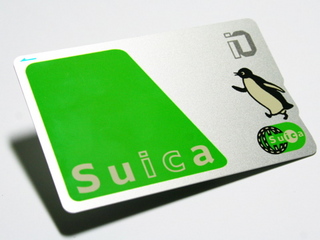
JR East's Suica card

In fact, first of all, there are several smart cards from different railway companies in Japan. Each of main privatised regional railway companies has one: the most common in Tokyo are the Suica card operated by JR Higashi (East Japan Railways) and the Pasmo card issued by a collection of smaller private railway companies as well as the TOEI subway, bus and Tokyo Metro systems. JR NIshi (JR West) and JR Toukai (JR Central) also have their own cards, ICOCA and TOICA respectively. They are all now pretty much interchangeable and Suica, which is the oldest system in operation since 2001, in particular can now be used for other kinds of payments in station shops and the ubiquitous Lawson chain of konbini (convenience stores) elsewhere in the city. It also now has a keitai denwa (mobile phone) enabled version in which the card is virtually present as a piece of phone software.

Great! It’s convenient, costs no more than buying tickets separately and if you forgot to bring any cash for your morning paper, you can use Suica for that too.

So, just like London’s Oyster card then?

Well, no.

TfL's Oyster card
TfL's Oyster card

The Oyster card, issued by Transport for London, looks pretty much the same and operates along similar technological lines, but because it also requires the user to register using a verifiable name, address and telephone number, with which the card is then associated, it is effectively also a tracking system, which is gradually producing an enormous database of movement surveillance. And of course this has not gone unnoticed to the UK’s police and security services who have reserved the right to mine this database for reasons of ‘national security’ and detection of crime. If you lose your card or have it stolen, then not only do you lose your £3 deposit, you’d better tell the authorities too or you might end up having some criminal activity associated with your name on the database.

Suica cards, on the other hand, can be bought from any ticket machine, require no deposit and no registration, and it doesn’t matter if you lose them, or leave the country, even for several years.

Tokyo and London’s transport systems have both experienced terrorist attacks so there’s no particular reason why Japan’s authorities shouldn’t have demanded a similar database (if you accept the UK’s reasoning). Tokyo also has a far more extensive, complex and multiply-owned transport infrastructure. Surely this must inevitably lead to an insecure and out-of-control system where disaster is inevitable.

So in which of the two cities does the transport system work far more efficiently? And where is that you are actually less likely to be a victim of crime, and feel safer?

I’ll give you a clue – it isn’t London.

Community Safety in Shinjuku

As well as trying to interview officials at national and city level here, I am also looking at a few different areas of the city, including Shinjuku, where I have done some work before. Shinjuku is a central ward of Tokyo that includes the Tokyo Metropolitan Government (TMG) buildings, part of a growing high-rise district, possibly the busiest railway station in the world, one of the most extensive entertainment districts in the city (not just Kabukicho, the conventional ‘red light’ district, but also a lot of gay clubs and bars), and substantial Korean and Chinese communities.

We had an interesting interview this week with the two officials seconded from the Metropolitan Police Department (keishicho), to run the efforts in Shinjuku (as usual there is a lot more than I can summarise here). We met in the Emergency Control Room, a cramped space full of monitors old and new, walkie-talkies and lots and lots of yellow telephones. We had a brief chat about emergency planning, but as we there to talk security and surveillance, we moved on.

Anzen anshin (or bohan) machizukuri (community safety (or security) development) in Tokyo derives from a TMG ordinance (jourei) of 2003 which encourages all ku (city wards) to implement it. The main reason was that recorded crimes had reached a record high in the city in 2002 (I’ll consider crime figures in Japan and their reliability in another post). There were a patchwork of existing community safety organisations but these appear to have been separate from the chounaikai (local community associations). What the 2003 ordinance did was to make community safety the responsibility of the chounaikai with co-ordination, information and encouragement from the ku administration.

The Shinjuku authorities are very keen on this, much more so than some others, for example, Arakawa-ku where we are living and which I am also examining, which tends to rely on much more conventional policing. This may be a matter of money (Arakawa is nowhere near as wealthy as Shinjuku), but it may also be down to the attitudes of the public and local state officials. This kind of community safety work is time-intensive, and requires a substantial commitment in order to carry out things like citizen patrols (which seem to be one of the core elements).

We also talked about CCTV, which Tokyo started to implement in 2003 as well for the same ostensible reasons. Of course Kabukicho is one of the city-centre pilot areas (along with Ikebukuro, Shibuya, Ropongi and the later addition of Ueno), with over 50 cameras operated by the city police. Given their position it is hardly surprising that they had little time for talk of a ‘surveillance society’ (or indeed even the idea of ‘surveillance’ – the word kanshi provokes quite a strong reaction here – no, no – they are definitely not doing surveillance). They also talked about the co-ordination of shoutenkai (shopkeepers’ association) CCTV systems. It seems that despite their large numbers, these systems are generally not monitored, i.e. there is not control room and no-one is watching. The officials were also certain that the shoutenkai operators themselves were not even allowed to view footage without permission from local police. This is something I will have to investigate more as I have read in the past of shoutenkai representatives claiming the opposite – that they had to give permission for the police to view footage. It seems that both shoutenkai and chounaikai are being encouraged to install CCTV systems, and there are grant systems in place – basically one third comes from the city, one third from the ku, and one third has to be found by the organisation itself from its members.

This means that coverage is very uneven and tends to be restricted to wealthy and / or particularly committed –kai. Shinjuku has many, many shoutenkai systems. Nippori, in Arakawa, in contrast has three cameras – not three systems, but three cameras…

(Thank-you very much to Mr Takahashi and Mr Yabe for their time and patience with my questions).

Tokyo Elections and Urban Development

Pretty much as predicted, the LDP lost badly in the Assembly elections for Tokyo. They ended up with only 38 seats to the Democratic Party of Japan’s (DPJ) 54. The LDP will continue to be part of the largest bloc in the Assembly thanks to the 22 seats held by the Komeito, the party of the Soka Gakkai, a lay organisation of the large Nichiren Shoshu evangelical Buddhist sect. The Komeito have almost single-handedly kept the LDP in power in Japan for years now, and seem to have no point to their existence at all, apart from ensuring that laws on religious organisations are kept as light as possible. Nevertheless, even as a bloc, the LDP / Komeito no longer have a majority in the 127-seat Assembly.

Under pressure, unpopular LDP Prime Minister, Aso Taro, has now called elections to the national Diet for August 30th. Normally one would expect a wipe-out of the LDP, but that’s not how Japanese politics works. With very strong rural and regional support, the LDP will most likely win again, but a different faction will get their man (and it will most probably be a man) into the PM’s office. There has been a non-LDP government before, but it happens so infrequently as to be almost unheard of…

Whilst Aso is unpopular and LDP’s response to the recession has been both predictably unimaginative and unsustainable (in short, “more concrete!”), this wasn’t just about national issues, despite what LDP spokespeople in Tokyo would have us believe. There are some serious economic and urban development issues in Tokyo. More people seem to have lost patience with long-standing Governor Ishihara, who is backed by the LDP on the whole, and in particular the almost collapse of Ishihara’s subsidies for Tokyo banks affected by the global collapse of financial services, and the latest mega-scheme to free up land for private sector redevelopment, the proposed move of the famous Tsukiji fishmarket from its convenient and historic location at the edge of fashionable and expensive Ginza to some remote toxic waste dump in the middle of nowhere. 20 years ago, even 5 years ago, such ridiculous schemes to aid private capital were routinely forced through, but in the current climate, this may not be possible. Finally, like Rio de Janeiro, where I was earlier in the year, Tokyo is candidate city for the 2016 Olympics with all the financial (and social and security) implications that bidding for and hosting such a mega-event implies, and people are starting to wonder whether the city can afford it.

Still, the relentless march of redevelopment continues elsewhere: the old Koma Theatre in Kabukicho, which I predicted would be targeted by developers as soon as they started trying to secure the area with CCTV cameras and intensified policing a few years back, is now almost demolished (pictures soon)… apparently Shinjuku’s red light district is now officially safe for more mainstream and less obviously dirty forms on capitalism.

Tokyo Elections

Tokyo goes to the polls today. I have to say that there doesn’t seem to be much excitement, although it is widely expected that the almost permanently-in-power Liberal Democratic Party (who, as is the way of these things, are neither particularly liberal nor overly democratic!) will be given a severe kicking by the electorate. This may even cause the Prime Minister, Aso Taro, to step down. Aso is perhaps the most unpopular leader in the democratic world, with personal approval ratings that threaten to drop into single figures. He makes Gordon Brown looks charismatic, and has been best known overseas (although not so much within Japan) for making silly, often verging on the racist, remarks.

However, while these elections may be nationally very significant, they will have no bearing on the real power in Tokyo itself, Governor Ishihara Shintaro, an independent populist. He’s tough on crime, tough on the supposed causes of crime (foreigners, of course) (who has also pushed CCTV quite hard) and seems to have been Governor forever. The main reason he got elected originally was connected to the fact that he had a more famous brother, Yujiro, who was a very well-known film star, but it’s Shintaro who’s been the leading man for over a decade.