Poll claims 96% of US citizens support video surveillance

A Harris online poll of 2416 adult US citizens, conducted between May 28th and June 1st, 2009, has found a 96% rate of support for federal government video surveillance in ‘specific public places’, according to Reuters.

Further statistics from the survey include an 80% rate of support for ‘any available measures’ to protect citizens in a terrorist attack, and 54% supporting the US of federal stimulus funding for video surveillance. As the press release notes, public support appears to be totally detached from the evidence we have about the limited effectiveness of video surveillance – something is (quite literally) being seen to be done, and this is what appears to matter. Video surveillance is culturally engrained, even expected, as a result of two decades of movies and TV shows which use surveillance as a  theme (from programs like Cops to ‘realityTV’). So in many ways such a result is not altogether surprising.

The poll appears to have been commissioned as part of a PR campaign by an advanced ‘intelligent video surveillance’ company, which has a clearly stated commercial interest, which makes one wonder exactly how the questions were phrased, and how they were asked. The word ‘terrorism’ is mentioned a lot, and I expect there would be a great deal of difference in responses to a similar question that did not mention terrorism (or indeed did not mention the supposed purpose at all), and indeed a survey of people who had read a summary of available research on CCTV would probably once again, result in a different percentage (as economic experiments with ‘willingness to pay’ methods of valuing policy decisions have shown, informed participants make different judgements). I will try to get hold of the raw figures to take a deeper look…

US border surveillance pours billions into Boeing… and still doesn’t work

Federal Computer Week reports that the Secure Border Initiative (SBI) designed to provide secure and highly surveilled border systems between the USA and Mexico, is in trouble again. There have been major technological failures, cost overruns, and more with the result that the system is way behind schedule. Half the reason seems to be a political economic one. In many ways this system is a giant pork barrel for the Boeing Corporation, which has been sucking up US state subsidies for years and is taking literally billions of US dollars for this project and in unrelated federal recession subsidies. No-one seems to have really checked whether Boeing could really do the job, and like so many large state security and surveillance projects, and most things that have been tried on the Mexico border, it just doesn’t really work.

The article reports the new Director of the SBI, Mark Borkowski as admitting that “the program was first conceived as a quick implementation of existing off-the-shelf technologies […] In retrospect, it would have functioned better if a customized technology solution was developed to meet the requirements […] Some of the things we put into place, in hindsight, were not effective […] What we bet on, which was probably not a good bet, was that this was like buying a new printer for your computer. …We started the wrong way, in my opinion.”

The cost breakdown for the Department of Homeland Security is reported by FCW as:

$1.1Bn to Boeing ($620M  for SBInet technology and $440M for border-vehicle barriers and fencing).

$2.4Bn on construction of fencing and vehicle barriers along the southwestern border

$6.5 Bn longer-term to maintain, monitor and repair the fences and structures.

Of course the ridiculous costs are bad enough, but the wider issues here are with the obsession with controlling migration in an economic climate in which the North America Free Trade Agreement (NAFTA) has progressively stripped Mexico of any economic autonomy and made its (and by extension the whole of Central America’s) working class a reserve of cheap labour for US corporations and its relatively increasingly wealthy, a market for US consumer goods. It’s not surprising that the Mexicans regard it as more than a little unfair that they have been forced into a subservient position, yet are not welcome to come into the USA, and are subject to such harsh security and surveillance to prevent them from doing so. Added to this, as the Mexican President made clear last year, relaxed US laws on gun ownership have resulted in a massively increased flow of weapons into Mexico from the USA, which has exacerbated gang conflicts which thrive in the atmosphere of inequality and exploitation. And of course, the violence just adds to the reasons why people want to leave and find opportunities in the richer, safer USA…

In many ways, what richer nations are doing is not only prioritising their own security, but also simultaneously exporting their insecurity.

Moon protest highlights wider border surveillance issues

The mass mooning of the US balloon camera owned by Sierra Nevada Corporation went ahead, but the irony was that the system had already been disabled by the weather. Apparently a large thunderstorm cause a gash in the fabric of the balloon last week which, if nothing else, should prove rather more effective than the protest in making sure that the US government does not invest in it.

However the wider issue of the US surveillance of the border with Canada remains (not mention that of the Mexican border, already a major concern) and whilst this particular technology and the appropriately ridiculous protest, has attracted most attention in the media, let’s not forget that camera towers have been erected and the USA is flying UAVs along the border. Surely President Obama should realise that the paranoid policies of his predecessor do nothing apart from damage relationships (and trade) with a close neighbour?

Meanwhile, back in the USA…

Just when you though the USA might not be going down the same kind of vehicle tracking route that the UK, Japan and Brazil are following, former Congressman, longtime privacy advocate and erstwhile scourge of ECHELON, Bob Barr, reports in his Atlanta Journal and Constitution blog, that increasing numbers of jurisdications in the States are indeed investing in license plate reading systems. California seems to be leading the way, but there’s plenty of others states following, and no doubt this will be another way of wasting (sorry, investing) Obama’s massive recession-busting boost for security…

India invests in surveillance drones

According to The Times of India, the Indian military is investing massively in boom military industry of the moment – Unmanned Aerial Vehicles (UAVs or drones).

An IAL Heron TP UAV in flight

The initial order is apparently for coastal protection and involves the purchase of Heron UAVs from Israel Aerospace Industries, a specialist in such technologies which produces everything from large payload drones to tiny micro-UAVs like the Mosquito, which can be launched by hand and is designed for “providing real-time imagery data in restricted urban areas.” The Indian Defence Research and Development Organisation (DRDO) and Aeronautical Development Establishment (ADE) have also been developing their own drones in conjunction with IAI, the latest being the Rustom MALE.

A Predator UAV equiped with Hellfire missile (USAF)

Herons are supposedly unarmed but armed versions were used in the 2006 invasion of Lebanon by Israeli armed forces. The ToI article also makes it clear that Indian forces will be buying more overtly aggressive drones such as the US Predator systems that have been used to such devastating effect against Al-Qaeda and the Taliban in the Pakistan-Afghanistan frontier regions. Far from easing up on the use of these remote-control killing machines, Obama’s administration has accelerated their use. They put fewer US troops in the firing line, and can attack remote areas, from where it is also very difficult to get an accurate independent view on their activities. However they are alleged to have been massively inaccurate, with the Pakistan government claiming that only 10 out of 60 missions between January 2006 and April 2009 had hit their targets, killing 14 Al-Qaeda leaders and 687 civilians, an appalling ratio.

With the advent of strategic bombing and then the ICBM, the Twentieth Century saw a massive increase of the role of remote surveillance in warfare, which was intimately linked to the growth in destructive power and the ability to not to understand the consequences in any direct or emotional way. Even with the tank and artillery ground warfare was not so remote, but now in the Twenty-first Century we are seeing surveillance-based, remote-control warfare becoming increasingly normalised. It is not surprising to see both hypocritical states like the USA and Israel intimately involved in the promotion of this form of conflict which looks cleaner and more ‘moral’ from the point of view of the user, but which in fact simply further isolates them from the consequences of their action. Real time surveillance turns everyday life in to a simulation, and drone-based warfare makes war into something like a game. And it’s a deadly and amoral game that increasing numbers of states, like India, are now playing.

Big Brother isn’t listening (at least in Maryland)…

Hot on the heals of my earlier post on the subject, I have just received the news that following the publication of the report in The Baltimore Sun, the Maryland Transit Authority have pulled the proposal to use audio surveillance on their buses.

However, an interesting thing to note in this supplementary report by transport correspondent, Michael Dresser, on the paper’s blog, is that the proposal apparently came about because CCTV cameras these days come with sound-recording built in, and that other transit authorities in Cleveland, Denver and Chicago use it. The MTA administrator responsible for seeking the legal opinion on audio surveillance is quoted as saying “It’s something that’s becoming the standard of the industry.”

So, if I am reading this right here, important policy decisions that have major implications for privacy are being treated simply as technical issues because the technologies that are being purchased have the capabilities. It’s only in this case because the MTA sought a legal opinion that we know at all, let alone that anyone objected. So how many other transit, police or urban authorities or commercial venues in how many places are now regularly using the audio capabilities of cameras without ever having considered that this might be a problem? And what other built-in technical capabilities will simply be used in future simply because they are available? What about the Terahertz Wave scanning that I covered earlier on?

US court rules GPS tracking is the same as the naked eye

CNET’s ‘Technically Incorrect’ blog leads me to a rather disturbing story in the Chicago Tribune last week about a ruling from a court in Wisconsin, USA. The judges in the appeal court decided that police use of covert GPS tracking devices is equivalent to the naked eye and therefore is not covered by US constitutional prohibitions (in the 4th amendment) on search and seizure. Whilst the local representative claimed that “GPS tracking is an effective means of protecting public safety”, ACLU argued that in fact this is an unwarranted extension of surveillance powers: “the idea that you can go and attach anything you want to somebody else’s property without any court supervision, that’s wrong.”

Now the case itself involved a man suspected of stalking, itself a form of surveillance and not something anyone would want to encourage or defend, however, once again, ends do not justify the means, particularly when the implications of the use of such means are so profound. The ruling illustrates the widespread inability of judges (and lawmakers more broadly) to deal effectively the way in which new technologies change the game or perhaps the inability of constitutional protections to protect effectively in an age of vastly improved technologies of visibility.

In fact the judges in this case themselves expressed some disquiet about their ruling. I can sympathise with them – it is far from obvious how to interpret new surveillance technologies with the constition and laws available. One would think, after the wiretapping cases of the 60s and 70s in the USA, that this lesson might have been learned, but it seems courts will continue to take terms like ‘inside’ and ‘outside’ literally – as perhaps they must. But surely if a device is attached to the ‘outside’ of a car or a house, or indeed is not attached at all and is remote, it does not automatically follow that the information that the device collects is not intimate and personal, and indeed not the same as what could only have been obtained in previous decades by direct human intrusion? For example, a device that can effectively ‘see through walls’ is not the same as the naked eye – it is the equivalent of a police officer being inside the house.  Whether this applies to a GPS tracker on a car (whether it is really any more or less than an officer sitting outside the house, or following the vehicle) is a moot point – there will be more and more of these cases, as police test the technological limits of the law, and it seems that most countries, not just the USA, still lack the professional (as opposed to the academic) legal thinking to deal with them.

SIVAM and Brazilian extremist nationalism

A Brazilian nationalist street stall in Rio

Whilst finishing up my work in Rio de Janeiro yesterday, I came across this interesting bunch of people, mv-brasil, who appear to be a Brazilian nationalist movement, with much in common with organisations like the British National Party or the various right-wing groups in the USA. Their website contains the usual odd mixture of anti-globalisation, evangelical Christian (they campaign against Halloween) and anti-United Nations / New World Order stuff with the added anti-Americanism. There of course is the usual rather uncomfortable fact of the ‘Brazilian Christian’ nationalist being a representative of a colonial power that invaded the country and took it from the indigenous people, but they roll over this one with some nods to Indian rights when it suits their cause, most notably when it comes to the Amazon.

A t-shirt with anti-internationalisation and privatisation of the Amazon slogan

One of the T-shirts for sale makes reference to this, being against ‘internationalisation and privatisation’ of the Amazon by the USA. It is a conspiracy theory I’ve come across before when I was doing some research on the SIVAM program – which provides some actual evidence for contentions that there is a secret American program to control the rainforest. I had someone tell me here in complete good faith that it was a ‘fact’ that several Amazonian tribes already thought that they were part of the USA and flew the US flag! This is combined with the fact the UN and international environmental organisations are very concerned about the destruction of the rainforest and the perceived lack of effort by successive Brazilian administrations to stop it. Put all this together and you have the ingredients for nationalist paranoia.

sivam_logoSo what is SIVAM? And why would I be interested in it anyway? The reason is that SIVAM is a surveillance system. Announced at the Earth Summit in 1992, and finally completed in 2002 and fully operationial from 2004, the Sistema de Vigilância da Amazônia (SIVAM) is a multipurpose, multi-agency network of satellite, aerial and ground surveillance and response that aims to monitor the illegal traffic of drugs and forest animals and plants, control national borders and those of indigenous peoples’ lands, and prevent the further destruction of protected areas of forest. A good technical account in English can be found in Aviation Today from 2002, and there is an interesting article on its construction here.

Donald Rumsefld visits the SIVAM control centre, 23 March 2005 (Wikimeda Commons)

The problem is that, although an initiative of various Brazilian government agencies including the environment and Indian affairs ministries, the federal police and the army, SIVAM is supported and funded by the USA – most of the initial $1.39Bn US cost came through a grant from the U.S. Export-Import Bank, and the consortium that supplies the equipment includes giant US military supplier, Raytheon – amongst many others from Brazil to Sweden. The visit of former President George W. Bush’s right-hand man and then Secretary of State for Defense, Donald Rumsfeld, to the SIVAM control centre in 2005, was widely reported in Bazil. It was of course interpreted by many as further evidence of Brazil’s ceding of control of the Amazon to the USA, or even presaging a US invasion of the Amazon, as Senator Norm Coleman discovered on a fact-finding mission later that year.

Latin American countries have every right to be suspicious of US motives: the Monroe Doctrine; George Kennan’s Cold War ‘grand area’ vision; the support for dictators like Augosto Pinochet; the invasions of Panama and Grenada; Plan Columbia and the widespread use of military ‘advisors’… the list goes on. And it is certainly the case that US strategic surveillance plans for ‘Full Spectrum Dominance’ and the like, have have long included ‘leveraging’ any system in which they are involved from the International Space Station to things like SIVAM. So of course they will have a strategic interest, and no doubt SIVAM data will find its way to US military C4ISR centres, but this does not amount to a plan to invade Brazil or take control of the Amazon.

US borders with Canada strengthened

There has been a lot of interest in the US border with Mexico in recent years, and rightly so. However, what not so many people have noticed is that the closing of the closing of the USA is taking place along the world’s largest land border between two countries, the border between the USA and Canada.

Unmanned Aerial Vehicles (UAVs) already patrol the airspace (and at a low enough level that private flights have had to be restricted, thereby doing two security jobs with one technology). However, the most recent announcement concerned the installation of video surveillance towers to monitor waterways. This is all on the basis of very little information about whether this is either cost-effective or necessary; according to the AP article, the Border Patrol themselves admit this: “What we don’t know is how often that vulnerability is exploited […] if, in fact, there’s a lot more going on than we thought, then this technology will help us identify it and it will help us respond and apprehend those people in ways that we haven’t before.” So essentially, this is surveillance to see whether surveillance is necessary – it seems we are now in a surveillance double-bind, so you no longer need a strong reason to install cameras; they are their own justification and may be justified in retrospect whatever does or does not happen. If nothing is seen, they will be said to be a deterrent, if something is detected then they will be proclaimed as showing the need for surveillance!

The technology employed against those tricky Canucks will be provided by the same supplier, Boeing, that has been so criticised for its failures on the Mexican border (and there have been plenty of failures down there). It seems that even when it comes to the trump card of security, which normally wins hands-down, the congressional pork-barrel remains the joker in the pack. Now, the Canadians and local firms along the US border have already been complaining about the post-9/11 restrictions that have begun to stifle cross-border trade on which many of those communities depend. In a recession, such considerations might be thought to count for something, but it seems that the mighty Boeing’s profits matter more…

US plans surveillance drone airship

I am sure there will be arguments about the violation of airspace, which will not be trivial as the ongoing diplomatic and increasingly military row over US surveillance vessels off China is showing…

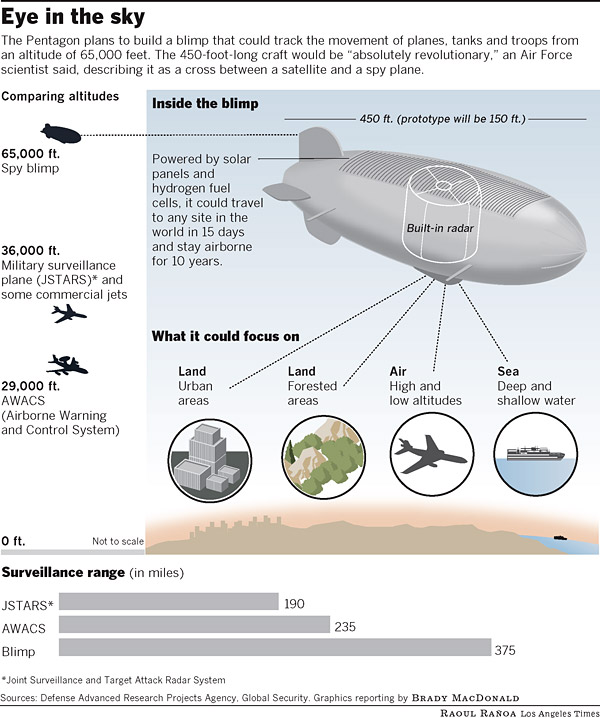
Unmanned aerial vehicles (UAVs) are one of the fastest-developing areas of surveillance technology. A new plan revealed by the US Department of Defense combines old and new tech with a plan, first revealed by the Los Angeles Times, for an pilotless surveillance airship called ISIS (Integrated Sensor Is the Structure) that will fly right at 65,000 feet (about 20km) high, right at the edge of ‘airspace’. The point of the airship is to provide the kind of constant watch that a geostationary satellite provides, but at a much lower level so that for more detailed pictures of the precise movements of vehicles, objects and people could be observed.

airship

Well, as usual, the reports only seem to to be concerned about how great this would be for US military tactics, and are not interested in the law, politics and ethics of such devices. For example, I am sure there will be arguments about the violation of airspace, which will not be trivial as the ongoing diplomatic and increasingly military row over US surveillance vessels off China is showing. And of course there are issues around the violation of human rights by such intrusive technology: international violations are very hard to deal with, however. And this will only be the beginning. The new Obama administration has promised more investment in intelligence and surveillance and less in warfighting. That sounds good in some ways, but of course just poses new problems and new issues for those of us concerned with ongoing US attempts to cover the whole world with surveillance for the benefit of its strategic aims.