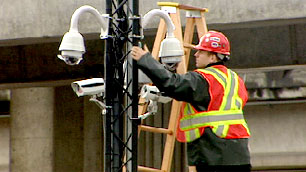
Vancouver Olympic surveillance legacies

A city worker installs video surveillance cameras outside GM Place in downtown Vancouver. (CBC)

As the CCTV cameras are going up, Vancouverites are starting to become more concerned now about what the legacy of increased security and surveillance will be after the Olympics. Although the initial promises were that the cameras would be taken down afterwards, with the money that has been put into building a swish new control room, it seems unlikely that the authorities will want to ‘waste’ this investment. As we warned in our Vancouver Statement in November, it seems as if the Games have become a globe-trotting Trojan horse for the video surveillance industry.

Surveillance Image of the Week No.4: Being Invisible

David Lyon sent me a reference to this wonderful Dutch artist, Desiree Palmen, who makes painstakingly painted or modelled invisibility disguises to comment on the ubiquity of video surveillance. They are somehow more beautiful for their hand-crafted (as opposed to high-tech) nature. For the picture below, her technique was to take a photograph of the interior and then paint it onto a canvass designed to be worn by the subject, who was then photographed again wearing the painted canvass in place.

Canadians should be concerned about camera surveillance

A new report by the Surveillance Camera Awareness Network (SCAN) at Queen’s University shows that Canadians believe surveillance cameras promote safety, but their perceptions don’t match the actual evidence. The first of its kind in Canada, A Report on Camera Surveillance in Canada will be used as background to help structure new federal surveillance legislation.

“There is little or no evidence that surveillance deters crime,” says David Lyon, coordinator of the report and director of the school’s new Surveillance Studies Centre. “Media such as TV police shows and crime stoppers promote the perception that cameras are more important than they really are.”

The report looks at the rapid growth of surveillance in Canadian society based on studies about:

  • The lack of Canadian legislation addressing public camera surveillance
  • Camera surveillance as big business
  • An exploration of camera operators
  • Research on public opinions about camera surveillance
  • Camera surveillance as one of the legacies of hosting the Olympic Games
  • Camera surveillance in Ottawa taxicabs
  • Camera surveillance in shopping malls

“The public should be concerned,” adds Professor Lyon. “Surveillance technology is constantly changing. Closed-circuit television does not accurately describe it anymore; now surveillance footage is increasingly digitized and free to flow online. What stops are in place to prevent it from falling into the wrong hands? We need to question the social ethics of surveillance footage as well as establish legal limits on how the footage can be used.”

(The Surveillance Camera Awareness Network at the Queen’s Surveillance Centre completed the report with funding from the Office of the Privacy Commissioner and the Social Sciences and Humanities Research Council of Canada. The report is the topic of a surveillance workshop on January 15 and 16, 2010 at Queen’s University).

Press Release from Queen’s University.

Contact: Jeff Drake
jeff.drake@queensu.ca
613-533-2877
Queen’s University

Moscow cops watch pre-recorded video footage

The police in the Russian capital have admitted that their police officers in several districts were watching pre-recorded video footage in place of live streaming surveillance pictures for an undetermined proportion of the five months from May to September last year, according to RT. It seems that the private company subcontracted to maintain the system, StroyMontageService, was defrauding the police of the equivalent of over a million dollars by recycling footage and not actually servicing the city’s video surveillance system.

Several questions are raised immediately here. Firstly, how closely were police actually watching if they didn’t even notice that they were watching recorded footage (surely the time-codes would have been wrong?); secondly, if the codes had been changed, how would there have been any way of them knowing, unless and until a major live situation was quite clearly not visible? Thirdly, how frequent is this kind of either deliberate fraud by subcontractor elsewhere, and indeed how common are simple errors that might lead to the same outcome? And finally, did this lack of live video feed make any difference to Moscow’s crime rate or clear-up rate. If they took five months to notice, it does rather suggest that video surveillance plays little role in either…

UK government to make CCTV useful?

That’s the way The Register puts it anyway… and there is more than a grain of truth in this. After 20 years of open-street video surveillance in Britain, it is not a safer place and the cameras are not event helping to solve that many crimes, let alone preventing them (which, let us not forget) was what was promised back at the beginning. The government in the UK is now (finally) becoming concerned about this and is apparently going to appoint a CCTV Commissioner or something similar and try to rationalise the crazy landscape of video surveillance in Britain.

However, the key lesson from the fact that video surveillance doesn’t really work should surely be that they might want to start reducing the numbers of cameras and putting the investment into something else. This isn’t going to happen. Instead, the UK government is still promoting video surveillance around the world and more and more places in every country seem to think that they should install CCTV because it ‘works in Britain.’ I even saw one story the other day saying that there had been no formal studies of the effectiveness of CCTV, which of course is simply not true – there have and they generally show little effect on crime, but the conclusion of this article was that in the absence of evidence, cameras were a sensible precaution.

How does that logic work? Since when did effective public policy on crime consist of throwing money at shiny toys? I think it was Harold Macmillan who said that when we need to be seen to be doing something, form a committee. In a high-tech age, people aren’t bought off by committees any more, but shiny gadgets will do it. And if the shine wears off, if the ordinary dull old cameras now don’t work, then there will be even shinier and newer mobile cameras, flying cameras, and probably cameras with frickin’ laser beams… Public policy on crime seems to be stuck on a technological treadmill. It’s time to step off.

Watching Them Watching You

The city government of Rio de Janeiro has voted 46 to 3 in favour of installing video surveillance cameras inside all new police vehicles, and overridden the veto of the Governor, Sergio Cabral.

Cabral, who is otherwise all in favour of video surveillance, did everything he could to stop this law, but in vain. The reason that the pro-police governor is so against this particular law and order measure is that the cameras are supposed to be installed not simply to ‘protect’ police officers but also to prevent abuse of power, corrupt practice and police violence against suspects. This is a huge issue in Rio (and Brazil more generally), and we saw a good example of this recently with the inhumane actions by officers after the fatal assault on Evandro, the founder of Afro-Reggae.

However, I do wonder how officers will take this development, how the cameras will be used in practice, and how many of them will conveniently experience technical failures at important moments…

(Thanks to Paola Barreto Leblanc for the heads up)

Manu Luksch

I am hosting the London-based Austrian new media artist and film director, Manu Luksch, here at Queen’s for a couple of days. On Tuesday 1st December, she is giving a presentation on her work on censorship in Iran and then in the evening, she is introducing and discussing her film, Faceless, a movie composed entirely of ‘found’ video surveillance footage (see the poster, below). You can find out more about her work on her website. She’ll be going on from here to Montreal…

Bizarre happenings in Rio de Janeiro

My collaborator, Paola Barreto Leblanc writes to me “Something really bizarre happened this week. In a public street in Rio’s center CCTVs from some buildings and a Bank – private circuits – caught a criminal action led by police officers [Policia Militar – PM, or Military Police, in fact]. Instead of helping a victim of an attack they rob the robbers!” The news story is available on youtube:

The thing that adds an extra layer of particularly bleak humour to this nasty event is that the name of the PM officer involved is capitão Bizarro (Captain Bizarre)… however, the really sad fact about the whole incident is that the victim was prominent social justice activist and founder of the internationally-renowned favela music group AfroReggae, Evandro João da Silva. He did a lot more good for the city and for the improvement of the lives of the urban poor than any gang-members or police officers ever did and he will be sorely missed. The PM chief, Mário Sérgio Duarte, who we interviewed back in April, is once again in the papers and on TV, apologizing. I noted at the time that Colonel Duarte seemed ‘profoundly indifferent’ to CCTV – I wonder if he will change his mind now and in what direction…

As Paola also writes to me, the nexus of CCTV in Rio is an intensely confusing one, mixing drug-gangs, corrupt police, the media, who like anywhere else seem to be living off the images from CCTV cameras without much in the way of respect for the victims. We are now starting to work together on a paper on these developments.

Would Canadians be “safer with a camera on every corner”?

I haven’t got very involved with Canadian debates on surveillance yet (but don’t worry, I will!). However a comment piece in Thursday’s Globe and Mail, which demanded that Canadian cities install ubiquitous video surveillance, prompted me to pen an immediate letter, which was signed by both Professor David Lyon and myself. It was published today, slightly edited – the full version is below. (They also decided to edit out our respective titles, which makes me look senior to Professor Lyon. Oops.)

“Marcus Gee writes that “We’d be safer with a camera on every corner” (Comment, May 22nd, p.15). If only this were true. However it simply is not the case.

Mr Gee quotes the UK as an example of where video surveillance is effective, but this is not supported by the crime figures in the UK or by academic research. The most comprehensive evaluation of all studies done of the effects of CCTV on crime (by the Campbell Collaboration, 2009) concluded that it had little or not effect on the occurrence of violent crimes like the disgraceful murder of Christopher Skinner, which prompted Mr Gee to write. Even the limited British police assessment of CCTV conducted by the Association of Chief Police Officers (ACPO) in 2008, admitted this was the case.

It is easy to demand that ‘something must be done’ as a response to any particular incident of violent crime, and CCTV is the currently fashionable ‘something.’ But let us get beyond the superficial and look at the evidence. Then we could have a proper debate about CCTV.”

Lies, Damned Lies and CCTV Statistics…

Earlier today, I reported on reports that claimed that 96% of US citizens support video surveillance. Now, thanks to Vicki Contavespi, and the people at BRS Labs who commissioned the survey from Harris Interactive, I have the raw figures. And, unsurprisingly enough, whilst they aren’t ‘lies’, they don’t quite show what the headlines suggested – just as my headline, a quote often attributed of course to Disraeli, is also an overstatement of the case at hand. This is a very interesting survey. There were quite a few questions asked, and I don’t have time to go through all of them here now, but I will just deal with the question of ‘support’ for video surveillance and break it down just a little more.

First of all, the main questions on the acceptability of video surveillance (and other surveillance techniques) are couched in an particular way that is common in market research. The lead question is “How strongly do you agree or disagree with each of the following statements?” There is then a list of statements, which each have four options: strongly agree, somewhat agree, somewhat disagree, and strongly disagree. There is no ‘neutral / don’t care / no opinion’ option, which might have taken out many of those in the ‘somewhat’ categories on either side. The headline figures used then, of course, elide the ‘strongly’ and ‘somewhat’ figures.

For video surveillance, there are two main statements, firstly, “The federal government should be able to utilize video surveillance as long as my personal privacy is not invaded”, and secondly, “Local law enforcement should be able to use surveillance cameras to monitor public places.” The first question already contains a bias, in that is specifies a situation of no privacy invasion. This effectively nullifies the most common objection to video surveillance, and especially for those for whom the Federal Government is a intrinsically suspicious entity. The second, interestingly, doesn’t have this proviso, but then ‘local law enforcement’ isn’t ‘the Feds’ and generally does not attract the same antipathy. But the lack of a qualifying statement might provide a better clue to US public attitudes on video surveillance overall. For the first statement, the ‘headline’ figure of agreement is 82% and the second is 78%. However this disguises the fact that ‘strong agreement’ is much more limited, 36 and 35% respectively. And if you add up the ‘somewhat agree’ and ‘somehat disagree’ figures, you get 57% and 58%, which indicates to me that the majority of US people don’t have strong opinions for or against CCTV. See – statistics are all about what you are looking for in them!

What is even more interesting is that the question was then asked: “Which of the following aspects of video surveillance cameras, if any, concern you?” You would think that, given the headline and press release, that the survey showed no real concerns about CCTV. But that really isn’t the case at all. In fact, 88% of respondents said they were concerned by at least one of the listed aspects of video surveillance. Now remember, you’ve only got 18% or 22% who said that they disagreed with CCTV in terms of the question posed above, so this means that even most of the people who supported CCTV to whatever degree of strength, had concerns and most had more than one concern. This is quite striking. The main concerns were “not knowing what will be done with the information that is gathered ” (66%), “The fact that recorded footage can be used to mistakenly incriminate me” (61%), “Not knowing the background of whoever may be watching” (60%), “Not knowing how often and where I might be watched” (50%) and “The fact that photographs can be taken of me without permission” (48%). The only one on which there was significant difference between men and women seems (and I haven’t done any statistical analysis of the difference) to be over the concern about how often and where people might be watched, about which women were more likely to be concerned than men. In fact, in the whole survey, there appear to be no real overt differences in response based on gender.

So where, you might well be asking, does this 96% support figure come from? I searched through the tables some distance for the 96% figure before I found it. It certainly doesn’t refer to generalised support, but comes in response to the following question: “Which of the following areas, if any, do you think should be monitored by video surveillance in an effort to help protect U.S. citizens?” A-ha! So we have a question that implies the use of video surveillance somewhere, and that it will be used specifically to help protect US citizens (none of those foreigners!). The question is clearly pushing the respondents towards a positive answer. But here too things are not quite what the headlines claimed. Certainly, 96% of respondents said that video surveillance should be used in some areas. However, it is only in “Airports” (92%), “Public transportation” (85%) and “Seaports” (82%) that there is an overwhelming vote of confidence (though quite why seaports are considered to be less at risk or would benefit less from video surveillance than airports, I am not quite sure – the ghosts of 9/11 hover, I suppose).

“Public schools/Universities” barely scrape a majority (53%), and one wonders what the figures would be if they split universities and schools (and indeed different levels of school). “Playgrounds” only hit 39% – not so much of the common British ‘think of the kiddies’ paranoia here perhaps – “Businesses” – where of course surveillance is actually more likely to be found than anywhere else! – doesn’t manage a third (32%) and “Local neighborhoods”, which is the only unequivocal ‘public space’ category is only on 22%. Why not parks? Why not city centre streets? It is of course these places where the real controversy and the real fire and debate over CCTV lies. And the indications from this survey are that the more personal, the more intimate, the more there is a sense of ‘community’, the less likely US citizens are to accept video surveillance, even if it is couched in the overly positive way it is here.

And there is a question whose answers demonstrate further the complexity here. And, ironically, the percentage of respondents who replied to the question “Which of the following, if any, do you think are currently the biggest threats to your personal privacy?” with one of more concerns was – you guessed it – 96%! The major concerns were actually mostly from private or criminal surveillance: “identity theft” (74%), “Internet security threats” (70%) and “Unknown individuals who handle my personal information” (60%). Only 33% were concerned about federal or local government, but this isn’t surprising when this category is headed, as it is in the survey, “Big Brother”! Who is going to admit to being scared of ‘Big Brother’? And if you are going to give a silly popular stereotype as a potential answer, then the other categories should be similarly labelled… And why wasn’t this 96% the lead-in for the media?

As I said, there is a lot more in here too, and despite its flaws, this is an interesting survey which has much to it than meets the eye if you just read the media reports.