Watching Downtown Tokyo

So, I’m back in Tokyo until next April, revisiting the areas which I examined in 2005-6, where surveillance cameras have been installed by the Tokyo Metropolitan Police, and the wards where I did case-study research on community safety development in 2009 (see my posts in this blog from July to September 2009).

One initial impression is that the progress of video surveillance has not perhaps been as rapid as I would have thought, but it may be that this impression is mistaken. Certainly, the numbers of cameras deployed by the TMP have not increased rapidly. While I looked initially at Shinjuku’s Kabukicho district, where cameras were first introduced in 2002 and Shibuya and Ikebukuro (2004), they were also introduced in Ueno (2006) and Roppongi (2007). The numbers of cameras in these areas and the technologies in use have not changed greatly since their introduction: Kabukicho has 55; Shibuya, 20;  Ikebukuro, 49; Ueno, 12; and Roppongi, 44. The cameras are all in areas associated with the night economy – pink or ‘red line areas’, or what in the UK would be called ‘red light districts’ or places strongly associated with gang-related nightlife activities.

From then there was a gap and nothing happened until this year, when the TMP introduced a small number of cameras into an area they seem to have previously overlooked: the so-called ‘Kabukicho of the East’ – it’s even referred to in this way by tourist guides – Kinshicho in Sumida ward, still very much a rough, working class area. Kinshicho is apparently known for two things: gambling (on horse-racing – it’s not coincidentally the HQ of  the Japan Racing Association) and ‘gaijin bars’ (or hostess bars staffed by foreign hostesses). But, if one examines the crime maps produced by the TMP, Kinshicho is not a particularly high crime area especially compared to its western counterpart, Kabukicho, and there are other areas of dubious repute in Tokyo, so what’s behind this particular move at this time?

AJ201205130014M
CCTV cameras at the Tokyo Sky Tree Tower (Hirotaka Kawakami)

This is simply speculation on my part, and I will be talking to police and others about this in the next few months, but Sumida ward is gentrifying. In 2006, the massive new Olinas shopping complex was built in the Kinshicho area, and then in 2012, the Tokyo Sky Tree Tower, the new communications tower for Tokyo, complete with associated shopping and entertainment complex, landed in Oshiage, just to the north. Shitamachi (literally ‘low city’ – or downtown) areas have become fashionable now and not just among tourists. But this nostalgic search for an older, ‘authentic’ Tokyo, usually that of the post-WW2 period, is limited to safe images of craftsmen, small shops, stand-up bars, street food, hard-work and propriety. Frankly, Kinshicho seems to be seen as an embarrassing throwback to a shadow image of the ‘bad old days’ of the shitamachi of gangs, gambling and the sex trade, that the authorities at least do not want associated with the new and more pleasant presentation they are seeking to create.

But the TMP cameras are only a small part of the story of public space video surveillance in Tokyo, and if one sticks to the police numbers, one would get a very misleading impression. For example, the Sky Tree Tower has been the focus of a major introduction of video surveillance through the main mechanism for public space surveillance in Tokyo, the 2003 Anzen Anshin Machizukuri Jourei (Community Safety Ordinance). This empowers neighbourhood and shopkeepers’ associations to introduce camera systems with support from ward governments and the Tokyo Metropolitan Government. In Oshiage, a very large and locally controversial 77 camera-system was introduced from 2012, with most of the cameras (66) directly around the Sky Tree. Kinshicho also has its TMP cameras supplemented by an even larger number of non-TMP cameras – the Asahi article above claims 47 but it’s unclear whether that includes the TMP cameras or not.

The progress of community safety development is the main focus of my research here this time, so I’ll be visiting Oshiage and Kinshicho in the near future. And I’ll be writing much more about this method of crime control through development planning, as it will no doubt be a key feature of how preparations for the 2020 Olympics are made.

$100 to anyone who can find a ‘privacy-compliant camera’ in Canada

Actually, the headline (from the Toronto Metro free paper) is a little misleading as what my friend and colleague Andrew Clement is actually betting on here is that no-one can find a video surveillance system in Canada that is fully compliant with Canadian privacy law. Which of course may of may not be the same as ‘privacy’ in any other terms. But it’s an interesting challenge – that is largely to do with signage. Prof Clement and his team at the iSchool at UofT have been monitoring the way in which video surveillance systems in Canada are signed for quite some time. As their website, surveillancerights.ca (which is also where you can try to claim your $100…) says

“Signs should at a minimum clearly tell you:

  • who is operating the camera
  • who you can contact if you have questions
  • the purpose(s) of the surveillance”

The signs should also in themselves be clearly visible, not hidden away somewhere. There’s more detailed information about requirments here.

So, who’s going to take up this bet?

(Thanks to Matthias Vermeulen for the story and Aaron Martin for noticing the difference between privacy and privacy law.)

UK’s secret national flying camera strategy

If there was any doubt left, it seems the British government has finally given up all pretense of trying to balance civil liberties and security. A plan has been revealed by The Guardian newspaper for a national strategy for surveillance by Unmanned Aerial Vehicles (UAVs). And we are not just talking the micro-helicopter UAVs used by many UK police forces already, but 22m-long airships, the G22, which can stay airborne for many hours. The military drones will require special certification for civilian use.

And of course, these devices are supposed to be in place for the 2012 Olympics, but even in the documentation secured under the Freedom of Information Act (FoIA), it is made very clear that the drones will be used for a multiplicity of ‘routine’ operations, including from orders and fisheries activity to conventional policing and even “[detecting] theft from cash machines, preventing theft of tractors and monitoring antisocial driving… event security and covert urban surveillance” as well as all the kinds of activities that the already controversial Regulation of Investigatory Powers Act (RIPA) covers, including “fly-posting, fly-tipping, abandoned vehicles, abnormal loads, waste management”.

If this wasn’t bad enough, the whole thing has been developed in secret with the British governments favourite arms manufacturer, BAe Sytems, is projected to run as a public-private partnership due to the massive expense, and it has even been suggested that the surveillance data could be sold to private companies, according to The Guardian.

And the ‘selling’ of this to the public has already begun. Some suggestions of the use of high-flying drones had been made by Kent police, who had claimed it would be to “monitor shipping and detect immigrants crossing from France”. However, as The Guardian goes on to show this was a ruse which was part of long-term PR strategy to divert attention away from civil liberties issues. One 2007 document apparently states, “There is potential for these [maritime] uses to be projected as a ‘good news’ story to the public rather than more ‘big brother’.”

It’s really hard to say anything polite about these plans, the way they have been developed, and the complete lack of interest in or concern for the British public’s very real and growing fear of a surveillance state in the UK.

A footnote: almost as soon as this news was revealed, the British government raised the terrorist threat level to ‘severe’, without providing any indication that was any specific threat. Now, this may be entirely coincidental (and there are a couple of high-level meetings on Yemen and Afghanistan strategy in London next week), but if the threat level was much higher, the British public might suddenly be more amenable to the introduction of something to protect them from this ‘severe’ threat, like, say, flying drone cameras, don’t you think?

Community Safety in Suginami

Following our meeting with the Mayor the other day, we went back to Suginami-ku to talk to the community safety people, who are part of the Disaster Management section. Suginami is interesting because, as far back as 2004, it was the first Local Authority in Japan to introduce a special bohan kamera jourei (security camera ordinance) which is based in part at least on principles of data protection and privacy. And until neighbouring Setegaya-ku introduced their own ordinance last year, they were, so far as I know, the only such authority. The ordinance followed public consultation which showed that although people generally thought CCTV was effective (95%), a significant minority of 34% were concerned about privacy, and 72% thought that regulation was needed. These figures seem to be significantly more in favour of privacy and regulation of CCTV than the nationwide survey done by Hino Kimihiro, however he asked different questions leading to answers that are not directly comparable.

Suginami is one of the areas of Tokyo that has the other kind of CCTV system introduced by the Tokyo Metropolitan Police after 2002, help points where people press a button if they feel in danger and speak to someone from the police. The help points have both CCTV camera and an alarm / red flashing light if the caller says it is an emergency.

However the Suginami community safety officers said that these cameras have not proved very effective and in fact they cause a lot of problems, because children tend to press the button for fun, and run away – meaning that there are many false alarms.

Suginami has some of the same kind of array of ‘blue-light’ volunteer patrols as Arakawa-ku. In Suginami, there is a fleet of mini-patoka (mini patrol cars) and motorbikes, used by 15 retired police officers. These are mainly about visibility leading to deterrence and increased community confidence, as the volunteers ex-officers have no special powers nor do they carry side-arms or handcuffs or any other conventional ‘police’ equipment. Suginami does not have the small community safety stations like Arakawa-ku, although they do also have the same problem of local koban (police boxes) being closed. However where Suginami really stands out is in the sheer number of volunteers they have involved in their community patrols, organised through the local PTAs, shoutenkai (shopkeepers’ associations) and choukai (community associations). There are 140 groups with 9600 people actively involved in one way or another in community safety just in Suginami.

Suginami is a relatively wealthy ward and the kinds of problems that concern Arakawa (mainly minor street crime and snatch-thefts) are not such big issues here.  The main concern in this ward seems to be burglary and furikomi – the practice of gangsters and other criminals calling old people and pretending to be a relative or representative of a relative and persuading them to transfer money to a particular ATM (which you can do in Japan – it would be impossible in the UK). Furikomi is a very interesting phenomenon in that it seems to be a product of family, social and technological changes. Many older people who would have lived with family in traditional Japanese society are now living alone. They are lonely and miss the intimacy of family contact, so they tend to welcome unexpected calls from relatives who may now be living almost anywhere in Japan. These older people are also technologically literate and able to use mobile phones, ATMs and computers. The combination of this technological skill, dispersed families, and psychological vulnerability makes for a ripe target for fraudsters, and Suginami estimate that 40% of all crime in the ward is some form of furikomi.

In many ways, increasing concern for privacy is also a product of this change in lifestyles and family structure, as well as building techniques – western-style walls and better sound insulation mean that you can’t always know what is going on in the next room anymore, let alone in your neighbours’ apartments or houses. This also makes burglary rather easier, as once the thief has got past the initial walls or doors, no-one can hear or see very much. The intense and intimate ‘natural surveillance’ that used to characterise ordinary Japanese communities is disappearing. But the Suginami community safety officers see the possibility of revitalising such natural surveillance, and protecting privacy, without going down the route of impersonal, technologically-mediated surveillance. In many ways, this is quite heartening – if, of course, you are of a communitarian mindset. Such supportive, mutually monitored and very inward-looking communities can be stifling to those who do not fit and exclusionary to those from outside… and, not coincidentally, one of our last interviews was with a leading support group for foreign migrants in Japan, who have a very different perspective on all of these developments. That will be in my next post, which may not be until Saturday as we’re going off to Kansai for a couple of days…

(Thank-you to the Disaster Management section for their time and patience).

Is sousveillance the answer?

Marina Hyde in the Guardian last week wrote a very interesting piece on the ongoing fallout from the death of Ian Tomlinson at the G20 protests in London. She argued that the appearance of mobile telephone camera foogtage, which revealed more about the way the police treated the passerby, showed that this kind of inverse surveillance (or what Steve Mann calls ‘sousveillance’) was the way to fight the increase of surveillance in British society.

I’ve been suggesting this as one possible strategy for many years too, however what Hyde didn’t really deal with is the other side of the coin: the fact that the authotorities in Britain already know that this is a potential response and are trying to cut down on the use of photographic equipment in public places. Anti-terrorism laws already make it illegal to photograph members of the armed forces, and in the new Counter-Terrorism Act, there is a provision to allow the police to isue an order preventing photography in particular circumstances. Further, it is now regarded as suspicious by police to be seen taking an interest in surveillance cameras.

The bigger issue here is the fight for control of the means of visibility, and the legitimate production of images. The British state is slowly trying to restrict the definition of what is considered to be ‘normal’ behaviour with regards to video and photography. In the new normality, state video is for the public good, but video by the public is potential terrorism; police photographing demonstrators is important for public order, but demonstrators photographing police is gathering material potentially of use in the preparation of a terrorist act.

However, I am not 100% in favour of the proliferation of cameras, whoever is wielding them. I think it’s essential that we, at this moment in time, turn our cameras on an overintrusive and controlling state. However a society in which we all constantly film each other is not one in which I would feel comfortable living either. A mutual surveillance society in which cameras substitute for richer social interactions and social negotiation, is still a surveillance society and still a society of diminished privacy and dignity. I worry that sousveillance, rather than leading to a reduction in the intrusiveness of the state, will merely generate more cameras and more watchers, and merely help reinforce a new normality of being constantly observed and recorded.

Metropolitan Police Encouraging Stupidity and Suspicion

Rather than being a legitmate political response to an illiberal, repressive, undemocratic and unaccountable growth in surveillance, ‘interest’ in CCTV is now regarded as suspicious in itself…

Boing Boing has news of the latest London Metropolitan Police campaign which is supposedly encouraging people to report their suspicions on terrorist activity, but is in fact just another step on the illiberal, socially divisive and stupid road towards a McCarthyite Britain where British people are expected to spy on each other in the name of security.

Why not check your neighbours' waste bins?

Apart from encouraging people to rifle through their neighbours garbage, the most disturbing thing about this new campaign is the way in which it implies that any interest in CCTV cameras is a potentionally terrorist activity.

See that camera? No, you don't. It's not there.

From the late 1980s onwards, the British state in its usual bumbling, piecemeal and disorganised way, gradually created an increasingly comprehensive monitoring program of British city centres. There was never any strong evidence for the need for this technology, it was never approved by parliament, there was never a single CCTV Act that enabled it.

Now, just as it has become pretty clear that CCTV has very little effect on crime rates (its original justification, let us not forget), the state has started to close down criticism and even interest in or discussion of these surveillance measures. Effectively, we are being officially instructed to ignore the cameras and pretend we don’t see them. Rather than being a legitimate political response to an illiberal, repressive, undemocratic and unaccountable growth in surveillance, ‘interest’ in CCTV is now regarded as suspicious in itself.

At the same time, the British state is increasingly regulating the means of production of visual images by ordinary citizens. The state (and many private companies) can watch us while we have to pretend we don’ t notice, but for ordinary people to take picture or make video in public places, and in particular making images of state buildings or employees like the police (you know, the people who supposedly work for us), is being gradually and by stealth turned into a criminal act. In the past, I have been very careful not to shout about all acts of state surveillance being totalitarian (because very few of them actually are), but there is no other word for these trends. The police are attempting to make themselves the arbiters of how we see society and public places; they are telling us what can and cannot be legitimately the subject of interest and of visual representation.

They are also spending more time now ‘securing secturity’ – protecting the architecture of surveillance that has been built. You can see the private sector recognising this. At equipment fairs I have been to over the last few years, one of the big developments in camera technology has been methods of armouring and protecting the cameras themselves. There seems to be an effort, deliberate or unconscious, to forget the supposed original purpose of such surveillance in protecting us, and instead to concentrate on protecting the surveillance equipment.

This is particularly problematic for researchers like me. We’ll see what happens when I am back in London in May and June when I will be taking a lot of pictures of CCTV as part of my project, which is of course, ironically, sponsored by an official British state research council…

Chicago: the future of US CCTV?

…despite Britain’s reputation as a surveillance society… the USA is now eclipsing the UK. The post-9/11 surveillance surge has seen to that.

Back in the USA again. Chicago has been featuring a lot this week for its CCTV system. Newspapers generally offered glowing assessments of its capabilities based around homey anecdotes of pretty harmless incidents ‘solved’ by CCTV – in this case the stories, for example those in the Chicago Sun-Times and the New York Times, featured a theft from a Salvation Army kettle, which sounds like it is straight from a Mayoral press release. It is depressingly poor journalism and once again, all very reminiscent of the situation in the UK in the 1990s before academic and even government assessments dampened the enthusiasm for CCTV. There’s also a depressing naivety (and factual incorrectness) about the insistence from the authorities and from some ‘experts’ that these cameras have nothing to do with human rights like privacy as they are all in public spaces.

But there is one very important difference. Chicago, with massive investment from the Department for Homeland Security, has gone much further than most UK cities, not only in coverage but also in capabilities. First of all, Daley and police-chief Orozco have promised that “We’re going to grow the system until we eventually cover one end of the city to the other” in other words they do want, as the Chicago Sun-Times subheading claims, ” a camera on every street corner.”

The particular innovation that the city is pushing here is the linking up of the law-enforcement aspects with emergency services through something called Computer-Aided Dispatch (CAD). This is system that uses a live Geographic Information System to match camera location to reported incident location, so that when an incident is called in via 911, the nearest cameras can immediately turn to picture the scene. This is part of what Chicago calls ‘Operation Virtual Shield’, a fibre-optic cable system which links the cameras with other biological and chemical weapons-detection system in a “homeland security grid.’’

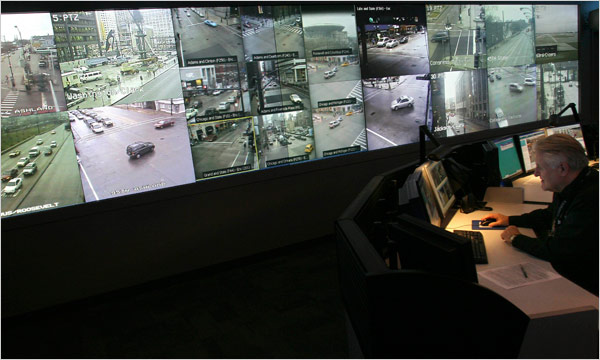
The Chicago control room (New York Times)

As part of the work we did for our latest book, Jon Coaffee Pete Rogers and I visited and analysed several different cities in the UK to assess their emergency-response and surveillance systems. While most had intentions to use the cameras for more active emergency-response purposes and particular local police were starting to try to install override systems for the multiple local camera systems that exist in the UK in the case of citywide emergencies (like a mass evacuation). And in particular, Manchester (whose high-tech control room looks like the Chicago one as seen in the NYT (picture above) and also often features in media PR for CCTV) has gone further down the Chicago route than most. But they still don’t come close. Britain’s systems are fragmented, ageing, generally not integrated with other functions and certainly don’t link to other kinds of sensors. Britain has introduced some stupid authoritarianism like the infamous ‘shouting cameras’ mostly as part of the Respect (sic) Zones initiative. But despite Britain’s reputation as a surveillance society I suspect that in terms of advanced integrated cameras systems, the USA is now eclipsing the UK. The post-9/11 surveillance surge has seen to that.

There’s two other points worth noting here. The first is that Chicago is bidding for the Olympics in 2016. I can almost hear multiple researchers in surveillance studies around the world, releasing a collective ‘of course!’. Mega-events like the Olympics, the World Cup – there will be a fantastic conference on this theme in November this year in Vancouver – or other non-sporting ones like world summits or the G-8 conference are often the trigger for the introduction of repressive measures and new surveillance systems. This was true in Japan (where state CCTV was first introduced because of the soccer World Cup in 2002), in South Africa (for various major world summits), and in Athens for the Olympics in 2004. Mayor Daley wants the city to be 100% free from the possibility of terrorist attack. Laving aside the actual impossibility of that desire, how far will he go to get there?

Well, the last Olympic venue, Beijing, might give some indication. For it is actually the plans in authoritarian, non-democratic China that seem most similar to what is going on in Chicago. Even the names have an eerie reminiscence: China’s Golden Shield, Chicago’s Virtual Shield. That is trivial, however the substance is not. The Chinese government, as Naomi Klein has written, is installing massive and comprehensive camera systems in every major city in China. It is also, of course, linking this system into its infamous Internet monitoring operation, with the ultimate aim of being able to track individuals in real and virtual space. Of course, the US, like most other nations is now trying to control Internet use too and the NSA already keeps massive data banks of communications traffic information as well as doing real-time monitoring as recent revelations have, once again, shown. But, it’s different in the USA isn’t it? The USA wouldn’t link up all these systems, would it? The Land of the Free? The home of democracy? I wouldn’t bet against it…

Gentrification and Control in the Old Centre of Sao Paulo

Yesterday, I met up with Brazilian surveillance researcher, Marta Kanashiro, and she showed me around the Luz area of the old centre of Sao Paulo, where she has been working. Luz was once a grand colonial district around the railway station designed by British architect, Charles Driver, in brick and iron, but it lost its importance in the mid-Twentieth Century as the station ceased to be the terminal for the coffee trade. The area acquired notoriety as home to a police headquarters where opponents of the dictatorship where tortured, and as a centre for prostitution, violence and drugs.

In more recent years there has been a real effort by the city authorities to reclaim the area which, despite being in many ways a laudable project, has been controversial both for its effects on the poor, and for its treatment of memory and the particular history of the place. On one side of Parque da Luz, the formal gardens in front of the station, is the Museum of Portuguese language, yet on other side of the station, all memory of the victims of police oppression and torture has been erased with the restoration of the police building.

In the park itself, the park authorities installed CCTV (the story of which can be read in Marta’s article in Surveillance & Society), but they haven’t tried to drive out the prostitutes, many of whom were still standing forlornly under the tall trees in the driving rain as we visited. However, according to Marta, they have tried to persuade the women to dress more respectably in keeping with the desired new image of the the neighbourhood! At one point the prostitute’s union was more involved in the management of the park, as were other community organisations, however the building in the centre of the park where these groups used to meet is now closed for refurbishment and it is unclear whether it will still be available in the same way afterwards. Another building in the corner of the part, next to the rather ramshackle security rooms, has already been restored, and where once the plans and documents about the park were on public display, now the place is prettier but empty.

The Luz regeneration has plenty in common with revanchist redevelopment in many other big cities around the world, and there are big questions about what happens to the already excluded population of the area as the regeneration spreads. There are two contrasting visions for the centre from two different but very similar-sounding organisations: Viva O Centro and Forum Centro Vivo. Both want regeneration – everyone does – but they have entirely different approaches to how it should be done. The former is an association of mainly businesses and police, similar to the Business Improvement Districts (BIDs) which are common in US and British city centres. It is behind a lot of the current redevelopment and has the ear of the city authorities. The latter is a group of academics and community activists who want a more democratic and participatory process, and who hold a lot of local events, cultural and political. They also accuse Viva O Centro of either actively or tacitly encouraging intimidation and violence (which has certainly taken place) against the poor population of the area. It is another reason why the attempt to erase of the memory of the brutality of the dictatorship is so important: it is a memory that needs to be constantly refreshed as the actions are echoed and repeated.

(A very big ‘thank-you’ to Marta Kanashiro for her time and patience! All mistakes in this account, as usual, are my own…)

Some things are just wrong

It is disturbing that… the default position for state officials seems to be that surveillance is a normal, even required part of everyday life.

Ok, there are some things about surveillance that are arguable, some things that are good, but some things are just wrong.

The Guardian today is reporting the story of Nick Gibson who is taking over the tenancy of a pub in Islington in north London. The police have insisted that he will not receive the licence he needs to run the pub unless he installs CCTV and is prepared to hand over footage to them whenever they want. Mr Gibson complained to his Member of Parliament, Emily Thornberry (not Thornhill as The Guardian claims), but she is apparently a spineless New Labour loyalist who has no time for niceties like civil liberties. She refused to represent him on the grounds that other local residents ‘want more CCTV’.

It is one thing to want to install CCTV if you run a business. Your customers can chose whether to patronise your establishment or not. It is however, entirely another matter to be quasi-legally blackmailed into installing it by police. There is no law that mandate the installation of surveillance cameras an in fact there is no statutory basis for CCTV at all in the UK – it is something that the Lords committee report on surveillance recommended as a matter of urgency. The police are simply abusing their right to impose licensing conditions to make local policy. The installation of CCTV is not a matter of ‘common-sense’, it is an ethical judgement, and police should not be be able to override the ethical judgement of individuals by edict in this way.

This is a very worrying case, because it shows that there is a kind of cozy ‘common-sense’ authoritarianism developing in the UK. It is disturbing that despite all the research, including that of the Home Office and the Association of Chief Police Officers, showing that CCTV has very limited utility, the default position for state officials seems to be that surveillance is a normal, even required part of everyday life.

Sao Paulo Metro Surveillance and Security

I spent some time on the Sao Paulo metro system yesterday so I tried to get some pictures of security and surveillance underground… Some things I would have loved to have got pictures of: the military policemen stalking a groups of favela kids through the crowds; the very tired and twitchy officer who looked to be absolutely itching for a fight, who got on the Metro after me; the perfect shot of two policemen standing under a camera. But I didn’t get those ones, so my words will have to do. The main reason is that I have a healthy instinct for self-preservation and taking pictures of men with guns – particularly when they are caressing the handgrip and trigger like it was an intimate part of their anatomy as the twitchy officer was – is a sure way to end up attracting unwelcome and possibly fatal attention. The officers in the stations did notice me taking pictures pretty quickly too – which perhaps suggests both the pervasiveness and the effectiveness of trained human surveillance. Anyway, I only have two shots, one of which was an experiment in a longer take, which didn’t quite come off so I might have to try this again…

I am sure I will have more to say today tomorrow on this after I have met up with Marta Kanashiro, the scholar of surveillance studies from the State University of Campinas.