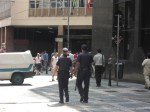
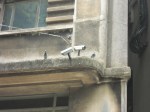
Nor surprisingly there is very little surveillance in the area around the hotel, except the old fashioned kind and you better be sure that people are watching you from the little shops and street corners. However when you head down the Av. Sao Joao into the financial district, it’s a different story. I was cautious about taking obvious pictures of police and security guards, let alone the serious security inside the bank entrances (metal detectors, scanners, guards etc.) because I just don’t know what kind of trouble that would bring, but here’s a flavour.
Tag: videosurveillance
Surveillance and the Recession
In the editorial of the latest issue of Surveillance & Society, I speculated that that the global recession would lead to surveillance and security coming up against the demands of capital to flow (i.e. as margins get squeezed, things like complex border controls and expensive monitoring equipment become more obvious costs). This was prompted by news that in the UK, some Local Authorities were laying off staff employed to monitor cameras and leaving their control rooms empty.
However an article in the Boston Globe today says different. The piece in the business section claims that – at least in its area of coverage – the recession is proving to be good business for surveillance firms, especially high tech ones. The reasons are basically that both crime and the costs of dealing with it become comparatively larger in lean periods. The article doesn’t entirely contradict my reasoning: organisations in the USA are also starting to wonder about the costs of human monitoring within the organisation, but instead they are installing automated software monitoring or are outsourcing the monitoring to more sophisticated control rooms provided by security companies elsewhere.

They also note that human patrols are in some case being replaced (or at least they can be replaced – it’s unclear exactly how much of the article is PR for the companies involved and how much is factual reporting) by ‘video patrols’, i.e.: remote monitoring combined with reassuring (or instructive) disembodied voices from speakers attached to cameras. Now, we’ve seen this before in the UK as part of New Labour’s rather ridiculous ‘Respect Zones’ plan, but the calming voice of authority from a camera, now what famous novel does that sound like? Actually if it’s not Nineteen Eighty-Four, it is also rather reminiscent of the ubiquitous voice of Edgar Friendly in that odd (but actually rather effective) combination of action movie and Philip K. Dickian future, Demolition Man. The point is that this is what Bruce Schneier has called the ‘security show’. It doesn’t provide any real security, merely the impression that there might be.
How long will it be before people – not least criminals – start to get cynical about the disembodied voice of authority? This then has the potential to undermine more general confidence in CCTV and technological solutions to crime and fear of crime, and could end by increasing both.
The case of the serial killer and a South Korean surveillance surge
the case of the serial killer, Kang Ho-Soon, looks like it will be the signal for a surveillance surge in South Korea
Martin Innes described how certain ´signal crimes´ can trigger major cultural shifts, changes in policy or in many cases what, a few years ago, I called a ´surveillance surge´. In the UK, the case of James Bulger was one such incident that continues to resonate in all sorts of ways, but in particular has been held to be a major factor in the nationwide expansion of CCTV. 9/11 can be seen as another for the expansion of surveillance in the USA. Now the case of the serial killer, Kang Ho-Soon, looks like it will be the signal for a surveillance surge in South Korea.
Kang, described as a classic psychopath, killed seven women in Gyeonggi province between late 2006 and 2008. He met the women through personal ads and by offering them lifts home as they were waiting at bus stops at night, and then raped and killed them before disposing of the bodies in remote locations. His capture was at least partly down to CCTV images of his car near the sites of the murders.
According to Kim Rahn´s story in the Korean Times, South Korea seems to in the grip of frenzy of fear of strangers, with massive increases in applications to companies offering mobile phone location and tracking services, all schools in Seoul installing CCTV apparently to prevent violence and kidnappings, and in Gyeonggi province, 1,724 surveillance cameras, many with high resolution night vision will be installed. The murders have also sparked new debates about the use of the death penalty in the country.
But, and there is always a ´but´, one interesting fact in the story is that the bus stops where Kang met his victims were unlit. Street lighting is now apparently also to be added. Now it is one of the truisms of studies of CCTV that improved street lighting is a far better deterrent of opportunist crime than cameras – not that you are ever going to deter a true psychopath. Neither street lighting nor all the CCTV cameras in the world will do that.
More broadly however, I wonder whether South Korea is going through a similar breakdown of the feeling of social assurance that Japan is experiencing. At the risk of sounding like George W. Bush, I know Japan is not South Korea and South Korea is not Japan, but both societies traditionally had highly structured, ordered cultures which have been rapidly transformed in the face of industrialisation and globalisation. From my own research in Japan, it seems that the move towards increasing surveillance is strongly connected to this transformation. However at the same time, increasing surveillance is also encouraging the further decline of trust and a move toward a society of strangers. This can be seen as part of what David Lyon is starting to call the ´surveillance spiral´, a self-reinforcing movement in which more surveillance is always the answer to the problems that can at least partly be traced to living in a surveillance society.

More CCTV stories: from Jerusalem to Cambridge
CCTV cameras are seen as the answer to anything and everything. It’s not much more than a form of magical thinking.
Two contrasting CCTV stories today.
On the one hand, we have a seemingly typical story of civic authorities wanting to install cameras, right down to the lazy, cliched, headline: ‘Smile, you’re on surveillance camera’ – how many times have we seen variations on that one? The cameras are proposed to arrest a decline in custom at a busy city market except… that the city is Jerusalem, and the market is the Mahane Yehuda market, a favoured target for suicide bombers. Now, I am not entirely sure how cameras will stop a determined suicide bomber, who by definition isn’t really that bothered about being seen committing a crime, but this is just an extreme case of underlying causes being missed. There are the usual civil rights concerns raised, and the effectiveness of cameras questioned. But suicide bombing isn’t just some unavoidable fact of life, it’s directly related to the ongoing repression by Israel of the Palestinian territories… a clear case of sticking plaster for a mortal wound if ever I saw one.
Here as in many cases, CCTV cameras are seen as the answer to anything and everything. It’s not much more than a form of magical thinking.
On the other hand, we see the town of Cambridge, Massachusetts, voting against allowing Homeland Security cameras to be used. It’s another extreme case of course. You could hardy find a more comfortable and safe middle-class town with a higher concentration of liberal intellectuals – they even had a former head of ACLU speaking at the meeting. It must be positively terrifying to be a city councilor in the face of informed opposition like that. Of course the story is replete with all kinds of ironies, not least the city representative who argues that the city voted against it only because there hasn’t been enough public participation!
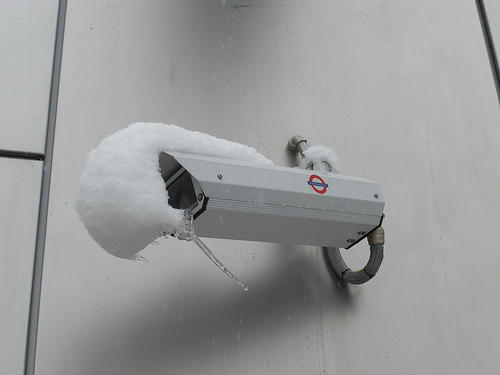
However, as the article also notes, the cameras are already installed, they just aren’t switched on. Perhaps, like this snowbound camera photographed yesterday in London, their ‘magic’ will work anyway and everyone will be happy…

Corrupting automated surveillance
OK, so automated surveillance systems are always right, aren’t they? I mean, they wouldn’t allow systems to be put into place that didn’t work, would they?

That was probably the attitude of many Italians who were supposedly caught jumping red lights by a new T-redspeed looped-camera system manufactured by KRIA. However, the BBC is reporting today that the system had been rigged by shortening the traffic light sequence, and that hundreds of officials were involved in the scam that earned them a great deal of money.
Now, the advocates of automated surveillance will say that there was nothing wrong with the technology itself, and that may be true in this case, but technologies exist within social systems and, unless you try to remove people altogether or by developing heuristic systems – both of which have their own ethical and practical problems – then these kind of things are always going to happen. It’s something those involved in assessing technologies for public use should think about, but in this case it seems they had thought about it, and their only thought was how much cash they could make…
CCTV in Canada
News from Queen’s University’s Surveillance Project that the Surveillance Camera Awareness Network (SCAN), a stellar group of Canadian Surveillance Studies scholars, has released the first phase of its report on Camera Surveillance in Canada.
The report shows that public space CCTV is still relatively rare in Canada, with only 14 cities having implemented it. It argues that despite the lack of evidence for any effectiveness, and the absence of proper informed consent to schemes, the vast majority of the public support cameras largely on the basis of an ill-defined hope that they ‘work’.
My view is that the conditions for a British-style expansion would seem to be in place, were it not for the very different and much more activist role of Privacy Commissioners, informed by research like this, in questioning the need for CCTV. Let’s hope Britain’s role as an experimental surveillance guinea pig for the world will at least teach people elsewhere something…
The authors also mentioned that there is a surveillance series in the Ottawa Citizen that began Wednesday January 29. It features many surveillance studies academics from SCAN and more, and the first piece is really very good.
As another part of the series, the Citizen has adapted the 2016 scenarios that Kirstie Ball and I wrote for the Report on the Surveillance Society for the ICO back in 2006. They have pushed a load of things together so that it doesn’t quite makes sense, but never mind…
CCTV is good for something… or is it?
MSNBC has some great footage of US Airways 1549 that crash-landed in the Hudson yesterday, taken from CCTV cameras on a nearby wharf.
However well this footage shows the undoubted skill of the pilot, I can’t help thinking every time I see this kind of use of CCTV footage that it must play a really important part in the process of normalisation. The fact that people can see footage from CCTV on the news adds to a largely mistaken impression that video surveillance ‘works’. It doesn’t matter whether the footage is of an amazing tale of heroism and survival, a crash or a crime prevented or committed, the images have a pre-rational power. They create a ‘demand’ for more cameras or the idea that they are necessary even though we may be watching something that nothing to do with the purpose of the cameras, and may even, as in the case of images of crime occurring, be witnessing the overt failure of the preventative purpose of CCTV.
Still, great video, isn’t it?
San Francisco CCTV (slight return)
The San Francisco Chronicle is reporting that a murder suspect was arrested as a result of CCTV footage. This comes hot on the heels of the critical report that I mentioned a few days ago. Is it a coincidence that we see these kinds of stories now? I think not. It seems that the SF police may be doing some spin-doctoring to counter any perception that the cameras ‘don’t work’. SF residents should expect more of the same over the next few weeks…
Winnipeg gets CCTV
Well, another city authority is apparently paying no attention to the continuous stream of assessments of CCTV systems in practice. This time, it’s Winnipeg in Canada. The cheif of police is hopeful that the small 10-camera system will work and is already saying he hopes it will be extended… before we know whether it will or won’t work. As usual the story is nothing but boosterism and contains no contrary view at all. I can predict a stream of (police) anecdotes about crimes ‘solved’ by the cameras for a few months and how much safer the town is, and then a couple of years down the line, a report showing that nothing much has changed in reality…
New Report on CCTV

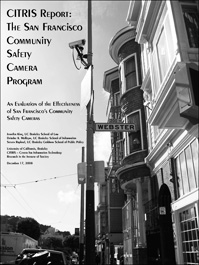
Another new report shows that CCTV is not quite as effective as its advocates claim. The CITRIS report on the 4-year old, 70-camera, system in San Francisco, written by Jennifer King, Professor Deirdre Mulligan and Professor Steven Raphael shows that although there was a 20% reduction in crime against property crime in the areas covered by the cameras, crime against the person (robbery, mugging, assault, rape etc.) remained unaffected. This just adds the findings of many studies in the United Kingdom that show the same lack of preventative power from video surveillance.