
A really stimulating article by Matt Jones over at Future Metro, my new favourite site, which I have only just discovered thanks to David Barnard-Wills. This manages to combine several of my interests: urban futures, surveillance, security, ubicomp, SF and comics, into one tasty package – I’ll have to check out Matt’s own blog too.
Month: September 2009
Philippines: military targets writers and artists
There have been a couple of interesting stories that have caught my eye from the Philippines concerning the surveillance of writers and artists by the military. First, soldiers were discovered to have been watching the house of Bienvenido Lumbera, a major artist. More recently, prize-winning writer, Pedro “Jun” Cruz Reyes Jr. has complained of surveillance of his house by unidentified men in a white van – and this isn’t the first time.
The first incident was dismissed as a ‘training exercise’ by the Philippines Armed Forces (AFP) – which, even if it were true, hardly excuses the actions, although it does attempt to remove the suspicion of a concerted program or illicit policy. Now, with this second complaint, that first excuse starts to sound a little more hollow. But, there are some other facts here that make me more suspicious, in particular the status of both these artists as critical figures in Filipino cultural life, and secondly, a recent controversy over the attempt by the military- and US-backed President Arroyo to award special prizes to some of her favourite popular filmmakers and comics artists, an act which was prevented by the courts after complaints by, amongst others, Lumbera.
Of course, this kind of surveillance as personal harassment (because it is so obvious that it must be designed to be seen by the person being watched) is typically thought to produce a ‘chilling effect’ on democratic debate and criticism. The culture of fear and repression is often the result of the military being over-prominent in everyday life. In the Philippines, with its history of US military-colonial dominance, dictatorship, political killings, and the longstanding conflict between the AFP and Islamic separatist groups (which is also a conflict between landowners and peasants) in Mindanao, such an atmosphere is pervasive.
The treatment of these two artists pales in comparison with the treatment of others. Back in 2007 the United Nations Special Rapporteur, Philip Alston, condemned the use of violence, arbitrary imprisonment and intimidation by both army and police under the cover of ‘anti-terrorism. The worldwide writers support group, PEN, estimates that since 2001, 60 journalists have been murdered in the Philippines, and in total 903 killings and hundreds more ‘disappearances’ of people from all walks of life have been reported. In August, the writer Alex Pinpin, and four friends who made up the s0-called ‘Tagaytay 5’ were finally released after a popular campaign. They had been held for 859 days without access to a lawyer and had been threatened, beaten and tortured in the name of the ‘War on Terror’. They were alleged without foundation, to have been members of a paramilitary group, the New People’s Army.
Read more from PEN here – it’s certainly eye-opening.
2nd Surveillance in Latin America Symposium
Following the success of the first Surveillance Studies symposium in Brazil last year, here is the call for the next one, this time in Mexico next year.
Introduction
In modern societies, identification systems have been used as an important mechanism to govern, manage, classify and control populations; in other words, to surveil them. This has meant the employment of certain technologies (passports, national identity letters, RFID, among others), providing interconnected data base systems with information according to specific institutional protocols. In this way, we define identification as visibility and verification of specific details of people’s lives. Likewise, these identification systems have responded to various functions: security, migration control, goods and service administration, as well for territory, space and group access.
The historical, social and politic contexts shape the particular purposes to which each identification system responds. Large-scale surveillance systems to identify the population have been installed in Latin America after decades of colonial, military and single-party governments In addition they have been prompted by increasing multiculturalism in cities, Population growth, migration rates, the perceived rise in terrorism, public security and health risks, as well as the creation of public policies (to aid poverty and unemployment) and globalization.
These conditions have caused the harmonization and articulation of corporations, institutions, technologies and specific protocols for citizen identification in Latin American countries, , depending on each country or region’s particular situation, and its relationship with other regions worldwide. Nevertheless, the Latin American environment allows us to consider the construction of privacy, identities, forms of government and the possibility of resistance policies.
Paper Proposals
In line with this analytic framework, the University of the State of Mexico, Faculty of Politics and Social Studies, hereby invites scholars, analysts and activists in Latin America and worldwide, interested in identification and surveillance, in relation to such matters as cultural or ethnic identities, privacy and data protection, new identification technologies (biometrics, RFID, etc), public policies, security, communication, ethics, law, or modes of critique or resistance; to participate in the International Symposium “Identification, identity and surveillance in Latin America”, by sending a lecture proposal.
Please send an abstract, 300-500 words long, Arial 12, space line 1.5, to the following e-mail: surveillance.studies.mexico@gmail.com, before October 30th 2009. Due to the nature of this event, the abstracts and papers are to be accepted in Spanish, Portuguese and English.
Note: There is no registration fee for this event. All participants are expected to seek their own funding for travel and accommodation. A number of rooms will be reserved with reasonable rates in a nearby hotel. More details to follow.
Main subjects
1. Governmental and corporative policies of identification
2. New technologies for identification and surveillance.
3. Purposes of identification systems in Latin America.
4. Communication and information technologies.
5. Privacy and transparency.
6. Identification, identities and subjectivities.
7. Relationship between global and local, in identification systems.
8. Postcolonial logics and political regimes.
9. Identities, surveillance and resistance.
10. Identification, identity and surveillance in Latin America: new theories?
Important Dates
Call for Papers Publication: July 30th 2009.
Abstract reception deadline: October 30th 2009.
Accepted lectures list publication: December 15th 2010.
Complete paper remittance deadline: February 15th 2010.
Complete program publication: February 28th 2010.
Second Symposium on surveillance in Latin America: March 16th, 17th y 18th 2010. University of the State of Mexico, Faculty of Politics and Social Studies. Toluca, México.
Organizing Committee
Nelson Arteaga Botello
Roberto J. Fuentes Rionda
Faculty of Politics and Social Studies, University of the State of Mexico
Rodrigo Firmito
Postgraduate Program in Urban Management, Pontifical Catholic University of Parana, Curitiba, Brazil
Fernanda Bruno
Postgraduate School of Communication, Federal University of Río de Janeiro, Brasil
Marta Kanashiro
Further Studies Laboratory of Journalism and Knowledge, Technology and Market Group, University of the State of Campinas (UNICAMP), Campinas, Brasil.
Danilo Doneda
De Campos Faculty of Law, Rio de Janeiro, Brasil
André Lemos
Federal University of Bahia, Brasil
With the support of:
David Lyon
David Murakami Wood
Department of Sociology, Queen’s University, Kingston, Ontario, Canada
Proposal reception, Information and Contact
surveillance.studies.mexico@gmail.com
Nineteen Eighty-Four in Spain
Tim Robbins and The Actors’ Gang are putting on a fascinating-looking adaptation of George Orwell’s Nineteen Eighty-Four in Barcelona. The production deliberately ties in with contemporary concerns about surveillance in the city, and in Spain and beyond. This production has already toured the USA, and you can find out more about it here.
Of course, this is far from the first adaptation of Orwell’s novel. Earlier this year, which is the 5oth anniversary of the publication of this seminal work, the UK’s National Media Museum put on a special version with John Hurt playing Winston Smith as he did in the 1984 cinema version, directed by Michael Radford (with its chilly soundtrack by The Eurythmics, which many regard as inappropriate but I really like!). The best version I have seen was done by Northern Stage in my old home city of Newcastle. This was a violent, uncompromising version (see this review in The Guardian) mixing live cinema and theatre. There was also the much earlier 1956 film directed by Michael Anderson and starring Edmond O’Brien, which shared with the climate in which the novel was written, the air of post-war ruin and privation (or at least its memory). Of course, one could regard Terry Gilliam’s Brazil as a riff off Nineteen Eighty-Four – but he’s never a director for a straight version!




(thanks to Aaron Martin for pointing me in the direction of the Barcelona production…)
Another day, another ‘intelligent’ surveillance system…
Yet another so-called ‘intelligent’ surveillance system has been announced. This one comes from Spain and is designed to detect abnormal behaviour on and around pedestrian crossings.
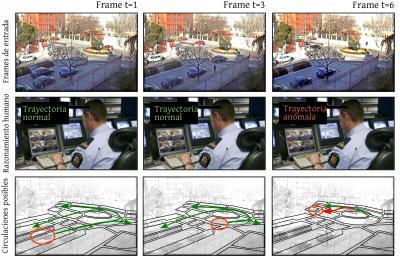
The article in Science Daily dryly notes that it could be used “to penalise incorrect behaviour”… Now, I know there’s nothing intrinsically terribly wrong with movement detection systems, but the trend towards the automation of fines and punishment, nor indeed of everyday life and interaction more broadly, is surely not one that we should be encouraging. I’ve seen these kinds of systems work in demonstrations (most recently at the research labs of Japan Railways, more of which later…) but, despite their undoubtedly impressive capabilities and worthwhile potential, they leave me with a sinking feeling, and a kind of mourning for the further loss of little bits of humanity. Maybe that’s just a personal emotion, but I don’t think we take enough account of both the generation and loss of emotions in response to increasing surveillance and control.
Further Reference: David Vallejo, Javier Albusac, Luis Jiménez, Carlos González y Juan Moreno. (2009) ‘A cognitive surveillance system for detecting incorrect traffic behaviors,’ Expert Systems with Applications 36 (7): 10503-10511
US border surveillance pours billions into Boeing… and still doesn’t work
Federal Computer Week reports that the Secure Border Initiative (SBI) designed to provide secure and highly surveilled border systems between the USA and Mexico, is in trouble again. There have been major technological failures, cost overruns, and more with the result that the system is way behind schedule. Half the reason seems to be a political economic one. In many ways this system is a giant pork barrel for the Boeing Corporation, which has been sucking up US state subsidies for years and is taking literally billions of US dollars for this project and in unrelated federal recession subsidies. No-one seems to have really checked whether Boeing could really do the job, and like so many large state security and surveillance projects, and most things that have been tried on the Mexico border, it just doesn’t really work.
The article reports the new Director of the SBI, Mark Borkowski as admitting that “the program was first conceived as a quick implementation of existing off-the-shelf technologies […] In retrospect, it would have functioned better if a customized technology solution was developed to meet the requirements […] Some of the things we put into place, in hindsight, were not effective […] What we bet on, which was probably not a good bet, was that this was like buying a new printer for your computer. …We started the wrong way, in my opinion.”
The cost breakdown for the Department of Homeland Security is reported by FCW as:
$1.1Bn to Boeing ($620M for SBInet technology and $440M for border-vehicle barriers and fencing).
$2.4Bn on construction of fencing and vehicle barriers along the southwestern border
$6.5 Bn longer-term to maintain, monitor and repair the fences and structures.
Of course the ridiculous costs are bad enough, but the wider issues here are with the obsession with controlling migration in an economic climate in which the North America Free Trade Agreement (NAFTA) has progressively stripped Mexico of any economic autonomy and made its (and by extension the whole of Central America’s) working class a reserve of cheap labour for US corporations and its relatively increasingly wealthy, a market for US consumer goods. It’s not surprising that the Mexicans regard it as more than a little unfair that they have been forced into a subservient position, yet are not welcome to come into the USA, and are subject to such harsh security and surveillance to prevent them from doing so. Added to this, as the Mexican President made clear last year, relaxed US laws on gun ownership have resulted in a massively increased flow of weapons into Mexico from the USA, which has exacerbated gang conflicts which thrive in the atmosphere of inequality and exploitation. And of course, the violence just adds to the reasons why people want to leave and find opportunities in the richer, safer USA…
In many ways, what richer nations are doing is not only prioritising their own security, but also simultaneously exporting their insecurity.
Surveillance cameras in the favelas…
Well, my fears have it seems, been vindicated already. Earlier this year, as part of my case-study on surveillance in Brazil, I visited the community of Santa Marta, a favela (informal settlement) in Rio de Janeiro. Santa Marta is interesting because of the amount of investment and effort that has been expended in occupying, pacifying and developing the place, by the new gubernatorial administration of Eduardo Paes, who has simultaneously cancelled Favela Bairro, the widely praised and more extensive favela development programs of his predecessor, Cesar Maia.
Leading the new Community Police efforts in Santa Marta was Capitao Pricilla, an indomitable and well-liked young female officer of the Military Police, one of several rising female officers with a new approach, and we heard from residents how trust was being rebuilt between police and community because of her. At the same time, there were storm clouds on the horizon as the city administration was insistent on cracking down still further with its policies of choque de ordem (the shock of order), which involved harassing illegal street vendors from the favelas, and demolishing illegally-built buildings, and also building walls along the edges of some favelas. The word ‘ghetto’ was mentioned on more than one occasion by our interviewees and in more casual conversations.
Now, just last month, the Military Police have decided to install seven CCTV cameras in Santa Marta, in different areas of the community. This has prompted complaints of invasion of privacy, an there have already, my sources report, been protests about this in he favela, but it seems that this is coming from further up the chain of command than Capitao Pricilla and the community police. She isn’t mentioned at all by the article in O Globo, despite being a bit of a PR star, and instead the justification for the cameras is given by one Coronel José Carvalho, who also stated that there are plans to put cameras into the other two areas currently being targeted for development, the famous Cidade de Deus, and the much less well-known and more distant favela of Batan. This also contradicts what I was being told by the Commnder of the police central CCTV control room we visited, which is quoted as being one of the places where the cameras will be monitored. What is interesting is the cameras seem to be being treated by police almost as a tool of urban warfare: a Major Orderlei Santos talks about their experimental use for determine the deployment of officers in the favela.
Could the old macho, male, approach to policing as a war on the poor be trumping the new trust being developed by community policing? I hope not, but everything points that way.
(thanks once again to Paola and David for keeping me in touch…)
UK opposition plans to roll back ‘the surveillance state’
The Conservative Party Shadow Justice Minister, Dominic Grieve has launched a brief report outlining the opposition’s plans to introduce a new attitude to surveillance in the UK, and reverse many of the current Labour government’s policies. And it is mostly good, insofar as it goes. But, it is where it doesn’t go that is the problem.
The main measures include things we already knew, like a pledge to scrap the National Identity Register (NIR) and ID card scheme, and proposals to limit the proliferation of central databases and control the National DNA Database (NDNAD). However the Tories also want to abolish the Contact Point children’s database, restrict Local Government’s rights under the Regulation of Investigatory Powers Act (RIPA), strengthen the powers and functions of the Information Commissioner’s Office (ICO) and require mandatory Privacy Impact Assessment (PIA) for all new legislation or other state proposals.
So far so good – and these are all things I have proposed myself at various times – but there are also some very weak or pointless elements. First of all, the attitude to the private sector is predictably laissez-faire. Though the report includes a long list of the data losses that plagued the Labour government over the last few years, they fail to note how many of them involved private sector contractors or partners. And their only real mention of the private sector is to suggest that the ICO consults with industry on ‘guidelines’ and the possibility of introducing a ‘kitemark’ (a kind of stamp of approval). These are both pretty much worthless and tokenistic efforts. The Tories, as much as Labour, fail to appreciate that contemporary threats to privacy come as much from the private sector as the public. Unfortunately recognising and dealing with this would require a rather more robust attitude to private business than either of the UK’s two main parties are prepared to muster right now. This, I guess, is the reason why the Tories talk about ‘the surveillance state’ as opposed to ‘the surveillance society’ (the term used by ourselves and the ICO).
Secondly, there is no proposal to do anything to control or roll-back the most obvious and intrusive aspect of the UK’s surveillance society, the vast number of CCTV cameras and systems operated by everyone from the police down to housing associations and schools. In fact there is not a single mention of CCTV or public space surveillance in the report. Rather than missing an elephant in the room, this is more like failing to notice a whale in your bathtub…
Finally, there is the suggestion to introduce a right to privacy as part of a ‘British Bill of Rights’. Certainly what privacy means in British law needs to be clarified and strengthened, but actually this could be done through amending the existing Human Rights Act to make it better reflect the European Court’s already published views on the interpretation of Article 8 of the European Directive. Unfortunately, the Tories are stupidly ideologically opposed to doing anything to strengthen the HRA, and in fact their proposed ‘British Bill of Rights’ is a rag-bag collection of populist proposals that will instead replace the most progressive change to British law for some decades.
Finally, there is no mention of any changes to the pernicious Terrorism Act or Counter-Terrorism Act, that have further undermined the presumption of innocence and other longstanding foundations of British citizenship. There’s no mention of previous legislation that restricted traditional freedoms like the Criminal Justice and Public Order Act. In fact, there’s every reason to believe that the Conservative Party will be just as willing to clamp down on such freedoms in the name of the war on terror, or crime, or anti-social behaviour as the Labour Party, and no reason to suppose that they deal honestly with the underlying issues – which would mean, of course, telling people things that they don’t want to hear.
Surveillance in Science Fiction
There have been waves of interest in surveillance in fiction, and we are going through another one now, and not just in SF – I am currently writing a piece now on surveillance in post-9/11 fiction (which includes Doctorow, Stross, Macleod and other SF writers), and a discussion of this recently started on a listserv. I posted a quick message, which I will reprint here, as the first part of a catalogue of relevant novels in the genre.
Here’s my incomplete list of essentials in surveillance SF in roughly chronological order, which will be added to in future. The problem here is that SF abounds with dystopias of social control, and separating out the ones which say something interesting about surveillance is difficult…
Yevgeny Zamyatin – We which is pretty much the basis for George Lucas’s film THX-1138, so far as I can see, although it is not acknowledged. It was also read by Orwell, although for a long time he claimed not to have read it!
Aldous Huxley – Brave New World. Seems far more pertinent than Orwell in many ways, especially in terms of how control is best achieved by giving people what they want…
George Orwell – Nineteen Eighty-Four is of course as chilling and brilliantly-written as ever…
Philip K. Dick – A Scanner Darkly (and indeed most of PKD’s fiction – he is perhaps the best writer ever on paranoia and surveillance from the pulp of Eye in the Sky to more developed works like Ubik – I have a piece out this year in the Review of International American Studies on Dick and surveillance)
Bob Shaw – Other Days, Other Eyes – a superbly poetic technology called ‘slow glass’ forms the basis of this fix-up novel (made from three short stories with a cliched plot spun around it – the original stories are better and more suggestive)
John Brunner – Not just the proto-cyberpunk, The Shockwave Rider, it’s very worth reading the other three of his amazing four dystopic novels of the early 70s Stand on Zanzibar, The Jagged Orbit and The Sheep Look Up
David Brin – Earth. A quite frankly ludicrous pulp plot and Brin can’t write dialogue or characters, but a lot of great surveillance stuff in it that forms the background to his non-fiction, Transparent Society – his other novels have a similar interest in surveillance, if you can put up with his writing!
Paul J. McAuley – Whole Wide World – so far as I know, still the only SF novel to engage successfully with the UK’s CCTV system. It is also beautifully written and a cracking crime novel too. He is perhaps Britain’s most underrated writer… I have a partly-piece written about this, which I have never published!
Arthur C. Clarke and Stephen Baxter – The Light of Other Days. Clarke’s idea written up by the much younger Baxter, this steals a short-story title from Bob Shaw and much of the plot from Isaac Asimov (see below), but then takes it a bit further. Still utter pulp though…
Charles Stross – Glasshouse. This is set on what is supposedly a ‘panoptic’ prison in space, except it turns out it isn’t as panoptic as it is supposed to be…
Cory Doctorow – Little Brother. A teen novel, but the only deliberately written fictional manual for resistance to contemporary surveillance.
Surveillance is also pretty much omnipresent in cyberpunk novels (Gibson, Sterling et al.) but it is not really foregrounded in any of them, although one could mention Islands in the Net by Bruce Sterling as being a good example.
It’s also worth remembering that SF is and has been since the 1930s, a genre that is based primarily in the short-story, not the novel, and there are hundreds of interesting short stories on this theme, of hugely varying quality. Some are classics, like Isaac Asimov’s ‘The Dead Past’ or Bob Shaw’s ‘The Light of Other Days’ (see above – there is an interesting sub-genre of works in which surveillance tech emerges out of efforts to see into the past) or Frederik Pohl’s The Tunnel Under the World’ or Damon Knight’s ‘I See You.’
UN Human Rights Committee Finds Discrimination in Racial Profiling
I received the following message from James A. Goldston, Executive Director of the Open Society Justice Initiative, on a very important finding on racial profiling by the UN Human Rights Committee. I reprint he message in full, as it speaks for itself.
On July 30, 2009, the United Nations Human Rights Committee became the first international tribunal to declare that police identity checks that are motivated by race or ethnicity run counter to the international human right to non-discrimination. The committee issued its views concerning the Rosalind Williams v. Spain communication, originally filed by the Justice Initiative and Women’s Link Worldwide in 2006.
Williams’ case began 17 years ago, when she, a naturalized Spanish citizen, was stopped by a National Police officer in the Valladolid, Spain rail station. Of all the people on the train platform, she was the only one to be stopped and asked for her identity documents. She was also the only black person on the platform. Williams soon launched a legal challenge to the identity check, claiming she was targeted because of her race. In 2001, the Spanish Constitutional Tribunal approved the practice of relying on specific physical or racial characteristics as “reasonable indicators of the non-national origin of the person who possesses them,” arguing that racial criteria are “merely indicative of the greater probability that the interested party not Spanish.” The court’s endorsement lent legitimacy to a pervasive discriminatory policy of ethnic profiling that had for years been widely documented by human rights monitoring bodies.
In finding a violation of the International Covenant on Civil and Political Rights the UN Human Rights Committee concluded that while identity checks might be permitted for protecting public safety, the prevention of crime, or to control illegal immigration, “the physical or ethnic characteristics of the persons targeted should not be considered as indicative of their possibly illegal situation in the country. Nor should identity checks be carried out so that only people with certain physical characteristics or ethnic backgrounds are targeted. This would not only adversely affect the dignity of those affected, but also contribute to the spread of xenophobic attitudes among the general population; it would also be inconsistent with an effective policy to combat racial discrimination.”
The committee found that while there was no written policy to conduct police identity checks on the basis of skin color, “…it does appear that the police officer did act according to such a criterion — something that was justified by the courts that heard the case. The responsibility of the State party is clearly compromised.”
“… the Committee can only conclude that the petitioner was singled out only because of her racial characteristics, and this was the decisive factor for suspecting unlawful conduct. The Committee recalls its jurisprudence that not all differential treatment constitutes discrimination if the criteria for differentiation are reasonable and objective and if the goal is legitimate under the Covenant. In this case, the Committee finds that the criteria of reasonableness and objectivity were not met.”
The implications of the UN Human Rights Committee’s judgment extend far beyond Spain, where ethnicity-based police stops are still a common practice, to wider Europe, where years of monitoring have revealed a persistent and damaging pattern of ethnic profiling of minorities and immigrants in police stops and searches without explanation and without clear or effective purpose. The Justice Initiative has documented the prevalence and harms of this impermissible practice in reports such as “I Can Stop and Search Whoever I Want” — Police Stops of Ethnic Minorities in Bulgaria, Hungary and Spain and Ethnic Profiling in the European Union: Pervasive, Ineffective, and Discriminatory!, and has long advocated for operational, policy, and legal reforms before national and regional actors.
Although previous regional human rights tribunals have touched upon the issue of ethnic profiling — most notably the European Court of Human Rights in its 2005 Timishev v. Russia judgment, which held that the applicant had been unjustifiably subjected to differential treatment in relation to his right to liberty of movement “solely” due to his ethnic origin — Williams v. Spain is the first case to explicitly challenge ethnic profiling as a practice, and the UN Human Rights Committee the first international tribunal to issue a ruling prohibiting race- and ethnicity-based police stops.
Following this landmark judgment, the Justice Initiative will continue to work with government representatives and law enforcement agencies in Spain and other EU Member States, as well as with EU institutions in Brussels, to make sure that the policy and practice changes in line with the principles established by the UN Human Rights Committee are adopted and implemented.
Click here for further information on the Justice Initiative’s work challenging ethnic profiling.
 ubisurv