Poll claims 96% of US citizens support video surveillance

A Harris online poll of 2416 adult US citizens, conducted between May 28th and June 1st, 2009, has found a 96% rate of support for federal government video surveillance in ‘specific public places’, according to Reuters.

Further statistics from the survey include an 80% rate of support for ‘any available measures’ to protect citizens in a terrorist attack, and 54% supporting the US of federal stimulus funding for video surveillance. As the press release notes, public support appears to be totally detached from the evidence we have about the limited effectiveness of video surveillance – something is (quite literally) being seen to be done, and this is what appears to matter. Video surveillance is culturally engrained, even expected, as a result of two decades of movies and TV shows which use surveillance as a  theme (from programs like Cops to ‘realityTV’). So in many ways such a result is not altogether surprising.

The poll appears to have been commissioned as part of a PR campaign by an advanced ‘intelligent video surveillance’ company, which has a clearly stated commercial interest, which makes one wonder exactly how the questions were phrased, and how they were asked. The word ‘terrorism’ is mentioned a lot, and I expect there would be a great deal of difference in responses to a similar question that did not mention terrorism (or indeed did not mention the supposed purpose at all), and indeed a survey of people who had read a summary of available research on CCTV would probably once again, result in a different percentage (as economic experiments with ‘willingness to pay’ methods of valuing policy decisions have shown, informed participants make different judgements). I will try to get hold of the raw figures to take a deeper look…

Surely this is satire? Charles Clarke on liberty and security…

A comment piece allegedly by the former UK Home Secretary, Charles Clarke, has been posted on The Guardian newspaper’s site. I say ‘allegedly’ because it is hard to believe that a man in his position could write something to monumentally lacking in self-awareness or with less understanding of the issues he is discussing. He talks of a fourth Labour term (which is in itself increasingly a fantasy in which few, even in the Labour Party, believe) in which liberty and security are unified, “to consolidate the new constitutional relationships, establish consensus about the powers of the police and security services and address issues relating to identity”! He talks of CCTV and the DNA database as great advances, with no mention of the slamming of the operation of this database by the European Court of Human Rights and the massive climb-down by the government, or that fact that research commissioned by his own former Home Office Research Department shows that CCTV has little effect on crime. He claims that there is “an understandable public demand for more databases”; this will come as news to most people.He even claims that the Regulation of Investigatory Powers Act (RIPA) has been a success, ignoring the critical views of the regulators and the last Home Secretary’s promise to review legislation that has been used for all kinds of intrusive and inappropriate surveillance activities by local authorities.

Of course he is right that Labour deserves credit for establishing the Human Rights Act, the Freedom of Information Act, and for unifying the Information Commissioner’s Office (ICO). Yet these were all things that were done (or planned) in Labour’s first term and there has been little to celebrate in terms of liberty and security in Labour’s two terms since then, when even the ICO emerged, under former commissioner Richard Thomas, as one of the most trenchant critics of Labour’s activities.

But then right near the end, he suddenly switches to an entirely different line arguing that “The government needs to establish a coherent data regime that places the individual at the centre, with the practical right to see the data held on them and correct it if necessary. They should also be able to see who made any changes to data that is stored (and when the changes were made), and to give permission for the sharing of any data which is held”. The second sentence however misses the point of what the first implies (which in itself suggests that the regime Labour has created is incoherent). A data regime which places the individual at the centre would start not from permissions for sharing, but by asking what data needs to be stored, why, how and by whom. It would be based not a presumption of permission to share but on a request for such sharing with full disclosure of the purposes – that is the meaning of ‘transparency’, a word he uses in the next sentence, but missing from all of this are the words ‘consent’ and ‘accountability’. They are rather too important to be absent by chance.

And of course there is no mention at all of the role Labour has played in the EU and in other international fora, in spreading illiberal security ideas across national borders. The acceptance by the UK of things like the Prum Treaty and the Stockholm program have received almost no comment from British politicians on any part of the political spectrum (except in a general context of anti-EU nationalism, which misses the important issues involved).

All in all, if this is real, which I still can hardly believe, this is an astonishingly brazen and aggressively arrogant piece. It says everything about why, in terms of liberty and security, Labour have already lost the argument and why the country will hand over power at the next election to a bunch of upper-class twits with no coherent policies – in others words, anyone in preference to a party that once claimed that ‘things can only get better’ but has long since stopped even pretending that this is the case…

Even video surveillance hit by global recession?

According to a new market-research report produced by Arizona firm, In-Stat, the market for video surveillance equipment has seen a slow-down in unit grow in 2009, and even a decline in overall revenue (and this may be the first time this has happened for many years). This is interesting as it is conventional wisdom that the security sector is generally unaffected or even benefits from recession (but see some previous posts here and here for other aspects of surveillance in a global recession). However the report also states that whereas sales of cameras are relatively flat, sales of data-recording equipment, especially hybrid recorders that can handle both analogue and digital images, are increasing and this is partly due to the US government’s stimulus package. This suggests that those operating exisiting video surveillance systems that may have older analogue cameras are chosing not to upgrade their cameras now but are making sure that they can retain the images more efficiently. The report predicts that, after the recovery, the overall market for video surveillance equipment in 2011 will be $19Bn US.

Mind you, I haven’t read the report in full, only this summary, because it retails at $3,495 US! Someone is clearly expecting to make plenty of money out of the recession…

Surveillance cameras in the favelas (3): the other side

As my collaborator in Rio de Janeiro, Paola Barreto Leblanc, points out to me, it isn’t just the police (see previous posts here and here) who have been installing surveillance cameras in the favelas. Accoring to UOL, in September 2008, the military police found a whole clandestine CCTV system of 12 cameras, and a control room hidden behind a false wall, in Parada de Lucas, a favela in the Zona Norte of the city. The cameras covered all the entrances to the favela. The system was allegedly operated by a drug-trafficking gang but since the room was, according to the reports, destroyed in the police attack, and no one was captured, it is hard to verify the story… however it is not surprising that a major illegal commercial operation would seek to have early warning of police (and other gang) raids in this way. Indeed, this system may well have been the reason why no traficantes were caught in the raid in question. From the interview we did earlier in the year, it seems clear that the favelas have intense human surveillance systems of mutual observation, whether they are gang-controlled, community-controlled or police-‘pacified’ morros. Very little goes on in the crowded informal settlements that almost everyone will not know about. Of course, the nature of the power-structure within the favela will determine to whose benefit such knowledge works. CCTV in a context like this can be seen as a sign of insecurity and weakness. Perhaps the Parada de Lucas gang felt that they were losing their grip, and the cameras in Santa Marta installed by the military police certainly seem to indicate a lack of trust in the community and the civil pacification measures – investment, infrastructure development, regular meetings and confidence-building – so far undertaken.

Surveillance image of the week 3: remembering One and Other

One and Other, Anthony Gormley’s remarkable populist and popular participatory artwork, which enabled 2400 ordinary people to spend an hour each on the vacant fourth plinth in London’s Trafalgar Square, ended recently. Not surprisingly, given London’s reputation as a the surveillance capital of the world, there were some pointed reminders. This ‘plinther’ spent her hour dressed as a CCTV camera looking at the watchers and the watched…

CCTV plinth protest
CCTV plinth protest

(thanks to Eric Stoddart for this)

UK state spy program targets innocent

The headline may not come as any surprise but a damning report has been released on a key strand of the British government’s counterterrrorism strategy, Preventing Violent Extremism (or just ‘Prevent’). £140m (around $200m US) has been allocated to this program but much of it seems to have been devoted not to combatting nascent Islamic extremism (which is the stated aim) but MI5 simply collecting masses of information on entirely innocent British Muslims – information that will be kept until they are 100 years old! Part of this is because of the tenuous nature of the strategy in the first place: how would one define or identify those who are not terrorists but might become so? Will it be, as in cases reported by The Guardian, the student who attends a lecture on the conditions in Gaza or Muslim men with mental health problems? And much of this depends on teachers and lecturers reporting students. Therefore the program would seem inevitably to encourage suspicion and distrust, as Arun Kundnani writes and as the general tone of left and civil liberties critique has reinforced. But opposition has come from all sides: Pauline Neville-Jones, the Conservative shadow security minister, but also former chair of the Joint Intelligence Committee and political director of the Foreign Office, has also condemned the whole approach of New Labour, which she argues is rooted in the identification of discrete ‘communities’ who share similar characteristics. This can of course be the basis of a form of multiculturalism, but at times of increased security and suspicion it seems all to easy for it to morph into what is effectively racial profiling…

CIA buys into Web 2.0 monitoring firm

Wired online has a report that the US Central Intelligence Agency has bought a significant stake in a market research firm called Visible Technologies that specializes in monitoring new social media such as blogs, mirco-blogs, forums, customer feedback sites and social networking sites (although not closed sites like Facebook – or at least that’s what they claim).  This is interesting but it isn’t surprising – most of what intelligence agencies has always been sifting through the masses of openly available information out there – what is now called open-source intelligence – but the fact is that people are putting more of themselves out their than ever before, and material that you would never have expected to be of interest to either commercial or state organisations is now there to be mined for useful data.

(thanks, once again to Aaron Martin for this).

Surveillance cameras in the favelas (2)

A couple of weeks ago, I found out that the military police had installed surveillance cameras in the favela of Santa Marta, in Rio de Janeiro, Brazil, which I visited back in April. This is the first time such police cameras have been put into such informal settlements in Rio. My friend and colleague, Paola Barreto Leblanc, sent me this link to these youtube broadcasts from a local favela TV company, in which residents discuss their (largely negative) views of the cameras.

There is also a poster that has been put up around the area produced by the Community Association and other local activist and civil society groups – see here – which reads as follows in English:

SANTA MARTA , THE MOST WATCHED PLACE IN RIO

At the end of August, the inhabitants of Santa Marta were surprised to learn from newspapers and TV that nine surveillance cameras would be installed in different areas of the favela. A fear of being misinterpreted paralysed the community.

Many of the people of the city, and some in the Moro itself support this initiative.  However, we are a pacified favela, so why do they keep treating us as dangerous?

Walls, three kinds of police, 120 soldiers, cameras – this is no exaggeration.  When will we be treated as ordinary citizens instead of being seen as suspects?

Wall: 2 million Reais, Cameras, half a million Reais. How many houses could this amount of money build? How many repairs to the water and sewage system?

The last apartments built in Santa Marta are 32 square metres. The Popular Movement for Housing [an NGO] says that the minimum size should be 42 square metres. Other initiatives have gone with 37 square metres. So why don’t we stand up and demand this minimum standard? This should be our priority!

When will the voice of the inhabitants of this community be heard?

We need collective discussion and debate.

Fear is paralysing this community and preventing criticism. But the exercise of our rights is the only guarantee of freedom.

“Peace without a voice is fear”

We want to discuss our priorities. We want to know about and be involved in the urban development project in Santa Marta.

We will only be heard and respected if we unite.

Think, talk, reflect, debate, get involved…

Surveillance image of the week 2: camera catches man stealing camera

Just how postmodern can contemporary surveillance get?

Well, after the irony of numerous recent CCTV thefts in the USA – after all, if you’re going to put lots of shiny new cameras up in public places they are bound to be a target themselves – now another layer has been added in Bakersfield, California, with a video surveillance camera thief caught on the camera system he was stealing. Of course, some thieves don’t seem to realise that the camera isn’t the place the data is stored… either that or they just aren’t put off by CCTV at all. Say it ain’t so…

A clear demonstration of the deterrent effect of video surveillance in action... not.

More military robots…

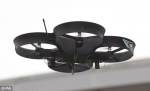
A story in the Daily Mail shows two new military robot surveillance devices developed for the UK Ministry of Defence’s Defence and Equipment Support (DES) group. The first is a throwable rolling robot equipped with multiple sensors, which can be chucked like a hand-grenade and then operated by remote-control. The second is another Micro-(Unmanned) Aerial Vehicle (Micro-UAV or MAV), a tiny helicopter which carries a surveillance camera. There have been rolling surveillance robots around for a while now (like the Rotundus GroundBot from Sweden), but this toughened version seems to be unique. The helicopter MAV doesn’t seem to be particularly new, indeed it looks at least from the pictures, pretty similar to the one controversially bought by Staffordshire police in Britain – which is made by MicroDrones of Germany.

The proliferation of such devices in both military and civil use is pretty much unchecked and unnoticed by legislators at present. Media coverage seems to be limited to ‘hey, cool!’ and yes, they are pretty cool as pieces of technology, but being used in useful humanitarian contexts (for example, rolling robots getting pictures of a partially-collapsed building or MAVs flying over a disaster zone) is a whole lot different from warfare, which is a whole lot different again from civilian law enforcement, commercial espionage or simple voyeuristic purposes. As surveillance gets increasingly small, mobile and independent, we have a whole new set of problems for privacy, and despite the fact that we warned regulators about these problems back in 2006 in our Report on the Surveillance Society, little government thought seems to have been devoted to these and other new technologies of surveillance.

The use of robots in war is of course something else I have become very interested in, especially as these flying and rolling sensor-platforms are increasingly independent in their operation and, like the US Predator drones employed in Afghanistan and Pakistan or the MAARS battlefield robot made by Qinetiq / Foster-Miller, become weapons platforms too. This is an urgent but still largely unnoticed international human rights and arms control issue, and one which the new International Committee for Robotic Arms Control (in which I am now getting involved), will hopefully play a leading role in addressing.