I'm David Murakami Wood. I'm currently Canada Research Chair at the University of Ottawa. I like reading, cycling, running, and I am slowly coming to the realization of the limits of getting older.
Details obtained under the Freedom of Information Act have revealed the extent of the use of the Regulation of Investigatory Powers Act (RIPA) 2000 by Britain’s 182 Local Authorities. The Act has apparently been used to authorise surveillance on over 10,000 occasions for monitoring acts that are mostly trivial. Only 9% of these resulted in any kind of prosecution or enforcement action. This, to me, indicates massive abuse of surveillance by local governments, and they must be controlled. Almost everyone thinks this now, and the government is currently conducting a review of RIPA (due the embarrassment caused by the constant stream of revelations).
This doesn’t go far enough. RIPA is simply bad legislation that was justified in parliament by reference to crime and terrorism. It is poorly overseen and its Tribunal for complaints – yes, there is one, not that anyone knows – is practically invisible. It should be repealed and a more carefully thought out law on the use of surveillance by public bodies with proper provision for judicial oversight, public accountability and post-legislative scrutiny should be introduced.
Ok, so I know it is a provocative and incomplete question, but it’s one I am forced to ask this morning as a case in Australia, where a badly implemented video surveillance system in Sydney airport is being blamed for the failure of a court case over a brawl in which a man was killed.
According to reports, the police are quoted as saying that they were “hindered in their search for images of the alleged offenders by an outdated and fragmented surveillance system”. They claim that the four or five different uncoordinated systems in and around the airport, all with different recording locations and formats, make it difficult for them to gather evidence. When you look closer however, it does seem to be the that the only real problem relates to one of the systems which was very old and could not record from more than one of its camera simultaneously.
Although it notes that there are other ‘community concerns’ than just having complete surveillance (of course…), the newspaper seems to be accepting the objectivity of claims that this is a problem of a lack of centralisation. Fear of terrorism is as usual the motivation for this, although the unlikely occurrence of terrorist events and the fact that the incident in question is a biker brawl (i.e. a domestic gang issue) means that this link is tenuous. It also should lead one to question why such a violent disturbance was allowed to progress to the point where someone was killed in an airport. That has very little to do with poor CCTV and much more to do with a failure of more basic security and a lack of care for passengers on the ground more generally. Perhaps the real issue should whether we are becoming so reliant on technological systems of monitoring that we are forgetting the protective purpose of security and the rather more human ways in which this could be improved.
The police apparently also have eye-witnesses, so you have to wonder what the agenda is here. Is it simply a case of police frustration? Would it really help if the systems were all joined up and run centrally? Or is this just a problem with one system? Is this case being used deliberately to try to create a wave of public outrage upon which more intensive joined-up video surveillance can be implemented? I don’t know the answers, but someone in Australia should be asking rather more searching questions than just ‘why don’t the cameras work better?’
(Thanks to Roger Clarke – who does indeed ask difficult questions – for pointing out this story)
I’m off to Rio de Janeiro on Thursday… as most people will be aware, Rio is far a long way from the romantic Hollywood-generated image of sun-kissed decadence. It is perhaps the most extremely divided city in the world. The richest parts have a higher standard of living than almost anywhere else and the poorest parts barely cling to the hillsides and to any kind of an existence. I have been reading Enrique Desmond Arias’ enlightening Drugs and Democracy in Rio de Janeiro (amongst many other books) in preparation, and right on cue, a major drugs war has apparently broken out between trafficking gangs in the Copacabana area…
I am going to be interviewing state and community representatives, and carrying out mapping exercises to assess the state of surveillance and security in several different neighbourhoods of varying social classes. The drug war is making me a little nervous, but in many ways it is an ideal time to be asking the kinds of questions I need to ask. Of course reading a book like Arias’, you tend to get anthropology-envy, but I just have to remember that my study is a very different kind of research. I am still trying to get a feel for the kinds of indicators that would enable us to make serious comparisons between the intensities and forms of surveillance across cultures and nations – and I am still very much at the beginning of the project. Some of these indicators might seem common sense and obvious but some are not, and some may not even be in any way ‘measurable’…
My fantastic temporary Research Assistant is Paola Barreta Leblanc – she has created a mash-up of my current schedule here (it will get more complex!).
Rather than being a legitmate political response to an illiberal, repressive, undemocratic and unaccountable growth in surveillance, ‘interest’ in CCTV is now regarded as suspicious in itself…
Boing Boing has news of the latest London Metropolitan Police campaign which is supposedly encouraging people to report their suspicions on terrorist activity, but is in fact just another step on the illiberal, socially divisive and stupid road towards a McCarthyite Britain where British people are expected to spy on each other in the name of security.
Why not check your neighbours' waste bins?
Apart from encouraging people to rifle through their neighbours garbage, the most disturbing thing about this new campaign is the way in which it implies that any interest in CCTV cameras is a potentionally terrorist activity.
See that camera? No, you don't. It's not there.
From the late 1980s onwards, the British state in its usual bumbling, piecemeal and disorganised way, gradually created an increasingly comprehensive monitoring program of British city centres. There was never any strong evidence for the need for this technology, it was never approved by parliament, there was never a single CCTV Act that enabled it.
Now, just as it has become pretty clear that CCTV has very little effect on crime rates (its original justification, let us not forget), the state has started to close down criticism and even interest in or discussion of these surveillance measures. Effectively, we are being officially instructed to ignore the cameras and pretend we don’t see them. Rather than being a legitimate political response to an illiberal, repressive, undemocratic and unaccountable growth in surveillance, ‘interest’ in CCTV is now regarded as suspicious in itself.
At the same time, the British state is increasingly regulating the means of production of visual images by ordinary citizens. The state (and many private companies) can watch us while we have to pretend we don’ t notice, but for ordinary people to take picture or make video in public places, and in particular making images of state buildings or employees like the police (you know, the people who supposedly work for us), is being gradually and by stealth turned into a criminal act. In the past, I have been very careful not to shout about all acts of state surveillance being totalitarian (because very few of them actually are), but there is no other word for these trends. The police are attempting to make themselves the arbiters of how we see society and public places; they are telling us what can and cannot be legitimately the subject of interest and of visual representation.
They are also spending more time now ‘securing secturity’ – protecting the architecture of surveillance that has been built. You can see the private sector recognising this. At equipment fairs I have been to over the last few years, one of the big developments in camera technology has been methods of armouring and protecting the cameras themselves. There seems to be an effort, deliberate or unconscious, to forget the supposed original purpose of such surveillance in protecting us, and instead to concentrate on protecting the surveillance equipment.
This is particularly problematic for researchers like me. We’ll see what happens when I am back in London in May and June when I will be taking a lot of pictures of CCTV as part of my project, which is of course, ironically, sponsored by an official British state research council…
This is massively important because it is based not simply on a financial, political or even an ethical position, but on the database projects’ respect for existing law. They are simply illegal…
A new report for the Joseph Rowntree Reform Trust by a very credible largely Foundation for Information Policy Research (FIPR) team that combines engineers, lawyers, software developers, and political scientists, has concluded that a quarter of the UK public-sector databases are illegal under human rights or data protection law. It also looks at UK involvement in some European database projects and finds all of them questionable too.
The report rates the 46 databases on a traffic light system – green, amber, red – and argues that those rated ‘red’, in particular the National Identity Register and the Communications Database, and are simply unreformable and should be scrapped. This is massively important because it is based not simply on a financial, political or even an ethical position, but on the database projects’ respect for existing law. They are simply illegal, and not just massively expensive, morally questionable or politically undesirable. In fact, a quarter of all the databases were found to contravene the law and more than half were ‘problematic’ (i.e. open to challenge in court) . All of those rated ‘amber’ (29 databases) the authors argue, should be subject to independent review.
There are a number of other major recommendations, including the reassertion of the necessity and proportionality tests contained in DP law, citizens should anonymous rights to access data, more open procurement of systems, and better training processes for civil servants. The most important and radical measures proposed, and entirely correctly in my view, are those concerning the location of data and the whole nature of UK IT development. For the former, the report recommends that the default location for sensitive personal data should be local, with national systems kept to a minimum – this appears to be rather like the ‘information clearing house’ system as opposed to central databases, that we proposed in our Report on the Surveillance Society, but better worded and justified! In the latter case, the authors simply note that fewer than 30% of government IT projects succeed at a cost of 16Bn GBP per annum and that there should never be a general and aimless government IT program, rather there should only ever be specific projects for clearly defined and justified (proportional and necessary) aims.
It is an excellent report and probably unanswerable in its logic. Tellingly, The Guardian report contains no response from any government minister…
Here is yet another episode in what has become a bit of a scrap between David Aaronovitch of The Times and everyone else who knows anything about surveillance (including the news reporters from his own paper). It is making me lose the will to live, but if anyone else is interested, here is Paul Lewis of The Guardian taking David out to count cameras in London.
I am sure there will be arguments about the violation of airspace, which will not be trivial as the ongoing diplomatic and increasingly military row over US surveillance vessels off China is showing…
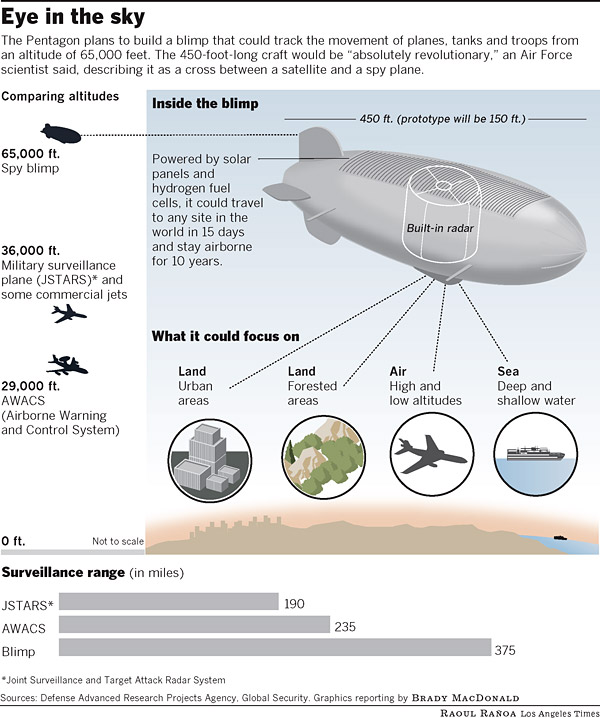
Unmanned aerial vehicles (UAVs) are one of the fastest-developing areas of surveillance technology. A new plan revealed by the US Department of Defense combines old and new tech with a plan, first revealed by the Los Angeles Times, for an pilotless surveillance airship called ISIS (Integrated Sensor Is the Structure) that will fly right at 65,000 feet (about 20km) high, right at the edge of ‘airspace’. The point of the airship is to provide the kind of constant watch that a geostationary satellite provides, but at a much lower level so that for more detailed pictures of the precise movements of vehicles, objects and people could be observed.
Well, as usual, the reports only seem to to be concerned about how great this would be for US military tactics, and are not interested in the law, politics and ethics of such devices. For example, I am sure there will be arguments about the violation of airspace, which will not be trivial as the ongoing diplomatic and increasingly military row over US surveillance vessels off China is showing. And of course there are issues around the violation of human rights by such intrusive technology: international violations are very hard to deal with, however. And this will only be the beginning. The new Obama administration has promised more investment in intelligence and surveillance and less in warfighting. That sounds good in some ways, but of course just poses new problems and new issues for those of us concerned with ongoing US attempts to cover the whole world with surveillance for the benefit of its strategic aims.
As a result of an annual report on datamining sent to the US Congress by the Office of the Director of National Intelligence, a research project, Video Analysis and Content Extraction (VACE), has been revealed. The program is aiming to produce an computer system that will be able to search and analyse video images, especially “surveillance-camera data from countries other than the United States” to identify “well-established patterns of clearly suspicious behavior.”
Conducted by the Office of Incisive Analysis, part of the Intelligence Advanced Research Projects Activity (IARPA), the program has apparently been running since 2001,and is merely one of several post-9/11 research projects aiming to create advanced dataveillance systems to analyse data from global sources. How the USA would obtain the information is not specified…
One could spend a long time listing all the DARPA and IARPA projects that are running, many of which are speculative and come to nothing. The report also mentions the curious Project Reynard that I have mentioned before, which aims to analyse the behaviours of avatars in online gaming environments with the aim of detecting ‘suspicious behaviours’. Reynard is apparently achieving some successful results, but we have no real idea at what stage VACE is, and the report only states that some elements are being tested with real world data. This implies that there is nowhere near a complete system. Nevertheless the mentality behind these projects is worrying. It is hardly the first time that the USA has tried to create what Paul Edwards called a ‘closed world’ and these utopian projects which effectively try to know the whole world in some way (like ECHELON, or the FBI’s proposed Server in the Sky) are an ongoing US state obsession.
It is the particular idea that ‘suspicious patterns of behaviour’ can be identified through constant surveillance and automated analysis, that our behaviour and indeed thoughts are no longer our own business. Because it is thoughts and anticipating action that is the ultimate goal. One can see this, at a finer grain, of programs like Project Hostile Intent, a Department of Homeland Security initiative to analyse ‘microexpressions’, supposedly preconscious facial movements. The EU is not immune from such incredibly intrusive proposals: so-called ‘spy in the cabin’ cameras and microphones in the back of every seat have been proposed by the EU-funded SAFEE project, which is supported by a large consortium of security corporations. The European Commission has already hinted that it might try to ‘require’ airlines to use the system when developed.
No doubt too, because of the close (and largely secret and unaccountable) co-operation of the EU and USA on security issues, all the images and recordings would find their way into these proposes databases and their inhuman agents would check them over to make sure we are all passive, good humans with correct behaviours, expressions and thoughts, whether we are in the real or the virtual world…
It is a kind of digital enclosure, an attempt to impose on the Internet the same kind of removal of common rights that the British ruling classes imposed on the land from the Seventeenth Century onwards…
I have just completed an article on the UK as a ‘bad example’ to the rest of Europe, and lo and behold another piece of regressive, repressive idiocy by the British government appears. It seems that the UK is trying to amend the proposed EU-wide Telecommunications package to destroy the principle of net neutrality. Their proposals will “remove the principle of users’ rights to access and distribute Internet content and services”, and replace it with “a ‘principle’ that users can be told not only the conditions for access, but also the conditions for the use of applications and services.”
In other words, they want to make the entire Internet work by End-User Licensing Agreements (EULAs) rather than the general principle of end-to-end connectivity. It is a kind of digital enclosure, an attempt to impose on the Internet the same kind of removal of common rights that the British ruling classes imposed on the land from the Seventeenth Century onwards. There is nothing about the Internet Age about this, indeed it is pre-industrial – it is pure justification of the same powerful economic interests that the British state has always represented. And, as the original report points out, this is particularly bitter because both the British (OFCOM-originated) amendments and their duplicate Czech mini-me amendments have a lot of their substantive justitifications cut’n’pasted wholesale from Wikipedia!
Like the thieves who stole our land, they are utterly shameless.
(I think I originally saw this in BoingBoing, and sorry for not linking it, but it keeps crashing my little computer right now…)



 ubisurv