The Iconography of High Velocity DNA tagging

There’s been quite a lot of media coverage in the last few days about the ‘High Velocity DNA Tagging System‘, made by UK company Selectamark, and apparently in line to be purchased by several UK police forces. The system uses a kind of airgun that can fire “a uniquely-coded DNA pellet” for up to 30-40 metres, which “can be used to mark an individual so that they can be apprehended at a less confrontational time for officers.” Claims on the website include one that the microdots of artificial DNA can penetrate through clothing and mark the skin of individuals, and also that the artificial DNA used can result in ‘infinite number’ of unique numerical identifiers.

None of this is entirely new: Selectamark is a company who’s core business is anti-theft marking of equipment, and essentially what they have done is create a gun-based delivery system for an existing technology that was previously used to mark things, thus turning it into a system for identifying individual human beings, in much the same way as has been suggested would occur with RFID implants (but which has not yet really happened in any widespread fashion). Like RFID, the identification is not biometric, i.e. resulting from unique bodily characteristics, but what amounts to a high-tech form of instant temporary tattooing or paint-marking. The company is silent on how temporary this is – and whether the microdots – which are just visible, but show up better under UV light – can be easily removed or washed off by those tagged.

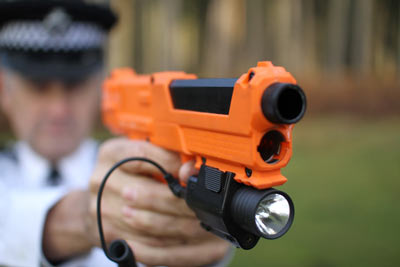
What’s also really interesting is the imagery deployed in the website. Of course there are the usual images of policemen with large guns (here complete with light source for night-time use). These guns, like tasers, have an interestingly toy-like quality to them with their bright orange plastic finish. Guns that aren’t really guns…

selectadna-high-velocity-pistol-400

However what’s more interesting are the background images used on the site. The targets of the tagging system are clearly depicted in one background image and will be recognisable to all British readers – ‘hoodies’ – the marginalized urban youth who were implicated in the rioting in London in 2011 (although there is also an inevitable pop culture association, especially with all that light-saber-y UV around, with the evil Sith from the Star Wars franchise).

slider2

The youths are depicted encircled in lines of UV-like light whose coils also reflect the image of DNA, which is used here as another background image.

slider

The late Dorothy Nelkin and M. Susan Lindee described DNA as a ‘cultural icon‘, and indeed, the never-really-explained ‘artificial DNA’ technology which underpins Selectamark’s product seems deliberate discursively confused with exisiting DNA identification technologies, or at least the association is clear: that DNA fingerprinting, which is already understood in media discouse as standing for absolute certainty as to identification, is ‘the same’ as this technology. And clearly this sounds better than associating it, as I did earlier, with tattooing – which has a much less wholesome image when it comes to the state’s usage (Nazi death camps etc.).

And then the lines of light that surround the youth also seem to beam out across and enclose the entire world, which is both a standard marketing trope (“we are a global company”) but also a shift in scale that reflects the way in which security and surveillance has moved, to encompass the globe. The world is also depicted as dark with the suggestion of a coming sunrise (fitting in with the overall ‘crime lurks in the darkness and Selectamark will shine a (UV) light in it” theme) and almost entirely urban:

slider3

But then what is the value in this global world, which Selectamark (and the police) are seeking to protect? What is the source of the light? Well, the answer, in the final background image, will surprise no-one. It isn’t those who need justice, the poor, the downtrodden, the huddled masses, it’s big companies:

slider4

The corporate sector is depicted as icons streaming information-superhighway style from the light along grid patterns: rational, clean and bright and filling, overcoming, the darkness beyond, in a corporate version of the creation story in the Book of Genesis. We are saved! Thank-you, Selectamark and your High Velocity DNA Tagging!

$100 to anyone who can find a ‘privacy-compliant camera’ in Canada

Actually, the headline (from the Toronto Metro free paper) is a little misleading as what my friend and colleague Andrew Clement is actually betting on here is that no-one can find a video surveillance system in Canada that is fully compliant with Canadian privacy law. Which of course may of may not be the same as ‘privacy’ in any other terms. But it’s an interesting challenge – that is largely to do with signage. Prof Clement and his team at the iSchool at UofT have been monitoring the way in which video surveillance systems in Canada are signed for quite some time. As their website, surveillancerights.ca (which is also where you can try to claim your $100…) says

“Signs should at a minimum clearly tell you:

  • who is operating the camera
  • who you can contact if you have questions
  • the purpose(s) of the surveillance”

The signs should also in themselves be clearly visible, not hidden away somewhere. There’s more detailed information about requirments here.

So, who’s going to take up this bet?

(Thanks to Matthias Vermeulen for the story and Aaron Martin for noticing the difference between privacy and privacy law.)

Anti-surveillance architecture

2-0763561030Architecture seems increasing implicated in the generation of a ubiquitous surveillance society, not simply in the relatively longstanding modernist obsession with glass and visibility, but with security increasingly considered not as option but as infrastructure. It was nice to see at least some people concerned with creating anti-surveillance architectures. Two great examples are Deborah Natsios, and Eyal Weizman, and another I recently came across (via The Verge), is Asher J. Kohn, whose Shura City project, aims to create a living environment in an Islamic cultural context, that is protected from drone surveillance. As Kohn states:

“Shura City is constructed to be livable. It is built according to local logic, using local materials, and amenable to local needs. It is meantto be alien – but not hostile – from the outside while homey and familiar from the inside. It is meant to confuse the machines and their distant operators while creating a safe zone forpeople whose lives are being rended by war. Shura City is not about judgment on the survivors or destruction of their persecutors. Shura City is about using architecture to create a space for humanity in an increasingly inhuman sphere.”

New Privacy Survey released

Simon Davies, AKA Privacy Surgeon, and the London School of Economics have a great new survey of privacy predictions for 2013 out now. Key quote from the press release:

“More aggressive action by companies to monetise personal information through advertising will inevitably fuel further controversy, while consolidation of markets such as social networking may induce emerging players to engage dangerous privacy practices.”

Whether 2013 is the tipping point in this regard that the survey suggests or not, it is certainly the case that various ‘lines in the sand’ are being crossed on a regular basis at the moment and if the public aren’t as concerned as the experts surveyed for this report, then privacy may even lose even its tactical utility as a way of opposing surveillance, let alone mean the same thing to most people as it used to.

Criminal Record Checks, Human Rights and Forgetting

Compulsory criminal record checks are increasingly common in many countries and for a wider range of employment and education applications. In many cases even criminal cautions and spent convictions are required to be disclosed, meaning for example that applicants for college and university courses may be turned down because of some minor brush with the law as a child – as has indeed happened on a number of occasions

But the necessity of such intensive surveillance of a person’s past is hardly necessary except for obvious cases like those who have committed sexual offences against children applying to work with children. The law in many jurisdictions has traditionally allowed for things to be forgotten for social reasons, and for people to have the space to build lives free from the prejudice that would accompany a permanent and accessible record of any minor offence. And now a senior judge in Britain has ruled that the trend to increasingly ubiquitous mandatory disclosure should stop. According to The Guardian newspaper, Lord Dyson argued that  “The statutory regime requiring the disclosure of all convictions and cautions relating to recordable offences is disproportionate to that legitimate aim [of like child protection],” and further that “as a conviction recedes into the past, it becomes part of the individual’s private life” and that a caution in particular should never be considered in the same way as convictions, “the administering of a caution is part of an individual’s private life from the outset”. Let’s see how the UK government deals with this ruling against their approach…

Canadian police to expand drone use

qube_mediagallery
AeroVironment Qube (avinc.com)

The Royal Canadian Mounted Police (RCMP) are investing more in micro-UAVs, in particular little remote-control surveillance helicopter drones, according to the National Post today. The new drones will be the quad rotor AeroVironment Qube model, one of the most popular small drones used by police worldwide.

According to the police themselves, they will limit the use of the drones to “accident reconstruction, search-and-rescue operations, major crime scenes and situations involving emergency response teams”, however as the article also notes, they don’t actually have a formal policy on the use of UAVs, and as with other controversial purchases by Canadian police, for example the LRAD accoustic weapons in Toronto and Vancouver, this highlights how little oversight there is of what technologies police can purchase.

(Thanks to Chris Prince for the story)

Is Google taking a stand?

According to Wired’s Threat Level blog, Google is taking a rather tougher stance towards the US federal government when it comes to requests for cloud-stored data for investigations. The company is now, it says, asking for judicial warrants from state organisations. As Wired points out, even though this might seem ethically sound, it is dubious legal ground as the US Electronic Privacy Communications Act allows the federal government access to such documents without a warrant. And yet, no court challenge has yet been made by the government to Google’s stance.

So what is going on here? Is Google serious about taking on ‘the feds’ in favour of users? Is this new pro-user line by Google merely contingent and once something ‘really important’ is demanded, the company would cave in? Is there some other kind of backroom deal? Is Google actually being rather cynical because the company knows that the NSA can access everything they have anyway (and probably by arrangement – after all, the NSA helped Google out a lot in its battle with China’s authorities)? I suspect there is much more to this apparently casual revelation…

Canada and Mali

I’m privileged to be supervising some great students at all levels, but Jeff Monaghan is something else*. Not surprisingly for someone who previously worked with the awesomely prolific and engaged, Kevin Walby (now over in Victoria – who may be the young researcher I most admire in surveillance studies), he mainly uses Access to Information and Privacy requests (ATIPs – under Canada’s freedom of information legislation) as a basic method, and as far as I can see he is constantly firing these things off and sorting through them for revealing nuggets. Right now, Jeff is working in the way in which Canadian development aid, like that of many wealthy nations, is becoming increasingly entwined with a security agenda, what he calls ‘security aid’. Anyway, he’s in the news today because one of his ATIPs has revealed that Canada was engaged in planning for military intervention in Mali, of some sort, over a year ago, belying their apparent public reluctance to get involved right now.


New UK report on the future of identity

There is yet a another major surveillance-related report out, this one from the UK, on Future Identities – Changing identities in the UK: the next 10 years. It is part of the UK government’s Foresight program, and is available from their website. Their other major current project is on the future of manufacturing. Although the cancellation of the last New Labour administration’s ID card scheme is not explicitly mentioned in the background it seems clear that this report was originally commissioned as a ‘what now?’ exercise – to open up a much wider debate. The Foresight project say this about the final report:
“This Report provides an important opportunity for the Government to consider how identities in the UK are changing and the possible implications for policy-making in the next 10 years. It has involved over 100 academics and stakeholders and is supported by 20 published evidence papers.
It shows that the economic downturn, the effects of globalisation, and increasing international migration have all been influential on notions of identity, while the impact of social media and modern communications technology have created a new digital UK. In particular the report discusses an emerging trend of hyper-connectivity and the ubiquity of the internet enables people to be constantly connected across many different platforms. The detailed findings of the report have implications for a wide range of policy areas and will support the design and evaluation of robust, innovative, open policy-making.”